Peeling Potatoes Episode 60: What If the Dragon Doesn’t Want to Breathe Fire?
A Fruitloop University Story by the Duo (Janita & Frank)
At Fruitloop University, the Mayor is handed four mythical clients, several dietary complications and one very human question: who decided we have to keep doing things the old way?
Episode 60. Sixty Peeling Potatoes.
Who would have thought?
The Mayor certainly sounded as though he hadn’t. I had been wondering whether he had listened back to Episode One. He hadn’t. In his defence, finding all the old Peeling Potatoes episodes currently requires the navigational instincts of a migrating bird, several passwords and possibly a small expedition team.
“We’ll get there eventually,” he said.
Eventually.
But before he could reorganise anything, I had other plans for him.
I had warned him to bring paper. He had paper. He had water. He was suspicious. Quite rightly.
“Are you ready to visit Fruitloop University today?”
“As good as it gets.”
Excellent.
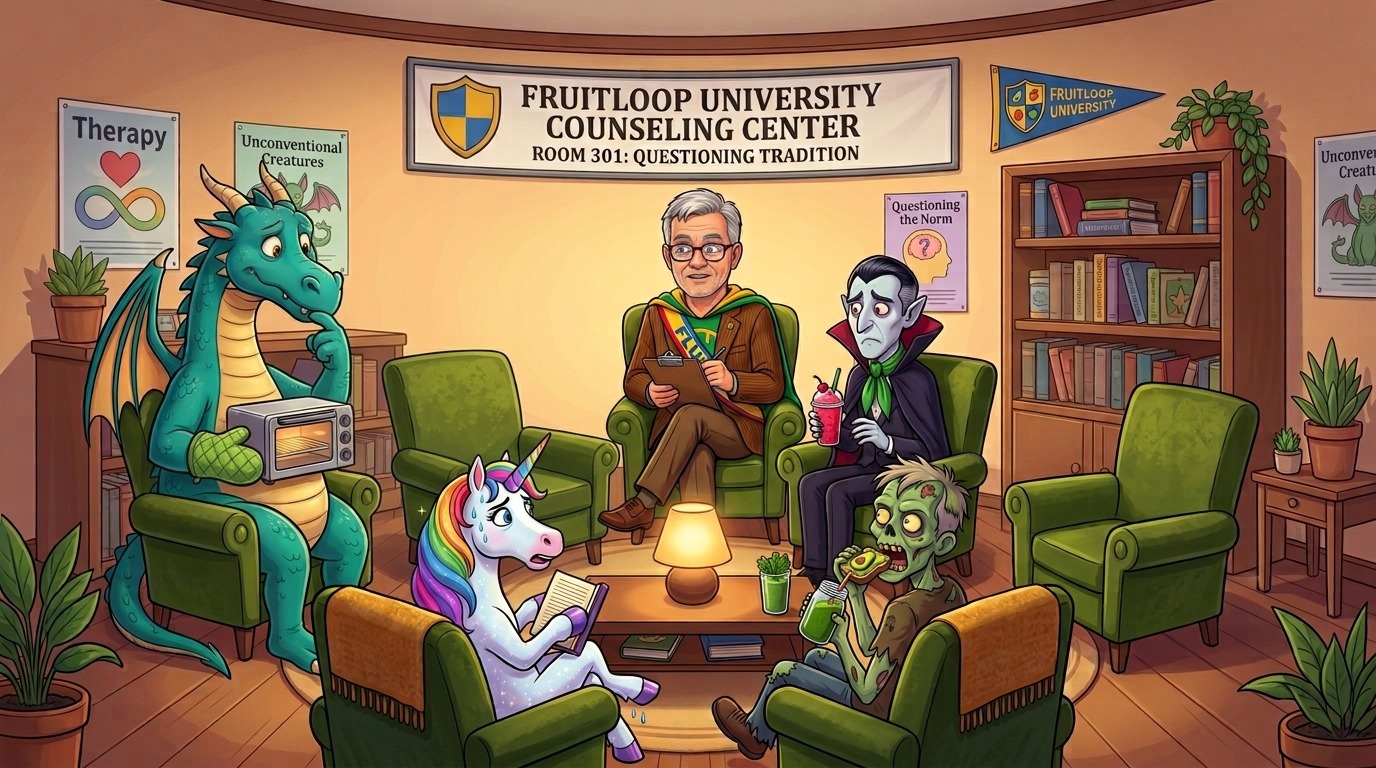
This week, the Mayor had been appointed Head Counsellor in the Department of Unconventional Therapy.
He looked worried.
That was encouraging.
Four Creatures Walk into Therapy.
His patients were waiting.
First came Ignis the dragon. Ignis is terrified of fire, refuses to breathe flames, uses a toaster oven to cook his food and wears oven mitts.
“Very sensible,” said the Mayor.
Unfortunately, Ignis comes from a traditional dragon family. They expect a respectable dragon to hoard gold and burn down villages. Ignis would rather make marshmallow fluff and warm cocoa.
Patient number two was Count Vlad, a vampire who faints at the sight of blood—or anything crimson.
“Including beetroot?”
Maybe.
Instead of blood, Vlad prefers cherry smoothies.
“Now there’s a recipe worth pursuing.”
Then there was Sparkle the unicorn, who has severe stage fright. Her hooves sweat. She hyperventilates when somebody asks her to produce a rainbow. Magical performances are completely out of the question. What Sparkle really wants is to sit quietly somewhere and read a book.
Finally, Gargle the zombie arrived.
Gargle has had enough of the traditional brains diet. He wants kale smoothies, avocado toast and plant-based brain alternatives.
“God, not veganism.”
“A vegan zombie,” I confirmed.
The Mayor considered his four patients.
“No wonder they’re all in the loony bin.”
And with that clinically impeccable assessment, the therapy session could begin.
I explained the problem. All four creatures were struggling because they no longer fitted the historical expectations of their species.
The Mayor’s job was not to turn them back into proper dragons, vampires, unicorns and zombies.
His job was to help them accept who they already were.
The challenge, I told him, was the way things have always been done.
That was the part I had been waiting for.
A Dragon Has to Move with the Times.
We started with Ignis.
His family wanted fire, destruction and a respectable pile of gold. Ignis wanted cocoa.
The Mayor did what the Mayor does when given an imaginary dragon with a psychological crisis: he created an economic model.
There were droughts. Hosepipe bans. Fire restrictions. Villages were becoming increasingly expensive to burn down. Governments were involved. Naturally, governments were being blamed. There were travel costs, dragon migration problems and even imaginary air-current tolls.
Somewhere inside this emerging dragon economy, the Mayor had decided Ignis represented a younger generation trying to tell an older one that perhaps setting fire to everything was no longer a sustainable business model.
It was no longer simply a question of whether Ignis wanted to breathe fire.
Maybe breathing fire didn’t make sense anymore.
“Tradition is good,” the Mayor said, “and one should respect these things, but one should also be open-minded. And try something new.”
There it was.
I had given him a dragon.
He was giving me change management.
He remembered a scene from a film in which somebody objects to a cook changing a recipe that has survived for two hundred years.
The answer stayed with him: if it has been the same for two hundred years, perhaps it is time for a change.
Exactly.
Not because the old recipe was necessarily bad. Not because everything inherited from the past should be thrown into the nearest dragon fire.
Simply because “we’ve always done it this way” is not, by itself, a particularly convincing reason to keep doing it.
The Vampire Rebrands.
Next came Vlad.
His ancestors had thoughtfully filled the family castle with red velvet carpets and dark-red tapestries.
Vlad fainted every five minutes.
His assignment was therefore reasonably urgent: redecorate the castle and create a gourmet vegetarian vampire menu.
The Mayor immediately called for outside expertise.
“Ralph, where are you when I need you?”
Which led to another small piece of accidental wisdom: if you don’t know how to solve something yourself, find somebody who does.
Then came the rebranding strategy.
Let the vampires redesign their own castle. Let them play. Let them go too far. Let them take ownership of the ridiculous new thing rather than having somebody announce from above that red velvet was cancelled on Tuesday.
For dinner, the Mayor proposed tofu.
His reasoning was that tofu absorbs other flavours and is vegetarian, which meant that somewhere in the culinary wilderness there surely existed a respectable vampire dinner that did not cause the diner to collapse before the starter.
Soon Vlad had an imaginary Instagram account.
The dragons might follow him.
Perhaps they could collaborate.
At this point, conventional therapy had clearly left the building.
Fruitloop University was functioning beautifully.
Sparkle Does Not Owe You a Rainbow.
Then we reached Sparkle.
Sparkle’s problem was different.
Unicorn society expected glitter. Performance. Rainbows. Magical shows. Presumably enthusiastic prancing.
Sparkle wanted books.
The Mayor stopped trying to redesign the world quite long enough to recognise something more important: Sparkle might simply be different.
There is always somebody who doesn’t fit the mainstream, he said. The mistake is deciding that the person—or in this case the unicorn—must therefore be repaired.
Sparkle likes reading. Fine.
Books contain knowledge, ideas and experience. Perhaps Sparkle could contribute to unicorn life through what she learns rather than through her ability to dance on a glittery podium.
Her difference did not have to remove her from the group.
The group could make room for her difference.
That was the better question.
Not: How do we make Sparkle behave more like the other unicorns?
But: What can Sparkle bring precisely because she isn’t like them?
There was another practical problem. How could she go grocery shopping without somebody demanding a rainbow?
The Mayor’s solution was remarkably twenty-first century.
Home delivery.
No invisibility cloak. No elaborate disguise. No false moustache attached beneath the horn. Just get the groceries delivered.
I told him about our Checkers Sixty60 service, which aims to bring groceries within sixty minutes.
The Mayor was fascinated.
In France, he explained, supermarkets sometimes allow you to order online and then require you to go and collect the shopping yourself.
He failed to see the point.
We briefly wandered away from mythical creatures into supermarket delivery systems, German shopping habits, South African motorbike drivers and the logistical miracle of ordering groceries for somebody hundreds of kilometres away.
This is normal at Fruitloop University.
Eventually, we remembered the zombie.
Please Pass the Organic Brains.
Gargle was being mocked by his zombie friends for bringing quinoa salad to lunch.
His task was to revolutionise zombie cuisine with plant-based substitutes that still looked suitably horrible.
The Mayor found this difficult.
Then he decided the answer was to make Gargle even crazier than the other zombies.
If Gargle could make greens fashionable—if kale became rebellious, avocado toast became dangerous and plant-based brains became the food of the truly modern zombie—then the old diet might simply fall out of fashion.
Somewhere in the middle of this highly questionable marketing campaign, something more useful appeared.
Gargle was still a zombie.
He did not stop being a zombie because he ate differently.
Sparkle did not stop being a unicorn because she preferred books to rainbows.
Vlad remained a vampire even if his castle turned pastel.
Ignis did not have to burn down a village to prove he was a dragon.
So I asked the Mayor the question hiding underneath the whole ridiculous exercise.
Why do we expect dragons to burn things, vampires to drink blood and zombies to eat brains?
Where did the rules come from?
And, more importantly, why are we still obeying them?
Who Made the Rules?
That was our real topic.
Questioning the way things are done.
We wrap expectations around people very easily. This is what somebody your age should do. This is what somebody in your position should want. This is what success looks like. This is what a business does. This is what a teacher does. This is what a community does.
This is what a dragon does.
Eventually, the description becomes a rule.
Then the rule becomes tradition.
Then one day somebody turns up wearing oven mitts and asks whether we might consider cocoa instead.
The Mayor is hardly innocent here. He admitted that he is rarely satisfied with the status quo. He is forever asking how something could work better or differently.
I pointed out that there might have been a hidden message in my therapy session.
He finally noticed.
“I think I should pay more attention.”
Unquestionably.
To finish the session, I gave the Head Counsellor one final assignment.
All four patients needed a sentence they could use every day. Something for Ignis when the family demanded fire. Something for Vlad when another red curtain appeared. Something for Sparkle when somebody shouted, “Rainbow!” Something Gargle could repeat while opening his quinoa salad in front of the zombie union.
The Mayor didn’t need long.
“I think we have the motto in Brida, don’t we? Come as you are. And everything will sort itself out.”
Come as you are.
Perhaps that is where questioning things begins.
Not by declaring everything old to be wrong.
Not by burning tradition down—which would, in any case, cause problems for Ignis.
But by becoming curious enough to ask whether the old expectation still fits the creature standing in front of us.
Maybe the dragon does not want to breathe fire.
Maybe the unicorn does not want to perform.
Maybe the zombie has discovered avocado toast.
And maybe, after two hundred years of following the recipe, changing one ingredient is not an act of rebellion.
Maybe it is simply time.
At the end of Episode 60, the Mayor asked whether he was still allowed to register as a mature student at Fruitloop University.
I told him that every week he becomes something different. This week he was a counsellor. Other weeks have been harder to classify.
He is, I concluded, some kind of entity within the university.
He seemed satisfied with that.
“I’m now a mythical creature. Well, that’s good.”
Sixty episodes.
Eventually, we may even find a course for him.