
Was That Friendly, or Was I Just Insulted?
North Hesse has apple wine, difficult hills, dangerous levels of friendliness and its own ideas about coffee. But once the jokes about regional character are exhausted, a simpler rule begins to emerge: perhaps politeness belongs less to places than to people.
By The Swimming Club, Manfred and Martin, both in Northern Hessen. (You have been warned).
There are certain precautions a visitor should apparently take before entering Hesse.
According to Manfred, do not expect deep, meaningful conversations. Hessians are stubborn. There is Handkäs. There is Aaleworscht. And do not make the elementary mistake of assuming that because Kassler sounds like Kassel, you will necessarily find what you are looking for when you get there.
Martin added another warning: Hessians are always right.
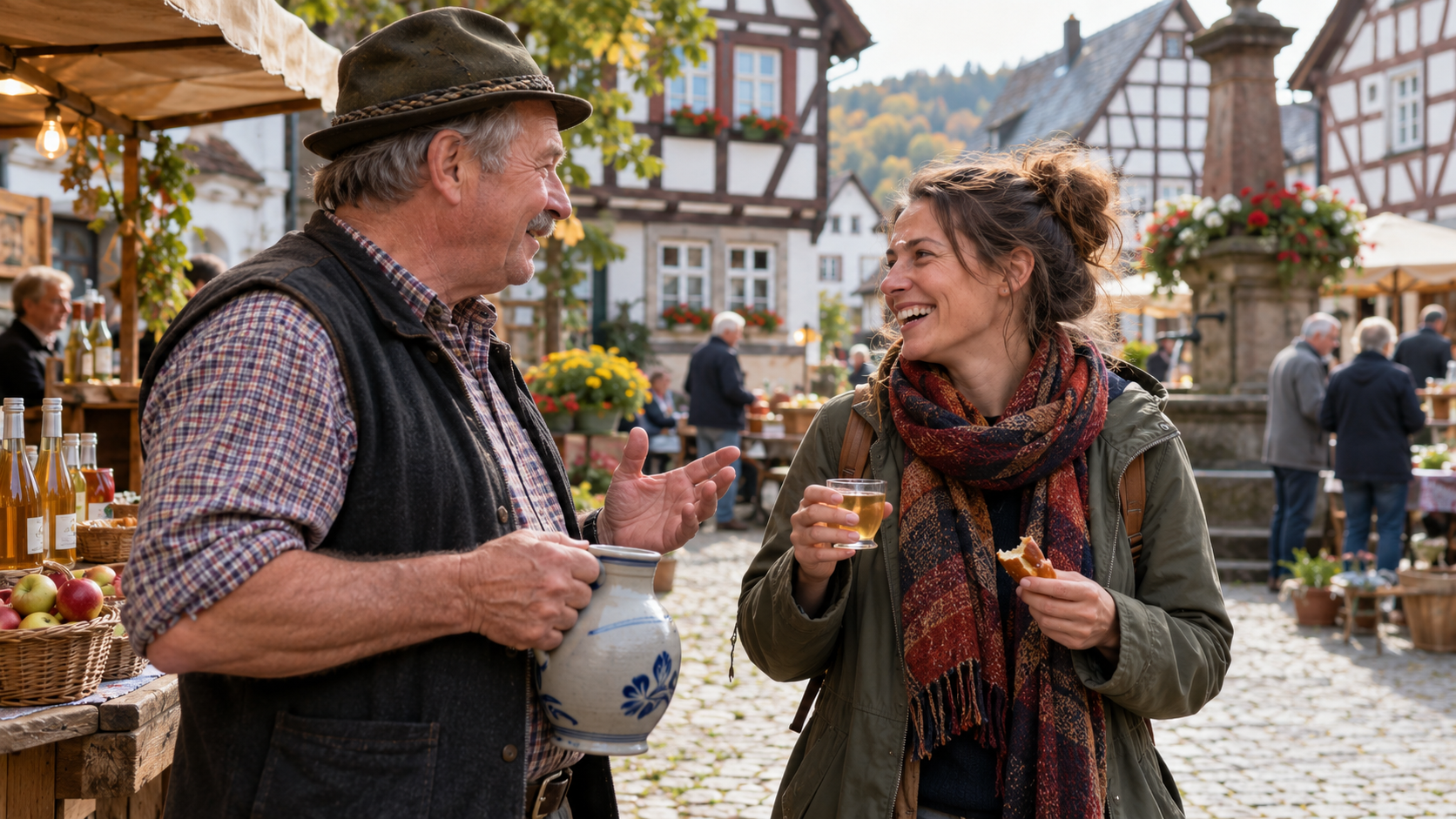
They are also capable of offering you wine which turns out to be made from apples. Other people might call this cider. In Hesse, this is apparently cunning.
By the time the opening warnings were finished, the verdict was becoming difficult to avoid. Viewed from the correct angle, Hessians are a thoroughly devious bunch of people. North Hesse has the additional distinction of sometimes being described as the Siberia of Hesse, with its own weather, its own hills and, judging by the conversation, quite possibly its own laws of human behaviour.
None of this was particularly encouraging for somebody trying to discover what counts as polite in different places.
Then again, that may have been the point.
Extremely friendly people.
Ask somebody when a stranger was unexpectedly nice to them, and you might expect a touching story.
Manfred took a more cautious view. Such moments exist, he said. One is surprised by them. We have to learn to cope.
Martin’s example was even more alarming: drivers who actually use their brains. Perhaps, he suggested, there should be a Nobel Prize for Road Behaviour.
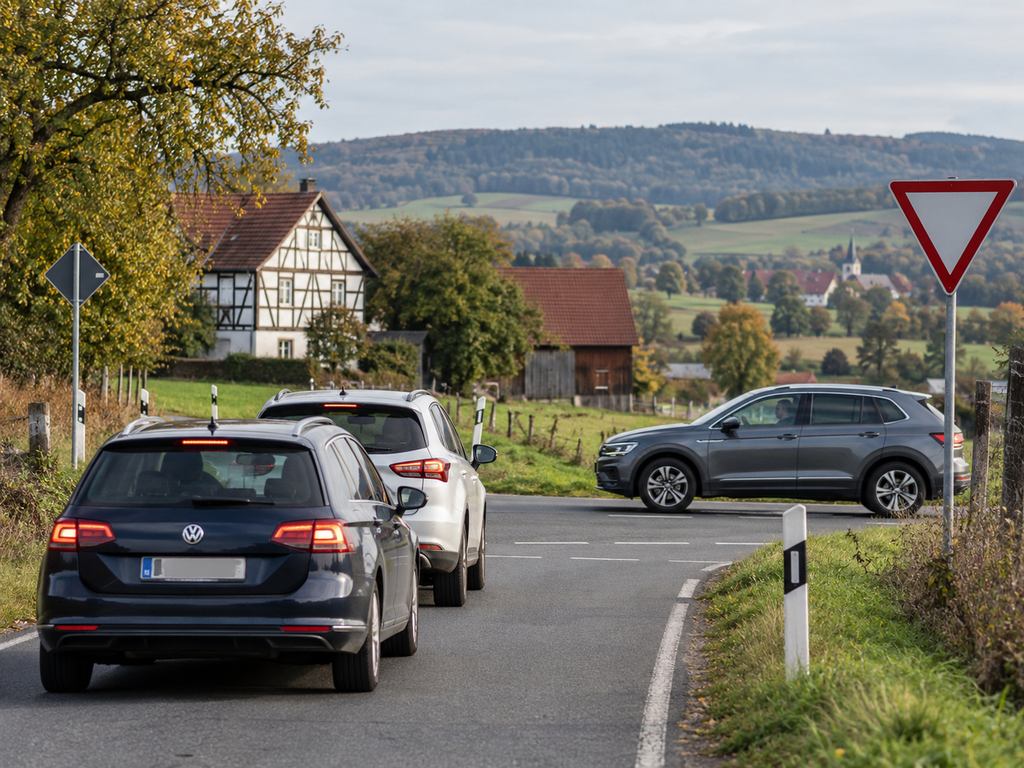
That brought the conversation naturally to England, where Martin had noticed something deeply suspicious. The drivers really were polite. They kept their distance and drove sensibly rather than, as he put it in German, like a scalded pig — flat out and without much apparent concern for anybody else.
Worse still, the politeness continued away from the road.
German even has the wonderfully suspicious expression der ist scheiss freundlich — roughly, “he’s bloody friendly.” There comes a point, apparently, when friendliness itself begins to look questionable.
North Hesse, fortunately, provides plenty of distractions. There are forests, hills and national parks. The Brothers Grimm lived in Kassel for a number of years, which was immediately accepted as proof that the region has contributed substantially to global education. Near Manfred there is even a village associated with Cinderella.
So North Hesse is well worth visiting.
Assuming, naturally, that you can afford the travel-insurance surcharge.
There are the Kassel hills to consider. Manfred pulls a caravan through them and maintains that this is more difficult than driving through the Alps. The Swiss, after all, invented tunnels. North Hesse appears to have preferred character building. Since Manfred would quite like an electric car, hauling a caravan up and down those hills gives him something further to think about.
Then there is the weather. Martin thought his part of Hesse had more in common with Scotland. Manfred considered the climate in South Hesse unbearable, while the weather in North Hesse simply is what it is.
Weather itself did not survive much scrutiny. The higher you climb a mountain, the colder it gets despite moving closer to the sun. Snow can fall on Mount Etna in Sicily, volcano permitting. A Scottish acquaintance once travelled from Inverness to Edinburgh and then flew to Frankfurt, leaving 26 degrees behind and arriving to 42. Manfred had experienced the opposite sort of surprise on a drive to Lake Garda: pleasant temperatures at home, an air-conditioned journey south, then the car door opening onto a wall of heat.
There are, clearly, local disturbances.
But underneath the weather, apple wine, road behaviour and jokes about Hessian character, a problem was beginning to appear. Every attempt to establish a regional rule of politeness seemed to produce an exception.
Then coffee provided some actual evidence.
The coffee test.
During the conversation, Manfred was at home in Bad Wildungen. At some point, he left the table to get himself a coffee.
Martin was in Kassel. The Mayor was in Cleebourg.
Neither was offered one.
They had to ask Manfred whether he might bring them a coffee too.
There it was: an unwritten rule discovered at the exact moment somebody broke it.
An Englishman, it was decided, would also have offered biscuits.
Manfred mounted a defence. There had been technical difficulties. He was combining human extraction with fresh input. This demonstrated that men in Hesse are perfectly capable of multitasking, even when they do not entirely understand that they are doing it.

Getting yourself a coffee without offering anybody else one is hardly a major international incident, of course. That is precisely what makes these rules interesting. Politeness tends to live in small things: offering, waiting, leaving enough distance, knowing whether shoes stay on or come off, judging when a telephone call is acceptable, understanding whether somebody’s bluntness means hostility or simply that this is how they speak.
Often, the rule becomes visible only when somebody misses it.
Yet performing every rule correctly does not necessarily make somebody pleasant. Martin and Manfred both knew the opposite experience: a person can behave impeccably and still feel cold. Beneath the rituals, another calculation is taking place.
Can I warm to this person? Are we on the same wavelength?
For Manfred, that can matter more than whether somebody has executed every small ceremony of politeness correctly.
The reverse is possible too. Somebody can make a terrible first impression, miss the expected rules and become likeable remarkably quickly. An immediate apology changes things. Humour helps. Sometimes a second chance is enough.
The rules matter.
Just apparently not quite as much as we imagine.
People, not regions.
Travel eventually dismantled what remained of the theory.
Manfred has spent time in France and does not recognise the supposed difficulty between Germans and French people. His experience has been much simpler: most people want to live in peace and get along.
The same has been true elsewhere. He has travelled in places sometimes described by others as dangerous and has generally found people friendly. He is careful about what that proves — these were journeys and holiday destinations, not a scientific survey of humanity — but over time he has developed a straightforward approach.
How you present yourself tends to be reflected back to you.
“We are ruled by prejudices,” he said. “Reality presents a different picture.”
So the conversation tried to force a decision. Suppose somebody had to choose where to live purely according to how pleasant strangers seemed. The Netherlands, Croatia, France or Hesse. Who survives the first round?
Manfred wanted to know how many rounds there were.
Then he ruined the competition.
All of them.
Based on his own experience of how people approached and interacted with him, he could not choose a region. It came down to the people, not the place. Introducing bureaucracy, neighbours and supermarket queues failed to produce a winner either.
In Austria, Manfred once received a parking ticket after stopping briefly to buy an ice cream for his wife. He paid it and moved on. On another journey, he was caught speeding shortly before entering Italy and had to pay at the border.
Supermarkets, meanwhile, appear to have achieved something approaching European unity: wherever possible, open as few checkouts as possible and extend the customer experience.
Perhaps that is the true shared culture.
Even New York, which Martin initially experienced as hectic, did not strike him as unfriendly. Life simply moved quickly. Once he adjusted his own speed, the place became easier to read.
That may be closer to the truth than most national stereotypes. Places have rhythms. If you mistake the rhythm of a place for the character of its people, you can get them badly wrong.
And exaggerated friendliness can be every bit as uncomfortable as bluntness.
The hole in the sock.
Some social rules remain wonderfully specific.
In Japan, Manfred noted, a visitor may be expected to remove their shoes when entering somebody’s home. He does not normally do that himself, so the request would surprise him.
It becomes particularly problematic if there is a hole in the sock.
Germany has its own rules. For years, one was simple: do not disturb a German between eight and eight-fifteen in the evening. That was television news time. The habit may have weakened, but some trace of the unwritten law remains.
Manfred sometimes wants to telephone somebody and is told by his wife that he cannot possibly call at that particular moment because of some social convention.
His response is more pragmatic.
Call them.
If you are disturbing them, they can tell you.
Otherwise, he argued, eventually you cannot do anything at all because you are too busy worrying about whether you are allowed to speak to people.
Which leaves the visitor nervously approaching North Hesse with rather a lot to remember: offer coffee, consider the biscuits, think carefully about the shoes, avoid television news time, distrust the apple wine and prepare emotionally for the weather.
Manfred’s final advice was considerably simpler.
Behave normally, as you would elsewhere. Let people be who they are and adapt to the person in front of you. If the chemistry works, fine. If it does not, then so be it.
After an hour of attempting to discover the correct rules of politeness, that was perhaps the most useful result.
Beneath all the local customs, habits and misunderstandings, the rule that matters most is not especially Hessian, German, English, French or Japanese.
It is human.