Peeling Potatoes 57: The Day I Made the Mayor Apply to Be a Clown
We were supposed to take a creative pause. Instead, I sent The Mayor to the biggest recruitment fair in the universe.
We Had Already Lost Count.
We began by trying to remember which Peeling Potatoes episode we were recording.
I thought it was 56.
Then I remembered that 56 might have been last week.
Perhaps this was 57.
The Mayor pointed out that we were still only in double digits, although one day we might reach three digits—provided we learn how to count.
My son can count to 200, so apparently he will have two responsibilities at our next meeting: helping us with the final week of Rest and teaching us basic mathematics.
This is how our creative pause began.
We had lost count, The Mayor had experienced a traumatic morning, and I had prepared the wrong subject.
We were supposed to discuss emotional rest.
Instead, I had created the opposite of a creative pause.
The Mayor was going to have to be creative.
Very creative.
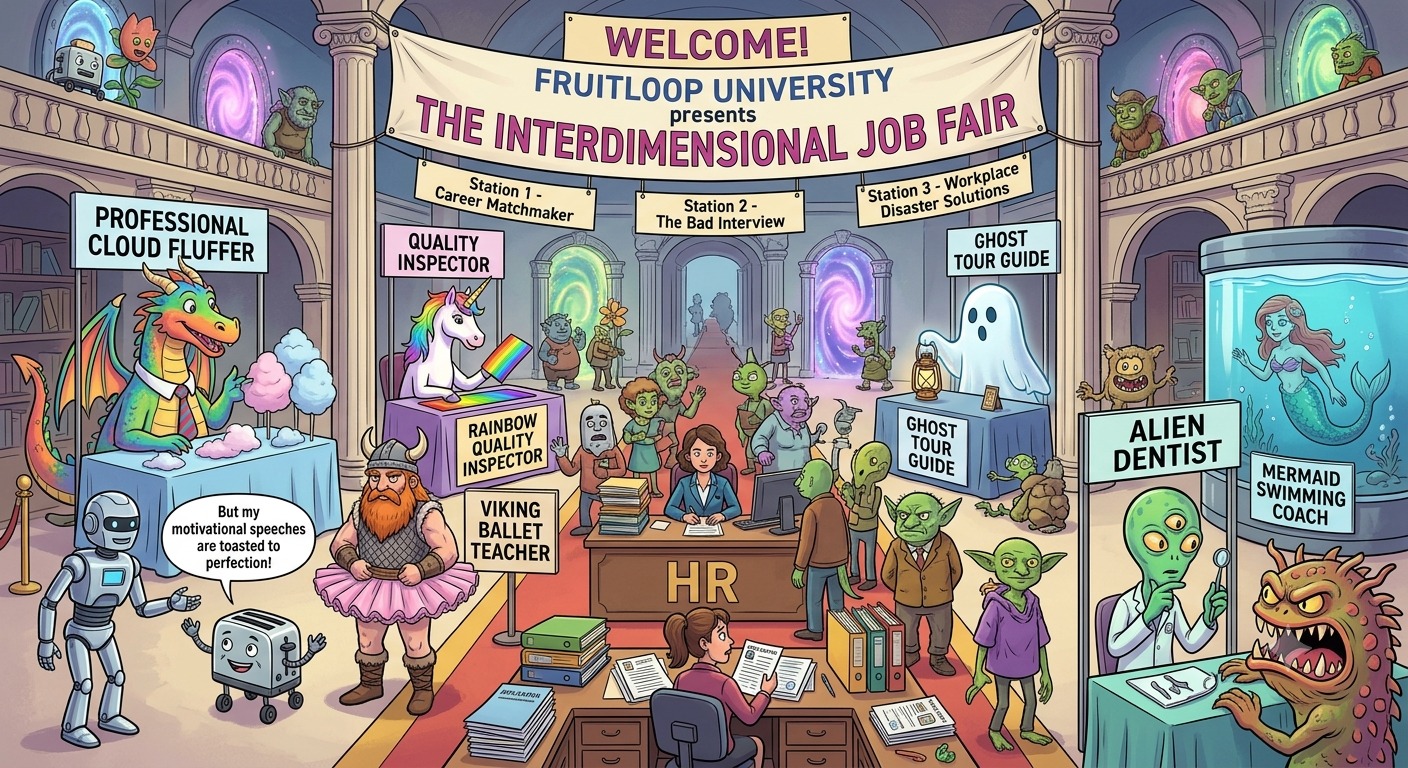
Welcome to the Recruitment Fair.
“Congratulations,” I told him. “You have been invited to the biggest job fair in the universe.”
The applicants included dragons, aliens, ghosts, robots, unicorns, Vikings, llamas, talking toasters and all kinds of magical creatures.
Unfortunately, HR was having a bad day.
The Mayor would therefore be HR.
Before we began the official recruitment process, I asked him to name his dream ridiculous job.
I had prepared some examples: dragon dentist, mermaid swimming coach and professional cloud fluffer.
The Mayor did not need my help.
His first answer was Ronald McDonald.
A McDonald’s clown.
He could not explain why. He had not visited McDonald’s for at least a year. The clown had simply arrived inside his head and refused to leave.
Naturally, I decided that I needed a cartoon of The Mayor as Ronald McDonald.
He was less enthusiastic about this than I was.
Do Not Judge a Dragon by Its Coat.
At the first station, The Mayor became a career matchmaker.
He had to choose a creature, give it a job, list three responsibilities and identify one thing it would be terrible at.
He chose a dragon.
His thoughts immediately travelled to the wildfires in southwest France. A dragon, he decided, would be a terrible firefighter. Every time it opened its mouth, it would make the fire worse.
The dragon needed a safer career.
The Mayor made it a kindergarten teacher.
The children could sing Puff the Magic Dragon. The dragon could teach them about loneliness, inclusion and the danger of judging somebody by their appearance.
It would also inspire a useful amount of fear and respect.
Perhaps not in that order.
I remembered a green dragon from a cartoon I watched as a child. He was also a firefighter, but he was small and friendly.
The Mayor concluded that this cartoon had made dragons an acceptable species.
Our kindergarten dragon could therefore succeed, provided it received some training and did not scorch the children.
The Clown’s Serious Side.
At the next station, I interviewed The Mayor for a job.
He briefly considered becoming a unicorn, but decided that unicorns were more my territory. He would remain a clown.
The village idiot.
Otherwise known as The Mayor.
“Why should I hire you?” I asked.
“Because I make you laugh.”
This was true.
Brida makes me laugh. The Mayor makes me laugh. Sometimes the laughter comes from the absurdity of what we are building. Sometimes it comes from the fact that he is being completely serious while everything around him has become Fruitloopy.
Then I asked for his greatest weakness.
His answer became surprisingly serious.
A good clown, he explained, allows people to see a reflection of themselves without embarrassment or pain. Humour can carry a serious message because it gives people a safer way to look.
His weakness was his inability to say no.
Even in an imaginary job interview, The Mayor managed to turn this into a strength. He would become a clown who refused to accept the status quo—a clown determined to create situations in which “no” was no longer the final answer.
Then I asked whether he had ever accidentally burned down a village.
“What a stupid question,” he replied. “Of course I have.”
Ronnie the Clown and Draggy the Dragon had been playing truth or dare. Things became slightly out of control.
The village disappeared in smoke.
Marshmallows were provided, along with several insurance disclaimers.
The Office That Solved Its Own Problems.
At the workplace-disaster station, every employee had caused trouble.
The dragon had toasted the office.
The ghost kept walking through walls during meetings.
The llama spat whenever somebody said “deadline”.
The mermaid had flooded the cafeteria.
The Mayor’s solution was to place the entire organisation somewhere resembling paradise, where the elements were always kind.
The toasted office no longer existed.
This immediately solved several problems.
Without walls, the ghost could no longer walk through them. Without a cafeteria, the mermaid could no longer flood it.
Everybody could work outside beneath a large African tree, like a pride of lions. We struggled briefly with the name of the tree until we arrived somewhere near baobab.
The llama would no longer need to spit because there would be no deadlines.
The Mayor believes that when people enjoy what they are doing, they often understand naturally when something needs to be completed. Motivation does not always require somebody standing nearby with a clock and an unpleasant expression.
Create a good environment, he said, and many negative behaviours disappear by themselves.
I had imagined a palm tree, probably because I was looking at one.
He had imagined Kruger National Park.
We agreed that the llama might struggle there and the mermaid would find it too hot.
Always Make Time for a Unicorn.
At another station, The Mayor had to invent the world’s strangest profession.
He created a unicorn whose job was to be a professional happiness-maker and glitter-thrower.
It wore no uniform because unicorns do not need uniforms. Its skin was already covered in sparkles, glitter and magical bits.
The danger was not the glitter.
The danger was that nobody would notice.
The unicorn might arrive while we were busy, distracted or multitasking. It would perform its magic in front of us, but we would be too occupied to receive it.
Later, we might remember the moment and say, “I wish I had…”
But the moment would already be gone.
The unicorn would not allow multitasking. When it arrived, you had to stop.
You had to notice the glitter.
You had to accept the joy while it was happening.
The Mayor said that one should always have time for an espresso.
Everything else can wait.
Therefore, one should also always have time for a unicorn.
Bread Is Very Inspirational.
The talking toaster caused another HR crisis.
It would not stop giving motivational speeches, and everybody was 30 minutes late for work because they were listening.
The Mayor decided that perhaps the toaster deserved to be heard.
He is not generally a fan of motivational speeches, but sometimes a carefully constructed speech contains something useful. We should listen first and form our own opinions afterwards.
Still, the toaster needed to stop eventually.
The solution was magic bread.
Once a slice was inserted, the toaster required 24 hours to toast it. During that time, it could rest, think and prepare new material.
Bread, according to The Mayor, is very inspirational.
The employees could enjoy one worthwhile 30-minute broadcast, then return to work while the toaster processed its next slice of data.
The toaster was happy.
The employees had learned something.
The boss had been put in his place.
I wanted to work there.
There did not seem to be many rules.
No Employee of the Month.
At the final station, The Mayor had to choose an Employee of the Month.
He refused.
Recognition systems can become unfair, he said. The same visible people are repeatedly celebrated while those providing support from the second or third row remain unseen.
Behind every person apparently working freely from a tropical beach, somebody else is maintaining the infrastructure.
The people in the trenches, dungeons and dark corners make the visible work possible.
So Employee of the Month was cancelled.
Instead, we would hold a monthly bash to celebrate everybody.
The toaster could give a speech.
The mermaid could flood something.
The dragon could toast the decorations.
Everybody could contribute what they did best, receive a thank-you and return to work with new energy.
Seriously Good Fun.
The Mayor passed every station.
More importantly, he finished the conversation feeling lighter than when he had arrived.
His week had been complicated. Pineapple 21 had become one of the most difficult issues he had assembled. The contradiction of “less is more” had somehow created something enormous.
Our ridiculous recruitment fair gave his brain somewhere else to go.
We had not paused by becoming silent.
We had paused by playing.
For one hour, there were no normal rules. A dragon could teach kindergarten. A Viking could wear a pink tutu. A ghost could become a dentist. A toaster could be fed fresh data in the form of bread.
The Mayor called it “seriously good fun”.
It was an oxymoron, but it was also exactly right.
Sometimes rest is not the absence of activity.
Sometimes it is the presence of dragons, glitter and one completely unqualified HR manager.