
The Best Moments Are Not Planned.
Fresh bread, an Alsatian apéro, a plate of choucroute and a week of imaginary visitors. Geneviève explores what it really means to welcome somebody into her part of the world.
By Geneviève, France.
Frank gave me visitors for a week.
Not real visitors, at least not yet. He imagined Janita arriving from South Africa with her husband and seven-year-old son. They would spend a week in our part of Alsace, close to the German border, and I would be their local host.
Then he began giving me problems.
Their plane is late. The child is hungry. Janita wants coffee. The shops are closed. Somebody does not like the food. They miss a train. A neighbour stops us in the street. Dinner is at seven, but at half past seven the visitors have still not arrived.
What would I do?
My first answer was probably not the one he expected.
“I plan nothing in this case.”
A plane can be late. A bus can be late. People can arrive tired. Before leaving the airport, I might ask whether they want a coffee or something to drink. You have to look at the people who have actually arrived, not only at the programme you made before they came.
That does not mean doing nothing. It means preparing for people without trying to control every hour of their visit.
First, buy the bread.
On the way home, Frank gave me another problem. We are nearly there, everybody is tired, and I suddenly realise there will be no fresh bread at home. Do I make them sit in the car while I stop at the bakery?
Yes.
I stop and buy the bread. Maybe a croissant too.
It is practical. Once the guests are at home, I do not want to leave them while I go shopping again. And bread is important here. Hospitality does not always begin with a beautiful dinner or a special excursion. Sometimes it begins by noticing that tomorrow morning will be easier if there is bread in the house.
Once we arrive, however, I would not immediately start filling their time. If they have travelled all day and are staying in a hotel, I would let them settle down and recover. Later we can meet, eat together or go somewhere. In summer there might be a barbecue. But the first evening is different.
Travelling takes something out of you.
The following morning brings another very local problem. Janita needs something from the shops.
But it is Sunday.
When you live here, opening hours become part of the landscape. You know what will probably be closed, where the exceptions are and what needs to be bought beforehand. A visitor does not know any of that.
In our part of Alsace, Sunday can still be a very quiet day. You cannot simply assume that a supermarket will be open, and sometimes even Monday requires a little planning. If something is important, we find a solution. Perhaps there is a shop somewhere else or somebody needs to drive. But I normally organise my shopping so that I do not have to drive somewhere every day.
For visitors without a car, that becomes more important. Our countryside is beautiful, but you cannot always depend on public transport. If somebody is staying in a village and wants to go somewhere, you need to think not only about how they will get there, but how they will get back.
These are not the things you normally put in a tourist brochure, but they are part of staying here.
Choucroute, potatoes and the apéro.
Then Frank decided I should prepare a traditional meal.
October in Alsace. A barbecue is less likely, so perhaps choucroute: fermented cabbage, potatoes, sausages and different kinds of meat. It is a substantial local dish and certainly something visitors might want to discover.
Naturally, Frank gave me another problem.
Janita’s seven-year-old son takes one taste and announces that he does not like it.
That is not a catastrophe.
He does not have to eat it. There can be bread or something else. When I was a child, my sister did not like fermented cabbage and sausages either. I did. Even children growing up in the same family do not necessarily enjoy the same food.
Potatoes are important in my own kitchen and accompany all kinds of dishes, including meat and fish. Rice has its place too. And Alsatian cooking is much more than one famous plate of choucroute. There are different sausages, different ways of preparing potatoes and many local dishes. Cross the border into Germany and some things look familiar, but the preparation and flavours can change.
I would certainly like visitors to discover our local food. But enjoying the meal together matters more than making everybody eat the same thing.
And then Frank reminded me of something I had forgotten.
The apéro.
Of course.
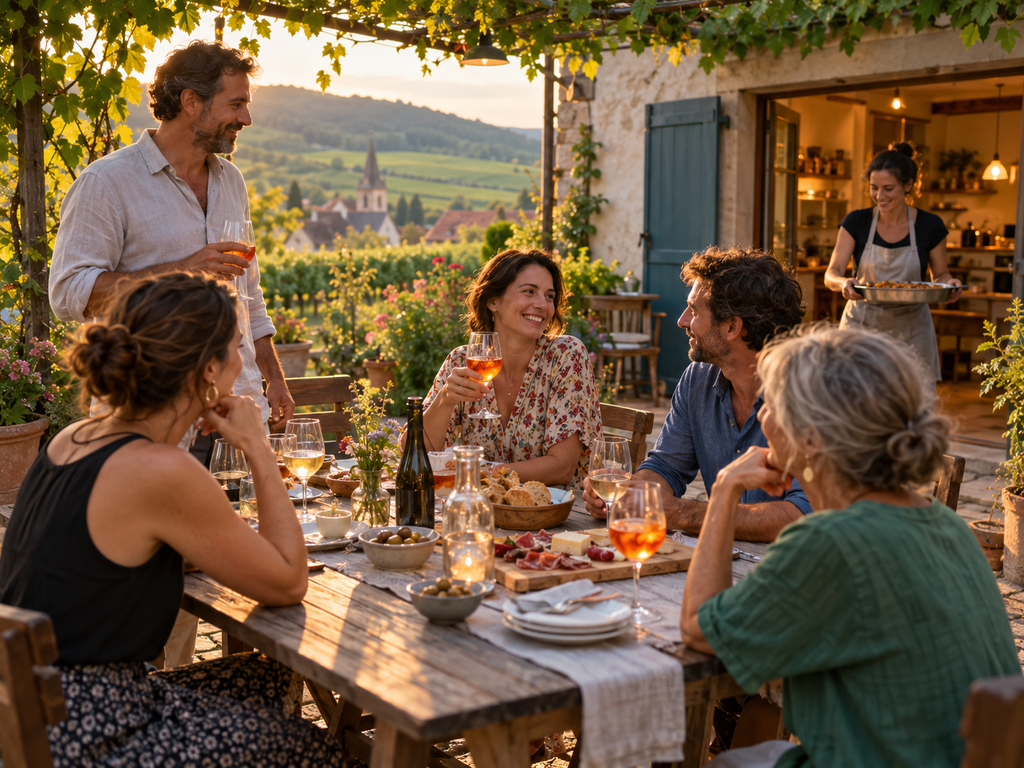
Here, the apéritif is not simply a drink before a meal. It is part of receiving people. Guests arrive, coats come off, drinks are offered and conversation begins while the person preparing lunch may still be busy in the kitchen. If people do not know one another, this is where introductions happen.
There is no need to rush everybody directly to the table. The apéro gives people time to arrive properly, socially as well as physically.
We might talk about the journey, the weather, what somebody has already seen or what they would like to do. Perhaps somebody has brought news. Perhaps a person visiting Alsace for the first time has questions. Meanwhile the host can finish preparing the meal without everybody sitting at the table waiting.
And it can take time.
A Sunday lunch here is not necessarily something to finish quickly. There may be several courses, plenty of conversation and perhaps a walk afterwards. Somebody accustomed to eating more quickly might be surprised by a lunch that continues for hours, but for me the conversation is part of the meal.
Of course, language can complicate things. If Janita and her family are sitting with French-speaking guests, we have to notice who can understand what. It is very easy for local people to slip back into French and forget that somebody has been left outside the conversation.
Translation helps, although humour can be difficult. A joke does not always survive being explained.
You have to notice who is still part of the conversation.
Strasbourg, Germany and the places in between.
For a week in Alsace, I would certainly make suggestions.
Strasbourg is an obvious one, with its historic centre, streets and buildings. Even travelling there by train and discovering how our towns are connected may be part of the experience for somebody arriving from another part of the world.
But again, what is obvious to us is not always obvious to a visitor. Tickets, signs, platforms and local procedures can all cause confusion. Frank remembered discovering on one journey that his train ticket needed to be validated before travelling. If you have never encountered such a rule, how would you know?
Then there is Germany, only a short distance away. Visitors can cross a border and suddenly be in another country without making a major journey. Some things will feel familiar, others slightly different.
In December, of course, there are the Christmas markets. Strasbourg has its famous market, but smaller places have their own atmosphere too. We could spend an afternoon discovering them. A whole winter day with cold feet and a tired seven-year-old might be less attractive.
What looks normal to us can seem quite extraordinary to somebody else. Frank once showed a Christmas market to people abroad over a video connection. Our ordinary winter scene looked very different to people living somewhere much warmer.
I would also take visitors to the local wine cellar. Vineyards and wine production are part of the landscape here, so familiar that we may hardly notice them. For visitors they can be a completely new part of the region: the wines, the vineyards and the traditions around them.
But not every outing needs to be a famous attraction. Walking through a village and stopping at an old building can be just as interesting.
Sometimes the visitor notices something first.
The people along the way.
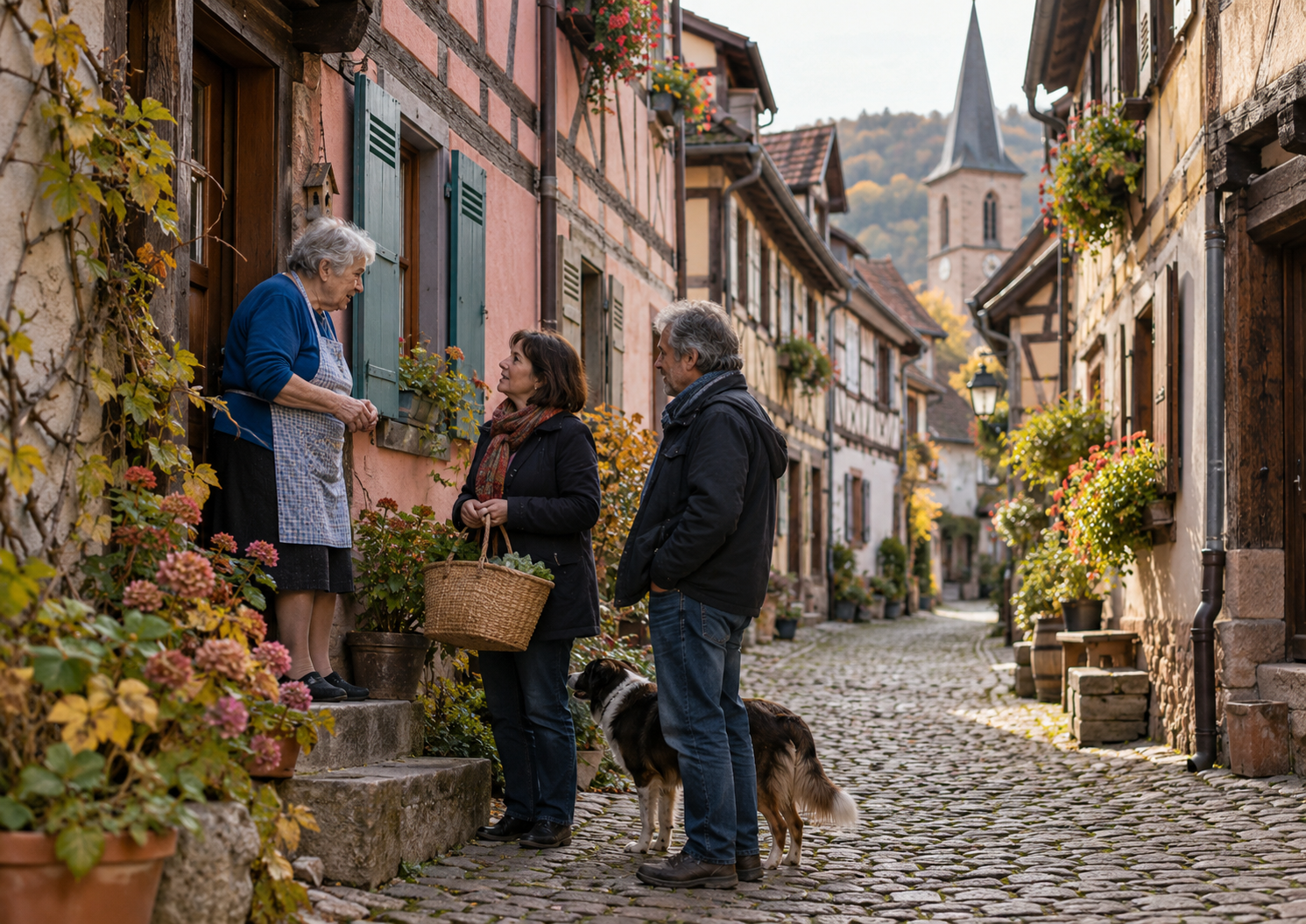
Imagine we are walking through the village and meet somebody I know.
We stop.
There are a few words, perhaps introductions, and the conversation continues a little longer than expected. That is normal here, especially among people who have known one another for years.
For a visitor, it may need some explanation. Who is this person? How do we know each other? Why have we stopped?
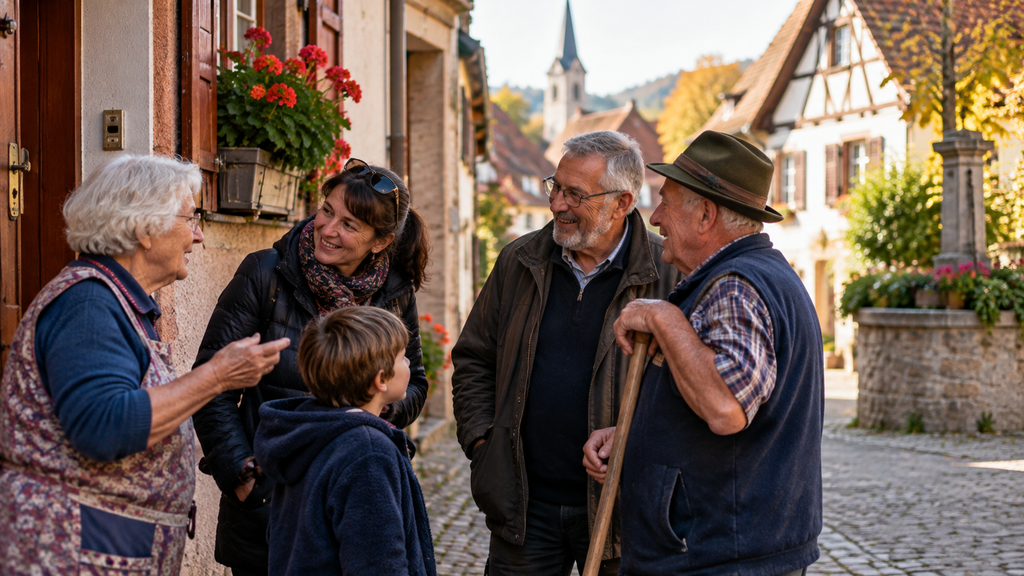
Language enters the picture again too. A short conversation between neighbours becomes more complicated when one of the people standing there cannot understand it. You have to think about including everybody.
Children sometimes solve this more easily than adults. Frank imagined Janita’s son wanting to join local children who were playing, even though they did not share much language. Children often find other ways to communicate.
Adults worry about the words.
Still, parents need to know where their child is and feel comfortable about the situation. Something that feels completely normal and safe to one person may be unfamiliar to another. You cannot simply say, “That’s how we do it here,” and expect somebody else to feel exactly the same.
And then comes a situation I particularly like.
Somebody discovers that we have visitors and says, almost casually, “Bring them over this evening for an apéro.”
No formal invitation. No complicated preparations.
Yes.
Those can be the best moments.
We remembered an occasion when somebody came by and we simply invited him to join us. There was no programme and nobody had been preparing for days, but it became a wonderful time together. Somebody had time, somebody asked, and somebody else said yes.
Perhaps there is a drink and something small to eat. Then one story leads to another.
Nobody has to perform. The occasion grows out of the people who happen to be there.
That is one reason I would never want to organise every minute of a visitor’s week. If every hour is already occupied, there is nowhere for an unexpected invitation to go.
Seeing home through somebody else’s eyes.
Frank then asked what would happen if Janita stopped to photograph something I would never think of photographing.
Perhaps a tree.
We have trees everywhere, but in autumn the colours change, and somebody arriving from another country might find them beautiful. Or perhaps she notices an old house, a small building or a detail in a village street that I pass every day.
You stop seeing familiar things after a while.
I know the feeling myself. You can walk past the same building for years, then somebody points out one small detail and suddenly you see it differently.
Visitors do that.
Welcoming somebody is not only about showing them the things you already know. Sometimes they make you look again at the place where you live.
You think you are the guide, and then the visitor shows you something.
Leave some room.
By Thursday, Frank decided that I had spent almost an entire week looking after Janita and her family.
Had I done too much?
Possibly.
People come on holiday to enjoy themselves, but they also need time of their own. They may want to go somewhere without us, spend an afternoon quietly or simply change their minds. The host has a life too.
So there has to be some balance. I can suggest places, help with transport and be available without believing I must accompany everybody everywhere.
Then we reached the final evening.
Should there be a proper farewell dinner, or could we simply eat something left over from the week?
Perhaps there should be a little occasion to say goodbye. But it does not need to be complicated. Even a tarte flambée can be shared with pleasure.
At the beginning of this imaginary visit, I said I would make no strict plan. By the end, we had talked about bread, Sunday shopping, transport, choucroute, potatoes, apéros, languages, children, Strasbourg, Germany, Christmas markets, wine, village life and farewell dinners.
So perhaps I would organise quite a lot after all.
But organising is not the same as deciding in advance exactly how everything must happen.
Buy the bread. Prepare something good to eat. Explain the shops. Work out the transport. Suggest Strasbourg, the vineyards or a trip across the German border.
Then leave some space.
Because after a week, the thing people remember may not be the famous place you carefully planned for them to visit.
It may be the neighbour who stopped to talk.
The tree somebody photographed.
The child who found somebody to play with.
Or the apéro that nobody knew was going to happen.
Those are difficult to put on an itinerary.
And perhaps that is exactly why they stay with us.