
The Basics Came From My Mother.
Grünkohl mit Pinkel begins with a drive to the butcher, gets better every time it is reheated, and carries something much older than the recipe itself.
By Ralf, the Grillmeister, Germany.
If you came to my house and said, “Ralf, make me the Ralf dish,” I know what I would do.
First, I would get in the car.
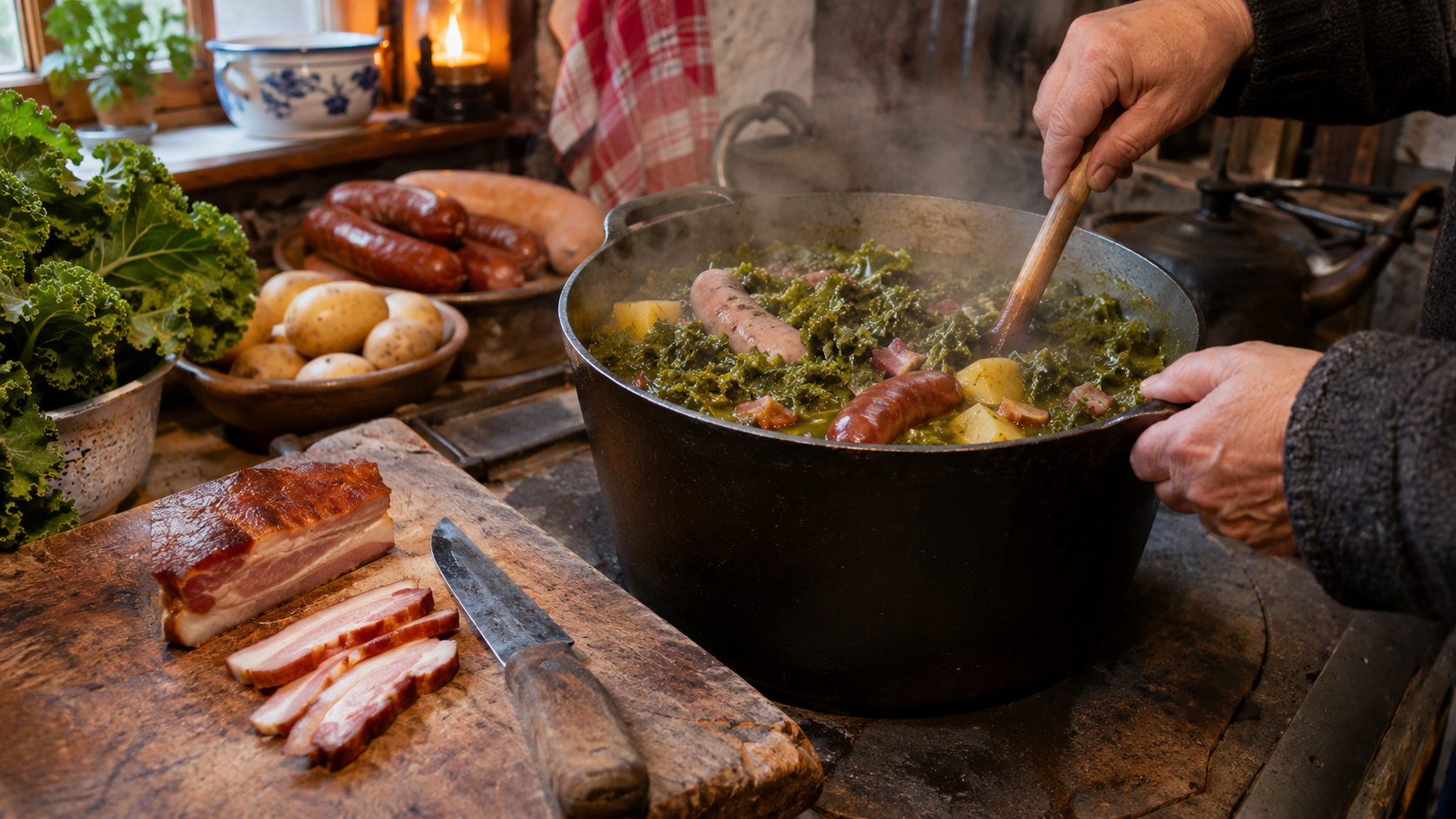
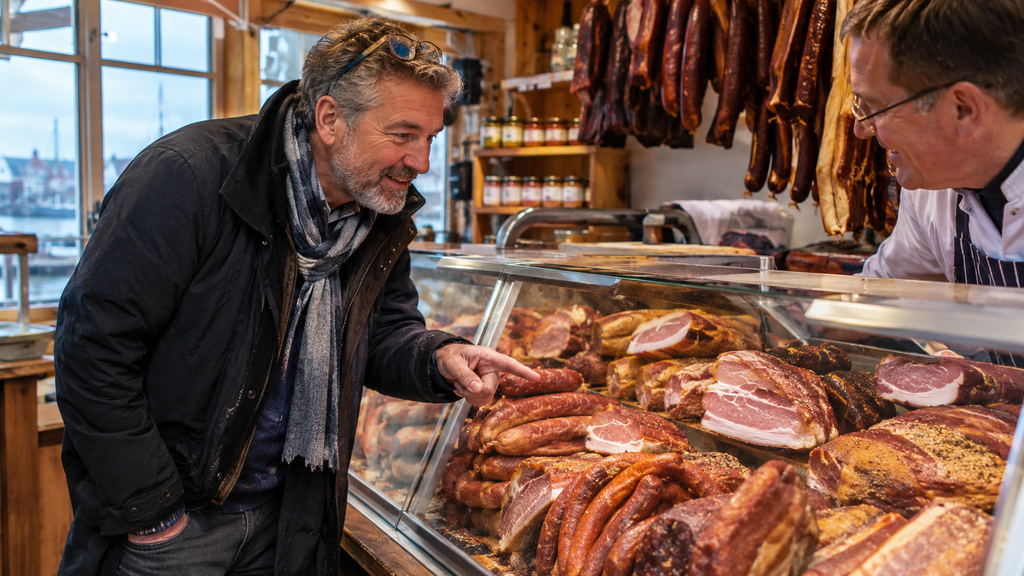
For me, Grünkohl mit Pinkel does not really begin with the pot. It begins at the butcher. I drive to my favourite butcher in Bremerhaven and stand there looking at what he has. I need Kassler, smoked bacon, smoked sausages and Pinkel, but even then I am looking around because perhaps there is something else.
This is dangerous.
I can go there with a perfectly good plan and suddenly see Kassler spare ribs. Then I ask, “What is this?” He explains it to me, and of course I say, “Give it to me.”
Now the plan has already changed.
That is part of cooking for me.
The Dish That Takes Its Time.
Grünkohl mit Pinkel is a northern German winter dish: kale cooked slowly with meat and sausages, served with potatoes. There are different versions depending on where you come from. Even between Lower Saxony and Schleswig-Holstein, people start arguing about whether the potatoes should be sweet, whether the kale should be sweet, which meat belongs inside and which Pinkel is the correct Pinkel.
I solve the Pinkel problem very simply.
I buy both.
I like Bremer Pinkel and Oldenburger Pinkel because they are different. One is fattier, one has more meat, and they behave differently when you cook them. The Pinkel itself does not go directly into my kale. I let it simmer separately in hot water because a lot of fat comes out. Later, I take a little of that cooking liquid and add it back to the kale.
The kale cooks slowly with onions, smoked meat, mustard and the other ingredients. The small potatoes are cooked first and later made crispy in butter.
And yes, there is garlic.
Not twenty cloves. I am not completely crazy.
Two small cloves.
In our kitchen we have fresh garlic, dried garlic, garlic powder, even Chinese solo garlic. If you ask me how you know when a recipe has become a Ralf recipe, garlic is normally a good place to start.
Unless we are making chocolate pudding.
Probably.
Five Minutes to Choose a Knife.
There is another part.
Before I cut anything, I have to choose the knife.
Somebody else looks at the vegetables and thinks, “What shall I cook?”
I can spend five minutes thinking, “Which knife shall I use?”
This is a serious decision.
I own one knife that I would never replace. My nephew gave it to me several years ago. A craftsman had made it for him as part of an exchange, and one day my nephew phoned me, came by train to see me and handed me this knife.
It was made by hand, and for me there is nothing better.
You can always buy another knife. You can buy a more expensive one, a newer one, one with beautiful advertising and perhaps a box that tells you it will change your life.
I don’t need it.
I have the good one.
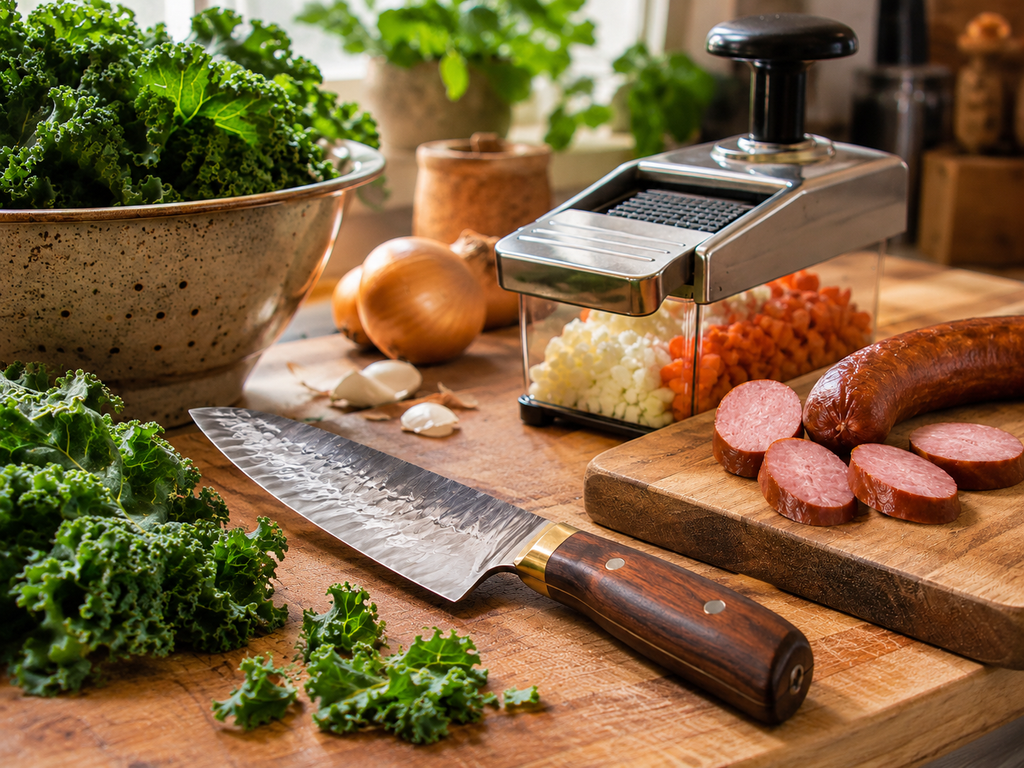
There is also a vegetable cutter in my kitchen that has earned exactly the same status, although our relationship started badly. I had bought one of those television kitchen gadgets before and hated it. It was terrible. So when I saw another machine recommended by barbecue people I followed online, I was suspicious.
I bought it because I could send it back.
I never sent it back.
Pepper: bam.
Cucumber: bam.
Tomato: bam.
Onion: finished, and no tears.
If it breaks, I will buy another one immediately.
That is also how I recognise the good one. You stop looking for an upgrade.
The Atmosphere Begins Before Dinner.
Next weekend, friends are coming to us.
They could have chosen a restaurant. We could have had a barbecue. They had a choice, and they chose my Grünkohl.
For me, that is already part of the pleasure.
The atmosphere does not begin when everybody sits at the table. It begins when I drive to the butcher. It continues while I am choosing the meat, finding something unexpected, preparing everything, deciding which knife I need and slowly filling the house with the smell of the food.
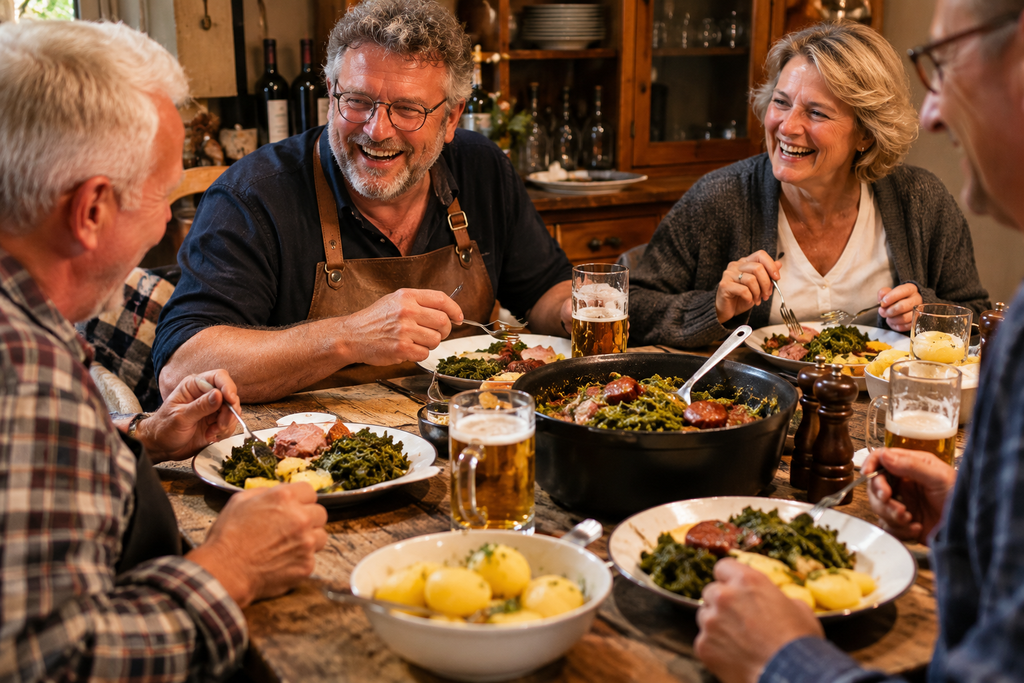
Then the big plate comes to the table.
Kale. Kassler. Bacon. Sausages. Pinkel. Potatoes.
Maybe some Kassler spare ribs have accidentally joined the party because I went shopping without adult supervision.
There must also be beer. Grünkohl is not really wine food.
Afterwards, many people around here would drink Korn. I don’t like Korn. I think it is horrible. Instead, I prefer a herbal digestif we call Tante Ella. It smells a little of vanilla and, after this meal, it seems to put everything back where it belongs: fat on the right, potatoes on the left, kale in the middle.
Medical science may have another explanation.
I prefer mine.
Better on Monday.
The wonderful thing about Grünkohl is that Saturday is not the end of it.
Saturday is good.
Sunday is better.
Monday can be fantastic.
Every time the kale is warmed again, something happens to it. The flavours come together more and more. At first I serve it in the traditional way with potatoes. Later, the leftover potatoes can go into a pan until they are crisp, then the cold kale and pieces of meat go in with them.
Everything heats together.
By the third or fourth serving, you have something that is no longer quite the same meal you started with.
For me, this is not a problem.
This is the reward.
I do something similar when I cook other food. If there is a little Chinese food left the next day, perhaps I add prawns. Then maybe some leek. The meal moves. It becomes something else.
I don’t like throwing good food away when it can still become interesting.
What Ira Chooses.
Ira has her own favourites.
If she can choose winter food, there will be turnips. There will be lentil soup. Pea soup. Potato soup.
Soup, soup, soup, soup.
This is actually very practical for me. I can cook a big pot. We eat it for two days, and some can go into the refrigerator. If I am away, she can warm it up herself in the evening.
Sometimes the simple things are exactly the right things.
One of the easiest meals she likes uses North Sea shrimps on good bread with egg. You can serve them on rye bread with just a little remoulade or butter, then put the shrimps on top and finish it with eggs.
Of course, in our house scrambled eggs are not simply scrambled eggs.
They have to be schlotzig.
We have standards.
When Dinner Has Worked.
How do I know a meal has been successful?
It is not because somebody says the correct words while sitting at the table.
It comes later.
Friends go home, then a WhatsApp message arrives saying it was a lovely day again. Perhaps they have gone home carrying a doggy bag, and the next evening they heat it up and send another message because the food is still good.
That makes me happy.
Cooking is work. Grünkohl especially is something you have to watch. You add things at different times. You don’t want the meat overcooked. You have to think about it.
I probably make it too rarely because it takes effort.
But I love doing it.
What Stays.
At the end of our conversation I was asked a difficult question.
Imagine I could keep only one recipe, food tradition or cooking habit from my life. What would survive?
My answer was not Grünkohl.
It was not barbecue.
It was not my special knife, garlic, Pinkel or crispy potatoes.
It was what my mother taught me at the stove.