
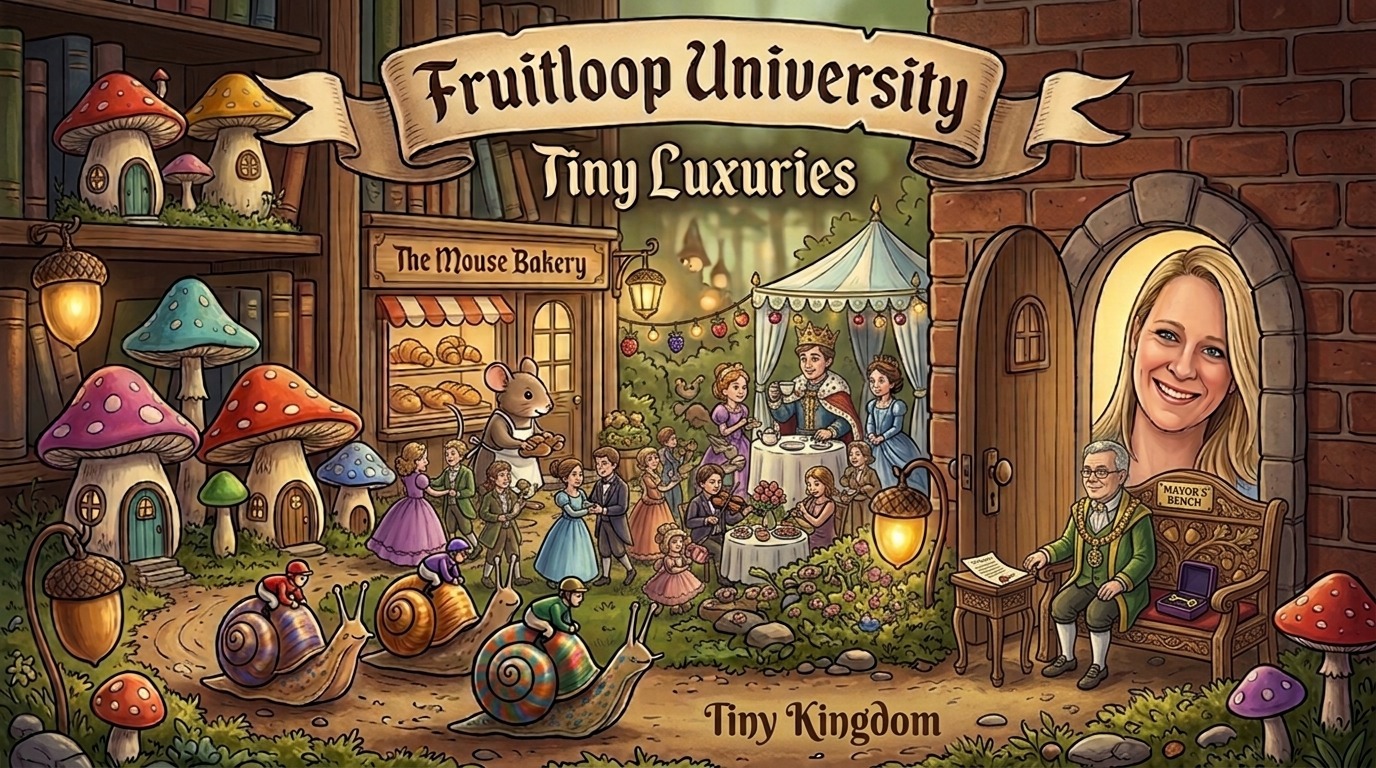
Peeling Potatoes, Episode 72: The Good One Was Never the Golden Cup.
I shrank the Mayor, carried him into Tiny Kingdom, made him race a snail, rescue a bakery and negotiate with a suspicious king. Somewhere along the way, we found the thing we were actually looking for.
By The Normal Fruitloop and The Mayor, for once cut down to size.
By the time we finally reached Fruitloop University, our “quick catch-up” had already taken twenty minutes and wandered through Wi-Fi, work, elections, cartoons and the fact that it was 32 degrees on my side of the world.
“Less politics, more university,” I said.
The Mayor agreed.
He had absolutely no idea what was coming.
The Mayor in a teacup.
I started gently.
After a long day at Fruitloop University, the Mayor was very thirsty. He found a beautiful little golden cup in the university kitchen, drank the water and suddenly his feet disappeared from view. His clothes became enormous. The furniture turned into mountains. His shoes were the size of boats.
I found him standing inside his own teacup.
His first concern was not the magical shrinking spell.
“Was I still decent? Let’s get this straight. Was I still decent?”
“Let’s say yes.”
That settled the important academic matters.
I took him to the university library to look for a way of reversing the spell. This immediately created another problem.
How exactly was I carrying him?
“Did you pick me up like a mouse on the back of my neck? Did you carry me gently in your palms?”
I had not thought that far ahead.
“I think maybe like…”
“Actually,” he said, “I really enjoyed being carried by you. Can we just go back to that stuff and forget about everything else?”
No.
Behind an old bookshelf in the library we discovered a hidden door. Behind the door was an entire city built inside the wall.
Welcome to Tiny Kingdom.
The Mayor was trapped there until he completed four challenges.
This was when he noticed another disadvantage of being miniature. From his new perspective, my eyes were enormous, my mouth was enormous and apparently my nostrils were quite spectacular too.
“You need to blow your nose,” he warned me. “Don’t you dare aim it at me.”
Fruitloop University had officially begun.
A snail called Speedy.
Tiny Kingdom was preparing for its annual Snail Racing Championship. The winner would receive a Golden Citizen Medal and an invitation to the King’s Garden Party.
The Mayor needed that invitation.
Unfortunately, he did not have a snail.
He also did not have money. His clothes had failed to shrink with him, which meant he was now wandering around Tiny Kingdom in whatever we had decided modesty required, without cash, cards or pockets.
I solved the economic crisis by announcing that Tiny Kingdom used acorns.
The Mayor immediately imagined the sign at the border:
“Welcome to Tiny Kingdom. Not part of the European Union. No credit cards accepted. Payment in acorns only.”
Money literally grew on trees.
Now he needed a champion.
He decided he would not choose the fastest-looking snail or the one with the prettiest shell. He would find the hungriest one.
His logic was simple. A hungry snail had motivation. Put the right food in front of it and hunger would do the rest.
He named his new racing partner Speedy Gonzales.
Naturally.
There was no elaborate training programme. The race was imminent and the Mayor had places to be. Fruitloop University still needed its Vice President, and apparently my carrying him around in one hand indefinitely was not considered a practical management structure.
“We’re getting this done ASAP.”
Then I put Speedy in last place.
“What is your strategy?”
The Mayor thought about it.
“We don’t have to be first from the beginning. We just have to be first at the end.”
The other snails could exhaust themselves. Speedy would conserve energy, stay hungry, wait for his moment and make his move when everybody else was flagging.
And if that failed?
Would he cheat?
No.
Partly because cheating was immoral. Partly because it could get him disqualified. Partly because the King might hear about it and refuse to see him.
And partly because, after considering the consequences, cheating simply sounded like too much trouble.
So Speedy and the Mayor won properly.
The first thing the Mayor did was feed the snail, as promised.
The second was to have a cold beer.
That should perhaps have been the end of the lesson.
Instead, I asked one more question.
“What is one everyday thing you always choose because it is simply the good one?”
For once, he did not have an immediate answer.
The little flicker.
He could have said coffee.
He almost did.
But the thing he finally chose was not material at all.
A few days earlier, he told me, he had stopped working and gone to bed feeling thoroughly down. Something was not working the way he had imagined. It felt as though he had almost completed a jigsaw puzzle, only to discover that one of the important pieces was missing.
Then he slept.
At around four in the morning, as often happens with him, the machinery upstairs started turning again.
Somewhere between stopping, sleeping and starting again, the missing piece appeared.
The following day was better. The Pineapple came together unusually early. Things that had felt stuck began moving. Then another small email arrived. It was nothing enormous. Nothing guaranteed. Just a signal.
A little flicker.
“This is working.”
Or perhaps: this is beginning to work.
That was his good one.
“The feeling that the odds are stacked against you, but you come out with a solution and it takes you one step forward. That is priceless.”
The strange thing was how neatly it fitted our snail race.
You have a goal. You do not know exactly how you are going to reach it. You may not even reach the goal in the form you first imagined. So you stay awake, you adapt, you use what is available and you keep moving.
The golden medal is not really the victory.
It is only something you can put on the mantelpiece afterwards.
The real victory is what happened before it.
“That,” the Mayor decided, “is the good thing.”
Which was why, apparently, he and Speedy had always been destined to win.
Crumbs.
Winning the Snail Racing Championship got us to the next challenge.
Michael the Mouse owned a bakery. His cakes were delicious, but his business was terrible because hardly anybody knew he existed.
He offered the Mayor half the business in exchange for turning it around.
The Mayor named it Crumbs.
I liked that immediately.
Then I asked what would make Crumbs different from every other bakery in Tiny Kingdom.
This time the answer was not the cake.
It was everything around the cake.
A bakery, he said, should be warm. It should be welcoming. It should have an atmosphere that makes people want to stay. He remembered passing a shop decorated for Christmas, with a big green wreath and fairy lights around the window. He had no intention of buying anything because it was too expensive for him, but the shop stayed in his mind.
It had an aura.
Crumbs needed that.
“What would the bakery smell like?”
“Grandmother’s kitchen.”
That was not quite the answer I expected from a cake shop.
For the Mayor, grandmother’s kitchen was not necessarily sugar and icing. It was warm stock bubbling slowly, bread from the oven, cinnamon, orange, mulled wine and all those smells that tell you something is being made by somebody who cares about what comes out at the other end.
The product mattered.
But so did the feeling of being there.
Make Crumbs warm. Make it inviting. Give people a taste. Let them remember it. Let them tell somebody else.
Then I gave him an impossible customer.
Five hundred cupcakes.
Delivery required in five minutes.
His answer was not to say yes and then panic. Nor was it to say no.
Give the customer twenty now. Find out what the cupcakes are actually needed for. Understand the event. Deliver the rest in batches as they are required, fresh from the oven.
The impossible order becomes something manageable.
Again, the answer was not the obvious one.
When I offered him a choice between one perfect cup of coffee and unlimited average coffee, he rejected both.
Study the perfect coffee. Work out what made it perfect. Learn how to repeat it.
Then try to make it better.
I was beginning to see a pattern.
The right mushroom.
Success at Crumbs made the Mayor rather famous in Tiny Kingdom, but technically he was still a tourist.
To become a citizen, he needed property.
I gave him three mushroom homes.
The Purple Palace had two floors, a balcony, a swimming pond and lots of space.
The Brown Cottage was small, warm and cheap, but moved slightly whenever the wind blew.
The Red Mushroom was a modest bachelor flat with a small garden and tiny kitchen, conveniently close to Crumbs.
At first he said the Purple Palace.
Then he thought about it.
Too much.
The Brown Cottage was charming, but the moving-in-the-wind business suggested future structural excitement.
He chose the Red Mushroom.
Not magnificent. Not perfect. Not the cheapest.
Just right for where he was at that moment.
It had what he needed.
There was even a garden for Speedy, who had somehow become part of the household.
“I thought he’d gone back to the snail farm,” the Mayor protested.
I had apparently decided otherwise.
The Mayor accepted this development and suggested that he and Speedy could sit in the garden together and chew grass.
Citizenship required one final statement.
What did he want to say to the people of Tiny Kingdom?
After all the acorns, racing, cakes, property negotiations and fame, his answer was surprisingly simple.
“My door is open anytime. You’re welcome.”
The accidental tourist.
Eventually we reached the King.
The King was suspicious of big humans. He believed they were greedy creatures who always wanted more than they needed.
The Mayor introduced himself as:
“The accidental tourist who stumbled onto paradise.”
I asked how he would prove that he was trustworthy.
“Not by what I say, but what I’ve done.”
He had kept his promise to his snail. He had helped Michael. He had built a business. He had become part of the community. He had earned citizenship.
The King could judge the evidence for himself.
Then came the question that changed the story again.
Why return to normal size at all?
If Tiny Kingdom was so wonderful, why leave?
The Mayor’s answer wandered into the much bigger question of belonging. You can love a place, he said, contribute to it, enjoy it and want to return to it, while still knowing that somewhere else is where you need to be.
Tiny Kingdom could become part of you without becoming all of you.
So the King offered three choices.
The Mayor could return to normal size but never visit Tiny Kingdom again.
He could remain tiny forever and visit whenever he liked.
Or he could become normal again, retain the ability to visit, and serve as the official royal ambassador between the two worlds.
“Option C. It’s a no-brainer.”
Of course it was.
“You can have your cake and eat it.”
More importantly, he said, if something is genuinely good, talking about it does not feel like work.
“It just comes out naturally.”
That sounded suspiciously close to the subject I had started with more than an hour earlier.
The good one.
One tiny luxury.
Before he left, I allowed the Mayor to take one tiny luxury home from the kingdom.
Not the medal.
Not a perfect cupcake from Crumbs.
Not a bag of acorns.
Not even Speedy.
He chose the contact details of the people who mattered.
I pointed out that this would be a very tiny piece of paper.
He did not care.
A piece of cake would be eaten. A trophy would gather dust. Even memories fade if nothing keeps them alive.
But if you know somebody, and you know how to reach them, there is still a lifeline.
A small message is enough.
Hi. I’m here. Everything’s fine.
Or:
Stuck in a queue.
Or:
The day has gone completely wrong. Talk later.
Tiny things.
But they keep the door open.
Perhaps that was the real luxury in Tiny Kingdom. Not owning more, winning more or becoming bigger. It was knowing what was worth carrying home.
A relationship.
A little signal.
A thank you.
A door left open.
The chance to return.
When our adventure was finished, the Mayor disappeared for a moment and returned to normal size.
Then he came back on screen.
“That was brilliant,” he said. “I feel actually really good. Thank you.”
“You’re welcome.”
“You’re a therapist, you are.”
“I’m not trying to be a therapist.”
And I wasn’t.
I had simply shrunk him, carried him around in my hands, forced him to race a hungry snail, turned him into a baker, sold him a mushroom and made him negotiate with a king.
Perfectly normal university work.
A little later, as we finally said goodbye for the weekend, the Mayor gave me his own instruction.
“Go forth and be happy.”
After Tiny Kingdom, that sounded like a very good one.