Peeling Potatoes, Episode 68: Who Made the Rules Anyway?
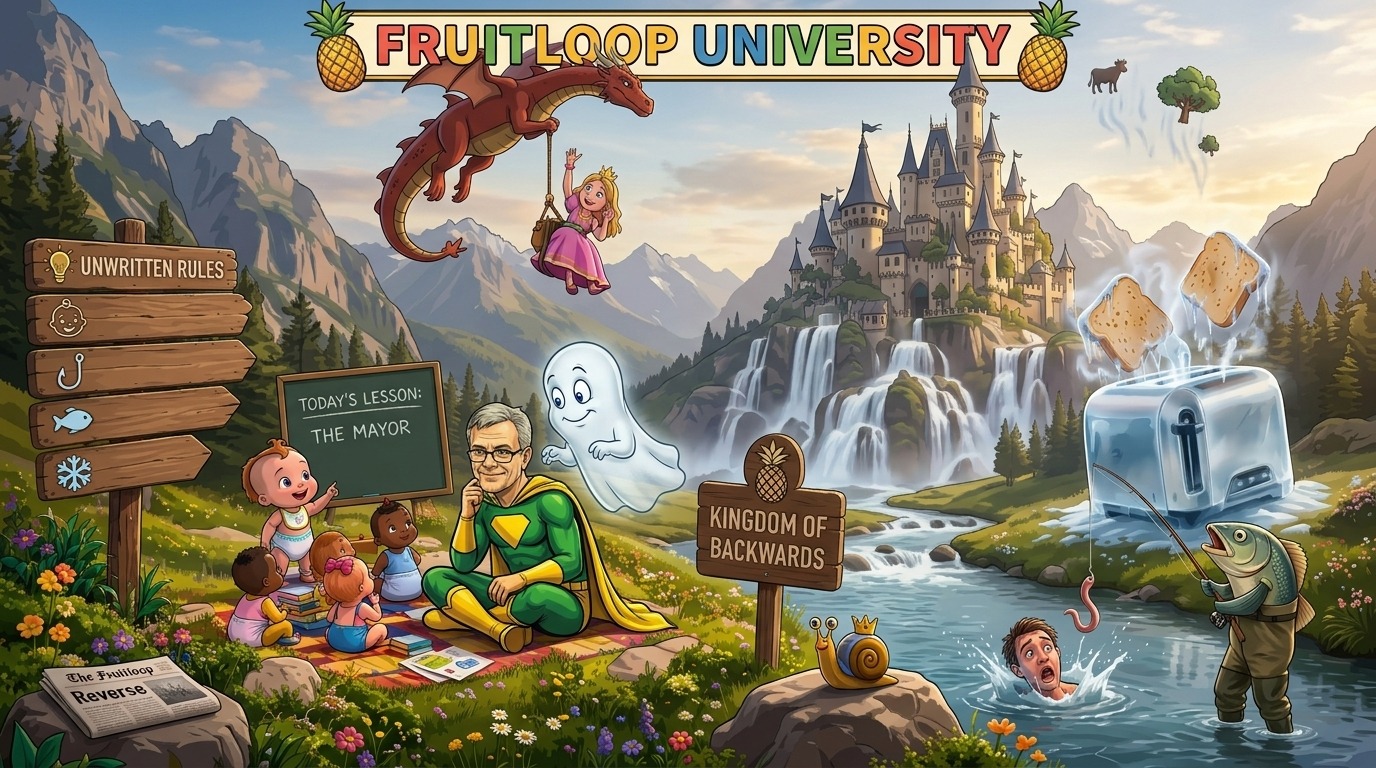
I sent Uncle Frank to the Kingdom of Backwards to test his manners. He responded by dismantling the kingdom, arguing with the toaster and threatening a fish. Somewhere in the wreckage, we accidentally discovered what politeness is for.
By The Mayor (Sorry, Uncle Frank) & Fruitloop (Sorry, Auntie Fruitloop).
At our Lunch meeting the previous day, we had been talking about something quite ordinary in South Africa. We often address older people as Auntie or Uncle, even when they aren’t family. It’s a familiar way of showing respect.
Uncle Frank, naturally, decided this required further consideration.
The following morning, he suggested we might retire the Mayor altogether and adopt the South African convention.
“Uncle Mayor doesn’t sound so spectacular,” I told him, “but Uncle Frank is good.”
As for me, I preferred Auntie Fruitloop. It sounded like an old lady who baked biscuits and fudge.
So far, so good.
Then Uncle Frank proposed entering the decision into the official minutes of the meeting, declaring that henceforth I would be Auntie Fruitloop and he would be Auntie Frank.
“Auntie Frank, is there something you need to tell us?”
Apparently not.
And there it was. A perfectly respectable South African custom had crossed continents, entered Fruitloop University and undergone a minor constitutional amendment.
Nobody had written down the rules. We had simply borrowed a tradition, made it our own and agreed to follow it.
Which was rather convenient, considering I was about to send Uncle Frank somewhere that had an entirely different set of rules.
The Kingdom of Backwards.
And he was about to object to practically every one of them.
Uncle Frank was tired. Very tired.
“Sleep has been something of a luxury,” he told me, before adding the instruction every university president hopes to hear from her vice president before an important academic exercise: “Be kind.”
Naturally, I sent him through a broom cupboard.
He had been looking for a broom when a giant vacuum cleaner sucked him through the door and deposited him in the Kingdom of Backwards, a place where babies are bosses, dragons rescue princesses, toasters freeze bread and fish go fishing for humans.
His task was simple. He had to understand the strange customs of this new country and survive without offending everybody.
“Hang on,” he said almost immediately. “If I offend them, then I’m actually making them my friend, aren’t I?”
And that was the moment I realised I had a problem.
Instead of visiting my carefully constructed Kingdom of Backwards, Uncle Frank had decided to reverse-engineer it.
If everything was backwards, he argued, then arriving at work meant leaving work. A clever baby boss must therefore be stupid. An impossible task must be possible. If he wanted to escape, perhaps he should stop looking for the exit.
Within minutes, he had created a philosophical loop from which neither of us was entirely sure he would return.
“I’m stuck again,” he announced.
I suggested he find the broom cupboard.
That only made things worse.
By the time I asked what he would do if his baby boss ordered him to teach a goldfish to bark, the goldfish had become a silverfish and was meowing.
Perfectly logical.
Apparently.
The dragon problem.
My next attempt involved a princess.
A dragon from the Dragon Rescue Centre swoops down and rescues her from her castle. Unfortunately, the princess had not required rescuing. She was hiding from her mother because she had not cleaned her room, and now the dragon had revealed her hiding place.
Was the dragon helpful, I asked, or was he interfering?
That finally slowed Uncle Frank down.
“You try to be helpful and you get it wrong, and if you’re not helpful, you get it wrong.”
For once, the Kingdom of Backwards had produced something that sounded suspiciously like ordinary life.
Perhaps, he decided, the dragon should simply have asked.
Would you like me to rescue you?
The princess could then say yes, please, or no, thank you, I can manage this particular maternal crisis myself.
It was a small crack in the nonsense, but something interesting had appeared.
Good intentions did not automatically make an action helpful.
Sometimes politeness meant asking before charging in on wings.
Then I asked the obvious follow-up.
How does the princess politely tell the dragon that she does not need his help?
“Why would she have to do it politely?”
There went my lesson plan.
“Go away, you horrible thing!”
I reminded him of a question we had already been circling around: who actually decides what is polite?
That stopped us both.
“Who made the rules anyway?” I said.
“Who made the rules anyway?” he repeated.
And suddenly the Kingdom of Backwards was doing its job.
Frozen toast.
The next morning, at least in my imaginary kingdom, Uncle Frank went to a café and ordered toast.
The waiter brought him two frozen slices of bread.
The toaster explained that freezing bread was a cultural tradition and that objecting to it would be disrespectful.
Uncle Frank’s first response was not particularly diplomatic.
In his world, he explained, proper toasters made proper toast, and he was the customer.
Then he caught himself.
“The expectations, I suppose this is the problem. You go in with certain expectations.”
He had walked into the café assuming his definition of toast was the definition of toast. He was judging the frozen toaster from the point of view of a hot toaster.
“When in Rome, do as the Romans do,” he said.
So perhaps he would have to eat the frozen bread.
After all, it would thaw eventually.
Perhaps he needed a little patience. Perhaps he needed to listen before deciding that everybody else was doing breakfast incorrectly. Perhaps frozen toast might even open an entirely new culinary world.
This was not quite the answer I had expected from the man who, moments earlier, had effectively told the toaster where it could put its cultural tradition.
But that was the interesting part.
Nothing had changed except the side of the table from which he was looking.
Try it before you judge it.
Later, I gave him a fish wearing a fishing hat.
The fish threw a worm at him and demanded that he bite it. Refusing the bait, according to the fish, was extremely rude in fish culture.
Uncle Frank was not enthusiastic about becoming lunch.
Suddenly cultural sensitivity had limits.
“If it’s a question of life and death, I’m sorry, but life wins.”
Which seemed fair.
So I asked the question underneath the fish, the toast and the dragon.
Should you follow a tradition if it makes you uncomfortable?
“You should try it,” he said. “You can only judge something if you have tried it.”
A few weeks earlier, he told me, he had taken part in a grape harvest parade. He had gone into it rather sceptical about traditional festivals and ended up walking through the main street in old-fashioned clothes, carrying a heavy pole while people along the route applauded.
From outside, he had seen costumes and an old tradition being reenacted.
From inside, he saw something else.
People enjoying being part of something together.
He noticed the work behind it. The organisation. The strange feeling of walking through a crowd while strangers applauded simply because you were part of the procession.
It did not turn him into a man desperate to attend every folk festival within driving distance.
But it changed the view.
“You can appreciate a tradition if you know what it’s about,” he said.
The same thing had happened while he watched a supermarket manager train a new cashier. From the other side of the checkout, the job had always looked straightforward: scan the products, take the money, give the change.
Then he listened to the training.
If this happens, do that. If that happens, do this.
Suddenly the supposedly simple job was not simple at all.
“I completely underestimated what you people do,” he told them.
There it was again.
Step inside somebody else’s position and the rules begin to look different.
Politeness is not surrender.
The fish returned.
Unfortunately, by now Uncle Frank and the fish had become friends, and the fish invited him to dinner.
The menu was human fingers and grilled human steak.
How, I asked, could he refuse without ruining the friendship?
His answer was immediate.
What sort of friendship was it if the fish had made no effort to understand its guest?
If you invite somebody into your home, you normally try to know what they can eat. In the same way, he said, it would be equally insensitive for him to invite the fish home and proudly serve fish for dinner.
There had to be give and take.
That was perhaps the most sensible rule we discovered in the Kingdom of Backwards.
Understanding another person does not require disappearing yourself.
Trying somebody else’s tradition does not mean accepting everything.
Being polite does not mean eating the worm.
And friendship certainly does not require eating your relatives.
Somewhere between cultural curiosity and personal boundaries, there has to be enough room for two people to remain themselves.
The real Kingdom of Backwards.
By now, even I was beginning to wonder whether the Kingdom of Backwards was quite as imaginary as I had intended.
Maybe, I suggested, we already live there.
After all, we do not see dragons, unicorns, zombies or vampires. Perhaps that is precisely because everything is backwards and the creatures that supposedly do not exist are simply obeying the rules.
Uncle Frank considered this.
Then we began paging the missing residents.
“Unicorn, please make your way to the reception desk.”
“The dragons, would you please fall in line behind the unicorns?”
“Mermaids, would you like to come up for air, please?”
Fruitloop University has standards.
They are simply not always recognisable ones.
But beneath the dragons and silverfish, something had shifted.
We had started with the question of what counts as polite in different places. By the end, “polite” had become far less tidy.
Sometimes politeness was trying the frozen toast before declaring it ridiculous.
Sometimes it was asking the princess before rescuing her.
Sometimes it was understanding that what looks easy from the outside may be complicated once you stand inside it.
Sometimes it was recognising that another person’s customs deserve curiosity.
And sometimes it was saying no.
Because the other side of good manners is consideration. If I expect you to respect my culture while refusing to notice your boundaries, that is not politeness. It is merely selfishness wearing a respectable hat.
Earlier, Uncle Frank had given me his definition of unnecessary rudeness: people who live inside their own bubble and expect everybody else to negotiate around it.
Perhaps that is where most of the trouble begins.
Not with knives and forks, greetings, punctuality, frozen toast or the correct way to address a dragon.
With the assumption that my normal must also be yours.
Back at the University.
Eventually I decided Uncle Frank had offended enough inhabitants of the Kingdom of Backwards and arranged his return.
The dragon and the ghost escorted him back to Fruitloop University.
He accused me of having him removed by security.
I denied everything.
“I didn’t send you there!” I reminded him. “You opened the broom closet and the vacuum swallowed you!”
He called this my disclaimer.
Quite correctly.
By the end of the adventure, the exhausted man who had entered the broom cupboard was awake again.
After we stopped recording, he admitted what he had been doing all along.
He had decided to reverse everything, undermine my questions and throw them back at me.
I knew.
“I could see that.”
But I also knew something else.
At the end of Episode 68, Uncle Frank looked at the whole ridiculous journey and said he had no idea how it could possibly become an article.
“It always works out in the end,” I told him.
He agreed.
Which is fortunate.
Because at Fruitloop University, that may be the only unwritten rule we have managed to obey.
And as for all those rules about manners, customs and being polite? Perhaps the important thing isn’t who made them, but whether we remember why they exist.
Uncle Frank, of course, would probably disagree.
Although he seems perfectly happy with the new name.
After all, he helped make that rule himself.