
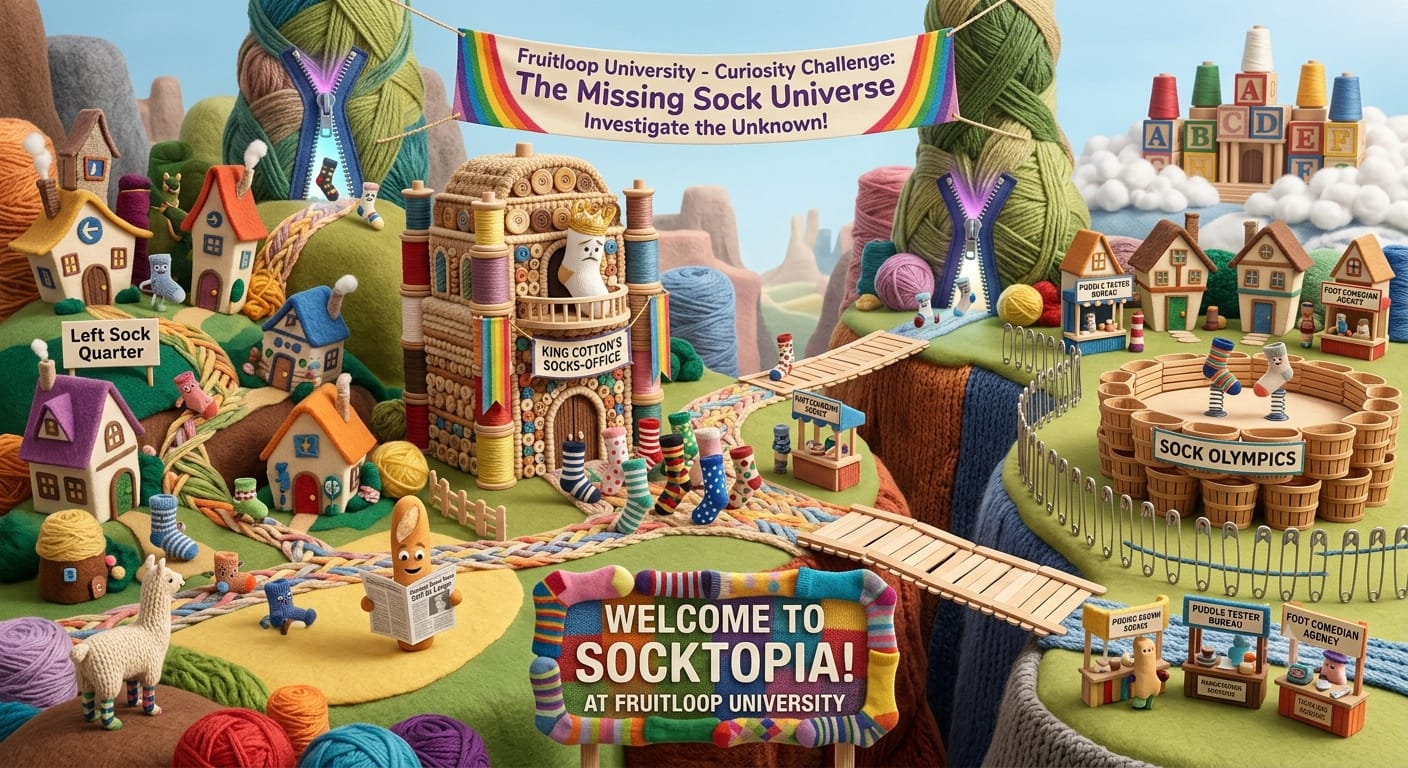
Peeling Potatoes Episode 58: I Took the Mayor to Socktopia
I opened a glowing portal behind the washing machine and took the Mayor into a world of revolutions, holy socks, suspicious ducks and laundry-basket racing. Somewhere along the way, I remembered how good it feels to simply have fun.
“I thought about the theme of the month,” I announced. “Curiosity.”
The Mayor immediately prepared himself for another investigation into his life.
“You know pretty much everything there is to know about me,” he said. “I don’t think there’s much more I can tell you.”
“No, no, no, no,” I told him. “It’s not about you. We are going on a completely different trip today.”
“Oh. Where are you taking me?”
For once, I was taking Peeling Potatoes away from the familiar safety of the kitchen.
I asked the Mayor to imagine waking up one morning, opening his sock drawer and discovering that half his socks were missing.
Again.
This time, he would not simply buy replacements. He would investigate.
Behind the washing machine, he would discover a tiny, glowing portal leading directly into the missing-sock universe.
I had developed a theory.
“We always think socks disappear in the washing machine,” I told him. “But I think that’s wrong. I think the socks leave on purpose.”
That was how I took the Mayor to Socktopia.
The Portal Behind the Washing Machine
The Mayor immediately understood why the socks had gone.
His washing machine lives upstairs, next to the bathroom, in a house built in 1904. The people who designed the house had not anticipated internet connections, modern window arrangements or the difficulty of keeping a room cool on a sunny day. They had, however, found a very sensible place for a washing machine.
The newly discovered portal behind it led outside, towards the hill and the vineyards near his house.
“The socks just want to leave the dark confines of the sock drawer,” the Mayor explained.
According to him, the life of a sock is a sequence of indignities.
First, it is trapped in a drawer. Then it is pulled onto a human foot. Finally, a shoe is placed over it.
The shoe gets to see the world.
The poor sock sees nothing.
Washing day is not much better. Socks are thrown into a machine and subjected to a violent and unpleasant experience. They might not smell particularly delightful when they go in, but the spinning gives them the perfect opportunity to escape.
The Mayor decided that the socks had fled into the vineyards in search of nature, fresh air and freedom.
“Socks are actually incredibly curious creatures,” he said.
Having learned the movement of walking while attached to human feet, they were perfectly capable of making a dash for it. Living in France may also have encouraged their revolutionary tendencies.
His socks had staged an uprising.
They were not leaving the rat race.
They were leaving the sock race.
I wanted to know whether the Mayor’s socks would describe him as a good owner.
“At the moment, yes,” he replied. “Because I leave them alone.”
It was summer, and he had barely worn socks for two months. He preferred sliders or bare feet and wished to make one principle absolutely clear: he would never wear sandals with pulled-up socks.
“That’s how South Africans spot Europeans,” I told him.
A European in the Kruger Park can often be identified by practical clothing, sandals and proudly elevated socks.
Somewhere in the Mayor’s drawer, meanwhile, lives a pair of socks with KISS ME written across them. They have the biggest personality in his collection, although he suspects they frighten people away rather than attracting them.
There are also several single socks drifting around the drawer.
The Mayor believes they are in trouble for failing to protect their partners.
“Socks come in pairs,” he said. “They do everything in pairs. If one gets away, the other one has let the team down.”
I had been waiting for this.
“That’s very interesting,” I told him, “because we are going to the Kingdom of Left Socks.”
Two Kingdoms, One Missing Royal Sock
Only left socks live in the Kingdom of Left Socks.
Nobody knows where the right socks are.
The Mayor decided that the left socks had survived by becoming unionised. They had formed the Brotherhood of Left-Behind Socks, paid their membership fees and created a strong community.
The right socks, he added, were actually the wrong socks because they had refused to move to Socktopia.
Unfortunately, there was also a Kingdom of Right Socks. The two kingdoms had not spoken for 500 years because somebody had lost the royal sock.
The political divide was severe.
The right socks remained loyal to their kingdom, convinced that they were right about everything. The left socks had developed left-wing tendencies, abolished their monarchy and formed a republic.
Both sides were thoroughly entrenched.
To solve the mystery of the missing royal sock, I appointed the Mayor as detective and presented him with six suspects:
A unicorn.
A dragon.
A ghost.
A llama.
A talking baguette.
And a suspicious duck.
The Mayor immediately declared the unicorn innocent because unicorns are above suspicion.
The ghost was unlikely to be responsible because a sock floating through the air by itself would attract too much attention.
The missing sock would avoid the dragon because it did not wish to be toasted. It would avoid the llama because it did not wish to be spat upon. The suspicious duck was far too busy being suspicious of everybody else.
That left the talking baguette.
The Mayor, however, did not believe the royal sock had been stolen at all.
Perhaps it had escaped.
The royal sock had lived a restricted palace life, unable to mix freely with ordinary socks. Secretly, it had developed revolutionary ideas. The talking baguette came from a country famous for revolutions, and its shape offered the perfect disguise.
The sock could simply slip over the baguette.
Together, the royal sock and the talking baguette escaped through the palace kitchen and ran into the sunset.
A beautiful romance had begun.
The detective, unfortunately, did not realise any of this.
Determined to earn his fee, he continued searching the palace, opening cupboards, investigating dark corners and discovering far too many royal secrets.
Eventually, he knew so much that the palace imprisoned him.
I was not impressed.
“I still need the detective.”
“I think I’ve cornered you,” the Mayor said.
“No, no, no,” I replied. “That’s where King Cotton comes into play.”
I had another stage ready for him.
The Revolution of Great Embarrassment
King Cotton ruled all of Socktopia, including both the left and right kingdoms.
Then he lost his favourite sock.
Without it, nobody knew which day it was.
The Mayor, now playing King Cotton, refused to reveal when the sock had disappeared.
The truth was that not even the king knew.
He had become the sock version of the emperor with no clothes. Once his final sock fled, the citizens were left with a naked and not particularly popular monarch.
Executing him seemed unnecessarily harsh, so they placed him under comfortable house arrest instead.
He received a house, a garden, high walls and very little public attention.
The monarchy became a republic.
I pointed out that the people still did not know whether it was Monday, Tuesday, the first or the tenth.
“They don’t need to know,” the Mayor replied.
Friday, after all, does not know that it is Friday.
Time had been one of the monarchy’s inventions: calendars, schedules, responsibilities, urgency and stress.
Socktopia decided it could live without all of them.
The sun almost always shone. At night, it merely dipped towards the horizon before rising again. The socks no longer needed to hurry anywhere.
The disappearance of King Cotton’s sock had accidentally liberated an entire civilisation.
In the history books, the peaceful uprising became known as the Revolution of Great Embarrassment.
King Cotton had not inspired hatred.
His real problem was worse: nobody cared about him.
“If somebody likes you or dislikes you, at least you know where you stand,” the Mayor said. “But if nobody cares, that’s a dangerous place to be.”
Perhaps the king had removed his clothes to attract attention.
Unfortunately, his plan transformed public indifference into public disgust.
His sock, unable to tolerate one final view of the naked king, fled.
I began to feel sorry for it.
Careers for the Unemployed Sock
Not every sock in Socktopia protected feet.
Some became professional puddle testers, foot comedians, cloud warmers or monster moustaches.
I asked the Mayor to invent three more sock careers.
He began with a profession close to my heart: Tupperware manufacturing.
His second career was more spiritual.
“A sock without a hole is a secular sock,” he explained. “When it gets a hole, it becomes a holy sock.”
The holy socks required somebody to recognise, certify and canonise them.
Socktopia therefore needed professional saint-makers.
I admitted that I owned several holy socks, although my dog was responsible for their conversion.
“You will never look at those socks in the same way again,” the Mayor told me.
He was right.
His third career was executioner.
Socktopia’s justice system did not believe in expensive prisons. A convicted criminal was given a sock and sent sliding across a dangerously slippery surface.
Anyone who reached the other side was forgiven.
Anyone who did not had reached the end of the matter.
It was efficient, dramatic and, as the Mayor pointed out, did not create too much mess.
Away from its unusual professions, Socktopia had surprisingly few landmarks, restaurants or public transport systems.
The socks had already spent their previous lives working on smelly feet, trapped inside shoes and obeying human schedules.
Freedom, to them, meant having nothing to do.
They hung around.
They lay around.
Occasionally, a single sock went looking for a mate.
It was the perfect expression of rest: a country where nobody wore a watch, nobody knew the date and nobody expected a sock to be productive.
There was, however, one major national celebration.
The Sock Olympics.
The Sock Olympics
The Mayor designed the games as a mixture of sporting competition and ancient Roman circus.
There would be a few executions to open proceedings.
The survivors received gold medals.
Next came the ceremonial canonisation of the holy socks.
The Tupperware manufacturers competed in discus throwing using Tupperware lids. This explained why nobody in the human world could ever find the correct lid for a container.
The missing lids had gone to the Olympics.
The professional puddle testers competed to make the largest possible splash without getting wet.
Monster moustaches appeared in a grand parade, presenting themselves in their full glory. The most magnificent monster moustache won the right to marry a cloud warmer.
Cloud warmers were warm, cosy and affectionate.
They found monster moustaches irresistible.
Once the parade was over, the moustaches lined up and the cloud warmers chose their partners.
The final event was a laundry-basket driving race.
I wanted to know which sock would win and what sort of personality a champion laundry-basket driver required.
The Mayor believed the answer was obvious: the foot comedian.
A laundry basket had very little to hold on to and was almost impossible to steer. The foot comedian would not approach the race as a serious athlete. He would behave like a clown, driving wildly around the arena and making a complete spectacle of himself.
He might not cross the finish line first, but he would become the most popular competitor at the games.
I decided that he had once been King Cotton’s court jester.
After the king was locked away, the jester needed a safer occupation and a larger audience.
Court entertainment had been dangerous. When a king did not laugh, the jester could lose his head.
Laundry-basket racing offered better career security.
A Tuesday in the Museum
Every week, strange objects arrived in Socktopia.
On this particular day, the citizens discovered:
A Tuesday.
Half a rainbow.
A dinosaur slipper.
A confused penguin.
And a tiny Viking helmet.
The Mayor sent the dinosaur slipper and Viking helmet to King Cotton.
Life under house arrest was dull, particularly when the king had no clothes, and the objects might keep him occupied.
The half-rainbow was placed in a rainbow-friendly environment until its missing half arrived, hopefully bringing the pot of gold with it.
Tuesday went into a museum.
It would remind future generations of the era before the Revolution of Great Embarrassment, when socks had still been forced to recognise weekdays.
The confused penguin joined the half-rainbow in something resembling a lost-and-found department.
Perhaps the penguin would eventually become less confused.
Perhaps the rainbow would find its other half.
“Hope rests eternal,” the Mayor said.
Finally, it was time for the Great Sock Election.
Four candidates wanted to become the next leader:
Captain Stripe.
Professor Polkadot.
Lady Fluffy.
And Sir Smelly.
The Mayor voted for Lady Fluffy.
Captain Stripe probably had too much power stuck in his head. Professor Polkadot might be a brilliant academic but a terrible leader. Sir Smelly required no further discussion.
Lady Fluffy seemed warm, sensible and down-to-earth.
Socktopia, the Mayor decided, would benefit from a female leader after the failures of King Cotton.
I wanted to know whether Lady Fluffy had a weakness.
“She likes chocolate.”
I immediately imagined a fluffy sock covered in melted chocolate, standing beside the holy sock while the holy sock prayed for the stains to come out.
Lady Fluffy won the election.
Hands down.
Or socks up.
Why I Took Him There
At the end of the expedition, I asked the Mayor whether he had enjoyed Socktopia.
“I did,” he said. “But I think I enjoyed seeing you laughing much more.”
That was the quieter truth waiting beneath the suspicious ducks, revolutionary baguettes and naked monarchs.
July had been difficult.
There had been misunderstandings, mistakes and moments that deserved to be placed firmly inside a bag marked Lessons Learned: Do Not Repeat.
Socktopia arrived on the final day of that month.
For one conversation, I took the Mayor away from the kitchen, away from ordinary logic and through a glowing portal behind the washing machine.
I gave him kingdoms, detectives, elections, strange professions and one impossible challenge after another.
Whenever he thought he had cornered my story by imprisoning a detective or removing a king, I invented the next step.
He threw the absurdity back at me.
I caught it and continued.
“The more ridiculous, the better,” I told him. “That’s part of Fruitloop University.”
It was ridiculous.
It was also affectionate, inventive and unexpectedly restorative.
The Mayor had entered Socktopia convinced that his creative brain had gone on holiday.
He emerged having built an entire civilisation—its politics, legal system, religion, sporting traditions, romantic customs and national museum—out of missing laundry.
I had created the world.
The Mayor had tried to derail it.
Somewhere between the two, I laughed.
That mattered.
Curiosity does not always need to answer a serious question or uncover a hidden truth. It does not always need to lead to a revelation about business, identity, community or life.
Sometimes curiosity simply opens a tiny portal in an ordinary room and asks:
Where might this lead?
On the final day of a difficult month, I followed that question into Socktopia and took the Mayor with me.
For a little while, I gave him a world in which there were no calendars, no pressure and no need to be sensible.
In return, he made me laugh.
That was more than enough.