In This Issue.
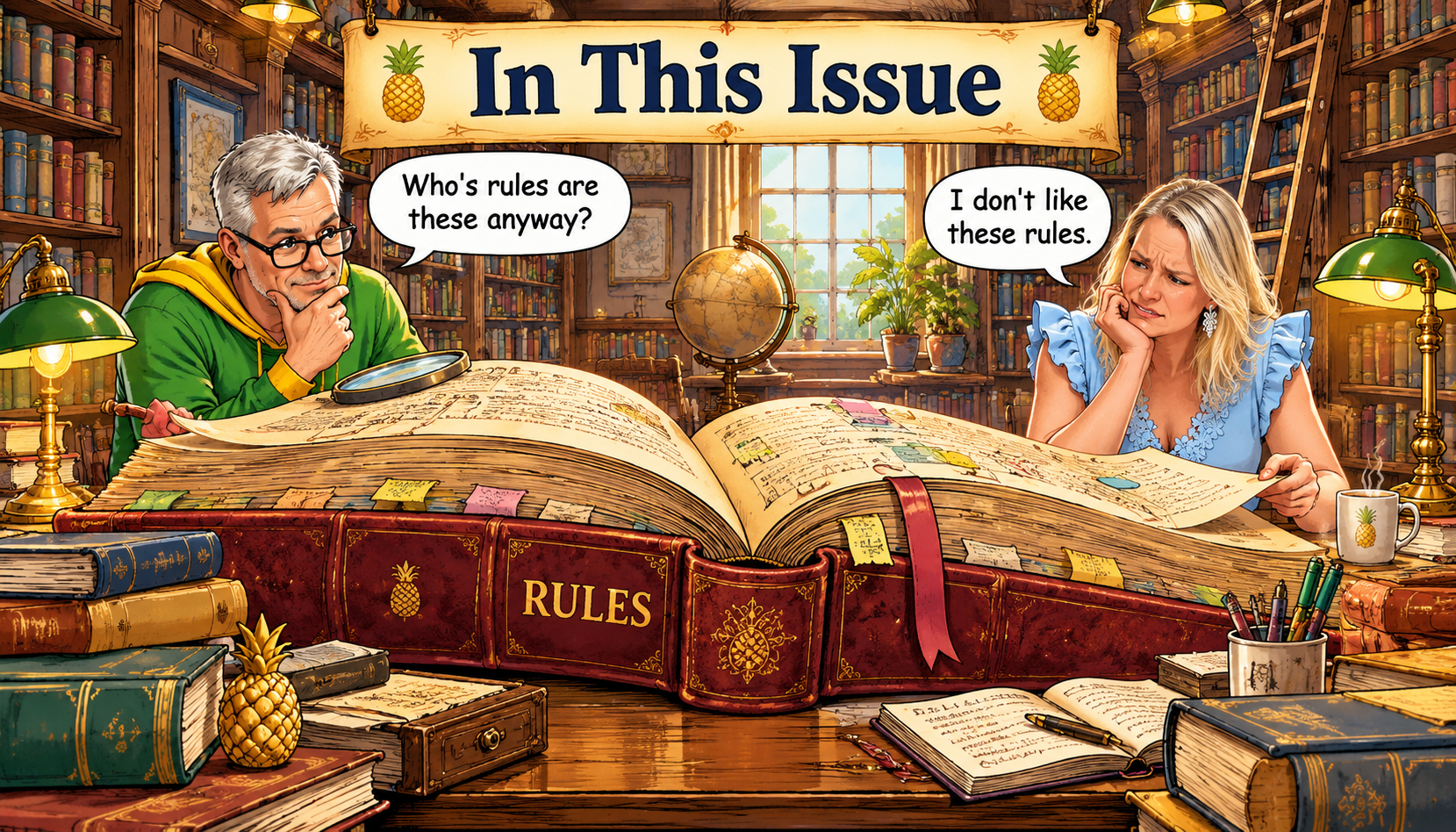
Who makes the rules we follow every day, and why do we follow them? Coming to the end of this month’s topic, I have come to realize just how fascinating—and sometimes completely baffling—our relationship with rules really is.
Sometimes, we are the architects of our own guidelines. We make unwritten rules for ourselves and others around us to keep the chaos at bay, and then we spend half our time trying our best to follow them, or secretly looking for the loopholes to break them.
Other times, the rules are handed down to us by someone else. They are printed in official rulebooks, posted on school gates, or stuck to the back of cleaning product bottles, and we follow them simply because someone in authority said so—even if we sometimes scratch our heads and wonder who on earth had to make the mistake that required a warning label in the first place.
As we wrap up this month’s journey into the boundaries, expectations, and quirks of daily life, we invite you to explore where these lines are drawn, who crosses them, and why we care so much in the first place.
In this issue, we explore:
Driving Dilemmas, Red Cards, and Punctuality Rules.
In my lead editorial, Whose Rules Are These Anyway?, I take a look at who makes the rules we follow every day, and what happens when somebody decides to challenge them or question the expectations and unwritten rules that shape ordinary life.
Over in When the Headlights Disappear, Manfred and Martin of the Swimming Club take us through driving experiences in Germany, Italy, and beyond—where a car following too closely, a horn that could mean several things, and two people seeing the same road very differently show that knowing the traffic rules is only part of the challenge.
In You Need a Clear Red Line, Alexander takes us inside regional football in Germany, where referees must make decisions and players have to live with them—reflecting on a difficult back-pass on a wet football pitch, an opponent who apologizes before fouling again, and a red card he still believes was wrong.
Next, Sarah takes us into the world of school rules, teachers, and expectations in The Penguin Who Would Change the Rules. She asks what happens when the people enforcing the rules don’t always follow the same standards themselves, and how much room there should be for questioning authority.
Closing this section in I Hate Just in Time, Ralf explores why being on time matters to him and how he deals with people who see things differently. While he likes being punctual, not everybody shares his relationship with the clock through everyday arrangements and the frustrations of waiting.
Personal Distance, Local Guides, and Cheese Controversies.
In The Correct Distance Between Us, Atlantic Corridor’s Ismar and Ritesh compare personal space, physical distance, and the different expectations people bring to everyday encounters—asking how close is too close, and showing that what feels perfectly normal to one person can be surprisingly uncomfortable for another.
Over in A Map Is Not the Same as Knowing a Place, Fabrice and Janita discover that planning a holiday for somebody else is not quite as simple as knowing where everything is. Imagine arriving in Alsace with your family and discovering that Fabrice has volunteered to be your local guide—with castles, forests, restaurants, and neighboring countries to explore, but first, a tired seven-year-old needs breakfast!
Meanwhile, Babette keeps busy in A Little More Cheese, Please with a disappointing flea market, a knitting project that takes three attempts, and a growing list of handmade Christmas presents. Between family meals, a new pizza oven, and a lively disagreement about lasagne, she asks: can there really be such a thing as too much cheese?
Dinners on Mars, Deep Secrets, and Culinary Specials.
In Who Pays? Apparently, the Mayor!, Fruitloop invites the Mayor to an imaginary dinner on Mars where the price is three embarrassing memories. Before long, they are remembering torn trousers, childhood mishaps, a spectacular bicycle crash, an unexpected conversation about writing fiction, a chocolate-covered pretzel scandal, and eventually, the question of who is paying.
In our Fictional Story of the Month, Hidden Bloodlines, Rowan Moore receives a call announcing the death of a father he never knew he had, dramatically changing his life. An enormous inheritance leads him into a world of family secrets, romance, betrayal, and danger—though the greatest mystery may be what his father left behind.
In their essay How Can We Get AI to Keep Its New Year’s Resolutions?, Bruce Lloyd and Frank Peters explore the gap between knowing and doing. While AI can produce impressive answers, can it help us turn those answers into something that actually works, from organizational incentives and education to the unexpected complications of building a real booking system?
In Ralf’s Kitchen, Ralf returns with Schlotzig Eggs, bringing another German specialty to the table as a little culinary inspiration for anyone who enjoys discovering what other people cook and eat.
In Frank Peters’ column, The Human Bit, Frank offers a quieter moment, reflecting on the human side of ordinary life and the small things we sometimes overlook.
Finally, in Peeling Potatoes — Episode 70, we take another visit to the wonderfully unpredictable world of Fruitloop University, where rules, logic, and common sense are never entirely safe. Join Janita and the Mayor for their weekly dose of absurdity, unexpected questions, and Friday afternoon nonsense.
Welcome to Pineapple 35—sit back, relax, travel to France or Mars with us, and enjoy the stories!