
How Brida Tables Came Into Being
A short story about pressure, quiet fear, and choosing the long way around
Brida Tables didn’t arrive as an idea.
They arrived as a settling.
Just before Christmas 2025 — that strange, half-lit stretch of the year where nothing quite ends but nothing really begins — something inside Brida stopped trying to be held together by goodwill alone.
There was no announcement.
No dramatic pivot.
Just the growing sense that what had once felt light was now asking for more energy than it could return.
Brida had never been a business idea. It was a correction — a response to a very specific failure in the world: adults who technically know English, but avoid using it because every available space makes them smaller.
Too many rooms demanded performance.
Too many “safe” environments still carried evaluation in their bones.
Too many systems mistook instruction for permission.
So Brida formed around a different centre of gravity. Conversation mattered more than competence. Presence came before outcomes. Adults were not positioned as learners, but as people with lives, histories, and voices that didn’t need improving before being heard.
For a while, that instinct lived comfortably inside something called community. There was warmth, openness, ambiguity, belonging. Meaning moved freely because no one was asking it to justify itself. There was surplus — of time, patience, emotional energy — and surplus hides its own importance.
You only notice it once it’s gone.
The shift didn’t come because something failed conceptually. It came when Brida had to begin carrying its own weight. When money entered the room, the old logic quietly stopped working.
Community does not like being priced.
Meaning collapses when it has to explain itself.
Ambiguity, so generous socially, creates hesitation when a card machine appears.
Suddenly the room wanted reassurance. Explanations. Definitions. Promises. Each question was reasonable. Each answer made the space a little smaller.
And then a harder question arrived — not as a strategy exercise, but as a moment of honesty:
What still works when nothing extra is available?
When novelty has worn off.
When goodwill is thin.
When surplus is gone.
That question doesn’t negotiate. It clears.
Once it was taken seriously, whole layers of Brida fell away — not because they were wrong, but because they could not survive pressure. Community as a product. Belonging as an offer. Persuasion as a tool. Explanation as comfort. Identity as a sales argument.
What remained was unexpectedly simple, and stubbornly solid:
People need a legitimate, time-bound place to speak English without being evaluated.
No improvement language.
No promised outcomes.
No narrative arc.
Just a room, a table, a beginning, and an end.
Everything else was optional. And optional things become dangerous when you’re tired.
Brida Tables didn’t evolve from the old model. They replaced it. The logic inverted almost overnight — not out of boldness, but out of necessity.
One table.
Sixty minutes.
Fixed time.
Fixed price.
Limited seats.
Paid entry.
No outcomes promised.
No explanations once you’re inside.
It wasn’t elegant. It was survivable.
Somewhere in that shift, Brida stopped behaving like a movement and began behaving like a restaurant. Not metaphorically — structurally. Seats instead of souls. Availability instead of persuasion. Regulars instead of reach. Empty seats understood not as failure, but as loss.
And oddly enough, everything became calmer after that.
This calm, however, demanded another letting go — one that felt far more counter-intuitive.
The obvious next step would have been noise.
More posts.
More funnels.
More emails.
More optimisation.
Social media marketing. Email marketing. Visibility systems designed to shout louder in a room that was already deafening.
But the more those options were considered, the more they felt like the wrong kind of pressure — fast, hungry, impatient. Ads that die a second after they appear. Emails skimmed, archived, forgotten. Flyers that go straight from hand to bin.
Brida had never worked on urgency. It worked on legitimacy and readiness.
And that was uncomfortable to admit, because walking away from noise feels like walking away from safety. There is real fear in choosing quieter paths — fear of being invisible, fear of being slow, fear of missing out while everyone else is shouting.
It felt counter-intuitive to step away from scale when pressure was already present. Counter-intuitive to trust conversation over campaigns. Counter-intuitive to believe that fewer, slower, human interactions could carry more weight than perfectly timed posts.
And yet, the more the system settled, the clearer it became: conversations stick. Ads evaporate. A human moment lingers long after a scroll has moved on.
That’s where the invitation card was born.
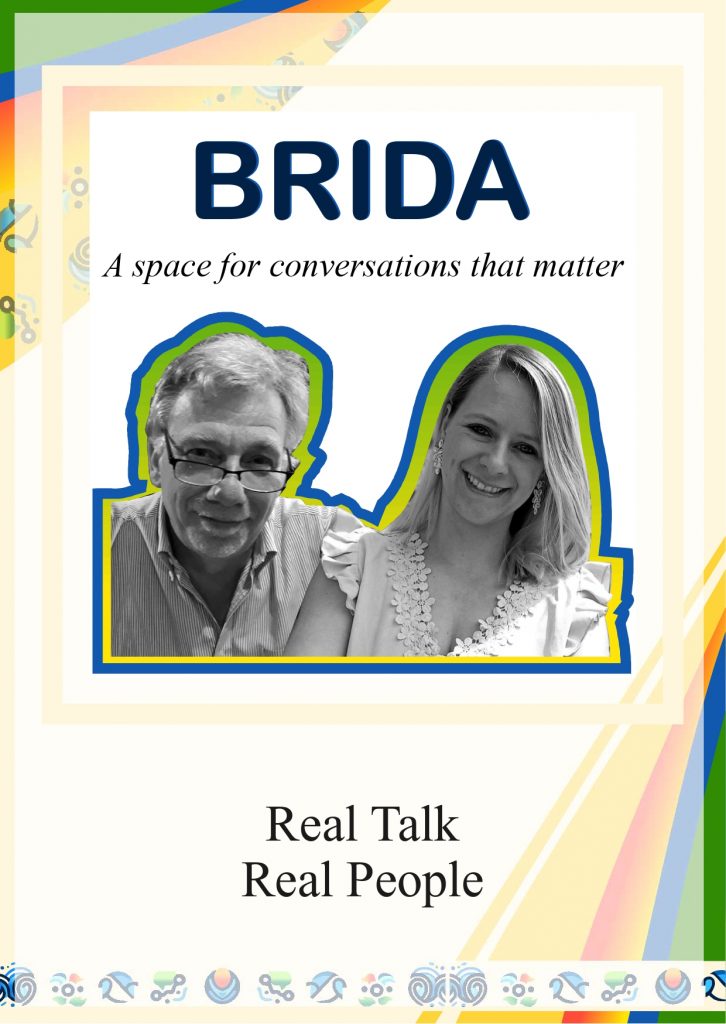
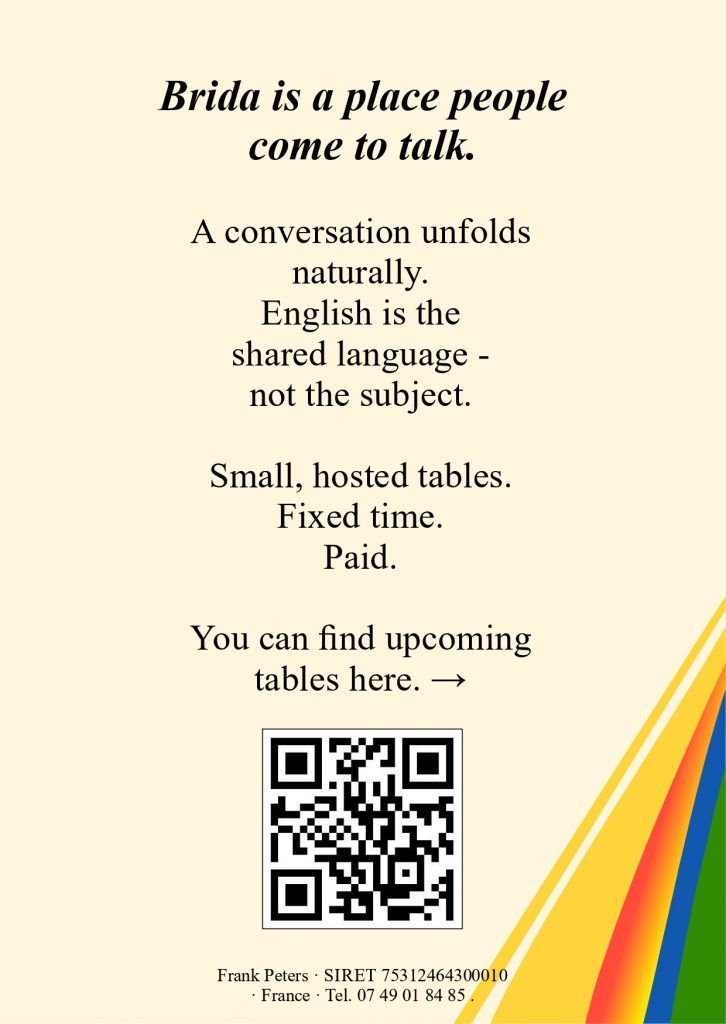
Not as a marketing asset, but as a permission object.
Something that could be handed over without urgency.
Something that didn’t demand action.
Something that could be kept, ignored, scanned later.
Manual distribution wasn’t a nostalgic choice. It was structural. The card behaved like the tables themselves — quiet, pressure-free, legitimate. It waited until readiness appeared.
Legitimacy first.
Action later.
Exactly like a table.
The weeks between Christmas and January weren’t a sprint. They were a steady subtraction. Each decision asked the same quiet question: does this remove pressure, or add it?
If it added pressure, it went.
That’s why the rules became narrow. Why the SOPs multiplied. Why so many things are now simply not part of the system. No discounts. No bundles. No testimonials. No learning language. No emotional bargaining.
Not because they’re bad. Because they drift. And drift is expensive.
The rules aren’t there to inspire. They’re there to hold the line on a tired Tuesday, when it would be easier to explain, soften, or shout.
By the time January settled in, Brida Tables were simply there — running, repeatable, unexcited, calm. The warmth hadn’t disappeared; it had moved inside the room. Meaning hadn’t been lost; it had been removed from the invoice.
What was traded was openness.
What was gained was continuity.
And that is the quiet truth of Brida Tables: they exist not because they are beautiful, scalable, or loud — but because they survive.
And survival, in this case, turned out to be the most faithful way of keeping the original Brida impulse alive.