
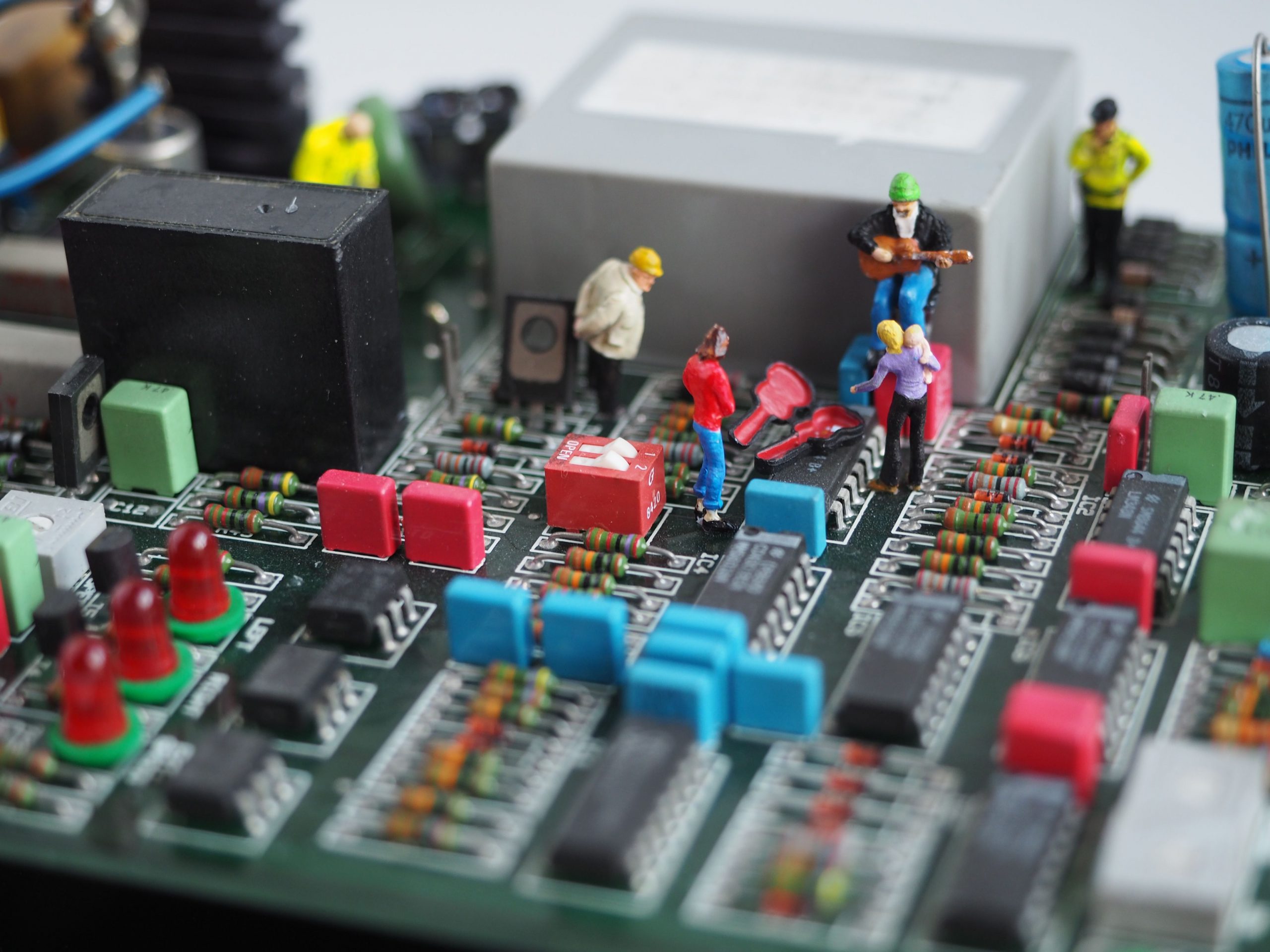
Hello, World
There are worlds I know reasonably well, and there are worlds where I am completely lost. Technology belongs firmly in the second category.
Put a microcontroller in front of me and I see a small piece of plastic with some metal sticking out of it. An engineer sees processors, interfaces, protocols, functional safety and possibilities. That difference fascinates me.
Recently, one of my regular conversations took me into this world from an unexpected direction. It began not with sophisticated technology, but with something almost absurdly small: a tiny plastic component costing around thirty cents. Without it, production was apparently going to stop.
That immediately caught my attention. We weren’t talking about some rare mineral, an exotic semiconductor or a component caught in an international trade dispute. We were talking about a little piece of plastic that could probably disappear underneath a sheet of paper.
Yet an entire production process depended on it.
Welcome to another world.
The thirty-cent problem.
At first, the story sounded simple. A supplier had reported that the component wasn’t available. Stocks would run out, the next delivery would not arrive for another couple of months, and therefore production would have to stop.
That was presented, more or less, as a fact.
Except somebody became curious.
Instead of accepting the information, they started looking for alternatives: other products, other sources, different ways of solving the problem. Eventually, they did something remarkably sophisticated.
They picked up the telephone.
After navigating the usual obstacles, they reached an actual human being at the distributor and discovered that the supposedly unavailable component was sitting in stock.
The problem was something else entirely.
Three different items had been ordered together. Two were available, one wasn’t, and the distributor intended to send everything in one shipment when all three items were ready. Nobody had separated the order. Nobody had asked the obvious question.
One telephone conversation changed the picture. The available parts could be sent, production could continue, and the immediate problem disappeared.
Problem solved.
Except I wasn’t convinced that the problem had been solved at all.
The shortage had disappeared, but the more interesting problem remained: how had so many people managed to inhabit the same process while seeing completely different realities?
The worlds inside the system.
From one point of view, there was an order in a computer system. From another, there were three physical components. From another, there was a production deadline. Somewhere else, there was an employee dealing with too much work, and somewhere else again, somebody waiting for an answer.
Everyone was technically looking at the same situation, but they weren’t living in the same world.
Each person had a lens. Purchasing saw purchasing. The distributor saw an order. Production saw missing components. Engineering saw technical consequences. Management saw costs and deadlines.
And I, looking in from somewhere completely outside this world, kept asking rather irritating questions.
Why can’t they send the two things they have? Why hasn’t anybody telephoned anybody? Why can something costing thirty cents stop something worth considerably more?
Sometimes ignorance is useful.
When you know how a system normally works, you naturally begin thinking from inside it. You know the procedures, you know the language, and you know what normally happens next.
When you don’t know, you are allowed to ask why the system exists in that form at all.
That became even clearer when our conversation moved from supply chains into another world entirely.
A tiny piece of magic.
This time, I was shown a small electronic development board containing a microcontroller.
That explanation didn’t help me very much.
Apparently, software would be loaded onto this tiny object, it would communicate through an Ethernet connection, and eventually it could become part of a sophisticated safety-critical system.
I tried to understand what was actually happening. How does the software get inside it? What does it do when it gets there? How do we know it is working? What can I actually see?
Eventually, the complicated technical explanation reached something I could understand.
The first test might simply be a message.
Hello, World.
I loved that.
An enormously complicated technological journey begins with two words. The machine says hello, another machine answers, and somewhere a software developer smiles because the ones and zeros have successfully travelled through their invisible little universe and come back again.
Suddenly, the mysterious world became slightly less mysterious.
Not because I understood the technology. I didn’t.
But I had found a doorway into it.
Another world appears.
Then came another complication. The people accustomed to developing software in one environment would now have to work much closer to the hardware itself.
That sounds trivial until you realise that these are different mental worlds.
In one world, software can almost appear independent of the machine beneath it. It can run here, there, somewhere in the cloud, while the hardware disappears behind layers of abstraction.
In the other world, the hardware matters enormously. You have to understand the little object actually doing the work.
Neither view is necessarily wrong. They are simply different lenses.
And suddenly, I saw the same pattern again.
The purchasing person had been inside a purchasing world. The distributor had been inside a logistics world. The engineers were inside a hardware world. The software developers were inside a software world.
Everyone was looking through a perfectly reasonable window.
The trouble starts when we forget that it is a window and begin to believe that it is the whole landscape.
And then came AI.
Eventually, our conversation reached artificial intelligence.
Could AI help write the software? Possibly.
Could you simply give the system all the technical documentation and ask it to work everything out? Not necessarily.
Some information is confidential. Some belongs inside organisational boundaries. Some cannot simply be dropped into a public AI system because it would make life convenient.
And so another world appeared: the AI world.
With it came another lens.
AI can expand the world we are able to enter. I have personally used it to create software despite having no serious software-development expertise. I describe what I want, test what comes back, complain when it doesn’t work, try again, and eventually something useful appears.
That is extraordinary.
But there is another possibility.
AI can also make our existing world smaller.
If we ask it only questions based on our own assumptions, it may simply help us build an increasingly sophisticated version of the bubble we already inhabit.
The technology can open doors.
We still have to decide whether to walk through them.
Discovering other worlds.
That may be what stayed with me most from the conversation.
I had entered a world of components, processors, software protocols, supply chains and industrial systems that is normally completely invisible to me. Inside that world, I discovered more worlds: the world of the purchaser, the engineer, the software developer, the manager, the supplier, the machine and the AI.
Each has its own language, its own logic and its own priorities.
And somewhere between them sits the real challenge: getting one world to notice that the others exist.
Perhaps discovering other worlds doesn’t always require an aeroplane or a passport. Sometimes it means asking somebody to explain their work until you finally understand why a thirty-cent piece of plastic matters.
Sometimes it means asking what happens inside that mysterious black object on the table.
Sometimes it means admitting that the thing which seems completely obvious from your side of the window may look completely different from the other side.
And sometimes the journey begins with the simplest message imaginable.
Hello, World.