
Do You Have Difficulty Filling In Forms?
The Human Bit, by Frank Peters
It is a wonderful question.
Especially when it appears on page 19 of a 32-page form.
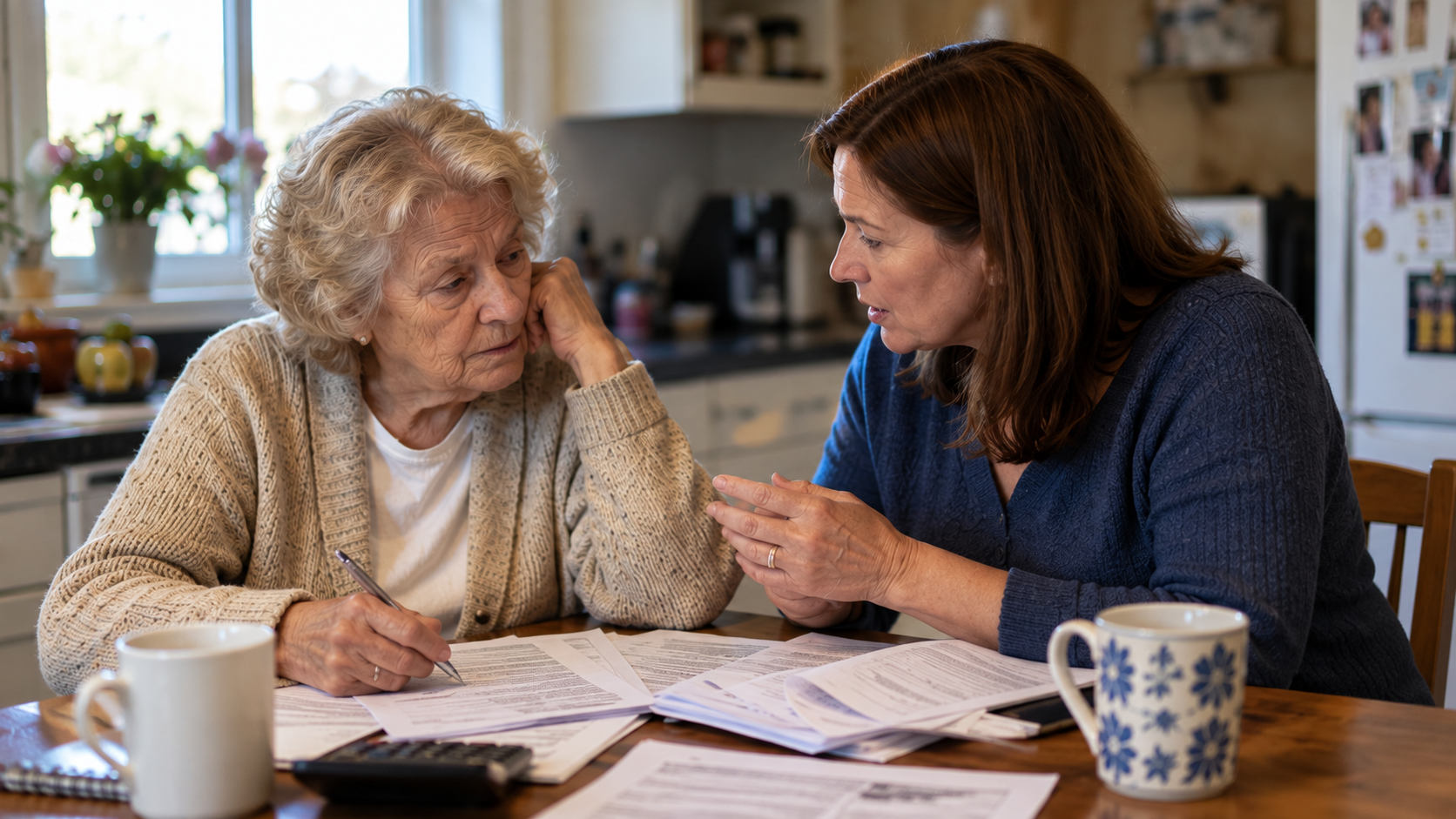
The form belongs to my mother-in-law. She is 85. It is the British government’s AA1 claim form for Attendance Allowance, intended for people of State Pension age or over. Question 37 asks whether the person needs help communicating with other people. Among the possible difficulties are using the telephone, remembering things and, rather wonderfully, “reading letters, filling in forms, replying to mail.”
Yes.
As it happens, she does.
My wife is trying to help her from France, about 700 kilometres away. They work through as much as they can on the telephone. My wife explains a question. Her mother tries to find the right place on the form. They establish what is actually being asked, discuss an answer and move on. Eventually it becomes frustrating and they stop. The rest will be finished this weekend, when they are physically together.
At her grandson’s birthday party.
Not because a birthday party is an obvious place to discuss falling, bathing, medication, toilet needs or how much assistance somebody requires during the night. It is simply the next time the family will all be in the same place.
That is how bureaucracy enters a life.
Every question makes sense.
When I first saw the form, I expected to find bureaucratic nonsense. Instead, I found something rather more awkward.
Most of the questions make sense.
If the Department for Work and Pensions is going to decide whether somebody qualifies for Attendance Allowance, it needs to understand how that person actually lives. The form asks about getting out of bed, washing, dressing, walking indoors, eating, medication, falls, communication and what happens during the night. It distinguishes between finding something difficult and needing another person to help.
Near the beginning it also explains special rules for people who are nearing the end of life and are not expected to live longer than another twelve months. That is quite something to encounter on page two when you are 85, but again, there is a reason for it: different rules apply in those circumstances.
There is no obvious fool behind the form.
A policy maker needs one piece of information. A lawyer needs a distinction. Somebody else needs evidence. A computer system requires another field. Each addition is defensible on its own.
Eventually you have 32 pages.
Perhaps that is how labyrinths are built. Nobody actually decides to build one.
My own small labyrinth.
Every year I complete my French income tax declaration. The French authorities have made considerable efforts to simplify it. Much of the information is already there. More happens automatically than it once did. There are explanations and online assistance.
And still there comes a moment when I stare at the screen and think:
Where does this go?
The problem is that my life does not happen in tax boxes. Something happened. Some money was earned. Some of it came from somewhere else. There was an expense or an allowance. Those are events in a life. The tax system then has to turn them into categories, and somewhere between the event and the category I am expected to understand how the French tax administration has decided to describe what happened to me.
Again, the mysterious box almost certainly has a reason for existing.
The difficulty comes when all the reasonable boxes arrive together.
Surely technology can do better.
The obvious answer is artificial intelligence.
Why give my mother-in-law 32 pages at once? Why not have a conversation?
Tell me what has become difficult for you.
She answers. If she mentions falling, the system asks when she last fell. If somebody helps her at night, it asks what that person does. If she does not understand why something matters, she can ask. At the end, the system shows her what it has understood and she, or somebody helping her, checks that it is correct.
The government still gets its structured information. The rules remain. The boxes remain somewhere in the background.
The person gets a conversation.
The same idea would work rather well with my French tax declaration. I could explain what actually happened during the year and let the system decide which administrative questions still need answering.
Except we already have chatbots.
Banks have them. Insurers have them. Governments have them. A friendly little bubble appears in the corner of the screen and asks how it can help. You explain what you want and, remarkably often, it gives you a link.
To the form.
That is not quite a revolution. It is a receptionist standing outside the labyrinth, pointing towards the entrance.
The more interesting possibility is not to use artificial intelligence to explain the form.
Let the conversation be the form.
But my mother-in-law probably does not want that either.
This is where the neat technological answer begins to fall apart.
My mother-in-law is not simply having difficulty understanding the AA1. Partly, she does not want to engage with it. The administrative and digital world has moved a long way during her lifetime and some of it has moved beyond somewhere she particularly wants to follow.
My wife can explain the questions. She can repeat them. She can translate bureaucratic language into something more ordinary. But there comes a point where the problem is no longer comprehension.
It is fatigue. Frustration. Reluctance. Perhaps a little fear. Perhaps simply the feeling that at 85 you really should not have to work this hard to tell somebody that you need some help.
A better chatbot does not automatically solve that.
Sometimes the answer is another human being.
At 89, my mother is rather different.
My own mother is 89 and uses online banking.
When something goes wrong, we travel about 50 kilometres to speak to somebody at the bank. The last time we did that, the woman helping her did something I rather liked. She did not treat my mother as an elderly person who had failed to understand technology. She was impressed.
What my mother was managing at 89, she said, was something plenty of considerably younger people struggled with.
So much for the elderly.
My mother-in-law is 85 and wants as little to do with this world as possible. My mother is 89 and does her banking online. When she reaches the point where she can go no further, I get in the car and we find a person.
One woman needs her daughter 700 kilometres away.
The other occasionally needs her son 50 kilometres away.
The technology is different. The invisible infrastructure is remarkably similar.
Family.
The people between the boxes.
Officially, my mother-in-law’s Attendance Allowance claim is a transaction between her and a government department.
In reality, the government sends a form to an 85-year-old woman. Her daughter in another country phones her. They work through some of it together. They become frustrated. They stop. A few days later the family gathers for a birthday and the paperwork comes along too.
Eventually the completed form goes back.
The administrative system records the claimant.
It does not really record all the human machinery that made the claim possible.
The same happens with my mother’s banking. The bank sees an online customer and, occasionally, the same customer appearing at a branch. It does not necessarily see the 50-kilometre journey that happened in between.
Much of modern life works because there is an enormous, largely invisible layer of daughters, sons, partners, neighbours, friends and carers helping people negotiate systems that were supposedly designed for individuals.
We talk a great deal about the interface between people and machines.
Quite often the interface is another person.
Several doors.
Perhaps some of the world’s most digital societies have already started to recognise this.
South Korea has pushed public services deeply into the digital world, but has also developed ways for people to receive human help with those systems rather than simply expecting everyone to master them alone. China, despite the extraordinary reach of digital services such as WeChat, has also recognised the need to retain offline and assisted routes for older people.
That seems more interesting to me than simply building a better app.
The clever system may be the one with several doors.
One person talks to an AI. Another fills out a conventional form. Someone telephones. Someone goes to an office. A daughter deals with part of the process for her mother. A human adviser steps in when necessary.
Behind those doors there can still be one system, one set of rules and one need for accurate information.
The route does not have to be the same.
That sounds obvious until you consider how much of the digital world has been built on precisely the opposite assumption.
Here is the process.
Please adapt yourself to it.
The human bit.
We often imagine humane technology as technology that becomes more like us. It learns to talk naturally. It recognises what we mean. Perhaps, eventually, it becomes better at noticing when we are confused.
But maybe that is only half the challenge.
The other half is accepting that we are not all the same.
My mother-in-law is 85. My mother is 89. One would happily leave much of the digital world behind. The other is still doing her online banking. I am entirely comfortable with technology and can still find myself defeated by a French tax declaration.
None of us needs quite the same thing.
Which takes me back to Question 37.
Do you have difficulty filling in forms?
Sometimes.
For entirely different reasons.
Perhaps the clever system of the future will not be the one that finally teaches everybody how to use it. Perhaps it will be the one that stops insisting that everybody arrives in the same way.
The form can be standard.
The human being does not have to be.