Issue 19 — 10 July 2026

The Pineapple

Rest From Performance

A collection shaped by the voices of the Brida Community

Created by Members of the Brida Community.
Compiled by Frank Peters, Founding Editor.
Shaped in Spirit by Janita Le Grange, Keeper of the Flame.

The Pineapple is published every Friday afternoon. If you would like the next issue to arrive in your inbox, you can subscribe free.

Subscribe

Contents

Partner Page
Advertisement
source
The Pineapple

Work Is Not Automatically the Enemy

Maybe we are not tired of effort. Maybe we are tired of the grind, performance, and pretending everything good should be fun.

We are talking about rest this month.

That sounds simple enough, until you ask the awkward question.

Rest from what?

The usual answer is work. We have made work so central, so demanding, so defining, that rest is now almost automatically understood as rest from work.

Close the laptop.
Leave the office.
Light the candle.
Book the retreat.
Buy the softer socks.

But I am not sure that is good enough.

Work is not automatically the enemy.

Effort is not automatically the enemy either.

And this is where I think the conversation becomes more interesting.

Because somewhere along the way, we have started confusing work, effort, grind, fun, enjoyment, and life itself.

They are not the same thing.

Work, Effort, and Grind

Work is structured effort.

That can be good or bad. It can build something, maintain something, repair something, feed someone, teach someone, hold something together, or slowly empty a person out.

Work is not one thing.

A garden is work.
Cooking is work.
Writing is work.
Friendship takes work.
Hosting a good conversation is work.
Building a community is definitely work.

But none of that automatically makes it bad.

Grind is different.

Grind is work stripped of dignity, rhythm, agency, craft, or meaning. It is effort that consumes more life than it returns.

Some people absolutely need rest from that kind of work.

Bad work. Pointless work. Humiliating work. Badly managed work. Work that turns people into tools. Work that eats the person doing it and still asks for a smile.

That is real.

But it does not mean effort itself is the enemy.

Most things worth having require effort.

The question is not whether something takes work.

The question is whether the work returns us to life, or slowly replaces it.

The Trouble with Fun

There is another confusion sitting underneath this.

We have started talking as if life should be fun.

Work should be fun.
Exercise should be fun.
Learning should be fun.
Rest should be fun.
Even personal growth, which sounds suspicious already, should somehow be fun.

But fun is a very small word.

Some good things are fun. Of course they are. A ridiculous conversation around a table can be fun. A strange Brida moment can be fun. Watching something go slightly wrong in exactly the right way can be fun.

Some good things are fun. Of course they are. A ridiculous conversation around a table can be fun. A strange Brida moment can be fun. Watching something go slightly wrong in exactly the right way can be fun.

But not everything good is fun.

Some things are enjoyable in a deeper sense.

Enjoyment can include satisfaction. Absorption. Usefulness. Competence. Contact. Rhythm. Beauty. Pride. The quiet feeling that something has been done properly.

An artisan knows this.

A baker, carpenter, gardener, cook, potter, tailor, musician, writer, or community builder may work very hard. The work may be tiring. It may involve repetition. It may include boring steps. It may not be fun every minute.

But it can still be enjoyable.

Because the person is in contact with material, skill, purpose, and result.

That kind of work does not pull life away from itself.

It can return a person to life.

Brida Is Work, But Not Grind

This is why I hesitate when people talk about rest as if the obvious answer is to stop working.

For the last six months, I have worked almost non-stop to restructure Brida.

Not because I was chasing busyness for its own sake.

Not because I had confused exhaustion with virtue.

The work needed doing.

Brida needed a better operating system. The old way of carrying everything in my head was no longer sustainable.

So I built.

I restructured. I thought, wrote, tested, corrected, rebuilt, and held the pieces together until the system began to work.

And it has begun to work.

The Pineapple now arrives with less panic. Editorial thinking has become clearer. Member signals are easier to catch. The hidden load is slowly moving out of my head and into a shared rhythm.

That is work.

But I do not experience Brida as work in the deadening sense.

Brida takes effort, but it is not grind.

It contains craft, care, attention, relationship, invention, usefulness, and proof of life.

It is not always fun.

Sometimes it is funny. Sometimes it is moving. Sometimes it is warm. Sometimes it is ridiculous. Sometimes it is administrative hell with pineapples on top.

But it is enjoyable because it is alive.

That difference matters.

When One Part of Life Takes Everything

Still, meaningful work can distort life too.

That is the uncomfortable part.

Something else happened while Brida was being rebuilt.

The house suffered.

The garden suffered.

Private life suffered.

The ordinary structures outside work became the place where everything postponed went to wait.

This is the bit that stings.

Not because the work was pointless.

Not because Brida did not matter.

Not because The Pineapple should have been left to arrive by magic on a Friday afternoon.

The work mattered.

The problem was that work became the only part of life with a functioning rhythm.

Everything else waited.

And when everything else waits for too long, it does not stay neutral.

The house becomes heavy.
The garden becomes an accusation.
The body becomes background.
Friendships move to the margins.
The place where you live becomes strangely invisible.

Then we say we need rest.

Maybe we do.

But maybe not the kind being sold to us.

A Walk, Not a Revelation

On Friday evening, I walked 17 kilometres with Fabrice.

That is not the answer to anything, and I am not about to become a hiking prophet.

But in three hours of walking, I learned more about the local area than I had learned in the last five years.

That stayed with me.

Not because the walk was heroic. It was just a walk.

But it reminded me that ordinary life had become background.

The house.
The garden.
Local knowledge.
Friendships.
The small geography of where I actually live.

None of these things disappeared.

They simply stopped receiving the kind of attention that turns a place into a life.

That is not the same as needing a weekend on a sofa.

It is something sharper.

It is the discovery that meaningful work can still leave parts of life unfed.

Productivity Wearing Softer Clothes

This is where the modern talk about rest becomes slippery.

Rest has become fashionable.

It is a theme, a product, a posture, an industry.

We talk about it in soft colours. We sell it with candles, retreats, slow mornings, wellness packages, curated silence, gentle music, and the promise that life can be made bearable if only we buy the right version of stillness.

There is truth in some of it.

People are tired. People do need relief. Some people are carrying far too much, for far too long, with far too little support.

But I wonder whether we sometimes use “rest” when we actually mean something else.

Maybe we are not tired because we work.

Maybe we are tired because everything has become work-shaped.

Friendship becomes networking.
Health becomes optimisation.
Hobbies become content.
Reading becomes self-improvement.
Walking becomes step count.
Sleep becomes a metric.

Even rest becomes something we are supposed to do correctly.

That is not rest.

That is productivity wearing softer clothes.

And it is exhausting.

Performing Ordinary Life

Social media makes this worse, of course.

Not because sharing is automatically bad. Sometimes it is lovely. Sometimes it keeps people connected. Sometimes it carries a small moment further than it would otherwise travel.

But there is a difference between sharing a life and constantly producing evidence that one is being lived.

The meal becomes a post.
The walk becomes a photo.
The achievement becomes an announcement.
The friendship becomes an audience.

And somewhere in the middle of all that, we begin performing for people we call friends, while quietly wondering whether they are still friends at all, or simply witnesses to the version of ourselves we have learned to publish.

The candle may be lit. The socks may be soft. The playlist may be gentle.

But the tiny inner manager is still in the corner with a clipboard, checking whether this pause is producing the correct result.

No wonder people are tired.

Even doing nothing has become something to get right.

Rest Is Not Escape from Effort

So I do not want to talk about rest as an escape from work.

That feels too simple. Too fashionable. Too easy to sell.

I want to ask a harder question.

What happens when one part of life becomes organised enough to absorb all your attention, while the rest quietly loses shape?

That is not only overwork.

That is imbalance of structure.

It is what happens when life starts to imitate the dashboard.

Maybe rest is not the opposite of work.

Maybe rest is the return of proportion.

Maybe rest is when work no longer eats the house.

Maybe rest is when private life is not the leftover drawer.

Maybe rest is when the garden is not another accusation.

Maybe rest is when the place where you live becomes visible again.

Maybe rest is when friendships are not squeezed into the margins.

Maybe rest is when life has enough rhythm that nothing has to scream to be noticed.

Not rest as withdrawal.

Circulation.

Work, movement, hobbies, friendships, curiosity, place, new experiences.

Not perfect balance.
Not wellness.
Not a life without effort.

Just a life in which several channels are still open.

What Needs to Reopen?

So perhaps the question is not: how do I rest from work?

Perhaps the question is: what parts of life need to be reopened?

The house needs attention.

The garden needs attention.

Friendships need attention.

The body needs attention.

The local area, the actual place where life happens, needs attention.

None of that is rest if we define rest as doing nothing.

But it may be rest if we define rest as returning to the parts of life that work pushed to the edge.

That is not a candle.

That is a correction.

And maybe that is where this month’s theme becomes more honest.

Rest is not escape from life.

Rest is not a product.

Rest is not the opposite of effort.

Rest is what becomes possible when life regains proportion.

Or, to put it more sharply:

Maybe we are not tired of effort.

Maybe we are tired of grind.

Maybe we are tired of performance.

Maybe we are tired of pretending everything good should be fun.

And maybe real rest begins when ordinary life is allowed to matter again.

source
The Pineapple

The Great Fuel Gauge of Fruitloop World

I haven’t quite been myself lately. For the past couple of weeks, I’ve been walking around, pacing the floors, and mulling things over in my head like a detective trying to solve a mystery: What on earth happened?

It’s the strangest feeling. I don’t feel lazy—in fact, my brain is shouting that I want to do everything—but my physical body is staging a total sit-in. The energy tank is completely, unequivocally empty. I’ve been dutifully swallowing my vitamins and trying to sleep, but the joy has temporarily left the building. I haven’t found any pleasure in reading, watching a movie, or definitely not cleaning. Everything has just felt like a massive mountain of pressure.

So, I put my detective hat on and looked at the evidence. Is it stress? Do I just need a tropical holiday? Or is it something a bit bigger? Diagnosis: I am officially burning out.

The Lifesuckers and the “Man Flu”

Lately, I’ve made a few decisions that didn’t just affect me and my family; they completely hijacked my routine, my work, and my happiness. It’s been actively sucking the life out of me like a corporate vampire. To make matters worse, I realized I haven’t seen or even spoken to my friends in ages because I simply didn’t have the time or the mental headspace to do so. I had stopped being a Fruitloop and accidentally turned into a pale yellow Cheerio.

And then, because the universe loves excellent comedic timing, the flu arrived.

Let me tell you, this wasn’t just a regular sniffle. This was man flu. You know, the kind of illness that turns a fully grown, independent man (in my case woman) into an absolute baby where everything in life just completely sucks.

The doctor’s orders were simple: Rest. Sleep. Stay in bed. (Easy enough, right?) Take your medicine. Eat. (Except I’m not even hungry and couldn’t care less what’s for dinner). Drink more water. (My soul screamed for a hot, life-giving coffee for energy, but fine, water it is). Stay warm. (I’m trying!).

The doctor’s orders were simple: Rest. Sleep. Stay in bed. (Easy enough, right?) Take your medicine. Eat. (Except I’m not even hungry and couldn’t care less what’s for dinner). Drink more water. (My soul screamed for a h

Enter the Household Hero

With my energy levels sitting at a permanent zero, I had no choice but to surrender. In between my essential meetings, I’ve just been sleeping.

Thankfully, my husband has stepped up and completely conquered the household. He has taken over the chores, cooked the meals, cleaned the kitchen, and single-handedly faced down the laundry mountains. He brings me my coffee, checks in on my breathing (yes, I am still alive), and has just been a wonderful husband.

Last night, I finally got so tired of lying down that I decided to wash the dishes just to feel human. And as I stood there, it hit me. My body has been flashing warning signals at me, my check engine light is glowing bright yellow, for weeks: too much pressure, too much stress. At this point, my health is way more important than an item on a to-do list, because I am heading down a dangerous road.

We’ve been mulling over our community theme for this month—Rest—and I had a sudden epiphany: I don’t actually know how to rest. I take short breaks, sure, but I never actually switch off and clear my mind. To truly rest means to calm the mental circus. Burnout doesn’t just go away with a good night’s sleep; it requires a strategic lifestyle intervention.

The 12-Step Fruitloop Resurrection Plan

I’ve been here before, and I know exactly what I did wrong. I took on too many tasks, I stopped having fun, and I stopped making time for myself. It’s time to fix it. I am only one person, and the world will not collapse if the laundry skips a day or if dinner is just sandwiches.

Here is my official, non-negotiable game plan to get my groove back:

Recover, recuperate, learn how to rest. Learn to share my stress.

If I am being completely honest, I do not talk about my feelings or what is going on inside with me. Why? Because it is not easy to admit, and it is definitely not easy to work through it. I have always been the one to take care of everyone else, completely forgetting about myself. I lose myself in the process, but it’s because I always want to do my best, be the best, show what I am truly capable of, and be the “strong one.”

Life throws curveballs. Things don’t work out, and we are left to fix them. Sometimes it’s easy, sometimes it’s incredibly difficult, and the stress feels like it never truly ends.

But we can find other ways to deal with the stress. It just takes some time, a bit of patience, and deep focus. Of course, when you are burning out with absolutely zero energy, focus is something that doesn’t even exist. But we try anyway.

I’ve realized that I am the only one who can save myself at this point. Before I can take care of everyone else in the ecosystem, I need to put on my own oxygen mask. No guts, no glory—but also, no rest, no Fruitloop!

But for now, the dishes can wait, my husband did the laundry and I will watch the birds for a while.

source
The Pineapple

It Was Just a Walk

Fabrice began with rest. But for him, rest was not only sleep, silence, or doing nothing. Sometimes rest was fishing at five in the morning. Sometimes it was beer in the courtyard. Sometimes it was walking seventeen kilometres through the woods and calling it “just a little stroll.”

The First Picture of Rest

When Janita asked me what picture comes into my mind when I hear the word rest, I did not first think of a sofa.

I thought of five o’clock in the morning.

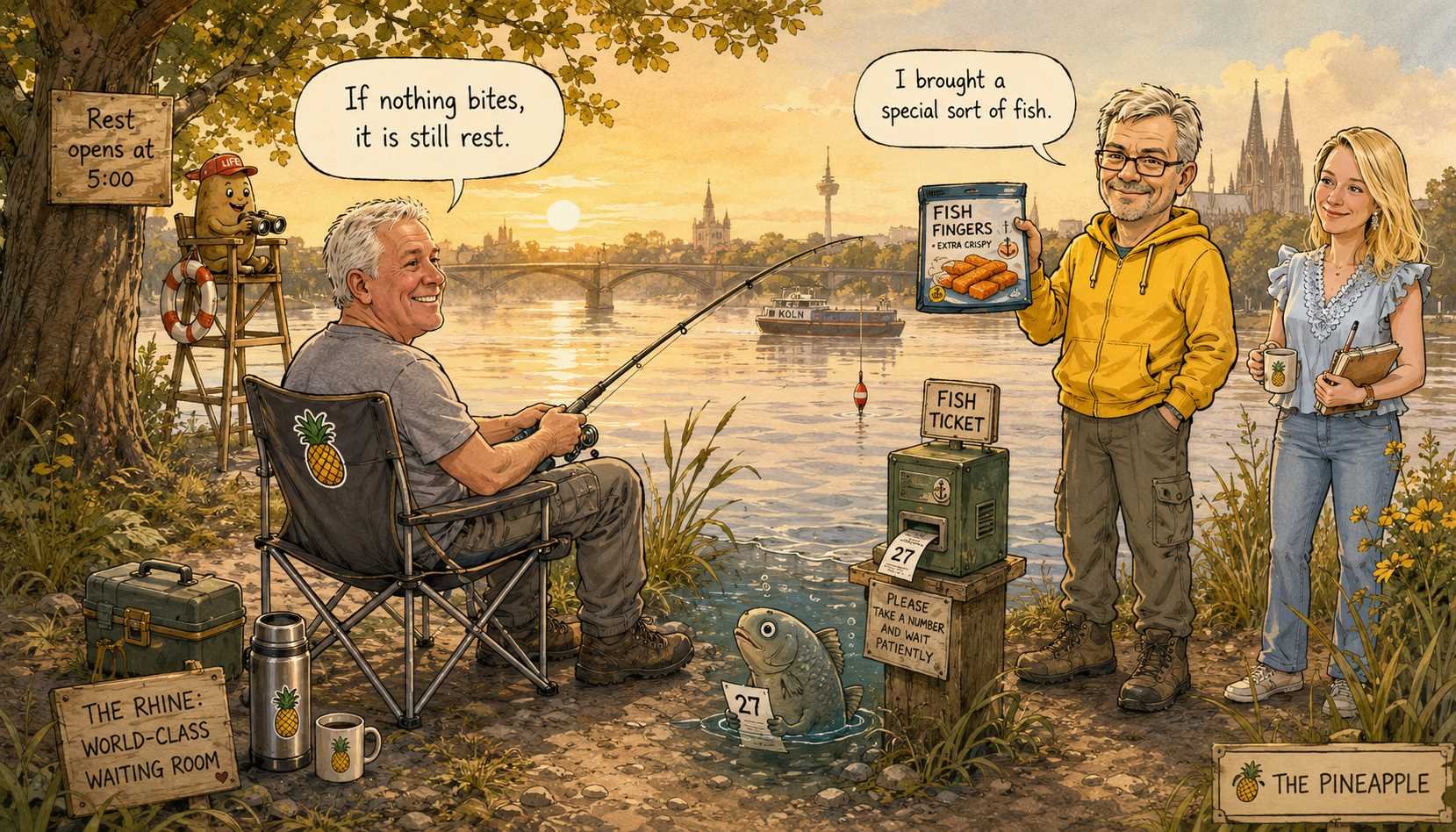
I go fishing on the Rhine. I have my fishing rod, my chair, and the quiet. I sit there and wait for the fish to bite.

That is a very nice rest.

Not every day, of course. When I have my fishing licence, maybe two Sunday mornings in the month, and one or two evenings in the week.

But this picture came first.

The river.
The chair.
The quiet.
And waiting.

If I come home with no fish, this is not a problem.

The supermarket has fish.

The Mayor said, “Look what I caught.”

Yes.

Fish fingers.

A special sort of fish.

Rest Is Sometimes Doing Nothing

For some people, rest means doing nothing.

For me, maybe nothing, maybe something. It depends on my mood.

Not every day I make something. But not every day I make nothing.

Sometimes, after work, I sit on the sofa and watch a movie.

Sometimes I sit in my courtyard with a beer. I watch my trees. The chestnut tree. The pine tree. I watch the swallows in the nest.

The swallows fly and catch flies and make little swallows.

This is also rest.

Janita told me she has pigeons in the roof of her office. Big pigeons, with babies.

I told her she can eat them.

She said she had eaten pigeon once at her grandparents, but it was not chicken.

I said, with potatoes, it is very fine.

This is also Brida rest.

A question about rest becomes a question about birds, then dinner, then potatoes.

When the Head Becomes Quiet

After a normal workday, I need my head to become quiet again.

Sometimes I sit in the chair with a beer and the swallows.

Sometimes I walk in the fields or in the forest. Maybe one hour.

Sometimes I listen to music. AC/DC. Dire Straits. Rock, blues, music from the 60s, 70s, and 80s.

And then there is Rocky Horror Picture Show.

Once a year, on Carnival Monday, I go to the cinema in Karlsruhe.

It is not only watching a film.

You go with a water pistol, toilet paper, rice, cards, and many things. During the film, the people in the cinema do the same things as the people in the movie.

When there is a thunderstorm in the film, the people in the cinema shoot water.

When there is a wedding, there is rice.

It is very special and strange.

But when you see it in real life, in the cinema, it is very fun. Children are there, older people are there, even a grandpa with a walking stick.

It is for all people.

That is also rest, I think.

Not quiet rest.

But the head is somewhere else.

What I See Around Cleebourg

Janita asked me what I notice when I walk around Cleebourg, or the nearby area, that other people maybe miss.

I see the difference between today and many years ago.

Today, in the fields, there is mostly maize and wheat. Maybe 90% is maize and wheat. A little bit of sunflowers, but not much.

Many years ago, there were many different crops.

Clover.
Rapeseed.
Beetroot.
More things.

Now it is reduced.

And the cows are gone.

When I was younger, all the farmers had cows. Not many. Maybe eight, ten, fifteen. But all the farmers had some.

Today in Cleebourg, nothing.

Zero cows.

That is a big difference between before and today.

Janita told me she grew up on a farm. They had cows, horses, sheep, pigs, geese, chickens, fruit trees, apricots, peaches, pears, apples, and a vegetable garden.

They had cows, horses, sheep, pigs, geese, chickens, fruit trees, apricots, peaches, pears, apples, and a vegetable garden.

I said, “You were very lucky.”

Because for me, these things are not only landscape.

They are memory.

When you walk, you see what is here now.

But you also see what is missing.

The Body Works, the Mind Rests

Last Friday, I walked seventeen kilometres with The Mayor.

We started after six in the evening. We finished when it was night.

It was not a race. It was not training. It was not to make a record.

It was just a walk.

Just a little stroll through the woods.

My body was working, yes.

But from the beginning to the end, it was rest for my mind.

The weather was okay. It was not too hot. It was not raining. We walked, we talked, we looked around.

I did not have time to take many pictures for Her Majesty down there.

Janita wanted pictures.

The Mayor sent three pictures.

Next time I must send pictures from the panorama view from the forest. It is very nice from the top of the hill.

The Mayor does not know how to get up there.

I know.

This is also rest.

Knowing the way.

Alone, Together, or With a Group

Do I rest better alone, with one good person, or with a group?

It depends on the situation.

When I am really tired, I prefer to be alone. I need to be lost in my thoughts.

When I am not so tired, rest can be with one good person and a good discussion.

Or with a group, if it is a good group.

Then we make jokes. We have food. We have a good time together.

Janita said she rests best with her family, with her husband and son. They do things together, go somewhere together, make jokes, and create silly conversations.

I understood that.

Rest is not always silence.

Sometimes rest is the right people.

After One Hundred Kilometres

After I finished the 100 kilometre walk, the first thing was celebration.

I came to the goal. I was happy because I had finished.

That was the goal for me.

Finished.

Then food.

Then beer.

Then discussion with Frank and with my wife.

Then I went to a birthday party. A little bit of food, more drink.

Then home.

Then sleep.

That was the sequence.

Celebration, food, beer, discussion, birthday party, sleep.

During the walk, I had maybe three or four kilos of food in my backpack. But when I arrived at the goal, I still had three or four kilos of food in my backpack.

I did not eat much.

Maybe a banana. Some small things.

Water, yes. Drinking, yes. Eating, no.

Just after the walk, I was not especially hungry.

The day after, yes.

The day after, very hungry.

Janita said that when she cycled long distances, she wanted decent food. Not only snacks and fruit.

The Mayor said, “One kilo potatoes.”

Janita said she would take one kilogram of meat and a little less potatoes.

This is the kind of serious nutrition discussion we have at Brida.

Stopping Before the Mistake

Janita asked if it is difficult for me to stop when there is still something to do.

No.

I can stop.

Sometimes I have a to-do list as long as one arm. I begin. I do things.

But at one moment, it is better to say stop.

For today, finish.

Because if I continue, the work is not good. It is not perfect.

I rest a little bit. My brain and my body rest.

One or two days later, I begin again with the to-do list.

The only person who makes pressure on me is myself.

Sometimes my mind says, “I must, I must, I must.”

Then I say stop.

I continue tomorrow.

Before I make a mistake.

The first word I used was not “mistake.” Janita helped me with the better English word.

But everybody understood the first word too.

What Is Important

Of course, it depends on the situation.

If something is very important, I finish it.

But if it is in the garden, or something not important, I can say, okay, I make it tomorrow.

Janita asked me how I know the difference between important and not important.

For me, important is in relation with home, family, and friends.

Family and friends are the basics of existence.

That is important.

Then we spoke about housework.

Janita said that when she starts cleaning the house, she wants to finish it, because then she does not have to do it tomorrow.

I said that my wife and I share everything.

My wife cooks, I eat.

This was perhaps not the official philosophy of modern marriage.

Janita said she and her husband help each other. Some days he cooks. Some days she cooks.

Like now, he had cooked dinner and it was ready.

I said, “Optimal.”

I can cook too.

I can boil water and put in an egg.

Two eggs, even.

One for me.

This is not McDonald’s.

It Is Better Not to Listen

At the end, Janita asked one last question.

If my legs could speak after the 100 kilometre walk, would they say, “Thank you, Fabrice,” or would they report me to the police?

I thought maybe my feet would speak first.

But after 100 kilometres, I did not speak with my body.

My body was talking, yes. Maybe there was a problem.

But I did not listen.

Sometimes it is better not to listen.

The Mayor said that was actually a very good sentence.

It is better not to listen.

He told us about a friend in Belgium who always counted, “One, two, four.”

The Mayor asked him why he counted to four and not to three.

The friend said, “If I say one, two, three, then I have to do something.”

So he said, “One, two, four.”

Then he did not have to do anything.

Maybe that is also rest.

Not stopping forever.

Not being lazy.

Just knowing when not to obey every little voice.

Sometimes the body works and the mind rests.

Sometimes the mind says, “I must, I must, I must,” and you say, “Tomorrow.”

Sometimes rest is a chair by the Rhine at five in the morning.

Sometimes it is a beer in the courtyard, watching swallows.

Sometimes it is seventeen kilometres through the forest with The Mayor, and you say, “It was just a walk.”

And sometimes, after one hundred kilometres, rest is simple.

You finish.

You celebrate.

You talk.

You sleep.

Partner Page
Advertisement
source
The Pineapple

When Rest Isn’t Doing Nothing

How a full weekend, an afternoon nap, a bike ride, and a quiet evening on the sofa reveal what real rest looks like.

Sometimes a conversation begins with one question and quietly answers another.

This one started with “rest in a busy life.” But beneath that was something more familiar: how do you keep going when life is full of work, family, responsibilities, celebrations, and constant change?

The answer was not about escaping a busy life. It was about finding small moments inside it.

Good Busy and Bad Busy

The past weekend was busy, but in a good way.

We had guests at home, so there was cooking, preparing, cleaning, and making sure everything was ready. There was not much time to relax, but I enjoyed it. I think there are two kinds of stress. There is bad stress that drains you, and there is good stress that comes from spending time with people you care about.

This was the good kind.

Even so, a busy weekend still asks something from you afterwards.

Sleep Comes First

For me, rest begins with sleep.

That sounds simple, although it is not always easy because I sometimes struggle to sleep well. But I know how much difference it makes. If I can sleep around seven hours, the next day feels completely different.

That sounds simple, although it is not always easy because I sometimes struggle to sleep well.

When I don’t sleep enough, I notice everything. I feel tired. My mood changes. I lose motivation. I make more mistakes.

Sleep is not something extra that comes after life is finished. It is what allows me to enjoy life the next day.

That is why, after a busy weekend, I try to go to bed early on Sunday evening. Starting Monday with enough energy makes the whole week feel easier.

A Nap Is Not Wasted Time

Last Sunday I did something else that helps.

After lunch I took a nap.

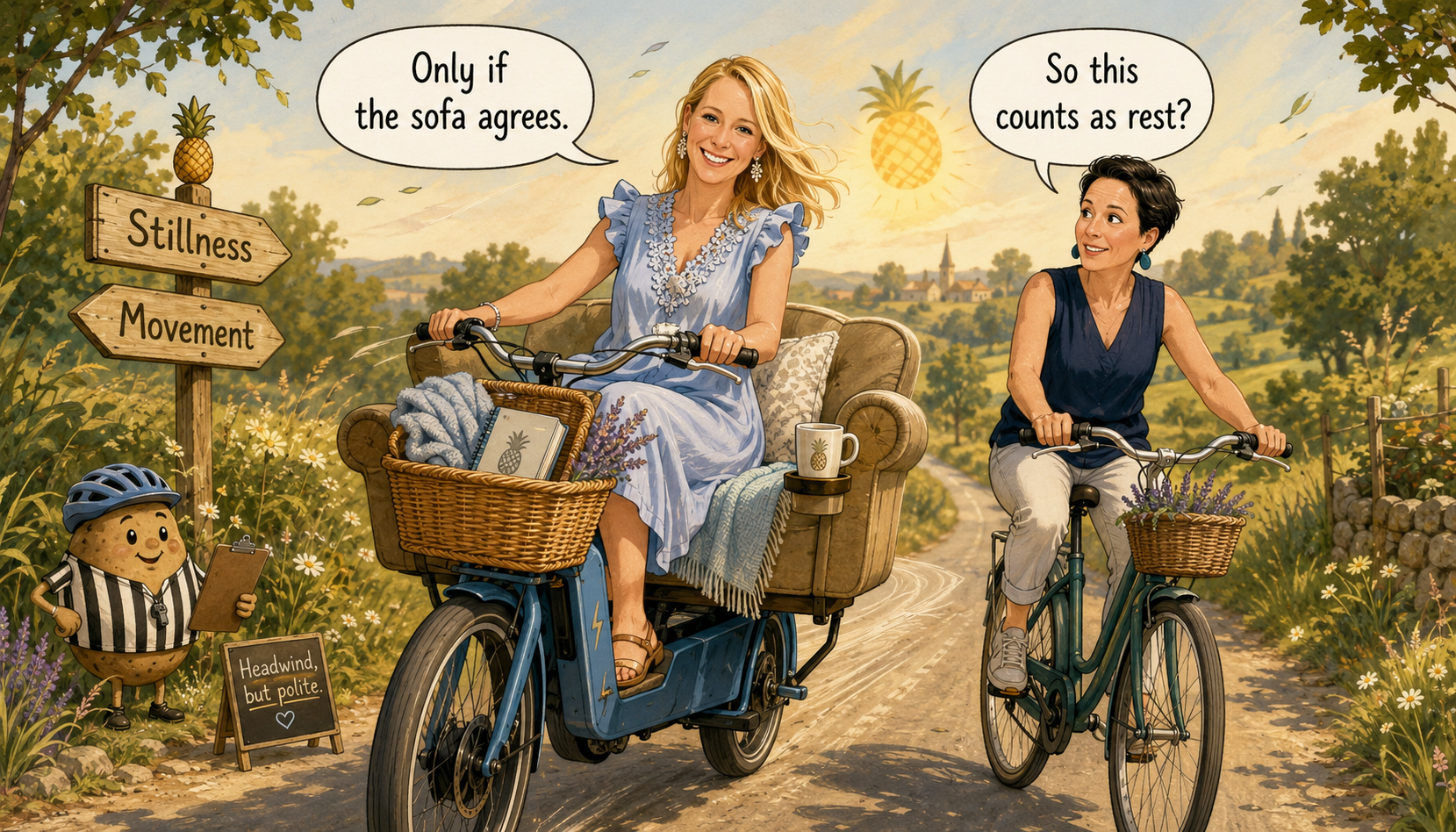
Some people feel guilty about sleeping during the day, but for me it was exactly what I needed. Afterwards my husband and I climbed onto our e-bikes and cycled about sixty kilometres, visiting my mother along the way.

The weather helped too. The sun was shining, although it was windy.

With a normal bicycle the wind would have made the ride much harder, but with an e-bike it was simply enjoyable.

Sometimes rest looks like lying still.

Sometimes rest looks like moving.

Exercise Can Also Be Rest

Running and cycling are different for me.

Running feels more like exercise.

Cycling is a little bit of both.

Being outside, breathing fresh air and spending time on the bike helps me feel calmer afterwards. The busy thoughts settle down. I feel quieter inside.

The hardest part is not the cycling itself.

The hardest part is finding the time to do it.

But every time I do, I remember why it matters.

Life Changes Its Kind of Busy

People often say that life becomes easier when children grow up.

In some ways that is true.

My daughters are adults now. One already lives independently, and my youngest has just received the results she needed for university. She is already preparing boxes for her apartment months before she moves.

I keep telling her, “Slow down. We still have time.”

She cannot wait.

Soon she will move into her apartment, and I know our house will become much quieter.

Perhaps too quiet at first.

When children are young, your energy goes into driving them everywhere, helping with homework, making meals and organising daily life.

Now the responsibilities are different.

There are university registrations, apartments, furniture, washing machines, paperwork and, of course, the phone calls that will probably begin with, “Mom…”

“I need money.”

“I have nothing to eat.”

Some things never really change.

The Quiet After Everything Is Done

When someone asked me where I feel most relaxed, I realised it isn’t really about a place.

It is about a moment.

Dinner is finished.

The house is clean.

Everything that needed to be done has been done.

I can sit on the sofa, switch on Netflix and simply watch an episode before going to bed.

That is probably my favourite part of the day.

Not because anything exciting happens.

Because nothing urgent does.

There Is Always Something Waiting

Even with my daughters leaving home, I know I won’t suddenly have endless free time.

I am part of our local council, and that brings its own rhythm of meetings and community events. This week alone there have been meetings, and next week our town celebrates the French national holiday.

Many volunteers help make it happen. Some prepare food, others organise the drinks, welcome people or keep everything running smoothly.

So I have already taken a day off work to help.

Life has a habit of filling empty spaces.

Perhaps that is not such a bad thing.

Rest Is Something We Build

Before this conversation I might have thought that rest meant having nothing planned.

Now I am not so sure.

Rest can be an afternoon nap.

It can be sixty kilometres on an e-bike with sunshine and a headwind.

It can be going to bed early on Sunday.

It can be knowing your daughter passed her exams and watching her excitedly prepare for a completely new chapter.

It can even be sitting on the sofa after dinner, with a clean house and no more jobs waiting for you that evening.

A busy life does not always leave room for long holidays or perfect weekends.

But perhaps rest does not ask for perfect conditions.

Perhaps it simply asks us to notice the small spaces where we can breathe before life starts moving again.

Partner Page
Advertisement
source

What began as a conversation about digital rest became something much more familiar: how ordinary frustrations take up space in our minds, and how laughter, family, and small victories help us put that space back where it belongs.

Sometimes we imagine that rest comes from switching off our phones or spending less time online.

But some of the biggest interruptions don’t come from screens at all.

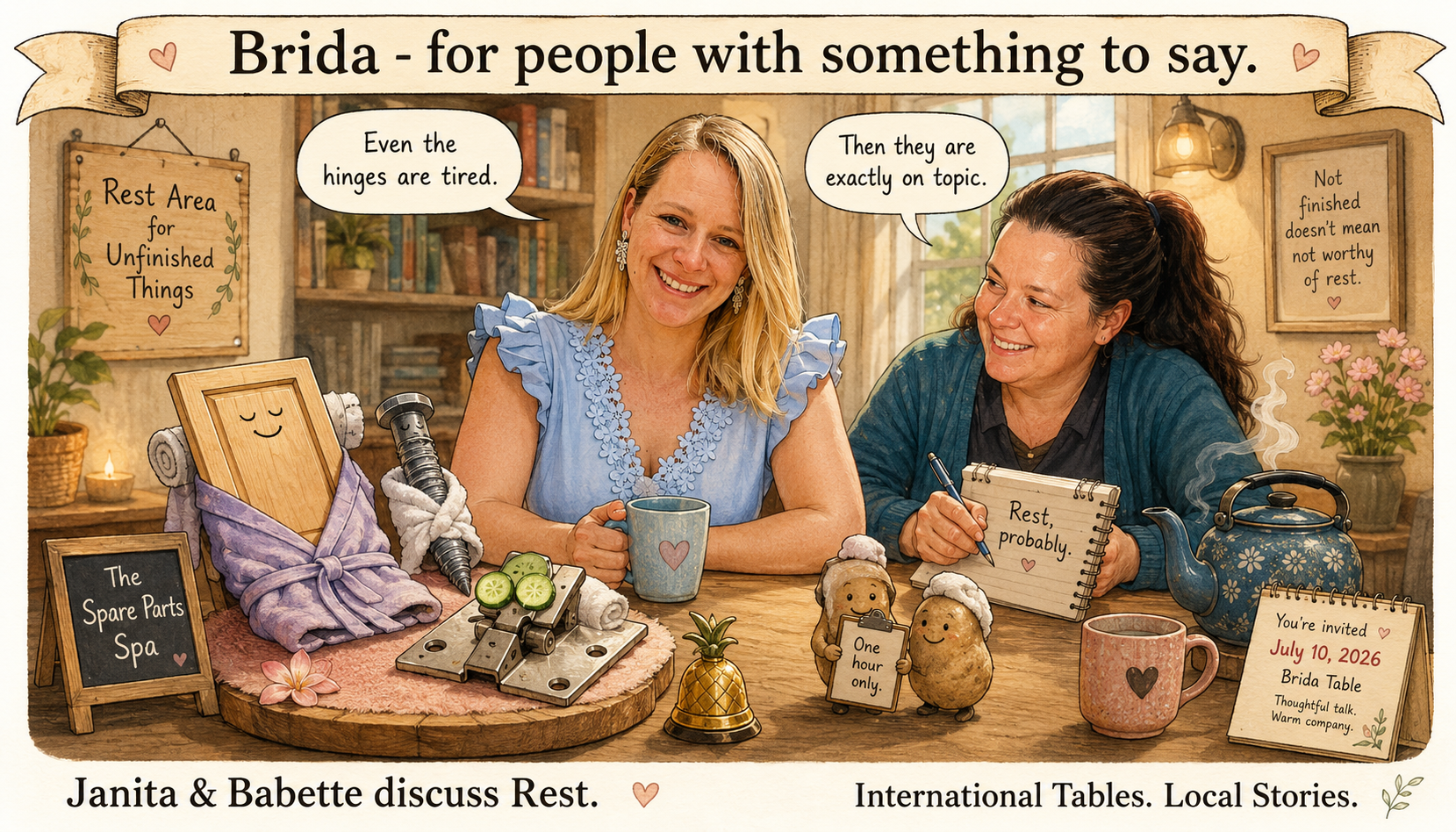
They arrive as broken wardrobe doors, missing parts, endless delivery dates, customer service calls, and the feeling that a problem you paid to solve has quietly become your new hobby.

That was where Babette found herself.

Six months of waiting

The story began back in February.

A new wardrobe had been ordered. It should have been simple.

Instead, every delivery seemed to arrive with a new surprise. One appointment became another. Parts were damaged. A door was missing. Replacement parts arrived weeks later, only for more pieces to be wrong again.

“It comes in bits and pieces,” she laughed, although by this point it was more the kind of laugh that keeps frustration under control.

After almost half a year, another delivery finally appeared.

More spare parts.

Not a finished wardrobe.

Just more spare parts.

The plan after the meeting was already clear. Take photographs. Phone customer service. Explain everything once again.

When nobody owns the problem

Perhaps the hardest part was not the waiting.

It was hearing that the problem belonged to someone else.

The furniture company blamed the manufacturer.

The manufacturer needed another chance.

Another wait.

Another promise.

From Babette’s perspective, none of that really mattered.

“I paid a lot of money,” she explained. “That’s not my problem.”

It is a feeling many readers will recognise. When responsibility is passed from one company to another, the customer becomes the messenger instead of the customer.

Her colleagues admired something unexpected.

Not her wardrobe.

Her patience.

They told her they couldn’t believe how calm she had remained through months of delays.

At least the sofa was fixed

This wasn’t even the first adventure with the same furniture company.

Earlier they had ordered a sofa in a dark, elegant green colour.

It arrived…

Turquoise.

Not almost turquoise.

Not “close enough.”

Turquoise.

Fortunately that mistake was eventually corrected, along with a gift voucher as compensation. Ironically, that voucher was later used to buy the wardrobe that started this whole new chapter.

Sometimes life has a strange sense of humour.

Life doesn’t pause for furniture

Of course, while wardrobes refuse to become wardrobes, ordinary family life keeps moving.

The weather had become so hot that Babette’s son was finishing school early. The classrooms were simply too warm.

He had also completed his final English test.

Like many teenagers, English isn’t his favourite subject, but there was quiet encouragement around the table.

Learning it now, while he’s young, will make life much easier later.

That thought felt familiar to Babette.

She knows exactly what it is like to discover that English slowly becomes part of everyday work.

From “a little bit” to real conversations

Years ago, Babette only needed English for hotel guests.

Simple questions.

Arrival dates.

Departure dates.

How many people were staying.

Whenever guests asked whether she spoke English, her answer was always the same.

“A little bit.”

Then something interesting kept happening.

After a few minutes of conversation, guests would smile and tell her she spoke much more than “a little bit.”

Today English appears in a very different place.

Emails arrive in English.

IT support happens in English.

International meetings happen in English.

Sometimes she still reaches for DeepL to translate a difficult word or phrase. Sometimes colleagues who could easily speak German continue speaking English because that’s the shared language for everyone involved.

It can feel frustrating.

It can feel exhausting.

But it also reveals something she doesn’t always notice herself.

She has already travelled a long way from “a little bit.”

Progress isn’t always loud

Towards the end of the conversation, Babette mentioned meeting Frank earlier in the week.

He had asked how the meetings were going.

Her answer was simple.

Everything was positive.

More importantly, they have fun.

That small sentence says quite a lot.

Learning a language isn’t only about vocabulary lists or perfect grammar. It is about having enough confidence to tell stories, complain about impossible wardrobes, laugh about turquoise sofas, encourage your children, and occasionally discover that you can say much more than you thought.

Progress often hides inside ordinary conversations.

Making room again

The planned topic for the day had been digital rest.

Instead, the conversation wandered through furniture disasters, family life, English at work, summer heat, customer service, and shared laughter.

Maybe that wasn’t such a detour after all.

Rest is not always found by escaping life.

Sometimes it begins when someone listens while you untangle the problem that has been taking up too much room in your head.

The wardrobe may still need fixing.

But for an hour, at least, the frustration became a story instead of a burden.

And somehow, that felt like a good place to start.

Partner Page
Advertisement
source
The Pineapple

The Spaceship With One Cupholder

A Swimming Club conversation about new cars, old instincts, digital rest, and the strange moment when technology promises comfort but asks you to go to university first.

The Car Is No Longer Just a Car

This began as a conversation about Digital Rest.

Not meditation apps.
Not screen-time graphs.
Not a clean theory about modern life.

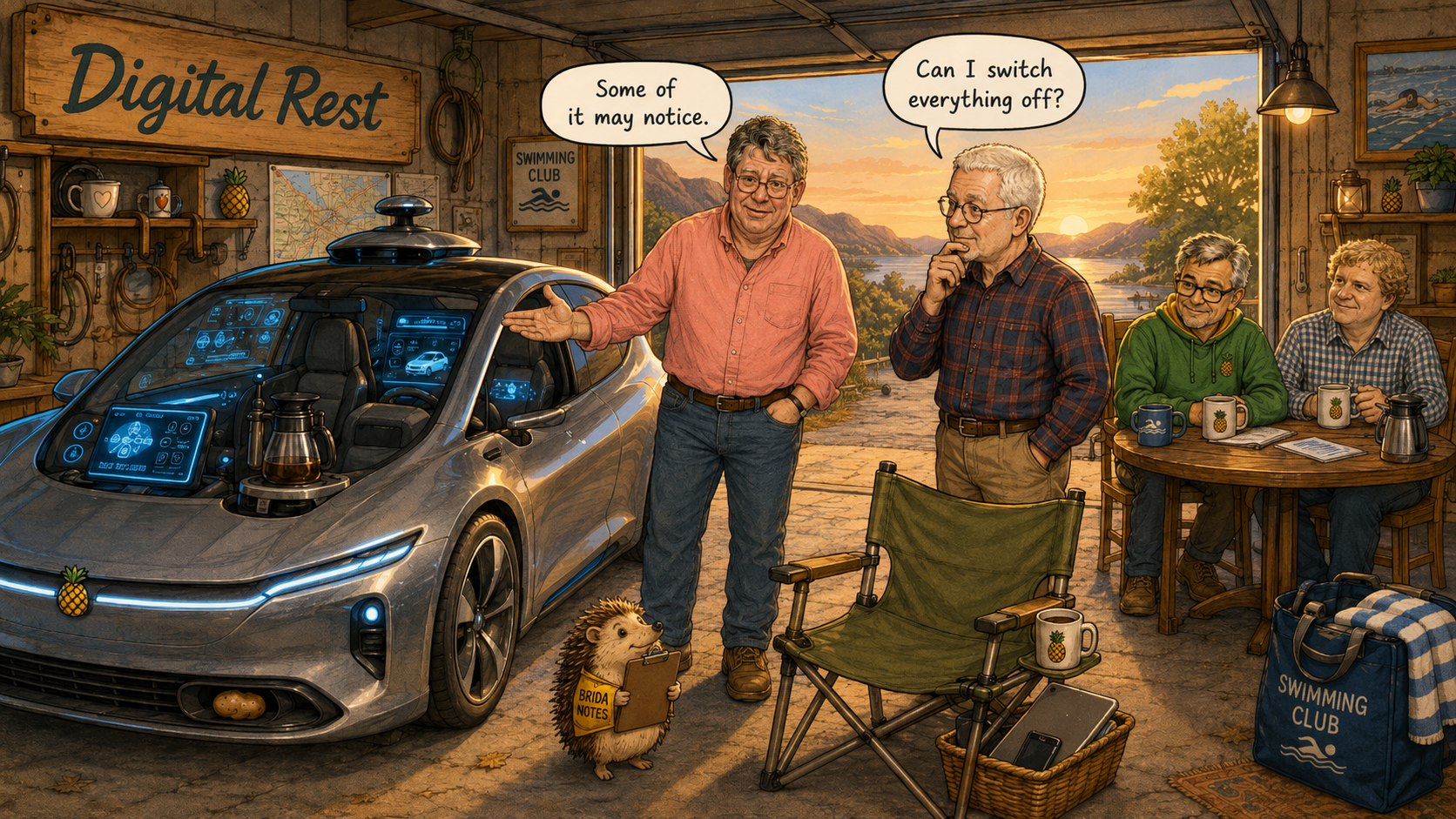
It began with a phone, a car, a caravan chair, and Manfred discovering that buying a new car in 2026 might require a small degree in technology.

Ralf had recently received his new Skoda.

It had screens, sensors, Apple CarPlay, speed-limit recognition, automatic braking, mobile-phone connections, software updates, warnings, and enough features to make a normal driver feel both impressed and slightly supervised.

Manfred, meanwhile, was thinking about replacing his 2007 car.

His first hope was modest.

“I hope the car still has a steering wheel and brakes,” he said, “because those things I still know.”

This is where Digital Rest became real.

Not as a question of whether technology is good or bad, but as a question of whether modern technology still allows a human being to feel calm, curious, and in control.

Handy Handy

When the table heard the words “Digital Rest,” Martin immediately thought of the phone.

“The phone,” he said, “because it is always handy. The handy handy.”

He is pro-phone, he said. But it can be too much.

Ralf had two answers: his mobile phone and his car.

They are now connected. He drives with Apple CarPlay. His route appears on a big screen. If he asks himself where his mobile phone is, the answer is usually simple.

It is in the car.

Luckily, he added, they live in a very safe area. There are no thieves.

Manfred’s version of Digital Rest was shorter.

“Handy off, laptop off, camping chair out, sit in front of caravan. End of discussion.”

This may be the clearest definition of Digital Rest ever produced at Swimming Club.

A Spaceship With Cupholders

Ralf’s new Skoda did not feel completely like a normal car.

“It is a spaceship with cupholders,” he said.

Then he corrected the statement.

Actually, there is only one cupholder, for his coffee pot.

And then there is a big hole, which he does not know what it is for.

Manfred listened from the other side of automotive history.

“My car is a perfectly normal car.”

Martin added his own simple position.

“My car is just a car.”

There it was.

Three stages of modern driving.

A car that is just a car.
A perfectly normal car.
And a spaceship with one cupholder and a mystery hole.

When the Car Helps

Modern cars do have their arguments.

Ralf explained that his Skoda reads speed-limit signs. It can brake automatically, slow down for roundabouts, and accelerate again afterwards.

“It is police proof,” he said.

Martin named cruise control. His old Mercedes E240 from 2003 already had it.

Manfred’s car, by comparison, still expects him to participate fully.

“My car has nothing. Just an accelerator and brakes. I still have to do everything myself, even look at the road signs.”

Then, for once, the whole table agreed on a modern feature without difficulty.

Air conditioning.

Some technology does not need a philosophy.

Some technology is simply civilisation.

When the Car Talks Too Much

But useful technology can also become restless technology.

Ralf had connected both his private phone and his company phone. The car was supposed to read only the private phone, but it had registered everything from the company phone.

The car was supposed to read only the private phone, but it had registered everything from the company phone.

To swap phones, he had to stop, open the door, put one phone on airplane mode, connect the other phone, close the door, and start the engine again.

This is not exactly restful.

There was a software update available, but he was not allowed to install it yet.

Maybe next week.

Or the week after.

Martin’s car has solved this problem differently.

“My car doesn’t talk with me,” he said. “It doesn’t like me. As simple as that.”

Manfred could not think of much that talks in his car.

There is cruise control.
There is air conditioning.
Mechanically, it is basic.

And there is a certain peace in basic.

Can One Switch It Off?

If Ralf were Manfred’s car-buying interpreter, Manfred had one serious question.

“Can one switch off all these new helpers?”

Ralf’s answer was not completely reassuring.

Some, yes.

Others, no.

For example, when the car stops at traffic lights, the engine switches off. When the driver accelerates, it starts again. Ralf wanted this function switched off, but it was not permitted.

Then there is the warning sound when he exceeds the speed limit.

Ping.
Ping.
Ping.

“But I always drive ten kilometres per hour faster,” Ralf said.

His solution is simple.

He turns up the radio.

It is not an optional extra, he explained.

It is a mandatory extra.

This is one of the strange truths of modern life.

The feature is there for your benefit. You did not ask for it. You cannot fully remove it. So now your solution is louder music.

Old Arithmetic

Ralf also gave Manfred advice about buying a modern car.

What should Manfred ignore?

“The price.”

The Skoda has many features. It costs €66,000. It is a company car. Privately, Ralf would never pay that amount.

He still thinks in Deutsche Mark.

€66,000 becomes 132,000 DM.

That was a lot of money for his parents. With that money, they would have been rich.

Now, for a car, this has somehow become normal.

A car can have software updates, radar warnings, automatic systems, and one mysterious hole beside the coffee pot.

But €66,000 is still €66,000.

Help or Attention?

The table then arrived at the real question.

Where is the line between “this helps me rest” and “this wants my attention again”?

Ralf described the distance regulator on the highway. It creates a safe distance between his car and the car in front.

But then another driver sees the space, overtakes him, and moves into it.

The car brakes.

Ralf loses the setting.

He has to reset it.

After a while, he switches it off.

Technology has planned for safety.

Human traffic has planned for opportunity.

Manfred had a more old-school caravan solution.

When he has his caravan in tow, he tailgates a truck. Then there is no motivation for others to drive between him and the truck.

This may not appear in the official manual.

But it is, in its own way, a system.

Learning, or Being Forced to Learn

Martin made an important distinction.

Learning new technology is fine.

Being forced to learn it is different.

Some things are enjoyable. Others are downright stupid.

Ralf’s experience was more positive. Before the Skoda, he had driven different rental cars for nine months. Volvo, Tiguan, Mercedes, each with different functions.

Those months became training.

By the time he received the Skoda, he had already learned many of the systems.

“I can drive and phone at the same time,” he said, “and the car drives by itself. That is cool.”

Manfred’s situation is different.

“This applies to me. From zero to one hundred kilometres in one step.”

His goal, he joked, is to read the newspaper in the passenger seat while driving.

But then he said the real thing.

He hopes that learning the new technology will be greater than having to learn it.

He wants the experience to be positive.

He wants to start the car without having to go to university first.

That sentence contains a lot.

It is not resistance to learning.

It is resistance to unnecessary pressure.

Curiosity can be restful.

Forced adaptation is not.

Is It Still a Car or a Relationship?

At some point, the table had to ask the obvious question.

If a car now has software updates, settings, profiles, apps, and passwords, is it still a car?

Or is it a relationship?

Ralf gave the best possible evidence.

His wife has a problem with an app called Blitzer.de. It warns drivers about mobile or stationary radar traps.

When it starts, a female voice says:

“Your favourite passenger is now activated.”

This is not just a technical feature.

This is domestic theatre.

Still, Ralf defended the machine.

It is only a car.

But it is a nice car.

And if someone has a caravan or trailer, some systems really do help. For people who know the pain of reversing with a trailer, this is not decoration.

This is genuine usefulness.

The table was not anti-technology.

It was anti-nonsense.

There is a difference.

The Pleasure of Driving

What would a truly restful digital car do less of?

Ralf’s answer was immediate.

It should not take away the pleasure of driving.

A driverless car might be okay, but he still wants to drive his car. He wants to be able to interfere at any moment.

“I don’t want to relinquish control.”

Manfred agreed.

He does not need a car that takes over too much. He wants control over driving.

Driving should be fun.

Sometimes, he said, you have to fight the settings because a real situation forces you to do something different from what the settings think you should do.

Martin agreed with both of them.

This was one of the clearest shared points of the conversation.

Digital Rest does not mean doing nothing.

It does not mean giving up control.

It means not being forced into a fight with your own machine.

The Brrmm Matters

There are old car habits that modern cars should not destroy.

For Martin, it is the driving experience, the character, and the design of the car.

And the sound.

The brrmm of an engine is important.

Manfred agreed. He wants the feeling of controlling the car independently, not being controlled. He wants to enjoy driving without always adjusting settings.

And yes, the sound matters.

The brrmm matters.

For Ralf, it was also the smell.

The smell of petrol.

He was once a car electrician, from 1980 to 1983. He worked with cars that smelled of petrol and diesel.

One day, maybe, he would like to buy a Mercedes-Benz 280 SL, the R107.

He worked on that car.

The ignition.
The smell.
The whole experience.

“It is unbelievably great.”

An electric car is not the same.

The six-cylinder engine, he said, sounds like a sewing machine.

This was not nostalgia as decoration.

It was memory through the senses.

Petrol.
Diesel.
Ignition.
Sound.
Machinery.
Youth.
Work.
Skill.

Some old things remain inside the body.

Advice Without Becoming the Expert

At the end, the table tried to give advice for buying modern technology without losing peace.

Ralf’s first advice was direct.

“Don’t buy a car from the VW Group.”

He had driven other brands where the functions worked. With the Skoda, there was always some sort of problem.

“It is a new car,” he said. “It cost so much money. Why can’t this thing work properly?”

Martin’s advice was more general.

Do not exaggerate comfort and user simplicity, because it can become nerve-wracking.

Manfred’s advice was calmer.

There has been a huge development in technology. Take it one step at a time.

No stress.

He finds it frustrating that cars used to have more or less the same features. Now each car is full of electronics.

In one situation, he could not even find the handbrake.

Then he learned the car no longer had one.

This is modern progress in one small scene.

A man looking for a handbrake that has disappeared into an electronic system.

Dream On

So what is Digital Rest, after all?

For Ralf, it is good music, empty streets, electronic functions that work properly, and driving on the highway while looking at nature to the right and left.

Then he added the correct technical assessment.

“Dream on!”

For Martin, Digital Rest means driving without noticing it.

For Manfred, the sentence began with the right ingredients.

Fun and curiosity should be more…

The transcript stops there, but maybe the table had already said enough.

Digital Rest is not the absence of technology.

It is the hope that technology does not steal the pleasure, the humour, the control, the sound, the smell, the road, the coffee pot, the camping chair, or the ordinary human right to start the car without first attending university.

Partner Page
Advertisement
source
The Pineapple

Peeling Potatoes 54: We’ll Do It Tomorrow

A conversation about active rest, cold coffee, clean sheets, boundaries, and the strange courage of doing slightly less.

We began with cold coffee.

Janita was sitting in South Africa, dressed as if she had been placed on the South Pole by accident. Her coffee was cooling too fast, but she was still using the cup to warm her hands. Her fingers were red from the cold.

Parts of Cape Town had snow. That was apparently enough to send the wind across the country and into her bones.

The Mayor, being helpful in the way only The Mayor can be helpful, suggested she speak to the authorities in Cape Town and ask them to keep their rubbish weather to themselves. Janita suggested they needed a barrier. He suggested a wall.

This is how we entered Active Rest.

Not with a yoga mat.

Not with a candle.

Not with a calm voice telling us to breathe deeply.

With cold hands, weather complaints, coffee, and the suspicion that rest is never as simple as it sounds.

The active rest quiz begins

The Mayor had come prepared.

This is always a dangerous sign.

He said he was willing to become a student of Fruitloop University, because Janita had proved many times that he still had a lot to learn. He also made it very clear that he was not a Cheerio, and that if she ever called him that again, their working relationship would have to be reviewed.

Janita accepted this seriously.

While laughing.

The topic was rest, and more specifically Active Rest. The Mayor had taken the day off the day before, travelled 200 kilometres to an exhibition, walked through crowds, looked at paintings that were not quite as Monet-heavy as promised, and had lunch with his mother.

His mother, we discovered, understands lunch in a very generous way.

Ice cream counts as lunch.

In fact, when his father was still alive, his parents would go on holiday and eat gigantic cups of ice cream with decorations and all the proper seriousness of a meal. His mother had a whole freezer drawer of different ice creams, like a private ice cream parlour with no need for prices.

So there we were.

Cold coffee in South Africa.

Ice cream lunches in Europe.

And a quiz about rest.

Rest, but with sushi in bed

The first sentence was simple.

Active rest sounds healthy, but in real life it usually means…

Janita already knew the answer.

The night before, they had chicken chow mein. Then, because it was cold, they decided to go to bed early. They ate dinner, took a shower, climbed into bed, and started watching a series.

Then they ate sushi in bed.

They were resting.

Actively.

This is the sort of answer that sounds like nonsense until you hear the truth inside it. Rest is not always tidy. Sometimes it is not even planned properly. Sometimes it is a series, a blanket, food that should maybe not be in bed, and the decision to stay warm.

The Mayor moved on.

Active rest sounds lovely until I realise it still requires me to…

Janita did not need long to find the problem.

Rest still requires something.

That was the beginning of the trouble.

The body asks before the brain agrees

The Mayor asked how her body asks for rest.

Janita had flu. She had been trying to shake it off, but her body was not cooperating. It was slowing her down whether she liked it or not.

That became one of the quiet truths of the conversation.

Sometimes the body asks politely.

Sometimes it sends a cold.

Sometimes it sends tiredness.

Sometimes it simply refuses to continue with our bright little plans.

The Mayor asked what kind of rest she finds acceptable.

The answer was not the rest where everything stops and everyone leaves her alone. That sounded almost too suspicious.

The acceptable kind of rest was the kind that still made sense inside family life. Sitting on the couch while her son watched cartoons. When he asked for food or a drink, she could say, “You know where this is. You know how to get yourself water.”

She was resting.

He was doing his own things.

Nothing exploded.

This became important later.

The chores that appear when rest arrives

The next trapdoor was familiar.

When Janita is supposed to rest, the chore she suddenly discovers is cleaning her office.

The office gets missed when the rest of the house is cleaned. So when she is meant to stop, she suddenly sees dust, a table that needs wiping, a floor that needs washing.

Then the windows enter the conversation.

She was already thinking about washing the windows at the weekend.

Maybe.

Maybe not.

The Mayor understood this immediately, because he too had looked at windows and thought dark thoughts. Kitchen windows. Living room windows. Office windows. Upstairs windows. Bathroom windows.

Windows are dangerous during rest.

They stand there quietly, pretending to be glass, but really they are accusations.

Clean sheets and other suspicious forms of rest

One of the best answers came when The Mayor asked about the activity that gets called rest even though it secretly drains us.

Janita said changing the bedsheets.

This made perfect sense.

In the end, she will sleep nicely. She will rest nicely. Clean sheets, tidy bed, fresh everything. But getting there is hard. It is a whole event. It promises future comfort while taking present energy.

In the end, she will sleep nicely. She will rest nicely. Clean sheets, tidy bed, fresh everything. But getting there is hard. It is a whole event. It promises future comfort while taking present energy.

That is a very clever trick.

The Mayor then had a memory about satin sheets.

He had once had them.

He did not recommend them.

He had never felt more uncomfortable in bedding.

So we added satin sheets to the growing list of things that sound better than they are.

Alongside underwhelming exhibitions, cold coffee, and rest that requires effort.

The inner critic does not approve

The Mayor asked what the inner critic would say if rest had to be approved.

Janita’s critic was direct.

“This is not rest. This is not rest. This is not rest.”

It was funny because it was too true.

The inner critic has no imagination. It sees you sitting down and immediately checks whether you are earning the sitting. It sees you watch a movie and asks whether you have created a to-do list in your head. It sees you lie down and asks whether the laundry has been dealt with.

For Janita, even watching a film on a Friday or Saturday night with her husband and son can become a place where her mind starts working. What is for dinner? What must still be done? What has been forgotten?

The body sits.

The mind keeps walking around the house with a clipboard.

Stopping the body is not the hardest part

Then the conversation moved deeper.

The hardest part of resting is not stopping the body.

It is stopping the mind.

For Janita, the mind keeps managing. It checks the house. It notices what is out of place. It sees what is in the way.

There is one space where this becomes simpler: her office.

Nobody comes in there.

Nobody touches her things.

Nobody messes around.

If it is untidy, it is her fault.

If it is tidy, it is also hers.

The Mayor remembered this from earlier conversations. My mess is my mess. Leave it alone.

There was humour in it, but there was also a boundary hiding inside it. A room where the mess belongs to you is not only a mess. It is a small kingdom.

If everyone survived the nap

The Mayor asked what would happen if Janita stopped being the capable one for one afternoon.

She said people might discover she can actually be lazy if she wants to.

The Mayor suggested she announce this to the South African media.

She refused.

But then she gave the evidence.

That week, because she had flu, she had told her husband she was going to lie down. Nothing fell apart. Everything was still standing. They had lunch. He cooked dinner a few times.

She took a nap.

The world continued.

She did not even feel guilty, because she was sick.

This is where the problem became visible.

Rest is easier to allow when illness gives it permission. If the body is officially unwell, rest becomes acceptable. If the body is only tired, stretched, full, or quietly warning us, rest still has to stand in court.

The mud bath problem

Janita likes rest.

But she does not fully trust it.

There is a reason.

A few months ago, she took a nap. While she was sleeping, her son went outside and built himself a mud bath.

This is not a metaphor.

This is domestic evidence.

This is why rest becomes suspicious. You close your eyes, and somewhere in the world a child invents a spa treatment from mud.

So when The Mayor asked why she keeps choosing forms of rest that allow her to remain available to everyone else, Janita answered plainly.

Boundaries are a big problem for her.

Even when she tries to nap, her son comes in to check whether she is really sleeping. If he sees her lying on her phone, trying to fall asleep, he runs to her husband and reports that she is not sleeping.

So it is not only her boundaries.

They are being tested.

Actively.

The rules we inherited

The conversation widened from housework into work itself.

The Mayor asked whose approval Janita might still be trying to earn by staying busy.

She thought it was mostly her own.

But she also connected it to how they were raised. Finish school. Study something. Find a job. Work the job. Nine to five. Or work yourself over the edge.

Her grandfather had worked for the same company for 60 years. Even after retirement, he still had a short-term contract with them. Her father had worked for the same company for 25 or 26 years.

Loyalty. Service. Staying. Continuing.

The Mayor recognised this. His father also worked for one company for more than 40 years. The company looked after him, financially and practically, through moves from city to city and country to country.

There was security there.

But the world has changed.

When The Mayor speaks to his mother about the way he works, and the way Brida works, her most pressing question is, “Where is the security?”

His answer is that the security is what you create yourself.

This is not a neat answer.

It is not comfortable.

But it belongs to the world we are in.

Busy can look like safety

The uncomfortable truth about busyness is that sometimes it helps us avoid going crazy.

Janita said this almost as a joke, but not only as a joke.

If she sits down and sees something out of place, something not where it is supposed to be, something in the way, she feels annoyed. Being busy gives her something to do with that feeling.

The Mayor made a German roadworks comparison, because of course he did.

Germans, he said, will find a hairline crack in the middle of nowhere and drill to the centre of the earth to make sure that crack never appears again.

He wondered if Janita does the same with crumbs.

A sandwich crumb appears, and suddenly the whole house must be rebuilt.

Janita objected.

Crumbs are okay.

Then she paused.

They do annoy her sometimes.

The pause was significant.

The promise we neglect

Near the end, The Mayor brought in his vegetable plot.

This could have sounded like a sudden change of topic, but it was not.

He had made a promise to himself after his heart attack, 10 or 11 years ago. The vegetable plot was meant to be a commitment to his health, his stability, and his mental state. He wanted to grow his own vegetables.

It went well for two years.

Then it fell away.

He resurrected it, but for several years now it has not worked properly. He looked at it and realised he needs help. He needs someone with the right tools to come in and help him lay the groundwork.

Not to do everything for him.

To help him return to a promise he made to himself.

That was the bridge.

Janita’s rest.

The Mayor’s vegetable plot.

The bike not yet ridden.

The exercise not yet restarted.

The nap not yet trusted.

The small promise to health that keeps being pushed to tomorrow because everyone and everything else seems louder.

Active interest

The Mayor said maybe we need to take a more active interest in the people we meet regularly.

Not doomscrolling.

Not watching from a distance.

Actually asking.

How is your fitness training going?

Have you ridden the bike?

Have you gone for a run?

Have you made progress?

And then celebrating small victories.

Because small victories are not small when someone is trying to change a pattern that has been running for years.

Janita listened.

She had already found her own takeaway.

She needs to care a little less.

Set boundaries.

Take a nap without guilt.

Nothing is going to explode.

Nothing is going to fall apart.

Everything will be fine.

That is quite a lot to learn from cold coffee and a quiz.

We’ll do it tomorrow

By the end, Janita’s husband was washing the floor.

This was excellent news.

The Mayor said he deserved a hug and a medal.

Janita said they had no responsibilities that weekend. Not the normal routine pressure. Not the rush of dinner, shower, bedtime, and all the little domestic gears turning at once.

They could relax.

She might take a nap.

Or lie on the bed and watch the series.

There was still someone coming to check things around the house, and she would have to keep the dogs away, especially one particular dog, but this was manageable.

The Mayor was also going into his own version of Active Rest. A hike with Fabrice at 7 o’clock. He did not fully know where they were going. He only knew he had been told to wear long trousers, decent shoes, and take walking sticks.

Janita reminded him to take enough water.

And snacks.

This is care.

This is Brida, in its ridiculous ordinary clothing.

We speak about rest, and somehow we end up with sushi in bed, mud baths, German roadworks, clean sheets, AI, job security, vegetable plots, cold coffee, and walking sticks.

But underneath all of that, the question is simple.

Can we rest before we are completely exhausted?

Can we stop earning every pause?

Can we let tomorrow carry what does not need to be carried today?

Janita found the motto for the weekend.

We’ll do it tomorrow.

Not as avoidance.

As mercy.

Subscribe to The Pineapple today: www.brida.eu/pineapple

source
The Pineapple

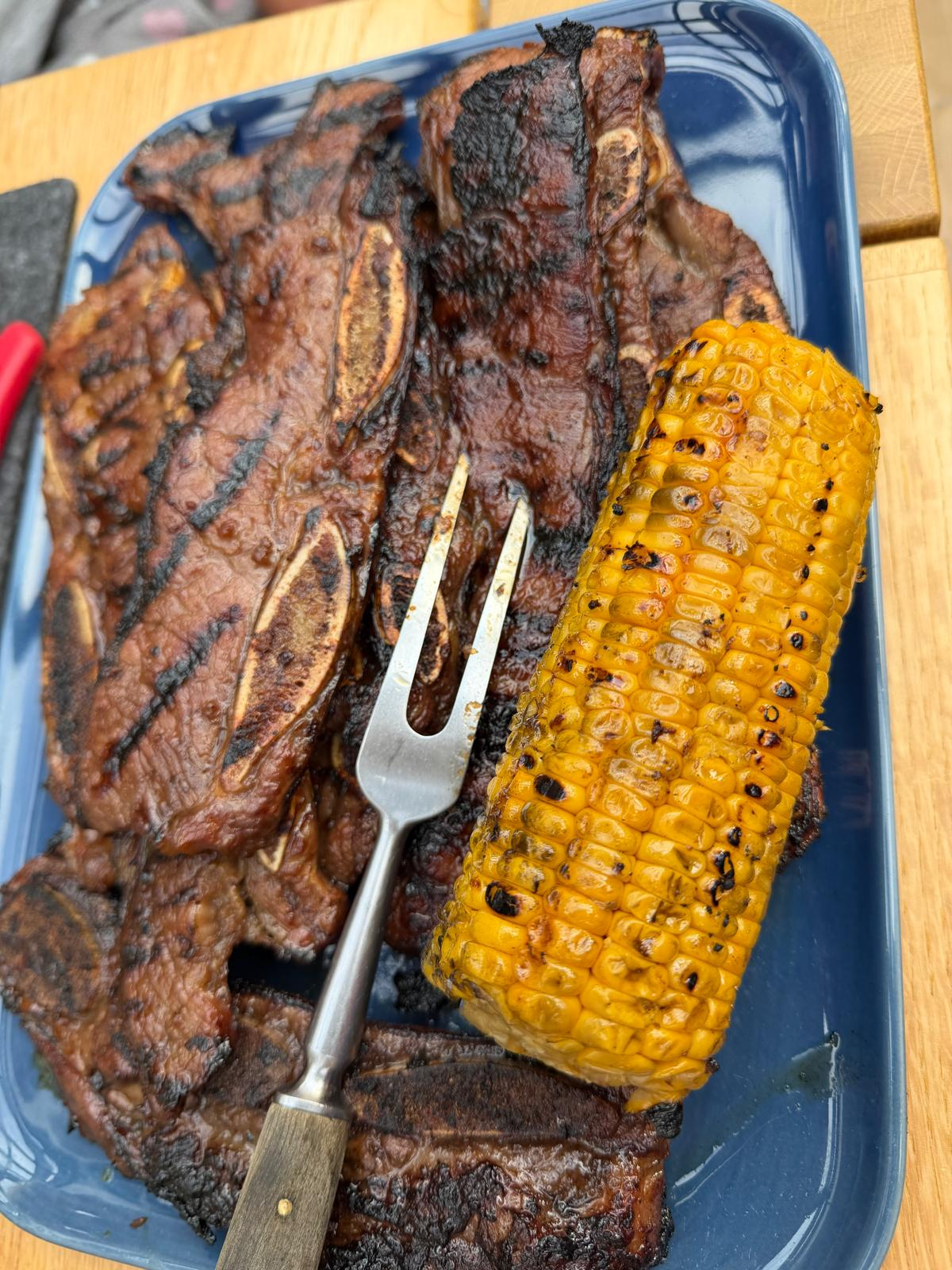
Korean BBQ Chicken Galbi

Chicken marinated with soy, sesame, ginger, garlic, spring onion and kiwi

Ingredients

Chicken

Marinade

Method

Ralf Note

The kiwi matters. You think maybe it is not necessary, but then the meat tells you the truth. Cooking teaches with your teeth.

Partner Page
Advertisement
source
The Pineapple

The Las Vegas Model

A conversation with Bruce about AI, power, pleasure, morality, and the strange human habit of muddling through

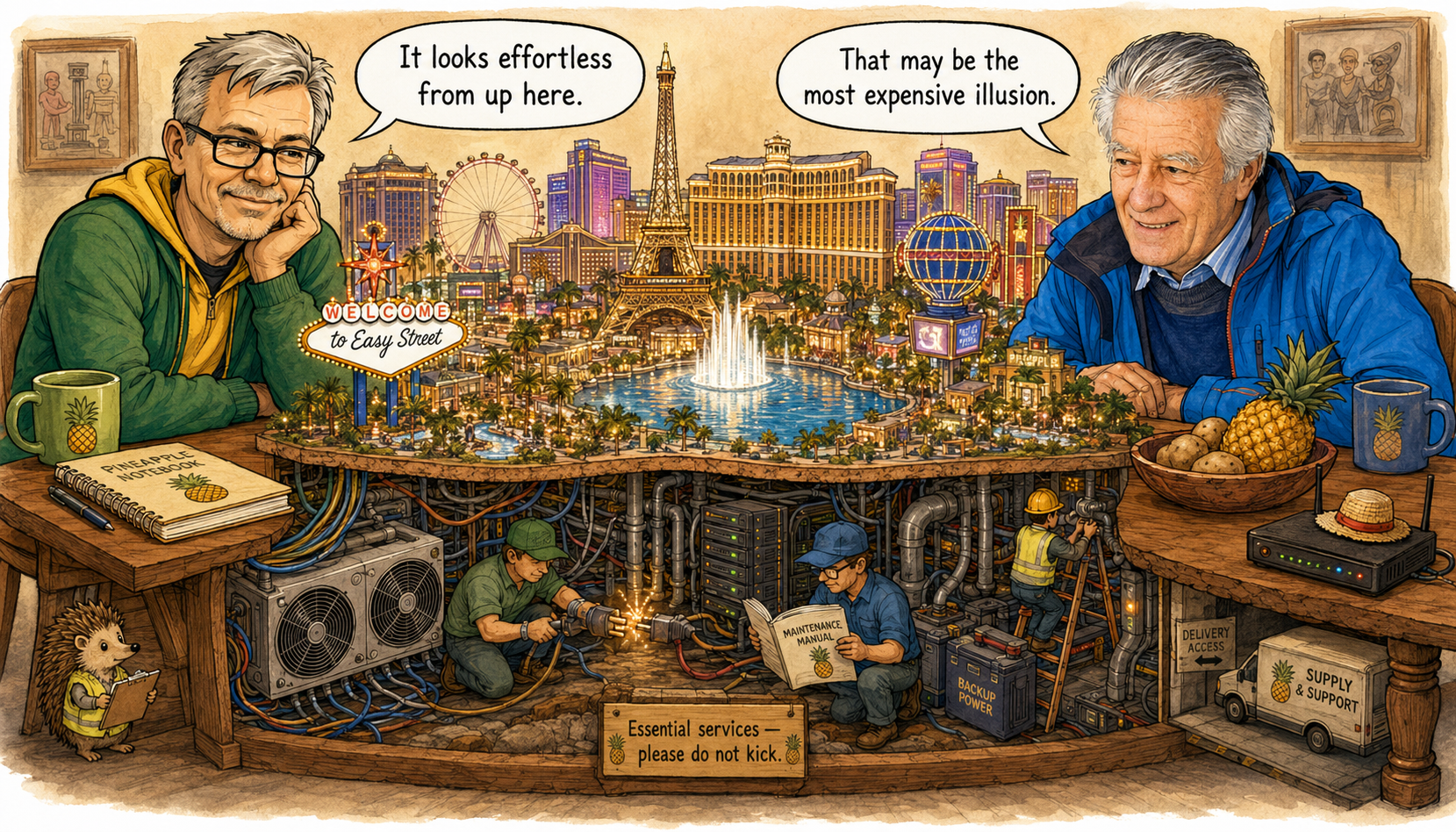
This began as a conversation about Las Vegas.

Not the city as a travel destination. Not the slot machines, the hotels, the Eiffel Tower copy, or the artificial Venice without the jet lag.

Las Vegas became a model. A bright, loud, tempting model for something much larger: the future of humanity when technology, entertainment, power, money, and human desire are all wired together.

The conversation was not easy. It moved from AI to ecology, from gambling to politics, from the American Dream to education, from information to wisdom. But underneath it all was one simple question:

What happens when a system understands the problem, but humans cannot agree what to do about it?

The machine can see the pattern

Bruce began with a warning.

AI is not perfect. It makes mistakes. Sometimes the mistakes are obvious. Sometimes the reasons for them are not clear. But even with those limits, he has found that AI can be useful for exploring “the frontiers of human contradictions”.

That was the purpose of the Las Vegas exercise.

Several AI models were asked to examine Las Vegas as a kind of future-humanity model. The models produced different views. Other AI systems then evaluated those views. NotebookLM was used to bring the material together into a more readable discussion.

The result was not a prediction in the simple sense. It was more like a mirror.

Las Vegas, in this reading, reveals a set of deep human patterns:

The triumph of engineering over ecology.

Probability replacing morality.

The simulation loop becoming a kind of primary reality.

Spectacle over substance.

The organised non-naming of power.

Extreme satisfaction.

Perpetual transience.

And finally, the existential gamble.

The last one is perhaps the most uncomfortable. Las Vegas is built on the gambler’s fallacy: the belief that the big win is just around the corner. Applied to humanity, that becomes something much darker. We gamble with the biosphere, political stability, and biological integrity. Instead of changing direction, we go all in on geoengineering, anti-ageing biotechnology, and artificial general intelligence, hoping we can hack our way out of the crises we created.

As Bruce put it, AI is “bloody good” at telling us what the problem is.

The trouble is that it cannot do anything about it.

At least, not on its own.

Probability versus morality

One phrase kept coming back in the conversation: probability replaces morality.

That phrase matters because it describes a shift many people already feel, even if they do not name it.

In a probability system, the question is not always “What is right?” It becomes “What is likely to work?” or “What gives us the best chance?” or “What protects our position?”

That may sound practical. Sometimes it is practical. But when every moral question becomes a calculation, something human begins to slip.

The Mayor connected this to vested interests, political agendas, economic agendas, and the extreme concentration of power now visible in the world. The concern was not simply that technology is moving quickly. The deeper concern was that power is becoming concentrated in ways that are difficult to resist.

History offers uncomfortable examples of this. A person or movement can set out its intentions very clearly, and still people fail to respond in time. The blueprint can be visible. The warning can be written down. Yet society can still lack the capacity to act on the most burning issues.

Bruce agreed that the larger problem is not technology alone.

When AI explores these questions, it often identifies power as the bigger issue. Technology matters, of course. But power decides how technology is used, who benefits from it, who is harmed by it, and who gets to define the story.

The difficulty is that focused, obsessive power is hard to resist. A person or movement convinced that it has the answer often has energy, clarity, and force. Those who take a more moderate view may not have a focused alternative. They may see the danger, but lack the institutional strength to stop it.

This is where moral arguments often fail.

Not because they are wrong.

Because they do not always have power behind them.

Las Vegas as the American Dream

The Las Vegas model also became a way to look at the American Dream.

In one version, Las Vegas offers the dream in compressed form. Everything is available, everything is lit, everything is possible, and everything is just one more chance away. The loss is part of the game. The system wins, but the player may still leave with the feeling of having had an experience.

Financially, most people leave with a loss.

Emotionally, the question is more complicated.

People will pay for a positive emotional experience. They will pay for spectacle, escape, excitement, and the feeling of possibility. They may even know the system is rigged and still choose to enter it. That is not a small detail. It is central to how the model works.

Las Vegas also offers simulated travel without the inconvenience of travel. Paris without Paris. Venice without Venice. A version of the world that can be entered quickly, consumed safely, and left behind without much friction.

“Plug and play,” as the conversation put it. Walk through the door and paradise is already switched on.

But the question then becomes: whose paradise?

The American Dream is not the European dream. It is not the Asian dream. It is not the African dream. Different regions, cultures, histories, and value systems produce different ideas of what a good future looks like.

Different regions, cultures, histories, and value systems produce different ideas of what a good future looks like.

Bruce suggested that the United States, at least in one political reading, is currently amplifying a Las Vegas version of the American Dream. Powerful, performative, transactional, spectacle-heavy, and driven by internal contradictions.

The problem is that alternative dreams are fragmented.

There are many smaller coherent dreams, but no single powerful counter-dream strong enough to challenge the Las Vegas model. The Chinese model has power but is not fully coherent, partly because it often borrows from the American model. The European model tries to take the best of both worlds, but if it does not understand what it is doing, it risks getting the worst of both.

That is the danger of mixture without clarity.

Taking the best from everywhere

At this point, the conversation moved from geopolitics into ordinary life.

There is a natural way in which people already combine models. Take the Mayor. A German national with a strong Anglo-Saxon influence, married to an English woman, living in France, can take pieces from different systems and somehow form a workable life.

This is not theory. It is daily life.

A bit from Germany. A bit from Britain. A bit from France. A bit from the internet. A bit from broadband, fibre optics, village life, global conversation, and the strange privilege of being able to work from home while speaking with people around the world.

Thirty years ago, this would have looked very different. It involved bookshops, physical materials, travel, and local limits. Now a person can sit in a village in eastern France and create publications, articles, conversations, and systems without leaving home.

That is extraordinary.

It is also fragile.

Behind that comfort are many services that have to work properly: electricity, computers, broadband, platforms, payment systems, maintenance systems, and many other invisible structures. Behind those outputs are people and organisations making sure the machinery keeps running.

Bruce named the discomfort clearly. Much of modern comfort rests on the back of systems that are hard to see and not always easy to defend morally.

People may make gestures at the edges. They may recycle, reduce, complain, or vote. But they still depend on the edifice.

To build a more rational, sustainable, optimistic future may require undermining the very structure that currently supports ordinary comfort.

That is not an easy moral position to live inside.

Control, fear, and the snail house

The conversation then moved towards migration, capital, labour, and control.

Bruce recalled work from decades ago on capital markets in developing countries. The argument was simple enough: if the free flow of capital is encouraged around the world, then serious economic analysis also has to consider the free flow of labour.

Capital has moved freely for a long time. Labour has also moved, but the politics around it are far more explosive.

People often do not object only to individual movement. They object to the feeling that the process is uncontrolled. The same is true, in another way, with illegal flows of capital. People want control. They want systems to be visible, accountable, and managed.

But instead of discussing the real issue, societies get caught in noise.

The Mayor connected this to the rise of nationalism. When the pace is too quick and the complexity too great, fear grows. People retreat into what they know. They go back into their “snail house”.

That image stayed in the conversation.

The snail house is small, familiar, defensive. It is not necessarily noble, but it is understandable. When the outside world becomes too fast, too abstract, too threatening, people cling to what feels safe.

This may take generations to shift again.

Bruce’s answer was dry, and maybe reassuring in its own odd way.

There is a historic momentum to the human race.

It is called muddling through.

If AI can find the answer, why can’t we use it?

One of the sharpest parts of the conversation was about AI’s ability to cut through nonsense.

AI can often define a root cause and offer a possible solution. It can strip away some of the political and human noise. It can show where the contradiction sits.

But it has no power of its own.

That sentence matters.

AI may be able to identify a better answer, but humans still decide whether to use it. Humans still control institutions, laws, budgets, habits, incentives, and enforcement. Humans still protect interests. Humans still avoid pain. Humans still prefer the answer that does not cost too much personally.

The Mayor wondered whether controlled experiments might help. Could councils or groups test AI’s logic and neutrality? Could they compare AI-supported conclusions with human-controlled decisions?

Bruce did not reject the idea. But he returned to management, responsibility, and damage.

If AI systems cause harm, there must be defined channels of responsibility. There must be a way to investigate potential damage. Society should not wait fifty years, as it did with asbestos or smoking, before accepting that responsibility exists.

The issue is not whether all harm can be predicted in advance.

It cannot.

The issue is whether the principle of responsibility is in place before damage becomes impossible to deny.

Would perfection make us boring?

The Mayor then provoked Bruce.

If a better model existed, if root-cause analysis was clear, if solutions were available, what would people actually talk about?

Maybe messy imperfection is part of humanity. Maybe argument, confusion, contradiction, and unresolved tension are not just failures. Maybe they are part of what keeps conversation alive.

Bruce’s answer was reassuring.

Even if humans came up with better general answers, they would not have all the answers. There would still be debate. There would still be lines to draw. There would still be future developments, unclear cases, competing values, and different visions of the good life.

There would still be plenty to talk about.

Perhaps the conversation would move from “What is the problem?” to “Where do we draw the line?”

That may not be less human.

It may be more honest.

Entertainment as reality

Las Vegas is only one part of a larger pattern.

Bruce pointed to the massive growth of the global entertainment industry and the global sports industry. These are not side issues. They are central to the way modern reality is organised.

People increasingly live inside systems of spectacle, pleasure, competition, distraction, and dopamine. This is not only about casinos. It includes video games, social media, sport, streaming, political performance, and the constant production of things to watch.

The concern is not new. Decades ago, people were already asking whether video games might have damaging effects, especially on boys. There is broad agreement that there is at least some effect, but little serious action has followed.

Now societies debate banning social media for under-18s. But bans have their own side effects. For many young people, the fact that something is banned only increases the desire to experience it.

Politicians must be seen to be doing something. Then they must manage the consequences of what they have done.

So even when solutions appear, the conversation does not end.

It becomes more complicated.

Education, information, knowledge, wisdom

Near the end, one word rose above the rest: education.

What are we educating? How are we educating? Whom are we educating, and for what?

Bruce’s first response was even more basic:

What is education?

That question could fill a whole separate conversation.

The Mayor mentioned the old idea that the volume of knowledge doubles every few years. Whether or not the exact statistic is right, the feeling is familiar. Information is exploding. AI has accelerated that feeling. In only a few years, language models have moved from primitive tools to systems that can reshape work, writing, research, and conversation.

Bruce made an important distinction.

He prefers the word information to knowledge.

There has been an unbelievable explosion in information. But the problem is the use of information. More information does not automatically become knowledge. And knowledge does not automatically become wisdom.

The old pyramid goes like this: data leads to information, information leads to knowledge, knowledge leads to wisdom.

Bruce challenged that.

It is too mechanical. Too tidy. Too much like an old scientific staircase where one thing automatically leads to the next.

There are jumps in the process.

Information gives context to data. But there is a big difference between information and the use of information. There is another big difference between the use of information and the good use of information.

Wisdom, together with values, helps decide the difference between good and bad use. It also helps decide what data should be collected in the first place.

That means the whole system has to be understood differently.

Not as a clean ladder.

As a dynamic process, driven by values, with feedback loops at every stage.

That may be one of the most important lessons of the conversation.

The future is not just about better tools.

It is about better judgement.

The human part remains

This conversation began in heat, small talk, AI prompts, productivity, and the strange practical magic of making a weekly publication with a few mouse clicks.

It moved quickly into the deep end.

Las Vegas became a warning about systems designed for pleasure, probability, spectacle, and profit. AI became a mirror that can show problems more clearly than many human debates. Power became the harder issue behind technology. Education became the unfinished question. Wisdom became the thing that cannot simply be automated.

The conversation did not end with a solution.

That matters.

A perfect answer would have been suspicious. Too clean. Too Las Vegas, perhaps. A bright replica of certainty, ready to enter without jet lag.

Instead, the conversation ended where many real conversations end: with more to explore next week.

There was still Dubai to discuss. There were still AI summaries to read. There was still the question of education waiting in the corner. There was still the old human problem of values, power, and what counts as a good use of information.

And there was still the strange comfort of Bruce’s phrase.

Humanity muddles through.

Not always beautifully. Not always wisely. Not always in time.

But still, somehow, through.

Partner Page
Advertisement
Partner Page
Advertisement
source

Next week, Brida continues with rest.

Not the kind of rest that has to look perfect.
Not the kind that needs a candle, a rulebook, or a special chair.

Just rest as it appears in ordinary life.

In movement.
In sleep.
In busy days.
In emotional weather.
In the small pause before something creative begins again.

Around the tables, we will be asking what helps people recover without disappearing from life. What happens when the body rests by moving? What makes sleep truly restoring? How do we find emotional rest when the week has been full? And what kind of pause helps creativity return without forcing it?

There will be conversations about active rest, sleep that restores, emotional rest, rest in a busy life, and the creative pause.

Some of these conversations may become Pineapple stories. Some may simply stay where they belong: at the table, between the people who were there.

That is also part of Brida.

The Pineapple is not here to extract every moment. It is here to notice what is alive.

So next week, the tables form again.

Quietly.
Normally.
With coffee, questions, interruptions, laughter, and the occasional sentence that stays with us longer than expected.

And maybe, somewhere in the middle of it, rest will become a little less abstract.

Maybe it will become something we can recognise.

Partner Page
Advertisement

Receive The Pineapple each Friday

If you’d like The Pineapple to arrive quietly in your inbox each Friday afternoon, you can subscribe here.

It’s free. Just one weekly issue, carrying the conversations a little further.

Subscribe to The Pineapple