Issue 17 — 26 June 2026

The Pineapple

Comfortably Uncomfortable

A collection shaped by the voices of the Brida Community

Created by Members of the Brida Community.
Compiled by Frank Peters, Founding Editor.
Shaped in Spirit by Janita Le Grange, Keeper of the Flame.

The Pineapple is published every Friday afternoon. If you would like the next issue to arrive in your inbox, you can subscribe free.

Subscribe

Contents

source
The Pineapple

In This Issue

This month’s theme was Balance.

A simple word until real life gets involved.

Because balance rarely arrives as a perfect arrangement. Work does not stay neatly on one side. Rest does not always feel restful. Phones help us and interrupt us. Routines support us and sometimes trap us. Families, weather, friendship, travel, food, sport, imagination and tiredness all arrive together, usually without asking permission.

So this issue became something broader than a neat reflection on balance.

It became a journey through the places where life feels both comfortable and uncomfortable at the same time.

We begin with Maxime in England, because his story gives the issue its clearest contrast. He has left the familiar behind: a new country, new work, new roads, a new language, a new gymnastics club, new loneliness and new confidence. It is uncomfortable. It is also full of life.

From there, The Mayor returns to a question that has been quietly shaping Brida from the inside:

How can we help?

Not how can we grow first.
Not how can we look better from the outside.
Not how can we turn people into numbers, funnels, audiences or prospects.

How can we help?

That question becomes useful when life refuses to stay tidy.

Alexander looks at the phone in his pocket and asks what it costs when one quick email during a break is enough to change the temperature of the mind.

Sarah brings the teenage version of the same tension: school, friends, scout camps, doom scrolling, banana chips, physics on the moon, and a free-time panther strong enough to eat the schoolwork cat.

Then Janita opens the fiction shelf with The House Next Door, a short story of suspicion, fear, shadows, and the dangerous speed at which the mind can turn a neighbour into a monster before the truth has had time to arrive.

After that, we return to ordinary life with slightly sharper eyes.

Sylvie brings a heatwave week of home office, family, running, pool water, Teams messages, lunch guilt and the quiet wisdom of a clean cola with ice.

Babette brings children, homework, sourdough bread, darts, tiredness, and the quiet difficulty of asking for help.

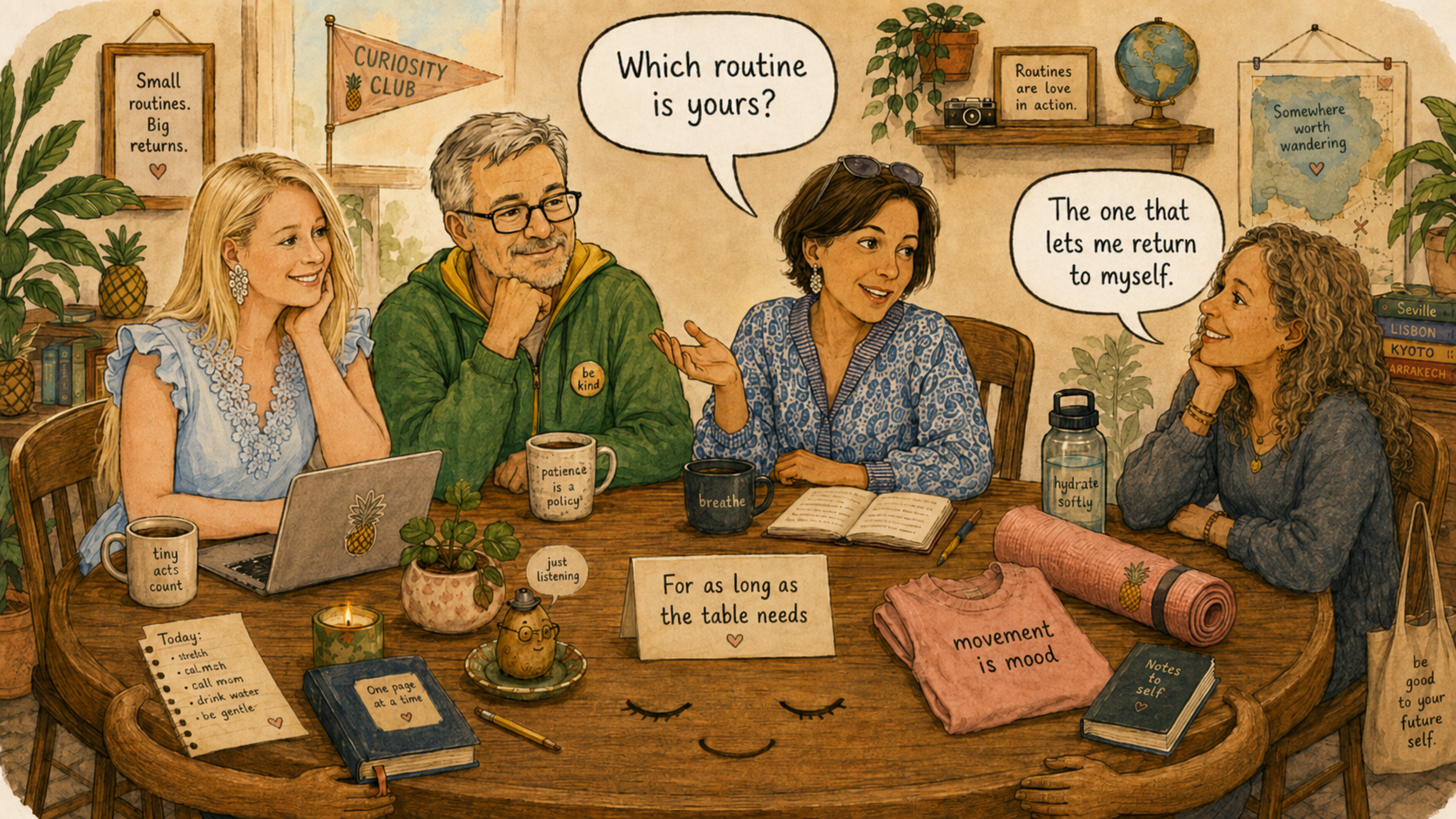
Lunch brings pink shirts, Seoul farewells, coffee in silence, invisible work, singing crocodiles and a royal penguin, all in search of the routines that help us return to ourselves.

Ralf enters the kitchen with a sparkling quark breakfast bowl, proving that healthy food does not need to be punishment food.

Then the issue starts moving again.

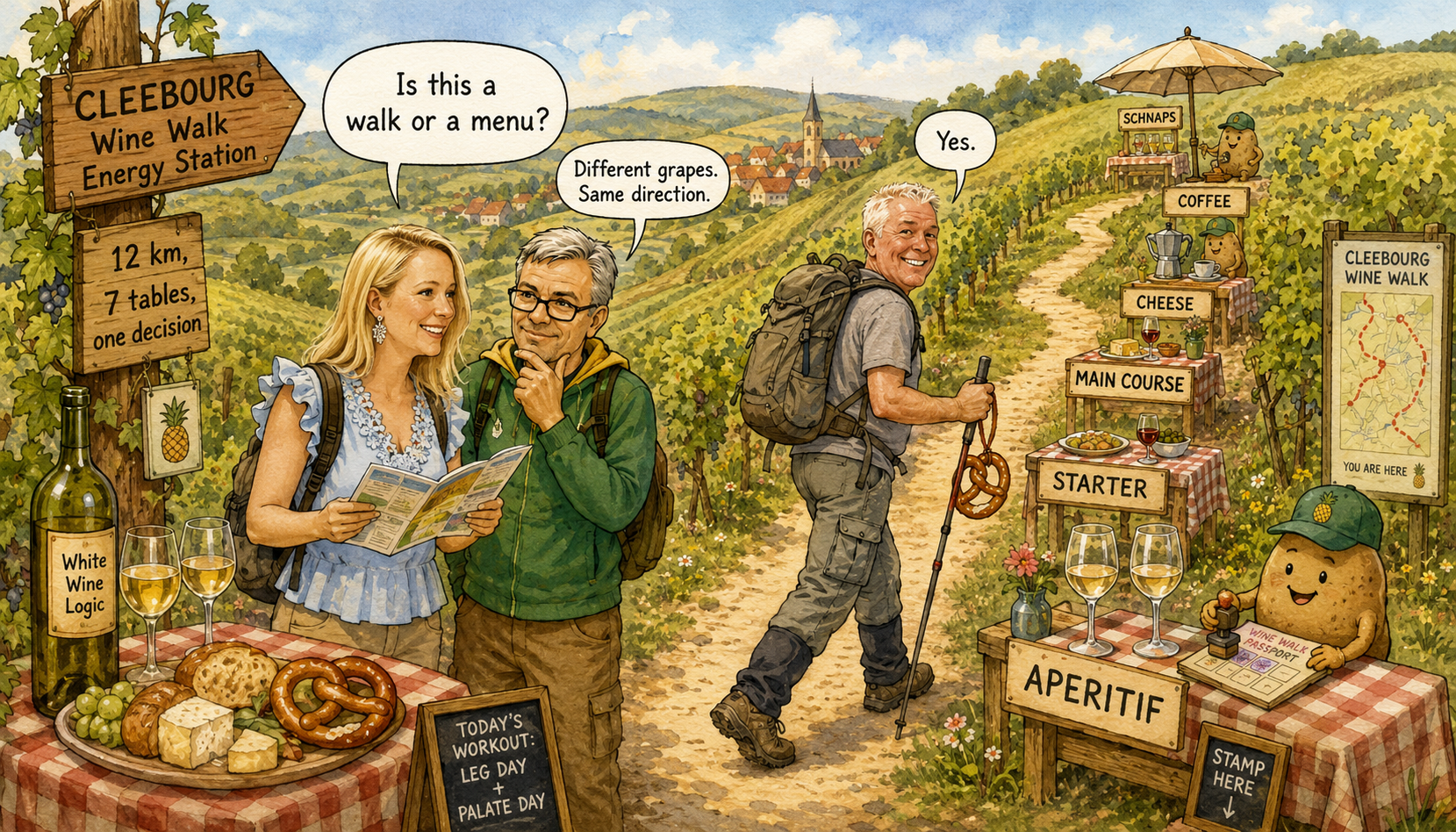
Fabrice brings little gifts, long walks, wild boars, cycling, shooting clubs, heat, handbags, Fruitloop, and the dangerous suggestion that the Mayor may one day have to walk 100 kilometres.

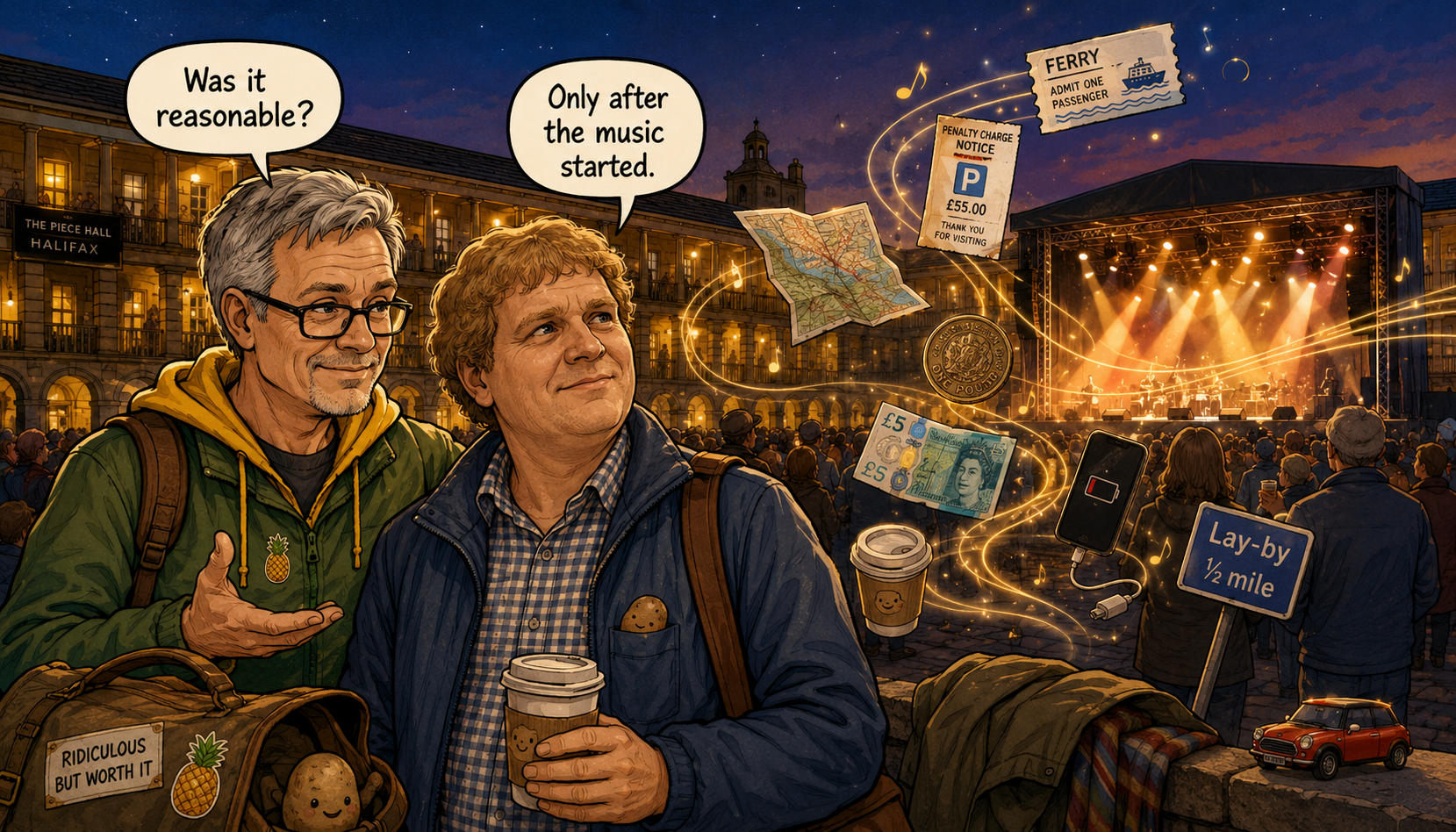
The Swimming Club takes us through ferries, lay-bys, trapped phone chargers, Halifax, The Piece Hall, and a Garbage concert that made the ridiculous feel entirely reasonable.

Peeling Potatoes returns with Fruitloop University, where an image, a prompt, and a fictional couple named Jack and Jill become a reflection on ordinary love, second chances, irritation, care, and imagination.

By the end, balance no longer looks like one calm thing.

It looks more like a collection of opposites trying to live together.

Comfort and discomfort.
Work and play.
Heat and rest.
Phones and silence.
Routine and surprise.
Fear and imagination.
Tiredness and movement.
Ordinary life and the strange little moments that make it feel alive again.

Maybe that is why this issue is called:

Comfortably Uncomfortable.

Because sometimes opposites do attract.

A new country can feel frightening and exciting.
A phone can help and disturb.
A routine can support and trap.
A long walk can exhaust and energise.
A ridiculous journey can make perfect sense.
A story can frighten us and wake us up.

This issue lives in those in-between places.

Not perfectly balanced.

But very much alive.

Enjoy reading.

source

When the Mayor and Fruitloop called me to talk about my life in England, I knew immediately that this was not going to be a normal interview. With them, it is never just a list of questions. It is always a conversation that goes in many directions, with jokes, teasing, serious thoughts, strange comments, and sometimes even Alexa interrupting when nobody asked her anything.

The Mayor explained that they had prepared 120 questions for me, although he promised they were not going to ask all of them because Fruitloop had domestic situations to attend to. The questions were divided into categories, but the idea was simply to let the conversation flow. The Mayor said that the result would go into the Pineapple on Friday, and then zillions of people, extraterrestrials, and Martians would read it, and I would become famous.

That sounded very serious, obviously.

The Mayor asked whether people in England understood me. I said yes. Then he asked whether I understood them. That was a bit harder, but for common subjects, yes, I did not really have problems.

He told me he could already hear a difference in my English, even though I had only been in England for a month. I said I felt a bit more fluent, but I still made too much mistakes. Of course, he corrected me immediately: too many mistakes. But he also told me not to worry, because he and Fruitloop make mistakes too. He said that if I knew how many mistakes they made, I would be shocked. Mistakes are part of learning.

He was right.

Then came the big question: where the hell in England was I?

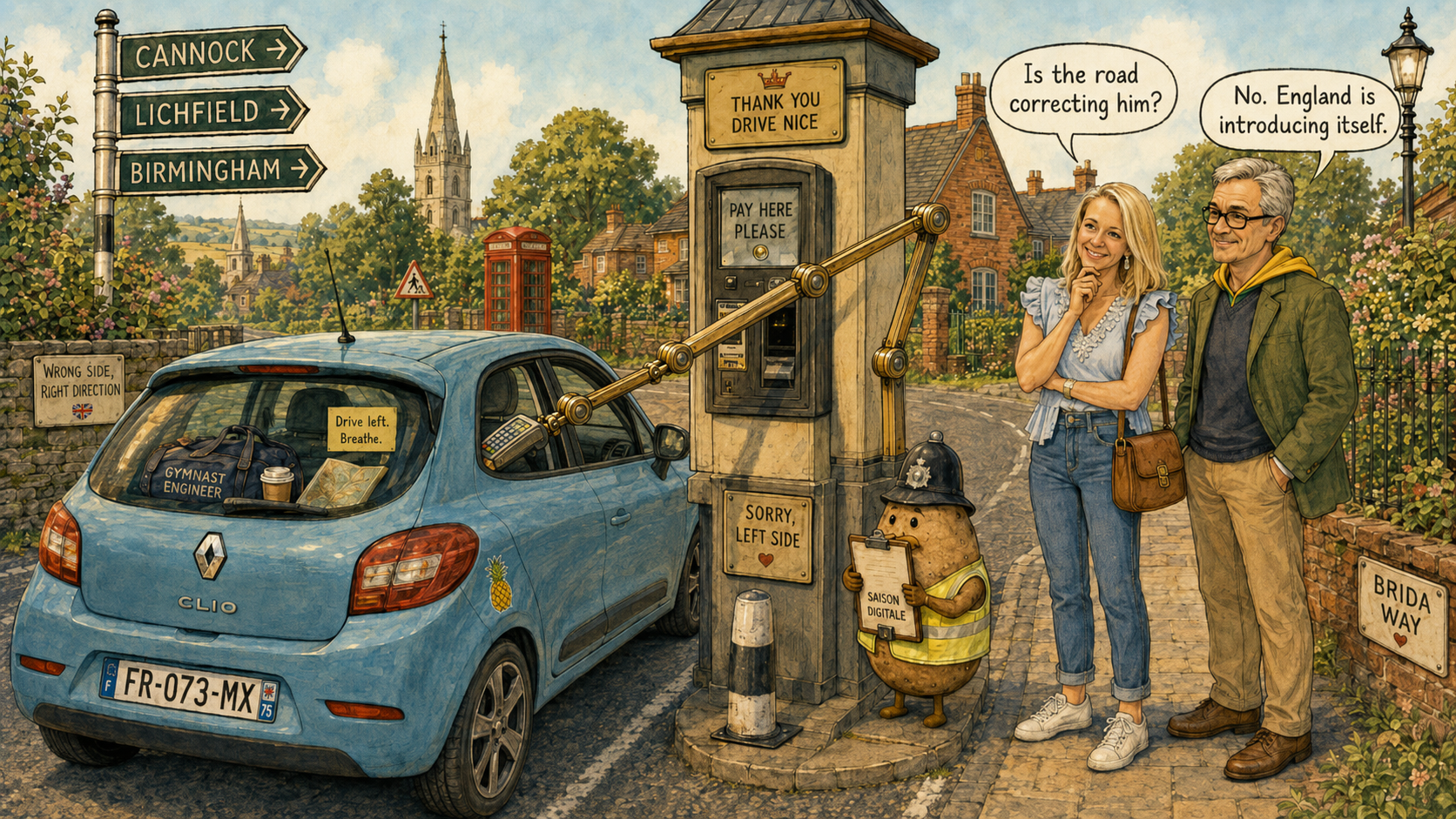
I told them I was just north of Birmingham. I work in Lichfield and live in Cannock. The Mayor immediately said no wonder I could not understand them. I had been to Birmingham, mostly because I do gymnastics there.

That was when they discovered that, of course, I had arrived in England and immediately found a gym.

At first, I had wanted to take a big rest of four months. I had not really taken a proper break for a long time. For the last two years, I had felt tired, and I thought it might be good to stop for a while. But when I found a club in Birmingham, it became impossible not to train. It may be one of the best clubs I have ever trained in.

The Mayor said he did not think I would ever be happy if I was not hanging upside down from the ceiling somewhere.

He is probably right.

When I thought back to my first few days in England, the strongest impression was driving on the left. It was really hard. On my first day, I drove a lot, and the roads shocked me. The roads are so bad in England, and there is so much dust on them. Driving on the left was difficult, and using tolls or payment points was also strange because everything is on the wrong side for a French car. The first time, I had to get out of the car. Later I realised that I could take another road and avoid that paying part completely.

The Mayor suggested that next time I should drive backwards into the payment point. Then he said that with a French licence plate, I had a licence to be a total idiot. It is a huge sign saying, “I’m not from here.” Fruitloop added, “Sorry, I’m French.”

In some ways, England felt new. In other ways, the situation felt familiar. It was not completely different from what I expected because I had already experienced leaving home when I went to Laval for my studies. I had also moved to the south of France for my second internship. Each time, it was the same basic experience: arriving in a new place, not knowing anyone, trying to make friends, trying to have social contact with people at work. So England was another new place, but the feeling of starting again was not new to me.

What has helped me feel at home most is the family I live with. They are really, really kind to me. They welcomed me almost like a new child. Because of that, I feel comfortable in the house and with the people I live with.

Fruitloop then asked what my days look like.

My routine is simple and full. I wake up early in the morning at 7. I go to work from 8 to 12. I have a pause from 12 to 1, then work again from 1 to 4:30. After that, I go to gymnastics. It takes around 35 to 40 minutes to drive from Lichfield to Birmingham. I train from 5:30 to 8:30, about three hours. Then I drive back to Cannock, another 30 or 35 minutes. I eat, and sometimes I work on the application I am developing. Sometimes I go for a little walk in the fresh air of the evening. Then it becomes night, and the same day begins again.

On weekends, I also train. I do gymnastics from 10 to 2, then I come back to Cannock and work on my application and develop my AI skills. So it is work, work, work, and then more work. I do not really take enough time to train my English, and I know I will have to make more time for that.

I told them that I am training with an Olympian. I train with six people who are in the top twenty in England. My coach is the person who won the most medals in one competition in England. He has a Wikipedia page.

I did not do anything magical. I searched on the web because I wanted to find a gymnastics club. There were not many around me, so I found one in Birmingham. I wrote an email. They replied and said I could come at a certain time to discuss what I wanted. When I arrived, I saw Luke Folwell, the coach, and all these gymnasts, and I realised it was a very big club. They welcomed me like any other gymnast and told me I could train as I wanted. That is it. Now I train with an Olympian.

Sometimes you just have to ask.

Fruitloop asked whether I had picked up any small everyday habits in England. I have not really picked up anything very different from France yet. Because it is summer, I work a lot in the evening when it is fresher, but that is not really because of England.

I have been to a pub, but with my parents. They came to visit me two weeks ago, and we went to different restaurants and pubs to eat and have a good time. That was fun.

Fruitloop asked whether I had discovered any local places, cafés, shops, or parks that had become part of my life. I do not really have time for that yet, but I have seen some very beautiful parks. Lichfield is a beautiful place, and the centre of Lichfield is very beautiful too, with a big park. But because I go to Lichfield every day from Monday to Friday for work, I do not really want to go there alone on the weekend. I prefer to visit other things.

Birmingham is a beautiful city too. It reminds me a little of Venice in Italy because there are small rivers, or canals, in the town. It is beautiful. I would like to hang out in Birmingham after training on a Saturday, but for the moment I have not taken the time. Fruitloop challenged me to do it next Saturday. He said the gym has a shower, so the problem is solved. Fruitloop told me to send pictures.

When Fruitloop asked about the food, I said it is different from France, but in reality it is good. Many people told me before I went that the food in England was terrible. But no, it is okay. It is not exactly the same, but we find meat, vegetables, pasta. The milk is a bit different, and I prefer the milk in France, but the roast is good and the local food is really nice.

My host does not cook for me every day, only sometimes, maybe once every two weeks. I cook for myself in the kitchen. For lunch, it depends. Sometimes I cook in the evening and take my plate with me for lunch. Sometimes, if I do not have anything, I walk to the supermarket near work with colleagues and buy something to eat. There are a lot of Tesco shops.

Sometimes, if I do not have anything, I walk to the supermarket near work with colleagues and buy something to eat.

Fruitloop asked how people behave in public compared with what I am used to. I feel it is totally different. In England, people do not look at what you do in the same way. In France, people are always looking at you. Here, you can just do what you want, and people do not care. I think that is better.

The Mayor then asked about the multicultural side of England, especially around Birmingham. He mentioned Brexit, the European Union, and the fact that there are many people from Africa, India, Asia, and other places. I told him I had noticed many Indian people, and in Chinatown many Asian people. I did not notice so many African people, but definitely more Indian people.

It was different from what I knew in Alsace or Laval, but it did not shock me. I had expected it before coming to England, so I was prepared to see it.

Then the Mayor asked how many times I had said “I’m sorry” that day. I said I did not think I had said it at all. He explained that saying sorry all the time is very English. People almost apologise for being there. After he said it, I realised that yes, my colleagues do say it sometimes. But my level of English is not yet at the point where I always notice these details. Sometimes I am concentrating too much on the rest of the sentence to notice small cultural habits.

He told me that tomorrow, when I went into the office, I should walk through the door and say, “Oh, I’m sorry,” and see what happens.

When he asked about the biggest cultural difference, I first said I did not really know because people are like people in France. But then I realised something important: people are really kind here. There has been no animosity toward me because I am French or foreign. At home, at work, at gymnastics, people are kind and welcoming. They welcome me like any other person in England. They smile. That may be the biggest difference from France.

The Mayor asked whether I had noticed the hidden nuances of English. He gave an example: if he asks his wife how she is and she says “fine,” he knows she is not fine. Meaning is not always in the word itself but in the pronunciation, the tone, and the expression behind it. I have noticed this sometimes. I saw colleagues who were angry about a situation with another person, even though the words themselves were not direct. I do not have a big story yet, but I have started to feel that there is hidden meaning sometimes.

What I have learned so far about the English mentality is clearest in gymnastics. There is a huge difference between training in England and in France. In England, people enjoy what they do, and they always encourage each other, even when the moment is difficult. In France, sometimes the coach says, “Do this three times,” then leaves, and you do what you have to do on your side. In England, people say, “Go, go, go,” and ask whether everything is good. They encourage you all the time. It is much more positive.

It is the same at work and everywhere. The mindset feels more positive.

Fruitloop then moved the conversation to work. She asked what it was like stepping into a new work environment in England.

For me, it is totally different because it is my first time really working as an engineer. My previous internships were more as a mechanic, not really as an engineer. So this is my first real engineering experience, and it is in English. The first week was very hard because I did not have the technical vocabulary. It was hard to understand what people were explaining to me, and they did not really know my level of English. After a few days, and then after two or three weeks, it became better.

But after two weeks, there was a moment when it was a disaster. I lost all my words. I mixed French and English. I had a headache, and everything became difficult. The week after, it was better again.

Fruitloop asked what the first English word was that I learned there. I said that is the problem: I do not really feel I am learning many new words, except technical terms like screw, rotor, retainer, and words like that, which are not very interesting. I feel that I work too much to concentrate properly on my English. But I am in England for that too, so I need to work less on work and work even more on English. The Mayor said that did not make sense, which was probably true.

At work, people are formal, but when we speak about other things, like what we did during the weekend, they are kind. They do not seem stressed. They have a lot to do, and they do it quickly, but the atmosphere does not feel stressed.

I do not feel very stressed about English at work because I am comfortable with my colleagues. But I have noticed that when I feel comfortable with people, I can speak English much more fluently. The words come. When I do not know the person very well, it is different. I become a bit nervous, and I cannot find my words so easily. It also depends on the subject. If I know the vocabulary, I can speak fluently. If I do not have the vocabulary, I sometimes cannot say anything. Then I have to find another way to say it, which is something I learned from preparation with the Mayor and Fruitloop. But in a work environment, people do not always have an hour to listen while I search for another way to explain something.

When they asked what I found interesting about how people work, I said I do not notice a big difference yet because this is my first experience in an engineering service. I have not seen the same environment in France, so it is hard to compare. We work in an open space. There are maybe forty places, with twenty or twenty-five people working there. There are human resources, a director, and a big laboratory on the ground floor. I think it looks similar to what it might be in France.

But I do think people have learned from me. I work on projects they do not have time to do. Each time I finish a job, they learn something from that. They are confident with me.

I also noticed a very big problem in an Excel sheet they had used to develop different electric motors. There was a big mistake, and I fixed it. They had used that sheet for the last four years. That means they may have made the same mistake for four years.

That was surprising, especially because they create electric motors for Ferrari, Bugatti, Aston Martin Valkyrie, the Red Bull RB17, Audi, motorsport, Formula 1, Formula E, and other high-level projects. I looked at that and thought: how can you do that with this spreadsheet? It was just not possible.

.When the Mayor asked what I had learned about myself since being in England, I found it difficult to answer immediately. I said that sometimes I am still shy, and I have to push myself to ask something or to speak.

He helped me by asking whether I had become even more independent than I was in Laval. In some ways, yes and no. I do not have my family here. It is a new place. I cook for myself. I go to the supermarket. But in terms of independence, it is similar to Laval. The biggest difference is that in Laval I went to school, and now I go to work.

He then asked whether I had become more confident because I now have to do everything in English. I think yes. And I think that when I return to France, I will probably be more comfortable there because if I can do these things in English, in another language, with other people, I will be even more comfortable in French.

The thing I am most proud of since arriving is gymnastics. They tried to put gymnastics to one side, but that is the problem: gymnastics is the answer. Still, solving the Excel problem at work was also something to be proud of.

Then Fruitloop asked more about gymnastics and the coaching style.

It is so different. The last time I had a real coach like this was in Haguenau, eight years ago. In Birmingham, I have a real coach who takes care of me. He asks whether I need something. He comes to see what I am doing. He encourages me all the time and gives me new exercises. He always checks whether I need something.

In France, it was different. In Laval, I had a coach who is now a very good friend of mine, but he is too young and does not yet have huge experience. My other coaches in Alsace train young people, so they do not have the time to train me correctly. If I do not go to them and ask for something, they may never look at what I am doing. In Birmingham, I feel I have a real coach again, and a very good one with the best advice.

My ankles are better. I work on floor and vault again, which is nice.

My body has handled the change, but it is a bit harder because I only train gymnastics three times a week. I have one day on, one day off. I am used to training every day, three or four hours a day, so having a day off every two days is harder. Because of that, I have taken a subscription to a gym club in Cannock so I can do conditioning when I do not go to gymnastics.

Fruitloop asked whether I had brought the rings that I had in my room. I had, but they were not hanging yet because I do not have a bar. The Mayor said he was not sure a standard two-up, two-down house in the UK could handle rings hanging from the ceiling. It might be safer to go to the gymnastics club. I said maybe I could bring them to the gym club.

Near the end, the Mayor said I sounded very positive and excited. Then he asked me directly: am I happy?

Yes. I am happy.

Really, yes.

Everything is good. I do not have any problems. I learn a lot of new things. I do not have time to think too much because I am always busy doing things. So yes, I am happy.

The Mayor noticed that I had said I did not have any problems. He asked whether, in France or on the continent, we are too negative, always saying this is a problem, that is a problem, Macron is this, Le Pen is that. I said yes, directly. Yes.

But I also explained that maybe I do not yet understand everything people say in English, so I do not fully realise other people’s problems. I need to be more comfortable with the language and understand better what people say all the time before I can really see that.

He asked what English habit or custom I would bring back to France. I did not know how to answer. Then he said he thought he knew why. He said I was living it. He could see in me an excited, positive, bubbling personality, an optimistic future. He said I had that before, but now it was exponentiated.

I think part of it is simply the new experience. If I were in Italy or somewhere else in the world, maybe it would be the same because the important thing is the new experience. But England has given me that new experience in work, in life, and in gymnastics.

Fruitloop asked whether I miss France, university, or home.

School, no. I never really went there, so I do not miss that. Of course, I have friends at school, but the relationship is a little special. We know from the beginning that we are there for school and that later we will be around the world, everywhere in France or elsewhere. So I do not really miss them in the same way because we always knew it would be like that.

I miss my family and my parents, but that is normal. We can call each other every week or every two weeks by video, so that is okay.

What I miss more is having close friends nearby. In Laval, my coach was also a very close friend. We were together almost every day at the gymnastics club, and after training we went to different bars. I miss that. The gymnasts I train with now are very friendly, but for the moment we do not really have moments together in a pub or somewhere else. I miss that a little bit.

Maybe that is why I always work on my project. I do not have anything else to do.

Fruitloop and the Mayor both told me to go to a pub. They said it is the best place to meet people in England. I said I would try the gym club in Cannock first.

I will be in the UK until the end of September, so I have three more months. After that, I will go back to Schœnenbourg. I will be there for a year because I will return to Sébastien Loeb’s private team for a gap year. I have just finished my fourth year of study, and I will work with Sébastien Loeb’s private team and go to the Dakar in January. After that year, I have to finish my studies. Maybe I will return to Laval, but I would prefer to return to the UK, maybe Cranfield.

The Mayor said they would keep their fingers crossed for me because Cranfield is a very good place. He also joked that Ferrari was still a backup, especially the electric blue one.

At the end, the Mayor thanked me. He said that he had spent the last three weeks doing a lot of planning, process work, and structural work, driving poor Fruitloop crazy in the process. That day, he had found himself asking why he was doing it all. Then he said that the big takeaway from the conversation with me was that he knew why.

The world is big.

The world is actually a brilliant place to be in.

It is positive.

You just have to find the right people.

He thanked me for sending a positive spark from Birmingham to Cleebourg and South Africa.

I thanked him too. I told him that maybe if I had never taken the courses with him and Fruitloop, I could never be where I am now.

That is true.

Without that preparation, I might not have had the confidence to arrive in England, speak with people, ask questions, write to a gymnastics club, work in English, fix problems, and build this new life.

For now, my life in England is busy. It is work, gymnastics, driving, cooking, learning, training, building an application, developing AI skills, meeting people, making mistakes, fixing mistakes, discovering roads, parks, pubs, supermarkets, English kindness, technical vocabulary, Birmingham canals, and a gymnastics club where I train with an Olympian.

It is strange sometimes. It is tiring sometimes. It gives me headaches sometimes.

But it is also cool. Very cool.

And yes, I am happy.

Partner Page
Advertisement
source
The Pineapple

The Question That Changed Everything

Sometimes a sentence stays with you for years without you really understanding why.

You hear it often enough that it becomes familiar, almost invisible. It settles somewhere in the background of your life, like a photograph hanging on a wall that you pass every day without noticing. Yet for some reason it refuses to disappear completely. Long after other memories have faded, it remains.

For me, that sentence was:

“Hello, how may I help?”

My mother-in-law answered the telephone that way. Every single time.

The phone would ring, she would pick it up, and before the caller had said anything meaningful, she had already established the tone of the conversation. Not “Who is this?” Not “What do you want?” Not even the usual polite greeting followed by a pause.

Simply:

“Hello, how may I help?”

At the time, I never thought much about it. It was simply the way she answered the phone. Yet somehow the phrase lodged itself in my memory. Years passed. Decades, in fact. The words remained, even though I could never quite explain why they had stayed with me when so many other things had been forgotten.

Only recently did I begin to understand.

Over the last few months, I have spent a surprising amount of time thinking about systems. Brida systems. AI systems. Community systems. Ways of organising information. Ways of helping people. Ways of building something that remains useful even as it grows.

When you start building things, there is a natural tendency to focus on the thing itself. How can it improve? How can it become more efficient? How can it reach more people? How can it grow?

These are not unreasonable questions. Most organisations are built around them. Most businesses depend on them. Entire industries exist to answer them.

But somewhere along the way, I noticed that another question kept appearing. It surfaced quietly, almost by accident, during conversations about projects, communities and possibilities. And whenever it appeared, the discussion seemed to change direction.

Instead of asking:

What can we gain from this?

the question became:

How can we help?

The difference is subtle, but the effect is profound.

The first question places us at the centre of the story. The second places somebody else there.

The first looks for opportunity. The second looks for understanding.

The first asks what can be extracted. The second asks what can be cultivated.

And cultivation, I have realised, sits at the very heart of Brida.

Many of the most meaningful things we have created over the years did not begin with a grand strategy. They began with paying attention. A member told a story. A conversation revealed a tension. An ordinary moment contained something worth exploring. Somebody shared an experience that resonated with others. A small tuber appeared beneath the surface, and instead of rushing past it, we stopped to look more closely.

That process has taught me something important. Communities do not become valuable because they are constantly trying to grow. They become valuable because they are constantly trying to be useful.

Those are not the same thing.

Growth can be pursued directly. It can be measured, optimised and accelerated. But usefulness is different. Usefulness requires curiosity. It requires listening. It requires a willingness to spend time understanding what matters to another person before deciding what to do next.

The more I think about it, the more I realise that my mother-in-law’s simple greeting contained an entire philosophy.

She was not beginning the conversation with herself.

She was beginning with the other person.

She was not announcing her intentions, her needs or her priorities. She was creating space for someone else’s.

In a world increasingly filled with noise, promotion and self-interest, that feels almost radical.

Perhaps that is why the phrase stayed with me all these years.

Not because it was clever.

Not because it was unusual.

But because it reflected something deeply human.

People want to be heard. They want to be understood. They want to feel that somebody is genuinely interested in what matters to them. Whether we are talking about friendships, families, organisations or communities, that truth seems remarkably consistent.

As Brida continues to evolve, I suspect we will create more systems, more Potato Patches, more conversations and more Pineapple articles. We will continue looking for better ways to connect people, share ideas and cultivate meaningful experiences.

But underneath all of that, I hope we keep returning to the same simple question.

The question that quietly changes the direction of a conversation.

The question that transforms opportunity into relationship.

The question that turns growth into cultivation.

The question that stayed with me for years before I finally understood why.

How can we help?

Perhaps that is where every meaningful conversation begins.

source

The strange thing is that I did not even have time to use my phone very much when I was away.

That was my first answer to The Mayor, and it was true. I had been travelling for work, sitting in meetings, moving from one place to another, and the phone was there, of course, but not in the way it normally is. Normally, I use it a lot. I check emails. I check messages. I look at Instagram to see new videos. In the morning, even before I get out of bed, I check what has arrived. And when I go to bed, I often open YouTube, put one AirPod in my ear, and listen to something until I fall asleep.

I said to him, very honestly, “I think this is horrible for my brain and my mind.”

But I also said the other truth.

I fall asleep faster when I hear something.

That is already the problem with digital balance. The phone is not only bad. It helps. It relaxes. It gives information. It gives music. It gives connection. It gives work. It gives distraction. It gives everything. And maybe that is why balance is difficult, because the phone is not one thing. It is private life, business life, family life, entertainment, stress, memory, pressure, and comfort in one small object.

For my work, I really need digital tools. My phone, laptop, and tablet are important every day. When I am with a customer, I write notes about the conversation. When I leave the meeting, I add more details that are important for me. When I travel, I check emails on my smartphone. At a trade fair or a training event, when someone comes to speak with us, I write down who they are, where they work, what they need, and all the contact details, especially when they do not give me a business card.

I could work without digital tools, yes. I could write everything on paper. But then, when I come home, I have to transfer all the notes into the system. And that means I have more work in the evening. This is why I use digital tools. When I write it directly, it is finished. I do not carry the work home in the same way.

The Mayor showed me his notebook. He has many notebooks. He writes by hand every day. He told me he has enough paper to continue until 2028. I had to smile a little, because for me this feels old school, but also interesting. I know this feeling because when I started in my current professional path, I also used paper. I wrote with a pencil. I could write very fast, and it was only important that I could translate it later after the meeting.

At that time, someone senior travelled with me and told me, “Alex, we are in 2024. Please make your notes on your laptop.”

After that, I used only the laptop.

At the beginning, it did not feel nice. With a pencil, I was faster. With the laptop, I needed maybe ten seconds longer to write everything down. And then there were ten seconds of quiet in the room. That quiet was unusual. It felt strange. But now most people use laptops in meetings. Everyone sits around the table, everyone types notes, and it is normal.

Still, I understood what The Mayor was saying. Sometimes the year and the technology become more important than the question of what works naturally for a person. The argument becomes, “We are in 2024,” not, “What helps you listen better? What helps you remember? What helps the conversation?”

That stayed with me.

Then we spoke about one moment from my week when my phone made my life easier. During a break in a training session, I checked my phone for new emails. It was easier than opening the laptop or tablet. Just a quick check.

But The Mayor challenged me there.

He said, “Wasn’t the break important enough?”

And he was right.

The break was there to switch off, speak with people, maybe relax for a few minutes. Instead, I took out the phone and pulled myself back into work. I did not think about it. I just did it. You sit down somewhere, at an airport or in a break or in a waiting room, and the first thing you do is take out your phone. Not because something is really important. More because you have the feeling that maybe something is happening somewhere, and you should know it.

You sit down somewhere, at an airport or in a break or in a waiting room, and the first thing you do is take out your phone.

He called it the fear of missing out.

FOMO.

I knew immediately what he meant.

And I had a very clear example. During that training week, I checked my emails in a break and saw a bad message from a customer. There had been a problem in a warehouse. One of our products was damaged, and there was a small fire. In the end, it was not the biggest disaster, because they saw it early and reacted quickly. But in that moment, when I read the email, my whole mindset changed. The next half hour, maybe the next hour, was negative in my brain.

The important part is this: I did not even answer the email that day. I answered it later.

So nothing would have happened if I had not read it during the break.

But because I saw it, I carried it into my head. And then I shared it with other people around me. Some of them needed to know, yes. Others maybe did not need to know at that moment. I think this is human nature. When I get a bad message, I want to share it because then I hope someone gives me a good answer, or brings me down, or helps me feel calmer. But by sharing it, I also give the negative feeling to other people.

That was not nice to realise.

It was not panic, but it was a shock reaction. A bad message came in, and my brain said, “Oh my God, this is important.” But rationally, there was nothing I could do in that moment. The damage had already happened. I was in a training course. The customer did not know that. The topic would need a proper answer later, with the right people involved, not a stressed reaction during a coffee break.

So yes, I think I overreacted emotionally.

And the easiest way for me to delete that negative feeling was to share it.

The funny thing is that in that training, we were asked not to use phones or laptops. We were supposed to make notes for ourselves, but not digitally. So, in a way, the rule was already pointing to the solution. The Mayor asked me what would have happened if, in the morning, we had all given our phones and laptops to someone, like children sometimes have to do in school, and only received them back at the end of the day.

Nothing would have happened.

Actually, I think it would have been better.

Maybe in the first moment it would feel negative. I am very used to checking when something is new. Private things, business things, all mixed together. I want to know. But when I look back, I think it would have been healthier to leave the phone outside, in the hotel room, in a safe, anywhere. Just not available.

That is easy to say after the moment. It is harder inside the moment.

Because the phone is normal now.

Later, we turned the question around. The Mayor asked what he could learn from me if he joined me for one workday and watched how I use digital tools professionally.

My first answer was: nothing.

For me, writing something in a notebook or writing it directly into a laptop is not so different. The only real difference is that with digital notes, I do not have to transfer them later. But then he challenged me again. He spoke about memory, about how the human brain is a miracle, about how he remembers things from conversations years ago because the connection itself stores something. He asked if maybe we are losing our power of observation and memory because we depend too much on technology to think for us.

I agreed with part of that.

But I also think the quantity of information is higher every year. At some point, you cannot remember everything. In a meeting, a customer may tell me what the company does, how big it is, how long it has existed, how long he has worked there, how old he is, when his birthday is, and many other things. If I do not write these things down, after the meeting they are gone.

Maybe that is because my memory is not trained enough.

Maybe it is because the information load is too high.

I think it is both.

The Mayor gave the example of birthdays. You can write them on paper. You can keep a birthday list. Or you can put them into a digital calendar. Then the system reminds you. LinkedIn makes it even easier. It gives you a notification and even prepares a message, and you only press a button. You feel like you remembered the birthday, but actually you did not remember anything. The system remembered. The system instructed you.

On this point, I am very bad. I cannot even tell you all the birthday dates in my family. Some important dates are saved in my calendar so I can congratulate the person. And yes, Julia helps me a little bit too. I think many partners do this. They carry part of the family memory.

But I also defended digital tools here. The Mayor has many notes in many places: notebooks, calendars, paper lists, maybe books with telephone numbers. Today we can work smarter and keep many of these notes on one or two devices. That is also balance. Not everything old is better. Not everything digital is bad.

Of course, then there is the question: what happens if the system is down, or the data disappears?

Then we have a big problem.

So there is no perfect system.

Maybe digital balance is not about choosing paper or technology. Maybe it is about knowing what each one does to your mind. Digital tools are very efficient. But they also create pressure. Paper is slower. But maybe that slowness sometimes protects the human part.

At the end, The Mayor asked me a strange question. He asked what would happen if I had to spend one week in a monastery or a temple, with no technology at all. No news. No emails. No WhatsApp. Nothing.

I said I think it would be healthy for me.

But I also said I cannot imagine it.

Because I would want to write Julia. I would want to ask how she is, how my son is, if everything is okay. That is not business pressure. That is family. That is love. That is also why the phone is complicated. The same device that brings a bad work email into my break also brings my wife and son close to me when I am away.

So what should I do with that?

Maybe I do not need to throw the phone away. Maybe I need to respect the moment more. A break should be a break. A family evening should be a family evening. A training course should be a training course. And when there is really a problem, I can answer it properly, not emotionally, and not always immediately.

I think I learned that my phone helps me a lot, but it also steals small pieces of my mind. Not in a dramatic way. Just quietly. A quick check here. A message there. A video before sleep. An email during a break. Music when I could maybe sit in silence.

And maybe the real fear is not only missing out.

Maybe the real fear is being alone with the moment in front of me.

I am not sure yet.

But I know this: if I had not checked that email during the break, the problem would still have been there later. The answer would still have been possible. The world would not have ended.

And my mind, for that one small break, might have stayed free.

Partner Page
Advertisement
source
The Pineapple

The Cat, the Panther, and the Toxic Phone

I arrived a little bit late for our meeting, and I was like, sorry, because I was with my friends and I absolutely forgot the time. Fruitloop said it was okay because she used the time to give cooking instructions to her husband. So really, I was late, but also I helped the dinner situation, I think.

My day was really cool, but also so warm. In France it was too hot to stay in school, so we had our practice in a room in the village center because there was air conditioning. In the school we don’t have this, so it was really hard to work, to play, to do anything. Fruitloop told me that in her place it was cold because of the wind, even if the temperature was 22 degrees. I said if we had 22 degrees, we would be wearing the same clothes as we wore during this heatwave.

Then we spoke about my holidays. I have many meetings, please. Tomorrow I have school practice again, then a meeting at 7:30 p.m. for the church camp, and before that a call with friends because we have to make the menu for the two-week scout camp. The church camp is from the 5th to the 8th of July, and the scout camp is from the 18th of July to the 2nd of August. Fruitloop realised this was probably our last lesson before the holidays, and I was like, oh no, terrible, but also it is holidays, so okay.

Our topic was balance between work and play. I said it is when you know how to be serious with your work, your career, your school, but next to this you also have hobbies and fun. During school, my study meter is higher because my mom doesn’t allow me to go out with friends during the week. Only weekends. But during holidays, my fun meter is higher, obviously.

Fruitloop asked me about a cartoon or game I still secretly love, and I said Totally Spies. The old one, not really the new one. I loved the lipstick laser, the mirror with GPS, all the spy things. I told her it is on Netflix, and she said maybe her son would not watch it because he thinks everything like Barbie or My Little Pony is for girls. Okay, his loss.

Then Fruitloop gave me the quote, “All work and no play makes Jack a dull boy.” At first I didn’t understand. Who is Jack? Is he a cartoon character? But Fruitloop said Jack can be anyone. Then I understood that “dull” means boring. I said if you delete play from your life, you delete hobbies, social interaction, good moments, and sharing time with friends. That makes people boring and sad. Really sad.

We spoke about what would make a 16-year-old Jack dull today. I said not having friends. Maybe you can have hobbies alone, but if you don’t have social relationships, you don’t learn how to speak with people, how to react, how to adapt yourself. At my school there are different groups in the room in the center of the high school. The nerds, the others, us, all these groups. But I said we can’t really judge if people are boring because we don’t know them. Maybe we just don’t speak with them because we don’t have the same hobbies.

After that, Fruitloop taught me about doom scrolling. I know scrolling, but not doom scrolling. It is when you scroll forever, like on TikTok, and you cannot stop. I said TikTok feels like magic because sometimes I see the warning video with the dead thumb, and I think, okay, I have to stop, but I can’t. I said scrolling is not really a proper break because your mind doesn’t stop. It helps you think about other things, but it secretly drains you. Sport is much better for a mental break.

If my brain freezes after four hours of studying, my fastest reboot is food. Banana chips are very good. Fruitloop also loves dried bananas, so now we are together in the banana chips club. I also said Nutella gives me energy, but Fruitloop buys the cheaper version because Nutella is expensive and her son would eat the whole thing with a spoon. Honestly, same energy.

I also said Nutella gives me energy, but Fruitloop buys the cheaper version because Nutella is expensive and her son would eat the whole thing with a spoon.

We also talked about staying up late with friends. I said when you are with friends, you don’t realise time passes. Like today, I forgot I had English and had to run home because my mother reminded me. I did my sport of the week, please. Sometimes when the alarm rings the next morning, I regret staying out late, but when I remember the memories and the good moments, I don’t really regret it anymore.

From scouts, I learned to adapt. When something happens and I wasn’t prepared, I can react in the moment. From school, I learned how to survive boring things by being boring too. Like, okay, I don’t want to be here, but I am here, so I have to do it. Very inspiring, I know.

I told Fruitloop I try to do all my homework on Friday, even if it takes two or three hours, because then I can enjoy my weekend without being scared like, “Oh no, I didn’t do this.” My Wednesday afternoon is also very important. It is my break. I can see friends, watch Netflix, eat snacks, do my everything shower, wash my hair, do scrub things, and just not think about school. If I didn’t have that, I think I would become crazy.

Next year my schedule will change because I chose specialities. I will have more science, maths, and physics, maybe double the hours. I don’t know if I will still have Wednesday afternoon free, which is absolutely sad. But I dropped subjects I disliked, like economic and social science and technology things, because they were so annoying.

Some school subjects can feel like play. Physics, for example. We had normal lessons with the textbook, but on Friday we had practical lessons for one hour and thirty minutes. We did experiments and calculations, like finding out how much we would weigh on the moon because of gravity. It was difficult, but I liked it because it made an annoying problem interesting.

Then we spoke about phones. I said my phone is a bad instrument, but also my best friend. It is a toxic relationship. I hate him, but he says, “Please love me, love me, love me all the time,” and then I love him. When I was at scout camp last summer for two weeks without my phone, it wasn’t difficult because I was with my friends. But sometimes, when I have no notification, I check every thirty seconds like, why is there nothing?

Fruitloop told me that when she was my age, phones were only for calls and SMS, with black and white screens, no camera, no real internet. Later she used something like WhatsApp, but people had to be online at the same time. That is so weird. I think modern phones are not always good, but also I don’t know how people survived before.

We talked about social media pressure, but I said I don’t feel pressure to be productive or start a business. I leave that for influencers. I use TikTok to send funny videos to my friends. I watch influencers sometimes, but I’m not a fan like I need to see them in real life. Fruitloop prefers animal rescue videos, which is more positive. I said social media is really fake now, and many people use AI. We also laughed about fake AI videos, like a lion attacking a car, where you can see it is not real. Some parents believe these videos, but I can smell it is fake. Please.

Then we did silly questions. If schoolwork was an animal, I said it would be a cat because it sleeps, but it is also agile. Free time would be a black panther. Then we realised a panther is also a kind of cat, but stronger, so my free time would probably eat my schoolwork. If they became best friends, it would be perfect because I would be balanced and relaxed.

If a balanced, stress-free day was a pizza topping, I said rocket. Also olives, mozzarella, pesto, tomatoes, and cheese. Basic pizza, but good pizza. Fruitloop said she should tell her pizza place, and I said she must send one to me by post, please.

For a useless but fun job that pays $100 an hour, I said professional fun activity tester. Last year in English, we learned about the best job in the world in Australia, where someone got paid a lot to test activities and places. Then we spoke about restaurant inspectors and secret shoppers, like supermarket FBI. Honestly, testing hotels sounds much better than checking if Nutella costs $12. Make it cheaper, please.

At the end, Fruitloop told me to enjoy my holidays, scout camp, and church camp. She said if I remember and have time, I can send pictures or videos. I said I hope I will remember, because honestly, it is me, so we never know.

So that was my meeting with Fruitloop before the holidays: too much heat, too many meetings coming up, one toxic phone, banana chips, physics on the moon, and a cat schoolwork being eaten by a black panther free time. I think that is balance. Or maybe chaos. But cool chaos.

Partner Page
Advertisement
source
The Pineapple

The House Next Door

Chapter One

The smell of braai smoke and cut grass hung heavy in the warm summer air. It was the perfect Saturday evening. My husband and I were sitting outside on the patio, watching the wood fire crackle down to a bed of glowing orange coals, while the faint, joyful sound of a neighborhood kid’s birthday party echoed from a few streets over.

Then, the peace shattered.

The sharp, agonizing screech of performance tires tore through the quiet suburban street. A flashy, late-model sports truck flew around the corner and came to an abrupt, jerky stop in the driveway next door. It was Vince.

He was young, excessively wealthy by the looks of it, and owned the sprawling modern house right beside ours. He drove a rotating fleet of loud cars, but the truth was, I couldn’t stand him. We had only spoken once or twice across the boundary fence, but every interaction left me with a deep, inexplicable sense of unease. He just gave me the creeps.

The passenger doors flew open, and three young women—dressed for a high-end night out and looking to be around twenty-three—spilled out of the cab, laughing loudly. Within minutes, a handful of other cars arrived, blocking the pavement, and the party officially kicked off.

Through our sheer curtains, I could see their dark silhouettes dancing carefree against the glowing windows next door. The thumping bass vibrated through the floorboards, punctuated by the clinking of beer bottles and the girls screeching along to their favourite songs.

My gut twinged. A subtle, cold knot formed in my stomach, telling me something about the scene was entirely off, but I couldn’t quite put my finger on it. I tried to brush it off, rationalizing that I was probably just being overly critical because I already disliked the guy.

“Dinner’s ready,” my husband called from the patio door, breaking my stare. “Let’s head inside.”

“I’ll grab the outside glasses,” I replied, standing up. “Would you like a refill?”

“Yes, please.”

I quickly cleared the patio table and stepped inside. But just before I slid the heavy glass door shut, my eyes caught a sudden, erratic movement through Vince’s kitchen window. Maybe it was just motherly instinct, but a fleeting, heavy thought crossed my mind: I hope those girls are going to be okay.

Shaking the shadow from my head, I locked the door and walked into the kitchen. My husband was already dishing up our dinner, and I refilled our drinks. After eating, we followed our usual weekend routine—taking turns in the shower before crawling under the duvet. My husband switched on the television, but the mindless hum of the screen quickly lulled me into a deep sleep.

Chapter Two

I jolted awake.

My heart was hammering violently against my ribs, and a cold, slick sweat coated my lower back. I sat completely rigid in the dark, every muscle in my body tense.

Did I just hear screaming?

I slipped out from under the covers and walked quietly through the dark house. I peeked through the blinds of the living room window, but the neighborhood was a landscape of pitch-black silence. There were no lights, no music, and no rowdy partygoers spilling onto the lawn. I glanced over at Vince’s house. The flashy cars were gone. Everyone had left.

I checked the glowing digits on the microwave clock: 3:00 AM.

When I climbed back into bed, my husband stirred, shifting his weight toward me. “Is everything alright?” he mumbled, his voice thick with sleep.

“Yes,” I whispered, pulling the blanket to my chin. “I woke up suddenly. It must have been a nightmare or something… I could have sworn I heard a scream outside.”

“I didn’t hear anything,” he murmured, his eyes already closing again. “Probably just a bad dream.”

“I don’t know. I’ve been feeling a bit off ever since Vince came home with those girls.”

“Well, they’re grown-ups, love. Leave them be.”

“You’re probably right.”

I didn’t get much sleep after that. When Sunday morning finally rolled around, I dragged myself out of bed feeling entirely exhausted, my body aching from the severe lack of rest. In the kitchen, the comforting aroma of fresh coffee and frying breakfast filled the air as my husband worked at the stove. In the living room, my seven-year-old son was happily watching cartoons, his superhero toys scattered across the carpet.

Later that morning, I packed my reusable bags and set off for the local supermarket. As I pulled down the street, I passed Vince’s driveway. He had just returned from somewhere, turning off the ignition of his truck. I watched him open the door and haul out an enormous, heavy stack of McDonald’s brown paper bags and extra-large drink trays.

It was a tell-tale sign of a massive hangover crowd, but the sheer volume of food he was carrying inside looked like enough to feed a small army. Maybe the whole party stayed over, I thought to myself. I forced a self-deprecating laugh at my own paranoia, shifted the car into drive, and pulled away.

Chapter Three

By Wednesday, the weekend had completely faded from my mind, and I was already counting down the days until the next Friday.

I was sitting on the couch, mindlessly scrolling through my Facebook feed, when a local community post made the blood completely run cold in my veins.

MISSING: THREE YOUNG WOMEN LAST SEEN SATURDAY NIGHT

My fingers trembled as I clicked on the emergency alert, reading through the text with a rising sense of horror. The three girls were best friends. They had gone out together for a girls’ night and had been spotted by security leaving Live Wire—a popular club in our town—in the early hours of Sunday morning. They had never made it home. They had been missing since Saturday night.

My mind instantly flashed to Vince’s screeching tires. He had brought home three girls.

Could it be a coincidence? In a town this size?

I bolted from the couch and ran straight to my computer setup. We had a comprehensive Ring security camera system installed around the perimeter of our property, covering the entire front garden and the shared driveway line. My hands shook as I opened the digital archives, logging into the cloud recordings from Saturday night.

I filtered the timestamp to the evening hours, scrolling past clips of the wind rustling the trees and our own return home. Then, I found it.

The playback was crystal clear. The wide-angle lens captured Vince’s truck slamming to a halt, the headlights cutting through the gloom. And then, stepping out into the ambient light of the streetlamp, came the three girls. I paused the video, zooming in on their faces, comparing them directly to the photos on the missing persons flyer.

I felt faint. The breath left my lungs in a sharp gasp. It was them. It was the exact same girls.

Without a second thought, I grabbed my phone and dialed the emergency detective number listed at the bottom of the Facebook post. The line rang twice before a deep, tired voice answered.

“Hello, this is Detective Moore.”

“Yes, Detective,” I said, my voice tight with adrenaline. “My name is Alice. I live on Gordon Street. I think I have critical information regarding the three missing girls you are investigating.”

The tone on the other end shifted instantly from routine to razor-sharp focus. “Okay, Alice. What do you know?”

“I have clear security camera footage from my home system,” I explained, leaning closer to the monitor. “It shows my next-door neighbour bringing those exact three girls back to his house late Saturday evening.”

I have clear security camera footage from my home system,” I explained, leaning closer to the monitor.

“Wow,” Moore exhaled. “And can you clearly identify their faces from the recording?”

“Yes. I’ve checked it over and over again against the photos. It’s definitely them.”

“Let’s set up an urgent meeting. Would you be able to hand over a digital copy of that footage to the department?”

“Yes, of course. Whatever helps the investigation. I want to give it to you.”

“Can we meet at the station this afternoon?” Moore asked.

“I can come right now,” I pressed. “The sooner you have this, the better.”

“I’ll be waiting for you. See you soon, Alice.”

I frantically exported the video file to a flash drive, grabbed my car keys, and rushed out the front door.

Chapter Four

When I pulled up to the police station, Detective Moore was already standing on the tarmac outside the main entrance, watching for my car. He didn’t waste any time. He escorted me straight back to his private office, plugged the flash drive into his terminal, and pulled up the footage.

I sat silently as he watched the loop, his expression hardening with every passing second. Once the video finished, he opened a formal file and took down my official witness statement, documenting every detail of the evening. I told him about the flashy cars, the silhouettes dancing, and the massive McDonald’s run the following morning. I hesitated for a fraction of a second before adding the detail about the muffled scream at 3:00 AM, making sure to note that it might have just been a vivid nightmare.

By the time the paperwork was finalized and I was allowed to leave, it felt like an eternity had passed.

When I finally walked through my own front door, I dropped onto the living room couch like a lead weight, entirely drained. My emotions were hovering at a dangerous high, a thick, suffocating blanket of fear for my family’s safety settling over me.

My husband sat down beside me, rubbing my shoulder. “Everything will be alright, Alice. Don’t worry so much.”

“I am just so scared that I might have put a target on our backs,” I whispered, staring at the wall. “That I’ve put us all in danger.”

“I know you’ve never liked Vince, and that’s okay,” he countered gently, trying to soothe me. “But I am sure there’s a logical explanation. I’m sure he didn’t do anything malicious.”

I turned to look at him, incredulous. “How can you be so sure? Those three girls are completely missing, and we live right next door to the man who took them from the club! He’s right there!”

“Don’t jump to any wild conclusions just yet,” he urged, his voice steady. “Wait for the detectives to do their job. And please, Alice… stay out of it now. Let them handle it.”

“I would never interfere,” I snapped, the anxiety twisting into frustration. “But right now, I want to march over there, shake him, and demand to know where they are!”

“I know you would,” my husband said firmly, grabbing my hands. “But don’t. You can’t go trespassing or harassing a neighbour, Alice. You’ll end up in a holding cell.”

“Yeah, I know… but what if they are still inside that house? Right now? What if they’re being held hostage, or something even worse is happening through that wall?”

“Detective Moore will find them,” he promised. “Trust the process.”

The next morning, our quiet suburban street looked like a staging ground for a major tactical operation.

The tar was swamped with marked police vehicles, unmarked sedans, and mobile forensic units. Teams of investigators in white boiler suits were already active, scouring Vince’s property inside and out. I stood by our front window, watching as a forensic technician meticulously dusted the handles of his sports truck, capturing every stray fiber and fingerprint.

Detective Moore had strictly kept his word; he hadn’t mentioned a single syllable about where the security footage had come from. But as I buckled my son into the car and backed out of the driveway to take him to school, I looked across the lawn.

Vince was standing on his porch, flanked by two uniform officers. His eyes scanned the street, passing over the police tape, until they locked directly onto my windshield.

Through the glass, I could see the raw, burning hatred twisting his face. He knew.

Chapter Five

The burning intensity of Vince’s stare lingered in my rearview mirror, a heavy weight that completely clouded my focus. I was so rattled that I almost sailed straight through a red robot. The deafening blast of a hooter from the sedan next to me jolted me back to reality, and I slammed on the brakes just in time, my tires giving a faint yell against the asphalt.

Get yourself together, Alice, I fiercely reprimanded myself, gripping the steering wheel until my knuckles turned white.

By the time we pulled up to the school gate, I forced my composure back into place. My son unbuckled his seatbelt, entirely oblivious to the chaos of the morning, his face lighting up with a brilliant, gap-toothed smile. I watched him sprint through the school grounds until his teacher caught him, giving him a warm hug. A tiny breath of relief left my lungs. He is inside. He is safe.

But the heavy, suffocating worry returned the moment I turned the car around. Hoping to ground myself, I pulled into the supermarket parking lot to gather ingredients for lunch and dinner. As I piled the items onto the conveyor belt, Mila, the cashier who had worked the morning shift for years, looked up at me with a deep frown.

“Hi, Alice,” she said, scanning a pack of mince. “Are you alright today? You look like you’ve seen a ghost.”

“Hi, Mila. No, I’m okay, thank you,” I lied, attempting a casual smile. “Just a long morning. How are things with you?”

“Oh, you know me! But flip, nothing ever happens in this town, and suddenly this morning is absolutely full of gossip!” Mila leaned over the register, her eyes wide. “I heard on the neighborhood group that those three missing girls are somehow linked to Vince! People are saying the police completely ransacked his place at dawn. I know you live right next door—did you see anything?”

My stomach did a violent flip. “I… I saw the police vehicles there when I left,” I said carefully, keeping my voice entirely flat. “But I don’t really know anything.”

Mila shook her head, swiping a loaf of bread. “Ag, I don’t believe it. Vince is such a nice guy, always so friendly and thoughtful when he comes in here. He wouldn’t hurt a fly. I honestly reckon the police have it all wrong.”

“I don’t know him that well,” I replied, my chest tightening. “We just see each other in passing.”

“Well, he’s always treated me beautifully,” she muttered, punching a code into the till.

I swallowed hard, forcing myself to nod. Mila loved to run her mouth, and if I dropped even a hint about the security footage, it would be all over the community pages by lunchtime. I didn’t even dare mention that he gave me the creeps, terrified that a casual comment might somehow make its way back to him.

I packed the groceries into the boot and drove home on absolute autopilot, my mind spinning.

When I pulled down our street, the heavy police presence was finally packing up. Forensic vans were idling, and detectives were rolling up the blue scene tape. But as I idled near our gate, my breath hitched. I watched two uniform officers carry out large, heavy plastic bags from Vince’s front door. They were long, black, and dense.

They looked exactly like body bags.

A cold wave of nausea hit me. I scrambled out of the car, grabbed the grocery bags, and practically sprinted into my house. I slammed the front door shut, throwing the deadbolt, the metal click echoing like a gunshot in the quiet corridor.

Oh no… please, no.

The image of those heavy black bags flashed behind my eyelids. The sheer, terrifying reality of what had been happening right across the garden wall crushed down on me all at once. My hands began to shake violently, the brown paper bags slipping from my fingers as my knees turned to water. The light in the hallway spun, tilting sideways, and the world went completely black as I collapsed onto the floor.

Chapter Six

I had no idea how long I lay there on the cold tiles, but when my senses finally began to trickle back, they brought with them the sound of frantic, heavy knocking echoing through the front door.

My head throbbed as I hauled myself up, my limbs heavy and uncooperative. I dragged myself slowly toward the entryway. I tried to call out, to tell whoever it was that I was coming, but my throat was completely dry, the muscles locked in tight panic. Not a single sound passed my lips.

With trembling fingers, I unlocked the deadbolt and pulled the heavy wood door open.

My heart stopped.

Standing on the threshold was Vince, his dark eyes fixed directly on mine. Right beside him stood Detective Moore. My mind fractured into a million frantic questions. Why wasn’t he in handcuffs? Why wasn’t he arrested?!

I looked at the detective, my eyes wide with unspoken terror, my hand gripping the edge of the doorframe just to keep my weak knees from buckling again.

“Alice, are you alright?” Detective Moore asked, his brow furrowing as he took in my pale face.

“I… I…” I rasped, my voice cracking. “I fainted. I saw… the black bags…” I couldn’t bring myself to say the words body bags out loud.

“It’s alright, Alice,” Moore said gently, stepping forward. “Can we come in?”

“We?” My chest tightened. I couldn’t speak, so I simply gave a numb nod and stepped back into the hallway, letting them cross the threshold. Every survival instinct I possessed was screaming at me. Vince knew. He knew it was my camera footage that had brought the police to his door, and now he was standing inside my sanctuary. In those few seconds, I was already mapping out a frantic escape plan in my head—sell the house, pack the family, move to another country, anywhere far away from this street.

I retreated to the kitchen, grabbed a glass of tap water, and gulped it down in one frantic go. I drank so fast I nearly choked, coughing violently against the counter. Good job, Alice, I thought bitterly. Choke yourself to death and save Vince the trouble of doing it himself.

Wiping my mouth, I forced myself to lead them into the living room. We sat down, the silence in the room heavy enough to suffocate. My heart was pounding like a bass drum against my ribs. I risked a glance at Vince; his face was a completely unreadable mask. Finally, I turned my eyes to Detective Moore.

“Can I… can I get you anything to drink?” I managed to ask.

“No, thank you, Alice. We won’t take up much of your time,” Moore replied, his tone reassuring. “We just came to clarify a few things for you.”

“I’m listening.”

“Vince is an undercover narcotics investigator,” Moore revealed flatly. “He works closely with federal task forces. He was deep into an active operation when he intercepted those three young women at the club. He realized they were being targeted by a syndicate, and he lured them away to safety.”

I blinked, the words refusing to process. “But… the black bags I saw them carrying out?”

“Vince didn’t harm those girls, Alice. And those bags weren’t them.”

“Vince managed to track down the major drug lords supplying the bulk of the narcotics to this entire surrounding area,” Moore explained. “The girls agreed to help him secure the evidence, but for their own protection, he had to move them to a secure safe house immediately. Absolutely no one could know where they were.”

Vince shifted in his seat, finally breaking his silence. His voice wasn’t the menacing growl I had expected; it was calm, measured, and deeply tired.

“I am incredibly sorry if I frightened you, Alice,” Vince said, looking directly at me. “I never meant to bring any harm or distress to you or your family. I was the one who officially reported those girls missing to the local precinct—I had to make the story believable to the gang so I could bait them into a trap. I had to move the girls in the dead of night when I thought no one was watching.”

He took a breath, glancing out the window toward his own driveway. “But things went sideways. A few high-ranking members of the syndicate showed up at my house on Saturday under the guise of a ‘party.’ It turned into a tactical confrontation. I took three of them down in self-defense, and I held the other three inside for interrogation.”

A realization hit me like a physical blow.

“I had to arrange for the girls to be extracted to a safe zone, and then I had to personally hide their vehicles in the middle of the night to keep the syndicate from tracing them,” Vince continued. “I had to keep the entire block as quiet as the grave. But during the chaos inside, one of the girls caught a glimpse of the scene and screamed before I could get to her and calm her down. You weren’t dreaming, Alice. I actually saw you looking out your window afterward. I was just praying you wouldn’t think too much of it.”

Detective Moore picked up the thread. “My local precinct had no idea Vince was deep cover; we just found it incredibly strange that a man would report girls missing when his own neighbour had security footage of him bringing them home. But last night, based on the intel Vince gathered in his kitchen, the main drug distribution hub was completely ambushed and dismantled. This afternoon, those three girls are being reunited with their families. Safe, sound, and completely unharmed.”

Epilogue

The living room fell into a profound, ringing silence. I sat entirely still, the weight of the truth washing over me, leaving me completely speechless.

In that quiet moment, a sharp wave of humility hit me. I realized how easily my own assumptions, my gut feelings, and my personal dislikes had twisted a hero into a monster. I had let my imagination build a horror story out of a man who was risking his life to protect the innocent.

Over the months that followed, the thick wall of suspicion between our houses completely crumbled. Vince became a true friend to our family. He was always the first to offer a warm smile across the fence, always greeting us cheerfully whenever we crossed paths in the driveway.

Eventually, he became exactly the polite, thoughtful person Mila had always bragged about at the supermarket register. And every time I saw him carrying his groceries up his porch steps, I reminded myself of the lesson I learned on that quiet summer morning: never judge a book by its cover, and never mistake the shadows for the truth.

source
The Pineapple

Clean Cola in the Heatwave

It was already very hot outside. Not just warm, but the kind of hot where the air feels heavy before you even move. I think it was close to forty degrees, maybe more in the sun, and I had seen the heatwave on the news the evening before. When Fruitloop told me it was cold where she was, I had to smile a little. Seventeen degrees. For winter, I thought, that is okay. Compared with forty, it is almost fresh.

But she had the wind. I could see it a little bit, even through the screen, that feeling of cold wind. She told me July is usually the coldest month for them, and sometimes the temperature goes down to zero, or minus two or three. Not many days, but still. If there is snow in the Cape region, they get all the cold wind from the south. I told her then, no skiing for you, I think. She said there are places, but she does not like the cold. I understand that. I like snow, but we do not have so much snow anymore either.

Here, the problem was the other side. The heat. For old people and small children it can be difficult, and sleeping at night is not easy. The air conditioning was on. We needed it. It is strange, because in Fruitloop’s winter she had not even put extra blankets on all the beds yet, only on her son’s bed because his room is colder. Last year, by this time, she already had two blankets. This year was warmer.

I was thinking about the weather applications too, because if you look at three different ones, they all tell you different things. One says more than thirty degrees, another says twenty-five. So what can you do? You look outside, you feel the air on your skin, and then you know.

Our summer was already full. On Friday we were invited to one of my sister-in-law’s birthdays. I have several sisters-in-law, so there is always someone. On Saturday evening we had tickets for an open-air music festival in town. All outside. Of course, they planned forty degrees. Very good idea, yes. Last week we also had the music festival in France for the start of summertime. At the tennis club we made tarte flambée, something like pizza but not pizza, with different ingredients. We made more than two hundred, but because of the heat there were not so many people at lunchtime, so we postponed it to the evening.

It was still nice. We were working outside together, and there was this good feeling when people do something with their hands, passing things, preparing, laughing a little, sweating also. There was a gospel group, and then a DJ at the end. Not bad. Because it was Sunday, everything had to stop at midnight. If it is Saturday, maybe it is different, but Sunday is Sunday.

The Saturday before, my husband and I went by bike to a festival in a German town. We thought evening temperature would be better. It was not planned to stay so long. But then, of course, we stayed. So we had to come back by bicycle at midnight. More than fifty kilometres. In the fields. In the wine fields. Luckily, we had lights on the bicycles, because otherwise it would not be possible. There was a road for bikes and tractors, but still, in the dark, you have to be really concentrated. You never know. The night was quiet, and the fields still kept the heat from the day. It was a good experience, but also, I was happy when we were home.

On Sunday it was Father’s Day, the same for us and for Fruitloop. Mother’s Day is not always the same, but Father’s Day was. I also went running early in the morning. Six kilometres and six hundred metres, and then I stopped. That was enough. It was already hot after six, even in the fields. At the end I was very red, like a tomato. But I had done it. In the evening we did another bike ride, about forty kilometres, to visit my sister. So sport in the morning, sport in the evening, and then the next day, no sport. After our call I thought, probably I will go to the pool.

The pool is funny now because normally my husband needs to heat it. Now it is the opposite. It is too hot. The water is around thirty degrees, and I like that, but he says no, that is not a pool, that is not funny. When the air is already so hot, you need the water to refresh you. So now we need to cool the pool, not warm it. Life is very complicated.

At lunchtime that day, my husband and I made a little surprise. My daughter was working in the restaurant, and we reserved a table for the daily plate. I phoned in the morning and gave the name. A few minutes later my daughter sent me a message because she had seen the name in the reservation book. She asked if I had reserved. I said no, what do you want now? I told her I was working and that there was too much smoke in town, so she believed it. Then we arrived, and she was surprised. They were doing barbecue, so that is why we ate there.

A few minutes later my daughter sent me a message because she had seen the name in the reservation book.

My other daughter was coming home too. She had finished at two o’clock and only had to start the next morning at half past ten. Her apartment was too hot. In the city, with the buildings, everything keeps the heat. There is not good isolation, and she said no, it is not possible to stay there alone. She wanted to come home, drive one hour, and go to the pool. I understand. Sometimes home is just where the air feels easier.

We spoke about holidays, but we have nothing planned. Earlier we could not decide because of the apartment situation for my daughter, and now it is done, but the summer is full already. We have an eighteenth birthday celebration, two parties with family and friends, another birthday from tennis, my mother will be eighty-five, my husband has his birthday, I have my birthday. Too many celebrations. We stay home, but we are always busy. It is like little holidays. I like that. Sometimes too many, yes, but you cannot choose everything.

That connected feeling is one of the difficult things with home office. I like working from home. I like that I do not need to travel, that I can cook something fresh, that when I finish work, I am already home. But it is also a paradox. Your work is there. Your laptop is there. Your phone is there. If something is in your head, you can open the laptop late in the evening, or on the weekend, and resolve it. Sometimes that is good. Sometimes it is not good at all.

I have Teams and emails on my private phone. That was my decision, yes, but now I live with it. If a message arrives, I see it. And I am curious. Sometimes I look. Sometimes it makes me angry, or it puts something negative in my head, and then I cannot concentrate on private life. Nobody is asking me to answer late in the evening. Often it is people from other countries, different time zones. But still, if you see it, it is there.

I have a lot of freedom at work. I can manage my time. If I take one hour for lunch, like I did at the restaurant, it is okay. If the work is not done at that moment, then it is my responsibility to do it later. My colleagues trust me. I do not have to report every break. Only if I take a full day holiday, someone needs to cover me.

Still, I felt a little pressure at lunch. We did not eat dessert because I wanted to go back to work. My husband said, okay, we drink coffee at home and he will eat an ice cream later. Very practical. I felt a little guilty, maybe because I thought of other colleagues sitting in the office, not having this same moment. But then again, they also have home office days. And I need to have lunch. It is not something I do every day.

On home office days I can start early, often after seven, and finish earlier. On office days I start around half past seven and maybe finish at five, then shopping for my mother, then home at half past six or seven. It works. I like the freedom feeling. I know some companies control people all day. In our office in Germany, it is not like that. Maybe in Belgium at the headquarters it is different, I do not know. But for us, we are quite free.

My office itself is not perfect in the heat. Upstairs they have air conditioning. Downstairs, where I work, I do not. But next to my office is the server room, and that room has air conditioning because the computers need it. So we leave the door open, and a little fresh air comes into my room. Not much, but a little. Fruitloop said I should move upstairs. Maybe. But all my screens and documents are downstairs. And I like being down there, alone but not alone. If I want to see someone, I go up the stairs. So I think I will stay there, even in a heatwave.

We talked about balance between work and play, and I was not sure at first what “play” meant. Playing? Or not working? Then I understood — breaks, parties, going somewhere, rest, life outside work. For me, balance means managing time so I do not fall into a system where I only work. That can become burnout. You need time for yourself.

But even fun can make you tired. A busy summer can be stressful before it even begins. Going to someone else’s party is easier. Having people at home is another thing. Then you must prepare, organise, clean, think of food, think of everything. And leaving early depends on the people, the group, the atmosphere. Most of the time, if someone wants to stay late, it is my husband. I want to go home, and he says, wait a little bit, wait a little bit. Then at the end we are the last ones. If one day he wants to go home and I want to stay, I will say the same to him. Wait a little bit. Just to give him his own medicine.

But when I was sick, he understood. Then it was different. He supported me, and I cannot complain about that.

In the heat, I do not watch much television. I prefer to be outside. My husband installed a television outside because of football, of course. From the pool you can see it. You can even turn it. Why not? But inside, no, not so much now. In winter I watch more, especially if I am alone in the evening. Then I like Netflix. I like watching what I want, alone, relaxed.

Outside in summer is better. Friends, family, sister-in-law, aperitif near the pool, sometimes in the pool, watching football. But when it is very hot, I do not like alcohol. I prefer cola without whisky. Fruitloop laughed and said, a clean cola. Yes, exactly. A clean cola with ice, or sparkling water. That is enough.

Running gives me positive energy, even when it is hard. It teaches strength, motivation, concentration. You need to prepare yourself in your mind, especially in the morning. I do not decide to run when the alarm rings. I decide the day before, so my mind has time to accept it. If I plan six or seven kilometres, I want to finish. Work is different. Work is responsibility. It is my salary, my contract, my daily life. Some days I do not feel like working, but then I work. You travel to work, or you open the laptop, and you do what you need to do. It is not negative. I like what I do. Sometimes it is a lot, but I like it.

Then, of course, the phone rang. Publicity calls. Every day. Fruitloop has insurance calls; we have energy calls. Solar panels, saving energy, all the time. Sometimes it is artificial intelligence or a robot call. I do not answer if I do not know the number. I block the numbers, but they always change. My blocked list is so big now. It is crazy. Fruitloop said some countries have laws against this. I hope more countries do. Stop calling me. Really.

At the end, the day was still hot, and I was thinking about the pool, about the clean cola, maybe an aperitif later. I had bought limoncello to try at home because I had tasted it once in a bar and it was good. I was curious. Nothing too big. Just the small glass, the heat still sitting in the stones, the water waiting, the phone maybe quiet for once.

That would already be a good kind of rest.

Partner Page
Advertisement
source
The Pineapple

Heat, Homework, and Bullseyes: Surviving Summer One Day at a Time

Some weeks seem determined to test your patience, and this one certainly qualified. The summer heat arrived with full force, turning everyday life into an endurance challenge. By Thursday, I could honestly say that I had very little energy left. It wasn’t just work or family or the weather—it was everything together. Even sitting in my home office felt like being inside an oven.

Janita immediately noticed my lack of enthusiasm. She asked how I was doing, and I admitted that it was simply too hot. Outside, the temperatures kept climbing, while inside my office the only thing standing between me and complete misery was a tiny fan sitting beside my laptop. It did its best, creating just enough of a breeze to remind me what real wind used to feel like. Of course, what I really wanted was proper air conditioning, but like many homes and schools here, we simply don’t have it.

Thankfully, the weather forecast offered a little hope. Next week promised cooler temperatures, somewhere around twenty-two degrees. That suddenly sounded absolutely wonderful. After several days in the high thirties, twenty-five degrees almost felt like winter.

Janita laughed when I said that twenty-five degrees would already be enough for me. I had been enjoying my own weather from inside her swimming pool. The water was already over thirty degrees, which sounded almost unbelievable to me. I joked that anything colder made me scream, while I couldn’t stop thinking about how nice it would be to simply jump into the water whenever the heat became unbearable.

The heat had also changed life for my children. My daughter had started school later in the morning because her classroom happened to be the coolest room in the building. Her teacher decided to teach only the most important subjects before letting the children cool off by playing with water or quietly finishing homework. My son was even luckier. Instead of staying until mid-afternoon as usual, his school dismissed everyone around lunchtime because the classrooms had become far too hot. I couldn’t blame the schools. Most of them don’t have air conditioning either, and with morning temperatures already reaching twenty-six or twenty-seven degrees, it simply wasn’t practical to keep children sitting inside all day.

Janita thought that was one thing Germany did very well. She explained that schools in South Africa usually carry on regardless of the weather. Whether it’s a heatwave or an unusually cold day, the children still attend their normal classes. At most, parents receive a message reminding them to pack extra water bottles. She wished her local schools would sometimes shorten lessons the way ours do.

In fact, one of my son’s friends had already told me that his school had reduced every lesson from forty-five minutes to only thirty because of the heat. The children jokingly called it their “heatwave timetable.” It sounded like a sensible solution to me.

Friday would be an even shorter day for my son because his class was visiting the mayor at the city hall. They would meet an hour earlier than planned and finish before lunchtime. Not a bad way to begin a weekend.

Despite all the adjustments, I could feel my energy disappearing every single day. I admitted that I had considered cancelling our meeting because of the weather. The only thing motivating me was knowing that afterwards I could finally escape into the swimming pool.

The only thing motivating me was knowing that afterwards I could finally escape into the swimming pool.

Unfortunately, before I could enjoy the water, there was still bread to bake.

Making sourdough bread isn’t as simple as putting dough into the oven. First I have to prepare the sourdough starter with flour and water and then wait for it to become active before mixing the final dough. Janita suggested I simply buy bread instead, but the nearest supermarket was still several kilometres away, and although I had asked my husband to buy some while collecting my son from school, he had completely forgotten.

Sometimes life has a wonderful sense of humour.

During our meeting, both of my children briefly appeared to say hello. My daughter had been disappointed the previous week because she hadn’t been able to greet Janita, so she made sure not to miss the opportunity this time. My son, on the other hand, was much more shy. It was the first time they had met, and although he politely introduced himself, he quickly disappeared again.

The conversation gradually shifted from the weather to something much more personal.

Janita asked whether there had been any moments during the week when I felt I desperately needed a break.

I laughed.

Every single day.

Although we had only recently returned from holiday, I already found myself wishing for the next one. Two whole months until the end of August suddenly felt like forever. Between work, family life, the constant heat and the lack of sleep, every day seemed to demand just a little more energy than I had available.

The nights were probably the worst part. Even with the windows wide open, there wasn’t the slightest breeze. The air simply stood still. We had only recently moved a fan into the bedroom, and even that small change helped me sleep a little better. Before that, it had felt impossible to get any proper rest.

We also compared school holidays. While our children would only begin their long summer holiday at the end of July, Janita explained that South African schools were just beginning their winter break. Their long summer holiday arrives in December instead, when they experience their hottest weather. We laughed about how strange that sounded from each other’s perspective.

The conversation even wandered briefly into snow. I admitted that I don’t particularly enjoy it. The children love building snowmen and playing outside, but someone still has to shovel the driveway afterwards. Unfortunately, last winter the snow arrived after Christmas rather than during the holidays, which seemed like poor timing.

Fortunately, not everything during the week revolved around work or weather.

Darts continued to provide a welcome escape.

On Monday and again on Wednesday evening I played exceptionally well. One of my fellow players had jokingly announced that he needed a victim to beat. I happily volunteered.

Instead, I won.

After the match he jokingly told me to “get the hell out,” which only made everyone laugh even harder. During another game I had claimed I couldn’t hit anything properly before immediately landing a perfect triple twenty. Naturally, nobody believed my complaints after that. We teased each other throughout the evening, and although the games only relaxed me a little, they were exactly the kind of social break I needed.

Towards the end of the lesson, Janita asked whether I found it easier to help other people or ask for help myself.

Helping others is easy.

Asking for help is much harder.

I realised that I often prefer doing everything myself because I don’t want to burden anyone else, even though I know that’s not always the healthiest approach. Sometimes that’s a strength, and sometimes it’s definitely a weakness.

That led us into a conversation about family life. If family balance were a game, what would the rules be?

My first rule came immediately.

Nobody talks to me until I’ve had my morning coffee.

After that, I admitted something every parent probably understands. I wish the children would simply help around the house without being asked repeatedly. It would also be wonderful if mobile phones weren’t permanently attached to their hands. My son often walks straight from the dining room to the bathroom with his phone still in his hand, and once he’s home, it’s all too easy for him to disappear into his room with his PlayStation, his phone or his Nintendo Switch.

Janita suggested changing the Wi-Fi password until the chores were finished. We’ve tried similar ideas before, but lasting change isn’t always easy.

One thing that worries me more than untidy bedrooms is that my son doesn’t naturally talk about problems. Since changing schools he has become slightly more open, but often I only discover that something happened after another parent or a teacher contacts me first. When I ask him directly, I sometimes receive nothing more than silence.

Janita reminded me that perhaps that’s simply part of his personality. We can’t predict the future or control every situation. We can only support him, be patient and hope that, with time, he becomes more comfortable talking about difficult things.

She was right.

Like the weather, some things simply cannot be controlled.

As our meeting came to an end, Janita smiled and reminded me that I had bread to bake and a swimming pool waiting for me. I couldn’t argue with that.

Some weeks are exhausting. Some weeks leave you counting the days until the next holiday. But they also remind you that a small fan, a successful darts match, a few laughs with friends, a conversation with someone who listens, and the sight of your children coming home safely are sometimes enough to carry you through until the cooler weather finally arrives.

Partner Page
Advertisement
source
The Pineapple

Pink Shirts, Singing Crocodiles, and Other Necessary Routines

We arrived at the table already halfway into the weather report, which is often how Lunch begins: not with a formal opening, but with someone worrying about someone else’s temperature. Rosii was worried about the Mayor, and fairly so. While Brazil was sitting at a dramatic 10 degrees, the Mayor announced that his corner of France was at 34 degrees and marching confidently toward 39, then 40, before apparently collapsing into “winter” at 24 degrees. We accepted this information with the seriousness it deserved, which is to say: mild concern, cultural confusion, and a strong desire to exchange climates by courier.

Nathalie joined from Seoul for what quietly became an important edition of Lunch. It was her last Lunch broadcast from South Korea before her move westward, and the Mayor immediately declared a strategic crisis. Brida had lost its Asian presence. The one in Australia had fallen off the planet, Nathalie was leaving Seoul, and suddenly the map looked very unbalanced. We all understood the seriousness of this, even while laughing. Some departures are not dramatic at the table. They simply sit there beside the coffee.

Then Nathalie noticed the Mayor’s pink shirt.

This was not a small compliment. This was historical healing. The Mayor told us the traumatic tale of young Mayor in 1970s Australia, wearing checked flares and a pink shirt open in the style of the era, only to discover at an all-boys school that pink was not a colour one wore without consequences. He could not get home fast enough. Decades later, after what sounded like emotional rehabilitation, brother-in-law intervention, and possibly textile therapy, the pink shirt had returned. Rosii and Nathalie both agreed: pink suited him. The Mayor absorbed this like a man receiving rare diplomatic recognition.

From there, we moved into routines. Nathalie said she does not really have one fixed routine, but sport helps her feel better: running, cycling, gymnastics, or exercise early in the morning. Rosii’s routine was fuller: teaching an English class on Monday at 7 a.m., Pilates on Tuesday and Friday, stretching on Monday and Wednesday nights, more Pilates on Friday evening, and work filling the spaces in between. For her, those hours of movement are not just exercise. They are the hour where she takes care of herself.

Fruitloop chose coffee in peace and quiet. No questions. No speaking. Just coffee. Preferably in her warm office where the sun comes in, unless she can drink it in bed without being disturbed, which is apparently a rare luxury in family life.

And this opened the bigger conversation: the routines we choose, and the routines that choose us.

Rosii spoke about women she knows who are teachers, wives, mothers, house managers, and still expected to function like “super girls.” She remembered colleagues at public school who carried work, children, home, and responsibility all at once. The Mayor connected this to his 89-year-old mother, who keeps reminding him that women do not only have jobs at work. They also have jobs at home. Cooking, mothering, washing, planning, and climbing laundry mountains. He called her a feminist activist, and we silently promoted her to the Lunch Advisory Council.

Fruitloop added the story of her friend with three children, sport schedules, extra classes, work travel, and a husband who helps but also disappears to farms and game ranches during hunting season. Rosii recognised the same pattern in a coordinator with three daughters in three different life stages: child, teenager, and young adult. We all paused around the same truth: some people’s routines are not routines. They are logistical miracles.

Fruitloop added the story of her friend with three children, sport schedules, extra classes, work travel, and a husband who helps but also disappears to farms and game ranches during hunting season.

Rosii then named the routine that chose her: work courses, scripts, videos, deadlines, and the difficulty of finding people to participate. She did not choose to make work videos. The job chose it for her. Nathalie said household work chose her, too. She hates it, but still feels obliged to keep the house clean before beginning other activities. Fruitloop’s version was everyone saying, “I’m hungry.” The Mayor, naturally, said his unavoidable routine was getting up and putting on the pink shirt before the cats could begin their chaos.

When the day begins badly, Rosii brings herself back during her commute. Her radio is broken, so she speaks positive sentences to herself while driving: I am positive. I am courageous. I am productive. Today will be good. The Mayor became slightly concerned because she demonstrated the driving motion with her eyes closed, and we briefly imagined São Paulo drivers being warned about a woman chanting affirmations through traffic. Rosii clarified: she does not sing. She talks to herself. This did not entirely reduce the Mayor’s concern.

Nathalie offered a more philosophical approach. In the past, when a day became negative, she only wanted to go to bed and trust that the next day would be better. Now she tries to listen to life. Perhaps losing something, missing something, or being delayed may protect you from another path. She tries to find the positive signal inside the negative event. Not everything has an explanation, but sometimes life gives clues.

Fruitloop’s bad morning was practical: fluish, tired, no water, and unable to wash her hair. In South Africa, this is not a small matter. She had storage containers, buckets, and a neighbourhood water tank if necessary, but no water from the tap. The Mayor asked the dangerous toilet question. Fruitloop explained the bucket system. We moved on quickly, with dignity only slightly damaged.

Then came the question: when does a good routine become too strict?

Nathalie said it becomes dangerous when it turns into dependence or obsession, especially with exercise. If missing one day feels catastrophic, the routine has become restrictive. Fruitloop agreed, mentioning runners and rugby players whose whole identities can be built around one thing. The Mayor widened the idea: work itself is a routine, and retirement can be frightening when people have not prepared for life outside that structure. Rosii brought it back to balance: job, family, social life, hobbies, and the need not to become only one thing.

By then, we had earned the Fruit Loopy questions.

First: what if your alarm clock became a friendly singing crocodile that only stopped when you did ten jumping jacks?

Rosii rejected this immediately. She likes to wake in silence. A singing crocodile was not welcome. Nathalie thought it might be funny and motivating, but only if she were alone. She had recently seen a Korean woman exercising while waiting for transport, because, as Nathalie explained, Koreans cannot wait while doing nothing. Fruitloop admitted that on some mornings the crocodile might help, but on tired mornings she would throw it over the wall into the church grounds. The Mayor, who does not use an alarm clock, could not quite enter the scenario. He chose instead to remain Sleeping Beauty in a pink shirt.

Then came the doctor’s prescription: for more balance, we must schedule a 15-minute tea party with a royal penguin.

Nathalie saw the penguin as therapy. A neutral listener. Someone outside work, outside the environment, who would keep your worries safe and not repeat them. Rosii remembered her colleague Vivi, whose phone rings at 10 a.m. and 6 p.m. to remind her to thank God. Rosii liked the idea of stopping during the day, even for five minutes, to breathe, reflect, and become lighter.

The Mayor, however, rescued the penguin from therapy and took him to London. In the Mayor’s version, we were at the Ritz or the Savoy having afternoon tea with Oscar Wilde the Penguin, discussing gossip, scandal, literature, and society. Fifteen minutes would never be enough. Two hours at least. Fruitloop said she would probably complain to the penguin about toys, water, hair, and dishes, depending on the day. And we all agreed that sometimes complaining to a penguin is exactly the kind of balance a person needs.

By the end, the Mayor had received two compliments about his pink shirt, Nathalie had marked her final Seoul Lunch for now, Rosii had become one of the women governing the Mayor’s life, and Fruitloop had survived flu, no water, and the threat of crocodile aerobics.

Maybe that is what routine really is. Not just the things we repeat, but the small ways we return to ourselves: coffee in silence, Pilates after a long day, affirmations in traffic, a clean house, a pink shirt, a bucket of emergency water, or a royal penguin who listens without judgement.

And maybe we are all each other’s penguins sometimes.

Not for fifteen minutes.

For as long as the table needs.

Partner Page
Advertisement
source

This is one of my healthy breakfasts, but of course I cannot just put quark in a bowl and be finished. No, no. There must be a little experiment. The low-fat quark is good, the protein powder makes it stronger, the blueberries bring the sunshine, and the sparkling water makes it lighter, almost like the quark wakes up in the bowl.

It is simple, but it feels like a small morning ritual. Not heavy. Not boring. A little fresh, a little sweet, and good for the body.

Ingredients

For one breakfast bowl:

Method

Put the low-fat quark into a bowl.

Add the protein powder and stir it in slowly. At first, it can be a little thick, like cement for very healthy people, so do not panic.

Add a small splash of sparkling water and mix again. The sparkling water makes the quark smoother and lighter. Add only a little at first, because you can always add more, but you cannot take it out again. This is the same in cooking, in engineering, and sometimes also in life.

When the texture is creamy and soft, add a little stevia. Taste it. If it needs more sweetness, add a little more, but not too much. The blueberries will also bring sweetness.

Stevia is a natural sweetener made from the leaves of the stevia plant. It tastes very sweet, but it has almost no calories and usually does not affect blood sugar much, so many people use it instead of sugar.

Fold in the blueberries, or put them on top if you want it to look more beautiful. In my kitchen, sometimes it looks beautiful, sometimes it just tastes good. Both are acceptable.

Eat it fresh, preferably in the morning, when the day is still quiet and the coffee is somewhere nearby.

Ralf’s Note

The sparkling water is the trick. Without it, quark can be a little heavy. With it, the whole thing becomes lighter, softer, and more alive. It is still healthy food, yes, but not punishment food. It is breakfast with a small smile.

source
The Pineapple

Little Gifts, Long Walks, and a Handbag for Fruitloop

It was very warm here.

But not warm like it should be.

Only 34 degrees.

Fruitloop was in South Africa with 16 degrees, and The Mayor was sitting here in the heat dome, sweating. I told her I would send her a postcard when I go back to France in September. That seemed fair to me. She goes to South Africa, and we stay here in the heat.

Then we had the language problem.

Fruitloop speaks Afrikaans. I speak French. The Mayor speaks many things, but sometimes I think he also does not understand himself. So this was going to be a good conversation. She speaks Afrikaans, I speak dialect, and somehow we must all understand each other in English.

Afrikaans, I said, is a little bit Dutch.

The Mayor said it is not a language. It is a baby language.

I think this was dangerous, because Fruitloop was there. But we continued.

For me, when someone speaks Afrikaans, I do not understand. When Fruitloop speaks English, I also do not understand. When I speak French, sometimes I do not understand me. So we were in a good situation. Nobody understood everything, but everybody laughed.

Fruitloop asked why I was tired.

I had worked from six in the morning until three in the afternoon. At work, I walk. I drive my car, I walk, I go home, I take a shower, I come to the meeting, and after the meeting I go home and make a little sport in the room. Push-ups, a little training. Not outside, because it is too hot.

She asked asked what gives me energy.

I said I do not have the choice. I am walking. With energy or without energy, I walk. It is better to walk with energy, but if there is no energy, I still walk.

That is maybe not a philosophy, but it works.

I also knew that on Saturday I had renewed my energy. There was a birthday, many people, a swimming pool, party, and after that, on Sunday, my wife and I did the wine walk here in Cleebourg.

Fruitloop did not know what a wine walk is, so I had to explain.

In many villages in the region, in summer, we make a little walk of 10 to 15 kilometres. Here it is a wine village, so the theme is white wine. You walk maybe 12 kilometres, and every two or three kilometres there is a stand. The first stand is the aperitif. The second is the starter. The third is the main course. Then cheese. Then coffee. With or without schnaps.

For Fruitloop, of course, with schnaps.

She was very interested in the wine.

The Mayor said this was interesting. Fruitloop only wanted to know if she could drink wine at every table. I said yes. At every table. Different grapes, different wine.

The Mayor said she could drink and I could eat.

That was also fair.

The food is not too big, because if you eat too much, you have a problem walking after. There is maybe a pretzel, then pâté, then bouchée à la reine, with chicken and white wine sauce in puff pastry. After that, a few small pieces of cheese, and then coffee and schnaps.

When Fruitloop comes to France, I will give her schnaps.

This is a deal.

Then we talked about music.

The Mayor mentioned the music from the village, and I had to correct him. No, no, no. For me, this music is torture music. It is not AC/DC. AC/DC is nice music. This is something else. The Mayor called it oompapa music.

It is very good for torture.

He said if you have holes in your teeth, the music fills them automatically.

I had closed the window when it played. I heard enough.

Then we spoke about Fête de la Musique. I explained to Fruitloop that it started in France in 1982 or 1983, from the culture minister, and it is on the longest day of the year, 21 June. The purpose is to celebrate music and the longest day.

The Mayor said that for us now, after the longest day, we are going downhill to Christmas. For Fruitloop, in South Africa, they are going uphill to Christmas.

The Mayor said that for us now, after the longest day, we are going downhill to Christmas.

I had to think about this.

Yes, because our days become shorter, and hers become longer.

Then I explained another tradition near here. In winter, around February, in a village maybe 20 kilometres from here, there is an old heathen festival. They hunt the bad spirits. They make wooden discs, put them on a long stick, make them burn in the forest, and then hit the stick over a big stone so the burning disc flies into the valley.

This is for chasing bad spirits.

And drinking beer.

That part is important.

Also mulled wine. But mulled wine is only good when it is cold. Under zero, it is very fine. Over zero, no. For me, cold begins at minus five. Maybe at minus five I start thinking about gloves. Maybe not.

The Mayor said in South Africa 15 degrees is freezing cold.

They are different down there. They speak Afrikaans and freeze when it is still spring.

Then somehow we arrived at Christmas markets in Strasbourg. The Mayor had taken Fruitloop there on his phone last year. He walked through the Christmas market for her. He said he sacrificed himself because there were too many people. Then Fruitloop saw a handbag shop.

This became important.

There was a small handbag. Tiny. The Mayor zoomed into the price tag. He asked me how much I thought it cost.

I said maybe 150 or 200.

No.

It was 600 euros.

Fruitloop said she would never buy it. She said it is nice to look at, but she would not buy it.

Of course, The Mayor said, she would not say no if someone gave it to her.

That is when the handbag became dangerous.

I said maybe The Mayor could buy it next year.

He said no, no, no. Fruitloop is married. There might be a problem with her husband.

I said it is just a friendly gift.

The Mayor said he might have a problem with her husband. I said not if he runs faster than a lion and swims faster than the shark.

This was good motivation.

Then the conversation came back to healthy habits.

Fruitloop asked which healthy habit is easiest for me to keep, and which is hardest.

I said drinking beer and going to the shooting club is easy.

But not too much beer. One after the other. Not all at the same time.

The harder thing is maybe friendship and loyalty. I am not just stubborn. I am also sometimes impulsive. When I have a friendship, I give 100 percent. Friendship and loyalty are one package for me. If someone is a real friend, I give everything.

But if someone takes me for a ride, this is a big problem.

The Mayor understood very quickly. He said maybe it is better for this person’s teeth that I do not see him too often.

That is true.

This person lives in Cleebourg. I see him sometimes at the shooting club. It is not a problem for me. It is maybe a problem for him.

Then The Mayor asked how the shooting club is a healthy habit.

For me, shooting has been part of my life since I was 14. I am 59 now, so that is 45 years. I grew up with weapons at my grandparents’ home. It was normal. It was not a problem. Today my weapons are in a big cupboard, closed and safe. I take them to the shooting club and then I bring them home.

I did competitions for many years. I stopped competition three months ago. Now I go shooting a little less, for my personal pleasure and personal training.

After a competition, I am tired because it needs concentration. There are 60 cartridges. Thirty in precision, thirty in speed shooting. After that, yes, I am a little tired.

But I am happy.

It is like finishing a bicycle ride. You feel the accomplishment. I did it.

After a competition, I put my weapon in the case, close the case with locks, put the case in the car, close the car, and then I drink a beer.

After. Never before.

Maybe one or two beers, but not more if I must drive home. If my wife drives home, then after everything is safe, maybe three, four, five beers. But not before.

Safety first. Beer after.

Then Fruitloop asked if there was something I thought would give me energy but actually made me tired.

The Mayor used himself and Fruitloop as an example. Maybe I think talking with them gives me energy, and afterwards I am totally exhausted.

I said yes, it gives energy.

Sitting here, speaking English, laughing, thinking, trying to understand Fruitloop and The Mayor, it gives me energy. But yes, afterwards I am tired.

That is normal.

English is energy, but it is also brain work.

Then I talked about the 100 kilometre walk.

At the beginning, my energy was 100 percent and tired was zero. During the march, energy went down and tired went up. At the end, after 100 kilometres, energy was zero and tired was 100.

The Mayor said this was not a normal situation.

No. Not normal.

Not yet.

I had a problem with my feet. My energy was okay, but my feet were the problem. If not for my feet, I think I could maybe have done 10 or 20 kilometres more. I am not sure, but maybe.

Now I want to continue training. Next week I want to buy trail shoes. Tomorrow I go swimming. Last week I began swimming again. Next week, normally Wednesday, I will go from my work car to home with my bicycle.

Fruitloop did not know what that means.

It means 47 or 48 kilometres.

On Tuesday I bring my bicycle to work. Wednesday morning, my wife brings me to work at 4:45 in the morning because she also starts at six. Then after work, I cycle home.

The Mayor was impressed by my wife.

He said, “That’s love.”

Yes. True love.

My wife is calm. I am stubborn. It works.

I have not trained on the bicycle in the last three months. Zero. But I think with my mountain bike I can make it in two or two and a half hours. From Karlsruhe to Wissembourg it is quite flat. After that, a little bit up. For safety, I tell my wife to keep her mobile with her. If I have a problem, I call and she picks me up.

Normally, I think I can make it.

Then The Mayor said the three of us should have an apéro together: my wife, him, and me. We can talk about my crazy ideas.

Why not?

Then we talked about the wild boar dinner in Hatten in September. The Mayor wants tickets. I said when I have tickets, I will name tickets for him. He wanted to know the price. I do not know the price yet. Maybe 20 or 22 euros.

He wanted three tickets: Mary, him, and Fruitloop.

Fruitloop also needs a flight ticket from South Africa, of course.

We eat wild boar and drink beer. It is Saturday afternoon, probably the second weekend in September. I think maybe 12 September. Then on 13 September, I want to do another marche gourmande in Wingen, 12 or 15 kilometres, with seven stations for eating and drinking.

The Mayor said this one is very good.

It is very good. A lot to eat. Not very expensive. Just very good.

Then they asked if completing the 100 kilometres changed my idea of energy.

I said the energy was okay. The feet were the problem. But now, in general, I think I have a little more energy because I have done it. The challenge was against myself, and I have done it.

I hope I can confirm this in one and a half months, because my goal is to make at least one more 100 kilometres.

Maybe the next one is in Belgium, near Brussels. I do not know exactly north, south, east, or west. I will find it on the internet.

The Mayor said maybe he can drive there.

This was interesting.

Then we began to talk about him doing a 100 kilometre walk.

I said he has free will to make his own decisions. This is my gift for him.

I register him for 100 kilometres.

The Mayor did not like this gift so much.

He said, “Not over my dead body.”

But I explained it properly. He gives Fruitloop a little bag. I give him registration for 100 kilometres. I send a little postcard. Everybody has a little gift.

Fruitloop gets a 600 euro handbag. The Mayor gets 100 kilometres. I get a postcard.

What is the problem?

The Mayor said something was not quite right, because he has to walk 100 kilometres and buy the handbag, while I just send a postcard.

But I said in 40 years he will look back and think, “Ah, 100 kilometres.”

He said in 40 years he will be 105.

What is the problem?

I am optimistic.

The Mayor said we need to drink one or two beers before we sign anything.

I agree. For important decisions, beer is necessary.

Then Fruitloop said she could see the headline already: “I sent The Mayor on a 100 kilometre walk.”

The Mayor said he had been roped into something. Fruitloop gets a handbag. He gets a 100 kilometre walk. I get a postcard.

It is perfect.

Then Fruitloop asked what advice I would give to a friend who wanted more energy but could change only one thing.

I said: come with me next week.

Learning by doing.

The Mayor asked if he could bring his Zimmer frame.

No. In nature there are no stairs.

He said if he does this, he will not speak German or French. I must speak English for 17 kilometres. And I must buy the beer afterwards.

I said okay.

He said 12 kilometres is peanuts.

So I said, if it is peanuts, make 17.

That is fair.

Fruitloop wanted pictures. Proof. Evidence. Before and after.

We will send pictures.

Then the weather came back. I said I hope it is not like today, because 40 degrees is no good. Maybe 25 to 30, maximum 32. That is okay.

The Mayor said in England they have 16 degrees. In South Africa also 16 degrees, and for them it is extreme temperature.

Fruitloop said it was cloudy.

We decided next week we must do two things. I drag The Mayor through the hills, and we send sunshine to South Africa. Maybe in the same parcel as the little bag.

Then I said I am not afraid, because I run faster than Frank.

Now there is a challenge.

Fruitloop said please do not hurt yourselves.

She also wanted videos if we decide to run.

Before and after pictures are enough.

At the end, The Mayor said he needed to drink something.

I think he needed it because he realised he had maybe agreed to walk with me.

For me, it was a pleasure.

A conversation with Fruitloop and The Mayor is like a training session. You use English. You laugh. You speak about wine, beer, bad spirits, shooting, 100 kilometres, handbags, South Africa, Christmas markets, and wild boar.

Afterwards, you are tired.

But it is good tired.

It gives energy.

Partner Page
Advertisement
source
The Pineapple

The Swimming Club Guide to Cat Naps on Lay-Bys

When The Mayor asked me what the first picture was that came into my mind when I thought back to Halifax, I did not think first of the driving, or the ferry, or even of the practical nonsense of England being back to front. I thought of the atmosphere during the concert at dusk.

That was the picture.

The darker it got, the better the ambience became. The venue itself helped a lot. The Piece Hall in Halifax is an old cloth market hall, without a roof, something like one hundred by one hundred yards, with shops on all four sides, three stories high, and this very old building feeling around you. There is a stage diagonally in one corner, and during the summer it serves as a venue for many concerts. But to say that is only the practical description. It does not really explain what it feels like when the light slowly disappears and the sound fills the square.

The Mayor asked whether, before the trip, I had imagined it as a simple concert visit, a small adventure, or already something slightly ridiculous. I think it was a big adventure from the beginning. It was full of memories from past concerts, but also the excitement of visiting a different town in a different country. That already makes the mind work differently. It is not just, “I am going to see a band.” It is, “I am going to cross water, drive on the other side, enter another rhythm, and somehow end up in Halifax for Garbage.”

Of course, when Manfred heard I was going to Halifax for Garbage, his first thought was not romantic or musical. Manfred wondered whether I would go straight to jail for past felonies, meaning Scottish parking tickets, or whether I would bribe myself out of a sticky situation. That is Manfred. He hears “concert trip” and immediately sees a criminal subplot. In fairness, with my history of practical adventures, he is not completely wrong to expect some complications.

The actual journey was not short. I drove to Hoek van Holland, took the ferry across to Harwich, and then drove another four hundred kilometres north to Halifax. On the way I passed Cambridge, Peterborough, Grantham, which of course makes one think of Maggie Thatcher, and Doncaster. Somewhere in that journey, I also developed the material for what may become a very important publication: The Swimming Club Guide to Cat Naps on Lay-Bys. I think this is a title with potential. It sounds both practical and slightly worrying, which is usually where the best travel advice begins.

The first moment when I really thought, yes, now I am in England, was not a big tourist moment. It was the drivers. English drivers are very polite in their manners. They keep their distance. They drive respectfully. This sounds like a small thing, but when you come from the Netherlands, and you have already crossed by ferry and are now sitting on the other side of the car, with everything reversed, these small signs become very strong. The countryside was also beautiful. The English landscape has its own softness. And the architecture, especially when you move through older towns and villages, gives you the feeling that the country is constantly remembering itself.

But one thing about a trip like this is that people only hear, “I went to a concert,” and they miss the small things that make it a real story. For example, meeting once more the fan who has been to many concerts. You can see the same band many times, but every venue is different. Even if you meet the same people again, or if you meet new people at the entrance, the evening changes because the place changes. The building changes the sound, the town changes the mood, the crowd changes the memory. A concert is never only the concert.

The Mayor was good at pulling these small details out. He asked what sounded simple before the trip, but was not so simple when I actually had to do it. The answer is: many things. In England, everything is back to front. In car parks, I had to get out of the car to collect my parking ticket, because of course the machine is on the wrong side for a continental driver. Then there is the English currency. The one-pound coins feel heavy, and the banknotes have this plastic feeling. It is not difficult exactly, but it is unfamiliar enough to make you feel slightly clumsy.

And then there was the phone charger.

I forgot the phone charger in the car on the ferry. This meant I had to wait seven hours. Seven hours is a long time when your phone is becoming a small dying animal in your pocket and the charger is unreachable in the car deck. This is the kind of detail people forget when they make travel sound glamorous. The ferry is romantic until your charger is imprisoned below.

Seven hours is a long time when your phone is becoming a small dying animal in your pocket and the charger is unreachable in the car deck.

Manfred would probably say this was predictable. He would probably not show too much sympathy either. He has a talent for treating my inconvenience as part of the entertainment package. And maybe he is right. A good trip needs a little bit of suffering, as long as the suffering is ridiculous and not fatal.

There was a moment when the trip became tiring, annoying, or more complicated than expected. My panic button was on holiday. That is the best way I can describe it. Normally, when things begin to go wrong, there is some internal alarm system. This time, it seemed to have taken annual leave. Maybe this was good. Maybe the only way to do such a trip properly is not to think too much once you have started. You just keep going: ferry, roads, cat naps, parking tickets, coins, plastic notes, Halifax.

Some parts were serious. Getting on the ferry on time was serious. There is no point being romantic about missing a ferry. Ferries do not care about your emotional connection to a band. They leave. So that part required attention.

But some parts were secretly funny. Meeting Paul, who comes from Gravesend in East London, was one of those small human moments that becomes part of the whole trip. Then there was the Halifax cash machine in Halifax, which sounds simple but made me smile. Sometimes place names become jokes by themselves, especially when you are tired and far from home.

Then there is the matter of Garbage.

Explaining the band Garbage to someone who does not know them is always a little dangerous, because the name itself sounds like a mistake if you do not know the band. But taste is a matter of personal preference, and for me this band cannot be pigeonholed into a single genre. They are unique and innovative. Every album is diverse and has its own character. They have never allowed themselves to be forced to conform. I love every aspect of this band: the diverse sound, the brilliant melodies, the moving lyrics, the magnificent and beautiful voice, the live performances, and also the fact that they are such lovely people.

That is maybe why travelling to Halifax does not feel strange to me. To someone else, it may sound excessive. Why would a person travel to Halifax for a concert? It is a good question, especially since I could have continued following the band in the UK. But The Piece Hall is a particularly beautiful venue. Halifax itself is a very beautiful city in the lovely Yorkshire region. Manchester and Leeds are nearby, so it is not as if Halifax is nowhere. It is somewhere with character, and sometimes that is the whole point.

The Mayor seemed interested in whether the trip felt bigger, smaller, or stranger after the concert than I had expected. Definitely bigger. So many impressions. So many great people I met. And the magic of the concert will echo on forever anyway. I know that sounds like something people say after concerts, but sometimes clichés survive because they are true. A concert like that continues after the sound has stopped. It lives in the driving afterwards, in the tiredness, in the memory of the dusk, in the old stone of the venue, in the people you meet once more.

Manfred’s role in the story, from a distance, was to keep the madness honest. He saw the possibility of jail, parking tickets, bribery, and sticky situations. He did not allow the trip to become too noble. That is useful. Every adventure needs someone standing at the side saying, “Yes, but this is also slightly absurd.”

And he was right. It was slightly absurd.

The Mayor asked what the first rule would be if this became a page in The Swimming Club Manual. That was easy. Never book just one ticket for a band you like as much as I like Garbage. Book tickets for multiple concerts. This is not financial advice. It is emotional logistics. If the band matters that much, and if you are already crossing seas and reorganising your nervous system around ferry schedules and English parking machines, then one concert is almost too modest.

Maybe that is the real lesson. Not a lesson in the serious sense, because I try not to turn everything into wisdom. But maybe a rule of life, or at least a rule of The Swimming Club Manual: when the madness is harmless, musical, and memorable, do not reduce it too much. Let it be a little bigger than necessary.

When The Mayor asked what he should remember from this story — the music, the travel, the madness, or the small practical details — I could not choose only one. It has to be a little bit of everything. The music was the reason. The travel was the body of the story. The madness was the flavour. The small practical details were what made it human.

But above all, he should remember the madness of the music.

Because that is what stayed with me. Not only the sound of the band, but the strange and beautiful fact that music can make a person drive to Hoek van Holland, cross by ferry to Harwich, travel four hundred kilometres through England, pass Cambridge, Peterborough, Grantham and Doncaster, negotiate backwards car parks, plastic banknotes, heavy coins, a missing phone charger, and still arrive feeling that the whole thing made perfect sense.

Maybe that is what a good concert does. It makes the ridiculous feel reasonable.

And in Halifax, at dusk, inside that old roofless cloth hall, with the stage in the corner and the light slowly disappearing, it was more than reasonable.

It was worth every mile.

Partner Page
Advertisement
source
The Pineapple

Peeling Potatoes 52: I Sent Fruitloop to the Creative Department of Fruitloop University

We went live for Issue 52 of Peeling Potatoes in what appeared to be a freezing cold South Africa, which meant, naturally, that the first serious academic matter of the day was not Relationship Balance, Digital Balance, or any other official calendar-approved balance, but tights.

Fruitloop appeared dressed in black, and The Mayor immediately wanted to know whether she was in morning, mourning, or simply mourning the laundry pile that had reached such tragic heights that depressing black was all that remained. She assured him that no funeral was taking place. She was merely warm and comfortable. No blanket over the legs, she said. Not even that cold, apparently. The secret was tights underneath her jeans.

This opened a door that probably should have remained politely closed but did not, because this is Peeling Potatoes, and doors do not stay closed when there is a strange hallway behind them. The Mayor, speaking as a man who never wears tights, wanted to know whether they actually keep a person warm. Fruitloop confirmed they do. Like long johns, apparently. Then came the great cultural question: why do men not wear tights if tights are so warm?

Fruitloop did not know. She did point out that cyclists wear tights. Male, female, it does not matter. The Mayor, checking the category very carefully, clarified that these were not the sheer kind with sexy decorations. No, she said. Not those. Thick wool black ones. Winter ones. Functional ones. Nobody would see them under trousers anyway.

The Mayor considered this possibility with great caution. If he ever tried it, he said, he would get changed in a dark closet just in case someone walked in and shouted something alarming. But then, as Fruitloop correctly observed, the first question would not be about his fashion choices. The first question would be: what are you doing in my house? Exactly. Mind your own business.

And so, fully academically warmed by the Great Tights Debate, we arrived at the milestone: Issue 52. One year’s worth of things together. We had been doing this for a little bit more than a year. It felt like a marker, even if the calendar had tried to derail us. The actual scheduled topic was supposed to be Digital Balance, or perhaps digital relationship, or some other modern danger involving screens and human confusion. But The Mayor, in his infinite wisdom and weekly chaos, had wandered into Relationship Balance instead.

Once he realised what he had done, he admitted that Relationship Balance was possibly a thorny, minefield-laden, dangerous territory for a mayor. So, instead of walking straight into it with both shoes untied, he decided to return the favour.

For three weeks, Fruitloop had sent The Mayor to Fruitloop University. He loved the concept. Now he was going to send her to Fruitloop University.

She liked this. Then she immediately wanted to know the academic level. Beginner? Intermediate? Advanced?

The Mayor said this was beyond levels. It was a level of creativity. We could have beginner creativity, intermediate creativity, and advanced creativity. Fruitloop, naturally, was being sent to advanced creativity. He was curious to see how she would react because this one would plug a lot of buttons, push a lot of buttons, and generally behave like a small academic machine with a pineapple stuck in its gears.

The department was not yet decided. Fruitloop said we could decide that at the end. This was wise, because sometimes Fruitloop University only reveals its department once the students have already passed, failed, argued, and invented an Italian couple called Jack and Jill.

The Mayor shared his screen. After the usual dance of technology, shrinking people, enlarging pictures, and trying to find the correct thing, the image appeared: an older couple walking together, arm in arm, in what was allegedly Rome. That was all Fruitloop was given. A couple. Allegedly Rome. The rest was up to her.

This was the task: The Mayor would ask questions, and with each answer, a story would slowly evolve.

First, the names.

Fruitloop, given an Italian setting and clearly invited toward something like Giovanni and Lucia, chose Jack and Jill.

Not very Italian, The Mayor observed. This was advanced creation, he reminded her. She knew. She chose them anyway. And thus, in Rome, with English names and Italian souls, Jack and Jill arrived.

Jill was about sixty. Jack was maybe sixty-five. Fruitloop did not want to make them too old, even though the picture perhaps whispered slightly older. The Mayor noted that this made him look like a spring chicken. We allowed this small delusion to pass peacefully.

Jack and Jill had lived in Rome their whole lives. They were Romans by birth, born and bred in Rome, despite their suspiciously nursery-rhyme names. When they were younger, they lived in the busy part of the city, the noisy part, the place where Rome breathes loudly and tourists multiply like pigeons. But now, retired or semi-retired, they had moved toward the coast, to a quieter town near the beach. They had traded the loud city for the sea, though Rome still held the bones of their story.

They had been married for twenty-five years.

At first, this sounded like simple arithmetic. Jill was sixty. Jack was sixty-five. Married twenty-five years. That meant she was thirty-five and he was forty when they married. Not impossibly young, not impossibly old, but certainly old enough to have histories. And those histories soon arrived carrying baggage, children, divorce, and a few emotional T-shirts that said: been there, survived that, not doing that nonsense again.

Before all of that, though, there was the first meeting.

Fruitloop placed them in an art museum. The Mayor said perhaps this was not creative enough, but then we discovered that the creativity was not in the building. It was in what happened beside a painting.

Jack noticed Jill first. Obviously Jack. He saw her standing in front of a painting, and the first thing he thought was how beautiful she was. She still was beautiful, Fruitloop said, but then she had been young and carefree. Jill looked at him and thought, “Oh, he’s cute.” The Mayor suggested we might need some European language here, but “he’s cute” remained the first translation of destiny.

It was not annoyance at first sight. Fruitloop was very clear about that. It was also not love at first sight. They noticed each other. There was curiosity. There was a spark. Jack approached her because she was looking at a painting, and he began talking to her about it. They spoke about the colours, the texture, the feeling of it. They did not try to impress each other with art knowledge. No showing off. No pretending to be experts in dramatic museum voices. They simply gave their opinions, and they both liked the painting.

Jack made the first joke. Definitely Jack.

Fruitloop compared it to Sarah’s penguin joke from another time, the kind of joke that is funny partly because it is ridiculous and partly because someone delivers it with complete commitment. Jill laughed out of joy and because of the absurdity. It was not polite laughter. It was the laughter that says: this is nonsense, but I may want more of it.

Then Jack asked if she would like to get coffee sometime. Could he please have her number? Jill was not entirely sure, but she was young and carefree enough to say yes. Let us see what happens, she thought.

Coffee, however, was only the suggestion. Jack escalated. The first proper date became a romantic candlelit dinner in a nice Roman restaurant. Fruitloop imagined good Italian food, wine, conversation, and then, with absolutely no shame, invoked Lady and the Tramp. Yes, the cartoon. Yes, the dogs. Yes, the shared bowl of spaghetti. Jack and Jill shared spaghetti, and perhaps, like the dogs, they ended up kissing. There was wine. There was a lovely conversation. There was tension in the air, but not discomfort. Excitement. A prickly, glowing tension.

Jack was more nervous. Fruitloop said he looked like the nervous kind. Jill spoke too much, perhaps because she was nervous too. But the moment when they realised this person might become important was not the kiss, not the wine, not the painting. It was dessert.

They both ordered tiramisu.

That was the penny-dropping moment. Not crème brûlée, though The Mayor tried to tempt the story in that direction. No. This one belonged to tiramisu. When they ordered the same dessert, something in the universe leaned over the table and said, pay attention, you two.

When they ordered the same dessert, something in the universe leaned over the table and said, pay attention, you two.

Jill fell in love first. Jack admitted it first. But Jack still claims that Jill said it first, because although he was the one who said the words, he wanted her to say them first. Women can be stubborn sometimes, The Mayor said. Sometimes or all the time, the room seemed to ask. Fruitloop gave Jill a stubbornness that would become one of the pillars of the whole story.

Jack and Jill took it slowly, but only in a very dramatic European way. Jack had to go to France for work, so they had a long-distance relationship for a while. When he came back, he asked Jill to marry him. She was not hesitant. Not at all. She had been expecting it. Waiting for him to return. This time, they both knew.

The wedding was big. Both had large families: cousins, aunts, uncles, people from work, everyone with a chair, a fork, an opinion, and probably an extra cousin nobody remembered inviting. Around three hundred guests. A large wedding cake. Lots of spaghetti. Lots of tiramisu.

Something had to go wrong, because no wedding story is allowed to leave the building spotless.

The cake tipped over.

It was too big, too heavy, and the table underneath it had legs that were not up to the Italian emotional load. The whole family still talks about it. Not as a tragedy, but as family folklore. It became one of the focal points of the day, apart from the beautiful bride and the gorgeous groom. Everyone laughed then. Everyone still laughs now.

But this was not their first experience of marriage. Here the story deepened. Jack and Jill had both been married before. Both had children. Both had gone through divorce. Both had walked through difficult situations before finding each other. They did not enter this marriage blue-eyed and bushy-tailed. They entered it realistic. They had baggage. They had history. They had already discovered that marriage could begin as a dream and still go downhill. They had raised children, survived painful endings, and started over.

That is why, Fruitloop said, they did not hesitate when they found each other. They had already known what the wrong relationship felt like. This time, they recognised the right one.

Their marriage became what they had once dreamed marriage should be. They were happy. Not perfect. Not untouched by difficulty. But happy. They had good jobs and financial stability, so money was not the main struggle. They had already taken time after their divorces to sort themselves out. The missing puzzle piece was each other.

Still, there was a season when love remained present but liking each other went on holiday.

Fruitloop imagined Jill reaching a point where she needed space. She loved Jack. She cared about him. But she did not like him very much for a while. She packed her bags and travelled through Europe with friends. The Mayor called it a break before the relationship cracked, and Fruitloop agreed. Jill was tired, overworked, stressed, and menopause had entered the building with its hot flushes, irritation, hormones, and general crocodile-fighting atmosphere. Small things Jack did annoyed her more than they should have. So she stepped away before she ruined something she still loved.

Jack also used that time to recuperate. Distance, we remembered, makes the heart grow fonder. Or something like that.

What kept them from giving up? Fruitloop gave the answer she called corny, but it was not corny at all: love. Unconditional love.

The old arguments remained, but they softened into domestic theatre. Jack left towels on the bathroom floor, kicked his shoes behind the door, and left socks on the coffee table. Jill never closed the caps on bottles. They hated each other’s quirks sometimes, in the small marital way where hatred lasts three minutes and is usually wearing slippers.

Jill was more stubborn. Definitely Jill. She would never admit she was stubborn. Jack knew it, but he smiled and told her he loved her for it.

When they were younger, they argued about who would shower first and who would wash the dishes. Now they argued about socks on the coffee table. The fighting had become softer with age. They were at a point where they did not care quite so fiercely. It had become normal. Something to fight about. Familiar thunder, no longer a hurricane.

Jack apologised first. Jack apologised properly. Jill apologised by making coffee and pretending that counted.

To stay together, Jack had to learn to be less clingy. His love language was physical closeness: hugs, kisses, wanting to be near Jill all the time. Jill had to learn how to balance her hormones, stress, work, children, and me-time. Jack had to learn that sometimes Jill needed space, but he also had to support her no matter how angry she was. Good luck with that, we said. Fighting a crocodile.

Jack brought affection into the relationship. Hugs. Kisses. Closeness. Jill brought gifts. She liked buying presents and sweet things. She also brought organisation, coordination, and planning. Jack was the dreamer. Jill was the practical one. But the map, they created together. Jack dreamed about things. Jill planned things. Together, they worked out how to get there.

Then Jack ignored the map and called it an adventure.

Jill worried more. Both comforted well, depending on the situation. Jill needed more quiet, but she also needed more conversation because she was sociable. She could talk a lot, but she also reached points where silence became necessary. They learned not to make their differences into enemies by not interfering with each other’s baggage. The history book was the history book. It was what it was. You deal with your baggage. We deal with ours. We know it is there, but we do not use it as a weapon.

Relationship Balance, after all these years, meant dates and space. They still needed to spend time together without the baggage, without the pressure, without the extended family and old histories climbing into the chairs. They still went out together. In the picture, Fruitloop decided they had gone back to the same restaurant where they had shared that dangerous first meal, the one with spaghetti, wine, and tiramisu. Conveniently, it was just around the corner from where they now lived.

A normal morning in Jack and Jill’s home was quiet and warm. Jack was retired. Jill still worked a little, but not long hours anymore. Jack woke early with the birds. He made the coffee, because, as Fruitloop announced, the Bible says Hebrews. Even her husband laughed at that one. Jack woke Jill with coffee and asked if she needed anything. He made breakfast. He packed lunch for her every day so she had something to eat at work. Their mornings were relaxed.

Jill complained about the weather, even when Rome was perfectly innocent. Fruitloop gave her a bit of her own personality there. Jill hated the cold, and the way she dressed in the picture proved it.

They had breakfast together. Jack cooked. Jack made coffee. Jack packed lunch. Jack’s laugh secretly comforted Jill because he noticed the small funny things. His daily love was practical and tender: coffee, breakfast, lunch, care. Jill’s daily love came home in the form of dessert, pastries, or something sweet, because Jack had a sweet tooth.

They still held hands when they walked, or at least she hooked her arm into his. They talked about people around them. Did you see that dress? Did you see her coat? Look at those shoes. They were not gossiping cruelly. They were doing the old couple’s street-theatre commentary, the kind that turns an ordinary walk into a shared newspaper.

Rome was the third character in the story. The art museum where they met. The restaurant of the first date. The café they had visited for decades. The first house. The streets where they had lived. The city had held their beginning and their second chance. The waiter at their old café knew their order, though sometimes they spiced it up and ordered something different, because even familiar furniture can surprise the room.

There was also a bakery on a street corner. Not just any bakery. The bakery.

Jack had a sweet tooth, and Jill loved buying pastries for him. One day, Jack took her to this bakery to show her how nice it was. But he had arranged everything beforehand. He spoke to the baker and the staff. They set up a little table. They made tiramisu. The baker closed the shop for an hour or two. And inside that bakery on the corner, with tiramisu and conspiracy in the air, Jack asked Jill to marry him.

When they needed to make difficult decisions, they went to the beach. The beach was quiet. It was different from the busy city. They could sit, stare at the ocean, talk, share feelings, and then decide together. When they needed to remember they loved each other, they returned to the bakery or the restaurant. They became part of the furniture there. Good memories turned into permanent seating.

Jack and Jill did not have children together, but both had children from previous relationships. Theirs was a patchwork family. Jill carried more of the family worries because she was the organiser, the planner, the chaos coordinator. She organised meetings with her children, his children, the wider family, and decided where everyone would go. Jack made the home feel safe. Jack also made the home feel alive. He loved music. He loved cooking. He was a good cook. He would play music in the kitchen, prepare dinner, and have a glass of wine waiting for Jill when she came home from work.

They were proud of how they helped each other, cared for each other, supported each other through difficult times and changes, and helped with the children without interfering. They were proud of being there for each other. What did they wish they had done differently? They wished they had met earlier. They wished they had married earlier. Not because the life they had was small, but because the love was so good they wanted more years inside it.

Age changed the way they saw each other. Jack now found Jill’s stubbornness beautiful. He admired her organisation and her love for family, things he may not have understood when younger. Jill admired in Jack the very thing that used to irritate her: his ability not to care. Even the socks on the coffee table became a strange kind of freedom. Sometimes she wished she could just do something and not care.

Age softened the fighting, softened a little of Jill’s stubbornness, and softened insecurity. They knew now they were going to be together until they died. They did not plan on leaving each other. Age made their love, care, and whole relationship stronger.

They still surprised each other. Jack surprised Jill when he picked up his socks and threw them in the wash. Jill surprised Jack when she did something spontaneous without planning. They laughed every day. Jack was silly. He did silly dances. He told silly jokes. He liked making Jill laugh. The last time one of them cried in front of the other may have been when Jack’s father passed away. Jack was close to his father, and Jill cared for him too.

Trust after twenty-five years looked like knowing that the other person could be trusted with decisions, feelings, and the life they had built. Forgiveness looked like forgetting what the fight was even about because, later, it did not matter. Romance looked like small things: coffee, breakfast, lunch packed for work, sweet treats, cakes, pastries, patience, and ordinary care done repeatedly until it became sacred.

Then we returned to the picture.

Where were they walking? Fruitloop decided it was daytime, so they had probably just had lunch at their old restaurant. They were now going to the supermarket or a marketplace to buy fresh ingredients for dinner. Jill was holding Jack’s arm because she loved him and wanted to be close to him. He had likely just made a funny joke with the waiter. Jill told him to stop with his nonsense, and then they laughed at each other. The smile in the picture was familiar territory. Comfortable territory.

It was not necessarily a grand special day. There had been some planning: lunch, then shopping, then dinner later because Jill had invited the children. But perhaps the lunch itself was spontaneous. An ordinary day became special because someone noticed it.

The walk revealed their whole marriage: care, deep trust, familiarity, knowing each other inside out, and still liking spending time together.

Then came the Fruitloop University deep dive.

What was the secret ingredient of their relationship? Fruitloop would not reduce it to one thing. There were many ingredients: trust, honesty, respect, love, care, understanding, listening, really listening, not just listening to answer. Spending time together. Doing things together. Hating each other for a few moments or minutes, then learning how to love each other again afterward. Not one thing. Many things combined.

What almost destroyed their balance? Hormones. Menopause.

What restored it? Jill going to the doctor. Taking a break. Spending time with friends. Jack learning how to deal with Jill’s outbursts and hot flushes and everything else.

What did they have to give up? Fear. They had both been married and divorced. They had both feared another relationship. What if it did not work out? They had to give up that fear.

What did they refuse to give up? Hope and family.

What had they learned about silence? Silence is golden. Sometimes it is better to stay quiet and not say things one should not say. What had they learned about speaking? Communication is very important. Partners have to say how they feel. They have to say when something is wrong. They have to admit when they are wrong. They have to give opinions. But they also have to choose wisely. Jack could say, “I don’t like your shoes,” or he could say nothing. Better still, he could say, “I love your shoes,” or, “You look nice.” Silence and speech both matter. The skill is knowing which one love needs in the moment.

What had they learned about being right? You cannot always be right. You have to admit when you are wrong.

What had they learned about being kind? They had to be kind to each other, though Fruitloop thought they probably already had that kindness before they met.

And then, looking at Jack and Jill after twenty-five years, with their second-chance marriage, their baggage, their children, their bakery, their restaurant, their beach, their socks, their bottle caps, their hot flushes, their coffee, their tiramisu, and their ordinary walk through an allegedly Roman courtyard, we asked what advice they would give to young lovers who think love should always feel easy.

Obviously, they would say it is not easy. Never give up. Fight for each other. Work for each other. Take care of each other. Love is not easy.

And what would they say to a couple who are tired but not finished?

Take a short break. Go to Vegas or the Maldives, or just apart from each other for a little while. Do something different. Have fun.

And that was Fruitloop University: Creative Department, intermediate level, despite The Mayor’s dramatic claim that it was advanced creativity. The course name became Creative Thinking. Fruitloop thought it was easy. The Mayor accepted the academic demotion with reasonable dignity.

We closed the session with birthday plans that were not state secrets but also not finalised, which sounds exactly like a state secret. Fruitloop had her husband’s birthday and her mother’s birthday to celebrate. The Mayor thanked her for everything she had done that week. She wished him a good weekend. He wished her good celebrations. A bit of sun appeared, proving that even South Africa’s freezing morning could behave itself eventually.

Next week, if The Mayor did not mess up the calendar again, we would talk about Digital Balance. Or perhaps Fruitloop would send him back to Fruitloop University. That would make it four to one, maybe. We would decide during the week.

But for this week, we left with Jack and Jill.

Not Italian names. Not a perfect marriage. Not a smooth road. But a story with an art museum, a shared tiramisu, a cake that collapsed, a bakery proposal, a beach for hard decisions, a restaurant for remembering, and a couple who still walk arm in arm because balance is not standing perfectly still.

Balance is leaning into the person who has learned how to walk beside you.

source
The Pineapple

Brida Next Week

Next week in Brida, we begin a new rhythm.

After a month of Balance, we move gently into Rest.

Not the decorative kind of rest. Not the kind that appears in wellness quotes beside a candle and a cup of tea, although we are not against tea if tea is doing its job.

This is the more human kind of rest.

The kind that asks what happens when the body is tired, the mind is full, the phone is noisy, the week has been too long, and yet life still expects us to continue being reasonably functional human beings.

So next week, we come to the table with different doors into the same question.

On Monday, Ralf opens the week with Social Balance. Alex takes us into the Balance between work and play, while the Atlantic Corridor looks at Digital Balance.

On Tuesday, Fabrice brings us into Active Rest — which sounds like a contradiction until you realise that many of us only recover properly when we are moving, walking, doing, laughing, or quietly escaping the chair.

On Wednesday, the Swimming Club asks what kind of Sleep restores. Sylvie looks at Digital Rest, which feels especially necessary in a world where the phone follows us into almost every corner of private life.

On Thursday, Babette opens The Creative Pause. Sarah NC joins the Thursday table, and Lunch brings us to Emotional Rest — perhaps the most difficult form of rest, because the body can sit down long before the heart does.

And on Friday, Peeling Potatoes returns to Active Rest, because apparently even potatoes need movement before they can become wise.

This is the point of Brida.

Not to turn life into a lesson.

To bring life to the table and let it speak.

Some people arrive with work. Some with family. Some with sport. Some with tiredness. Some with stories. Some with too many tabs open in their head. Slowly, around the table, the ordinary details begin to show us something larger.

Next week, the question is simple:

What kind of rest do we actually need?

Not what should we need.

Not what looks good from the outside.

What actually helps us return to ourselves?

Come to a table. Bring your week with you.

And if you are not yet at a Brida table, start with The Pineapple.

Subscribe to The Pineapple today.
www.brida.eu/pineapple

Partner Page
Advertisement

Receive The Pineapple each Friday

If you’d like The Pineapple to arrive quietly in your inbox each Friday afternoon, you can subscribe here.

It’s free. Just one weekly issue, carrying the conversations a little further.

Subscribe to The Pineapple