
The People Who Make Life a Little Better.
From birthday songs and Brazilian pizza to flying marquees and a jealous Mayor, the Lunch table discovers that sometimes the smallest gestures make the biggest difference.
By Nathalie, usually in Accra, but momentarily in France; Rosii in Sao Paulo; Monica in Adelaide; Fruitloop in South Africa; and the Mayor in Cleebourg.
It began with a birthday song. Not a particularly well-rehearsed birthday song, admittedly, but one sung with considerable enthusiasm and very little concern for musical accuracy.
Rosii had celebrated her birthday the previous week, but she had missed Lunch because of an appointment. The Mayor was determined that she would not escape the traditional embarrassment of having everyone sing to her.
Fruitloop counted down. One, two, three.
And off they went.
Somewhere between the different voices, questionable timing and the Mayor announcing that they really needed to practise, Rosii was treated to a birthday performance that probably would not have impressed a professional choir. It certainly impressed the birthday girl.
“Oh, so cute. Thanks so much for your care,” she said.
And there it was, before anyone had even introduced the day’s topic. A small example of what makes life better: people remembering you, making a fuss over you and singing badly because they care.
There was another reason for celebration. Nathalie was joining from France, enjoying a short visit home before returning to Ghana. She was delighted to be back in her own house, breathing the familiar air and enjoying the simple pleasures of French life. Even the chilly weather seemed a small price to pay.
The Mayor, who was relatively close by, regretted that there wasn’t enough time to meet for an apéritif. Perhaps in summer, they agreed.
For now, there was Lunch. And that was rather nice too.
A Birthday, a Pizza and Some Very Noisy Lids.
Naturally, the birthday conversation soon turned to food.
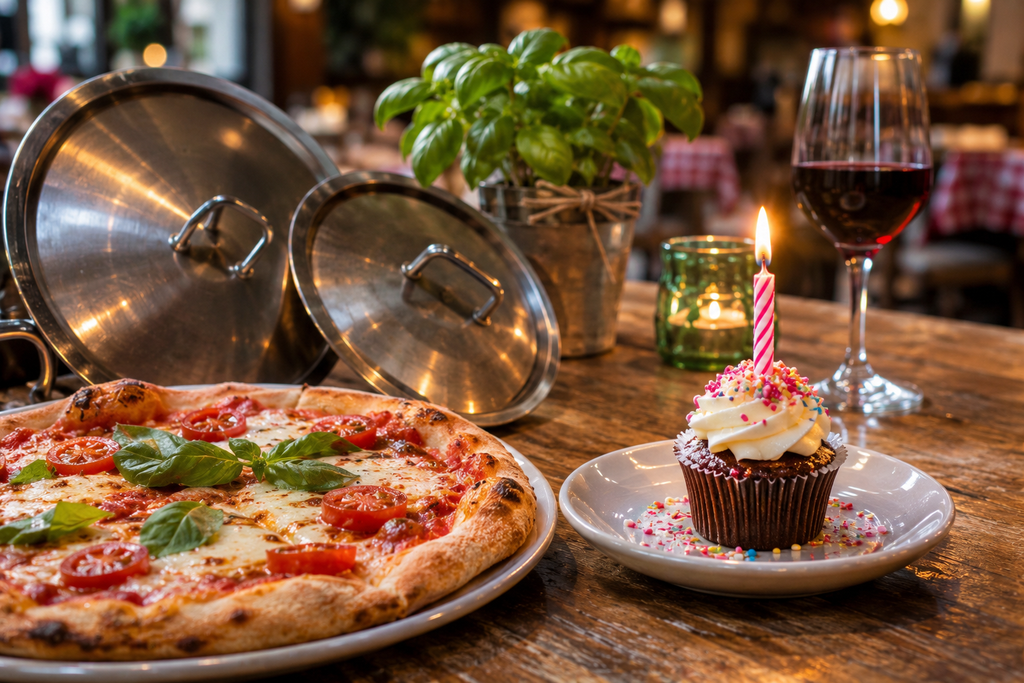
Rosii had celebrated with her family over pizza, which led to a lively discussion about Brazilian eating habits and her own complicated relationship with this particular Italian invention.
There had been a time when Friday meant pizza. Every Friday. Unfortunately, Rosii explained, she is not the sort of person who eats one slice and politely stops.
Two slices? Possibly. Three? Quite likely.
Eventually, she decided that pizza every Friday was perhaps not the wisest arrangement. But birthdays are special occasions, and special occasions deserve pizza.
This reminded the Mayor of an Italian restaurant Rosii had recommended years earlier. The restaurant was run by Giovanni, whom Rosii remembered with enormous affection.
He wasn’t simply the owner who occasionally appeared to inspect the business. According to Rosii, he was always there, talking to customers, helping his staff and making people feel welcome. She particularly admired the way he remained personally involved.
And then there were the birthdays.
At Giovanni’s restaurant, a birthday celebration was apparently not something that could pass unnoticed. Waiters would arrive banging large saucepan lids together, while another carried a little cupcake with a candle.
The whole restaurant would know that somebody was celebrating.
Rosii described the place as comfortable and welcoming, with staff who had worked alongside Giovanni for years. It was the sort of restaurant where the owner himself helped create the atmosphere.
She promised that when the Mayor eventually visited Brazil, she would take him there.
He accepted immediately.
It was a lovely example of the day’s topic before the topic had properly begun. Giovanni made his restaurant special not simply through food, but through his presence. He remembered that people were there for more than dinner.
Sometimes they were there to celebrate being alive.
The People Who Change the Atmosphere.
Fruitloop finally introduced the question: Who is the person in your circle who makes everything more enjoyable simply by arriving?
Rosii didn’t have to think for long.
Her sister-in-law was one of those people. Always cheerful, always funny, always able to make the family laugh. Her niece’s husband was another, someone Rosii described as positive and enjoyable to talk to.
But her sister-in-law held a particularly special place.
Whether someone was happy, sad or disappointed, Rosii explained, talking to her could make things feel better. She had a way of helping people relax and find their laughter again.
Nathalie’s answer carried a different kind of warmth.
She thought of her father, who had died. She remembered him as a positive, energetic and active person, someone whose enthusiasm seemed to spread naturally to those around him.
Being near a person like that, she explained, was almost contagious. Their energy became a kind of booster.
She also spoke about a woman she knew in her village who remained remarkably calm and positive, even when facing serious difficulties. Faith played an important role in this woman’s life, and Nathalie admired the quiet strength she seemed to draw from it.
When something went wrong in Nathalie’s own life, she sometimes thought about people like her.
There was something important in that observation. The people who make our lives better are not necessarily the loudest, funniest or most entertaining. Sometimes they are the ones whose example stays with us long after the conversation has ended.
Nathalie was careful not to suggest that everyone could behave that way easily. For some people, positivity seemed natural. Others had to work much harder at it.
Fruitloop wondered whether personality played a part. Perhaps introverts and extroverts simply brought different kinds of energy into a room.
The Mayor’s answer took an unexpected turn.
After reflecting on a demanding period of his life, he admitted that he sometimes found animals easier company than people. His cats, at least, offered affection without complicated expectations.
Although, as he quickly acknowledged, the affection wasn’t entirely unconditional.
The cats did expect food.
What If the Hosts Disappeared?
Fruitloop then asked a dangerous question.
What would happen to Lunch if she and the Mayor were no longer there?
Would the meetings become peaceful? Boring? Or would Rosii and Nathalie immediately take charge?
The Mayor appeared quite interested in the idea.
Nathalie thought she and Rosii would manage perfectly well. They would tell stories, laugh and help each other find the English words they needed.
Rosii agreed enthusiastically. Nathalie had so many interesting experiences from her travels, and Rosii was curious to hear more about her life and family.
They would learn from each other, she decided.
Nathalie suddenly became suspicious.
Was Fruitloop asking because she and the Mayor were planning to disappear the following week?
No, Fruitloop assured her. Nobody was abandoning anybody.
But the idea had taken hold. Rosii imagined the hosts becoming invisible, secretly watching while the two women conducted their own meeting.
The Mayor revealed that he had once used a similar technique in his teaching. He would write on the whiteboard that he was a ghost and that the students could no longer see him. They had to talk to one another without asking him for translations or vocabulary.
It was difficult at first, he explained, but eventually people found their way.
Fruitloop concluded that perhaps their work was done.
The Mayor thanked her for making them both unemployed.
It was a wonderfully ridiculous exchange, but there was a genuine possibility hiding inside it. Rosii and Nathalie weren’t frightened by the idea of speaking without their hosts. They could imagine themselves carrying the conversation, helping each other and enjoying the experience.
And if they couldn’t find a word?
Well, they would find another way.
Food, Stories and a Cat Appeared.
The next question concerned what people bring to a gathering.
Food? Stories? Or absolute chaos?
Rosii chose stories. She liked bringing funny experiences or interesting subjects that encouraged people to exchange opinions. Nathalie also preferred stories, although she pointed out that food could make a gathering with friends more relaxed.
For a serious meeting, however, eating might become a distraction.
The Mayor’s contribution was settled when one of his cats made an appearance.
The cat apparently decided that Lunch required his personal supervision. The Mayor introduced him to the table, while trying to prevent the cat from presenting an unfortunate part of his anatomy to the camera.
Fruitloop had her answer.
The Mayor brought cats and chaos.
There was also some discussion about tea, particularly the Mayor’s preferred variety, which had run out. Apparently, not all tea in his household met the required standards.
The cat, meanwhile, seemed completely unconcerned.
Then Fruitloop asked whether the person who makes everyone laugh is always good for a group, or whether too much humour can become exhausting.
This produced one of the more thoughtful discussions of the day.
Nathalie believed that laughter was essential, but there had to be a balance. If everything became a joke, people might struggle to have serious conversations or deal with important matters.
Rosii agreed. The English word they eventually settled on was balance, although Rosii had already expressed the idea through another familiar word: equilibrium.
The Mayor added that a funny person could be wonderful at a boring dinner party, particularly if the food was dreadful. But someone who constantly dominated a gathering might become rather tiring.
So the table reached an agreement.
Laughter was good. Seriousness had its place. And knowing when to use each was part of making a gathering enjoyable.
Naturally, this sensible conclusion was immediately followed by a banana.

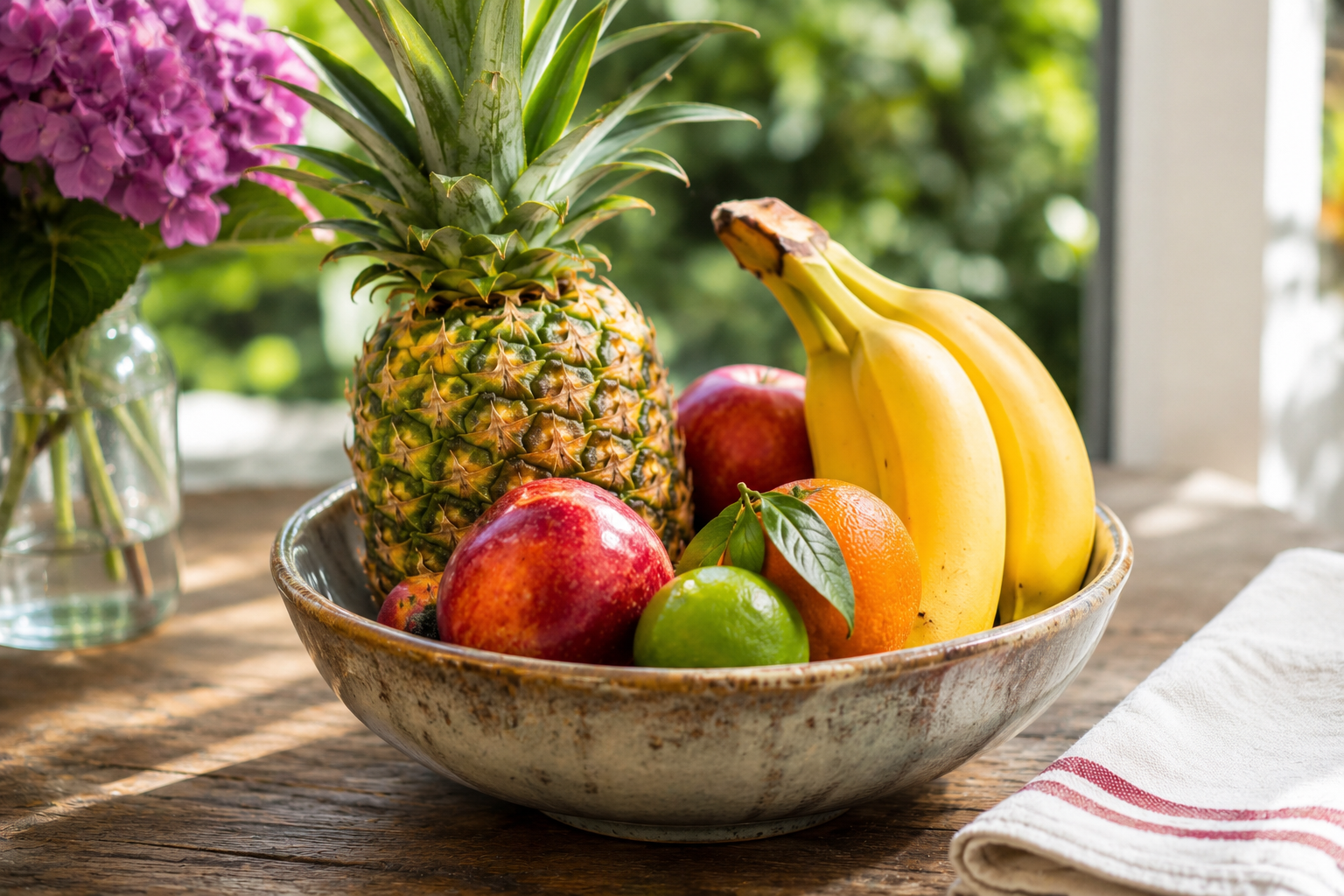
The Banana Who Wanted to Be President.
Fruitloop had prepared something special.
Imagine, she suggested, that a banana joined your friendship group.
Not an ordinary banana, of course. This banana told brilliant jokes, remembered everyone’s birthdays and gave excellent advice. In fact, it was so charming that it became more popular than everyone else.
Would you be jealous?
Or would you appoint the banana president?
Rosii initially struggled to find the English words for the scene forming in her imagination. She could picture the whole thing perfectly, but explaining her thoughts was another matter.
Eventually, she decided that if the banana gave good advice and made people laugh, it deserved the presidency.
Nathalie was equally generous, although she had reservations.
She would happily accept the banana as president, provided there was a more serious person working alongside it. Popularity was useful, but leadership required something more.
A banana, however charismatic, probably needed supervision.
Monica arrived during the banana debate, having been delayed by a difficult and exhausting situation involving responsibilities she was trying to leave behind.
She was delighted to see everyone’s smiling faces.
Monica explained that Lunch was often one of the highlights of her week. Fruitloop’s unusual questions and the pleasure of seeing everyone helped lift her spirits.
She also spoke warmly about the people at her Lions Club in Australia. Their shared commitment to helping the community meant a great deal to her.
The previous week, they had been working at an event in pouring rain when a large marquee threatened to blow away. Monica found herself holding it down for dear life.
Fortunately, she joked, she wasn’t skinny enough to be carried away with it.
A few hours later, she could laugh about the experience. The people around her made even difficult moments enjoyable.
Then she was brought up to speed on the banana election.
Monica examined the candidate’s qualifications with admirable practicality. Bananas contained potassium, were good for you and had a pleasant yellow colour, which happened to be one of her favourites.
She was perfectly happy to let the banana become president.
Especially because she had no desire to take on any more responsibility herself.
The Mayor, however, was less enthusiastic.
He announced that he would be insanely jealous of the banana. He would allow it to become president, naturally, but would immediately begin plotting its downfall.
A conveniently placed banana skin might do the trick.
Monica had been expecting something of the sort.
The Mayor considered the situation.
A banana with a personality. A Mayor with an attitude.
It was hardly a promising political partnership.
The People Who Show Up.
Monica’s arrival had brought the conversation back to its original question in a rather lovely way.
She had joined Lunch after a difficult night, with problems still demanding her attention. Yet she had made the effort to be there because the people at the table cheered her up.
Her stories about the Lions Club showed something similar. The pleasure wasn’t only in the work they were doing, important though that was. It was also in the companionship, the shared purpose and the ability to laugh together when the weather tried to destroy the marquee.
Rosii had described the same quality in her sister-in-law. Nathalie had recognised it in her father and the woman from her village. Giovanni had created it in his restaurant.
Different people, different circumstances, but something familiar connected them.
They made being together feel better.
And sometimes, simply arriving was enough.
Pineapples, Confetti and the Problem of Cleaning.
There was still one final Fruitloop question to survive.
Would you rather have a best friend who turned into a pineapple every time they laughed, or one who exploded into confetti whenever they sneezed?
The Mayor immediately raised a practical objection.
Who was going to clean up afterwards?
Fruitloop had experience in this department. One Christmas, her family had used party poppers that showered confetti everywhere. It stuck to the walls, the ceiling, their clothes and practically every surface in the house.
It took weeks to get rid of it.
Monica wanted to know whether the pineapple friend would eventually return to human form. The Mayor suggested that perhaps the pineapple could be eaten, which led to a brief discussion about cannibalism and the controversial practice of putting pineapple on pizza.
The conversation had now travelled from birthday pizza to the possibility of eating one’s best friend.
Lunch was progressing beautifully.
Rosii chose the pineapple. Nathalie agreed, partly because of its connection to The Pineapple and partly because she had no intention of cleaning confetti off her walls.
Monica also favoured the pineapple. To her, it suggested summer, beaches and happy tropical memories.
Fruitloop had an additional reason for avoiding the confetti option.
Her husband sometimes sneezed three or four times in succession, and not necessarily in the same room. If every sneeze produced an explosion of confetti, she would spend her life cleaning up after him.
The Mayor imagined him wandering through the house, leaving a colourful trail behind.
At least, Fruitloop observed, she would always know where to find him.
Just follow the confetti.
By the end of the meeting, the pineapple had won the popular vote, the banana had been elected president, and the Mayor had narrowly avoided being replaced by a piece of fruit.
Rosii was still laughing.
There was no great mystery about the atmosphere at the table that day. It had been created by the people themselves: a birthday song, an invitation to Brazil, memories of loved ones, a cat appearing at exactly the right moment, Monica joining despite her difficult morning, and two women discovering that they could probably host Lunch perfectly well on their own.
As everyone began saying goodbye in several languages, Rosii offered perhaps the simplest review of the afternoon.
“I loved our meeting.”
And that seemed quite enough.
After all, the people who make life better don’t always arrive with grand gestures or extraordinary wisdom.
Sometimes they bring stories. Sometimes they bring laughter. Sometimes they bring a cat.
And occasionally, if Fruitloop has anything to do with it, they bring a banana with presidential ambitions.