
The People You Can Count On.
What makes somebody worth having around? For Janita, it might be a boss who trusts you or a colleague who makes work enjoyable. For me, it is also about responsibility, friendship and knowing who will be there when something really matters.
By Fabrice, France.
A simple question with several answers.
Janita and I began our conversation with an imaginary visit to a café. I ordered sparkling water, while Janita chose a strawberry milkshake. From there, we started talking about the people who make ordinary places and activities better. Not necessarily the most important people, or the ones with the biggest titles, but those whose presence makes a workplace, club or association somewhere you enjoy being.
It sounds like a simple question. Everybody knows somebody who is good company, somebody who makes people laugh or somebody who can organise things when nobody else wants to take responsibility.
But as we talked, I noticed how differently Janita and I approached it. She remembered people who had made her working life more enjoyable. I thought more about what people actually do, whether you can depend on them, and what kind of relationship you have with them.
Perhaps that is because our working lives have been quite different.

A boss who gives you the keys.
Janita worked in a liquor store when she was young, and she remembers her boss as somebody who made a real difference. He was friendly, treated her well and taught her things she didn’t know. More importantly, he trusted her. Even though she was young, he gave her the keys to the shop.
That tells you something about their working relationship. A boss can give instructions all day, but handing somebody the keys means you believe they are capable of taking responsibility.

There was another side to the job that Janita remembers particularly well. On Saturdays, they could wear their rugby shirts to work, and there was a television for watching rugby or cricket. The sport depended on what was happening that weekend, but it became part of the atmosphere in the shop.
She experienced something similar at one of the pharmacies where she later worked. Her boss was also enthusiastic about sport, and they would sometimes watch rugby, cricket or the Olympics on a computer. Janita is still connected with that former boss on Facebook, where sport remains a regular subject.
I could understand why she remembered those jobs fondly. Her employers didn’t simply tell her what to do. They created an environment where people could work together and enjoy themselves.
Her experience in another pharmacy was very different. It belonged to a large chain, with procedures, targets, performance indicators and considerable pressure from management. The expectations applied to everybody, whether they worked at the till, stocked shelves or held a management position. There wasn’t much room for mistakes.
Janita was describing two kinds of workplace, and it wasn’t the professional activity that made the difference. It was the atmosphere created by the people running them.
For me, however, work has a different place in my life.
I go to work to earn money. I don’t go there to make friends.
That doesn’t mean I want to spend my working day arguing with everybody. Of course it’s better when people are competent and you can work together without unnecessary problems. But I don’t need somebody at work to make my life special. I have my friends outside work, and those relationships are something different.
For Janita, a good colleague or boss can become part of what makes the working day worthwhile. I understand that. I simply don’t expect my workplace to provide the same things as my friendships.
Being pleasant isn’t everything.
During the conversation, we considered whether somebody could be very good at their job but difficult to get along with.
I suggested myself.
I know I can speak loudly. I’m not always particularly polite, and I don’t necessarily wrap everything in diplomatic language. If something needs to be said, I tend to say it. People who know me might describe me as stubborn or grumpy, and I can understand why.
Janita remembered a colleague with a different kind of difficulty. When something didn’t go her way, this woman would become upset, sometimes cry or make a scene, and the attention would move away from the original problem towards her reaction.
That can be exhausting for everybody else, particularly when people are already working under pressure.
But being easy to get along with and being dependable are not exactly the same thing.
I might not always be the most cheerful person in the room. I might speak too loudly or say something too directly. But when somebody genuinely needs my help, that is another matter.
Of course, it depends on the person.
I don’t believe that being helpful means agreeing to every request or making yourself available to everybody whenever they want something. There are people who will ask and ask without considering what it costs somebody else. I have had situations where I eventually decided that enough was enough.
But for a good friend, I can do a great deal.
If somebody I care about calls me at midnight or three o’clock in the morning because they genuinely need help, I can get in the car and go. Even travelling more than a thousand kilometres to the south of France is not necessarily a problem.
That might seem strange coming from somebody who has just admitted that he isn’t always very polite.
But I don’t see a contradiction.
I can be difficult in a conversation and still be somebody you can rely on. I can enjoy somebody’s company without wanting to take responsibility for their problems. And I can have a close friendship with somebody I don’t speak to every week.
For me, friendship is not measured by how often we sit together drinking coffee. What happens when somebody really needs you matters as well.
The people who make things happen.
When we moved from workplaces to clubs and associations, Janita and I found ourselves on more familiar ground.
I have been involved in organising activities, and I know how much work can be hidden behind an event that appears quite straightforward to everybody attending.
Before you invite people, you need to know what you are actually going to do. You need a programme, a suitable place, the right people and whatever equipment or arrangements the activity requires. Sometimes you need assistance from another association. Sometimes somebody who promised to help becomes unavailable, or a location cannot be used.
And that is when you discover whether your preparation was good enough.
I like having a Plan B. If something doesn’t work, you need another solution. You cannot simply stand there with twenty people waiting and announce that the evening is cancelled because one part of the arrangement has failed.

Janita knew something about this from her cycling days.
She belonged to a large cycling club in South Africa, with several hundred members divided into different groups according to their abilities. There were beginners, intermediate cyclists and faster riders, with people responsible for arranging the group activities.
The club also organised evening rides of approximately thirty to thirty-five kilometres. The problem for Janita was that she had to drive around thirty kilometres just to reach the meeting point, and then drive all the way home after finishing the ride.
She realised that several other cyclists lived near her and had the same inconvenience.
So she started a WhatsApp group, invited the local riders and began arranging their own evening rides. She organised the meeting points, times, routes, distances and speeds according to whoever wanted to participate.
They went out several times and enjoyed themselves.
I liked that example because she didn’t need to complain about the original club or insist that somebody else change the arrangements. She saw a practical problem and did something about it.
It was also interesting to hear how she thought about the people joining her rides. The speed and distance depended on the group. The arrangement had to work for the people who were actually coming, not simply for the person organising it.
In my associations, I also have to consider the participants, but I tend to approach the work through the programme and the preparations necessary to make it happen.
The two things belong together. Somebody has to take responsibility for organising an activity, but the activity must also be worth attending.
We also discussed what would be involved if Janita took on an official role in one of the associations I know. She was curious about the meetings, events and responsibilities, and I explained some of the administration involved in running a shooting club, including correspondence with the authorities and the obligations connected with its activities.
Being president is not simply a matter of attending meetings. There are rules, safety responsibilities and paperwork. Janita was familiar with organising people, but she was also surprised by some of the administrative requirements involved.
It was another example of how much responsibility can sit behind something that members experience mainly as a social activity.
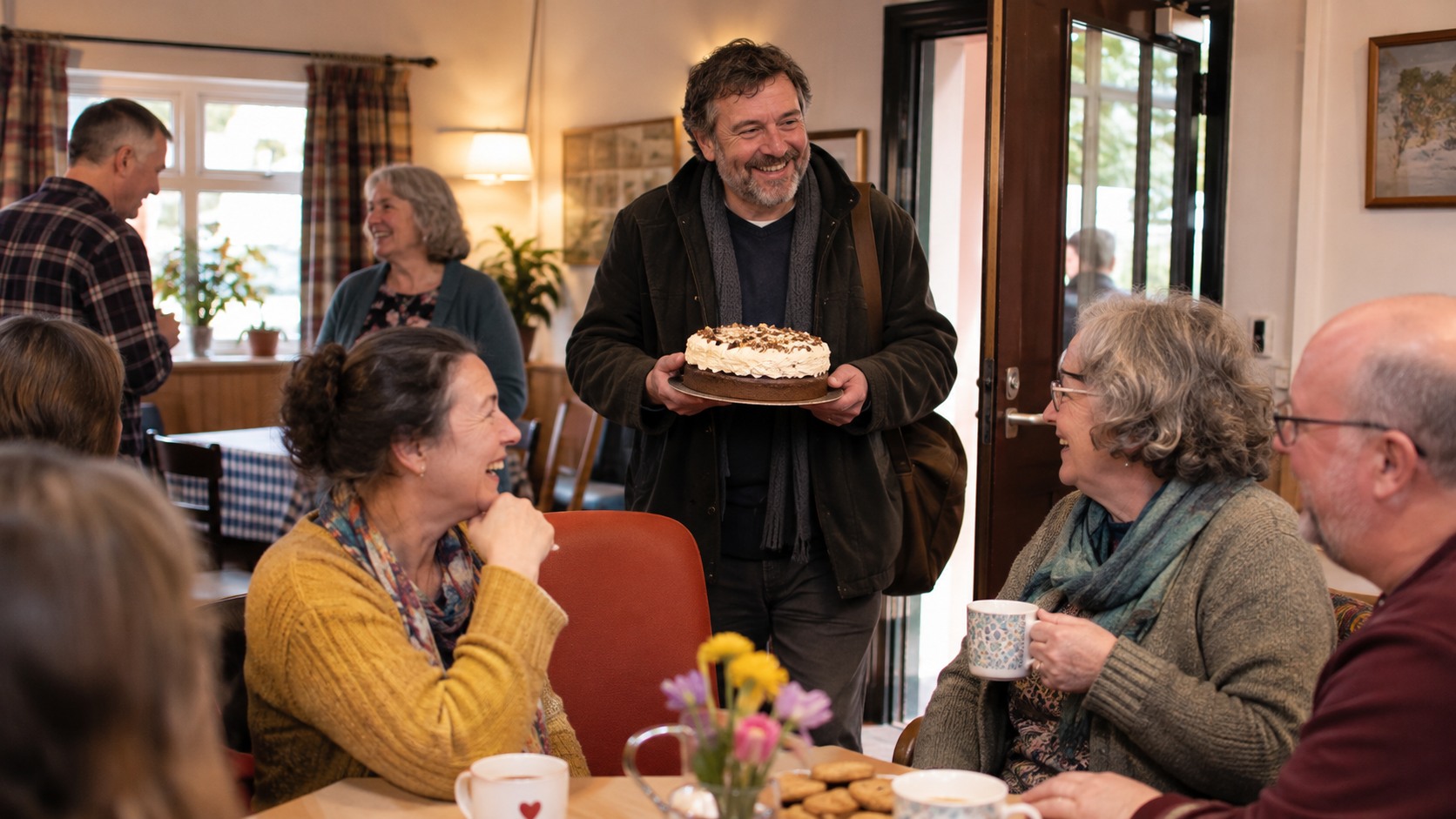
And what about the man with the cake?
We then considered an imaginary club member who never organises anything, never volunteers, regularly forgets meetings and generally contributes very little to the practical work of the association.
There was just one exception.
He always arrived with excellent cake and made everybody laugh.
Should we keep him?
Janita thought the answer was obvious. Of course we should. An association normally has a president, secretary, treasurer and other people responsible for running things. Not every member needs an official job. If somebody makes the gatherings more enjoyable, that is also a contribution.
I could understand her point, although somebody still has to do the work.
You cannot organise a successful event entirely with cake and jokes. If nobody arranges the place, prepares the programme, contacts the participants or takes responsibility for the necessary decisions, there won’t be much of an event to enjoy.
But if those things are already taken care of, why shouldn’t somebody come simply to spend time with the others?
It is one of the differences between running an organisation and belonging to one.
The people doing the administration may not be the people who make everybody laugh. The person who keeps the atmosphere pleasant may have no interest in joining the committee. And somebody who is excellent at organising might be a little difficult to deal with.
An association needs different kinds of people. The important thing is that the work gets done and people have a reason to come back.
The people we would invite.
Towards the end of our conversation, we returned to the imaginary café. We had our sparkling water and strawberry milkshake, and now there was one more chair at the table.
We were asked whom we would like to invite.
I chose my wife.
There were plenty of other possibilities, including people who might be entertaining or who had interesting experiences to share. But when I thought about somebody I would actually like to have sitting beside us, I didn’t need to search very far.
My wife was the obvious answer.
We talked about her patience. She is a very patient person, and that is something I appreciate. We have shared a great deal of life together, and she knows me with all my qualities and difficulties.
Janita chose Sarah, another member of Brida whom I haven’t met. She thought Sarah’s interest in traditional dancing, her languages and her sense of humour would make for an enjoyable conversation. She also thought Sarah and I might have things to learn from one another.
That would certainly be interesting. I enjoy meeting people who have different experiences and interests, and there is usually something to talk about once you begin.
But I was happy with my own choice.
We had spent the conversation discussing employers, colleagues, friends, club organisers and people who make gatherings more enjoyable. Janita had remembered bosses who trusted her and allowed people to enjoy themselves at work. We had both described the satisfaction and responsibility involved in organising activities. I had talked about being direct, sometimes difficult, and about how far I would go to help somebody who matters to me.
There are different ways of being important in another person’s life.
A good employer can make work more pleasant. A competent colleague can make a difficult job easier. An organiser can bring people together. Somebody with a good sense of humour can make an evening worth attending. And a good friend can be the person you call when you need help, even if you haven’t spoken for a long time.
I wouldn’t expect one person to fulfil all those roles.
Nor do I think somebody has to be endlessly cheerful or agreeable to be worth having around. People have different characters, different responsibilities and different ways of showing that they care.
As for the person I would choose to spend another afternoon with, there was no difficult decision.
I’d bring my wife.