

The Minutes Before Anything Starts.
What happens before the class, before the meeting and before we finally become the person we are supposed to be that day?
By Ismar, Campo Grande, Brazil and Ritesh, Bangalore, India.
Ismar’s mother is ready for Pilates ninety minutes early.
Not almost ready. Ready.
Sometimes she tells him so. Sometimes he simply notices her sitting on the sofa, prepared to leave, with everything beside her. She may do a crossword. She may look at her phone. But as far as the important business of the afternoon is concerned, she is finished.
The Pilates studio is about three kilometres away. By car, the journey takes perhaps ten minutes. This makes no difference.
“She always wants to go somewhere a long time in advance,” Ismar says. “‘It’s better to wait there. Let’s go, let’s go.’”
He does not share the enthusiasm. Ismar gets himself ready around ten minutes before they leave.
Between them sit eighty minutes of completely different philosophy.
It is a small domestic scene, but once you start paying attention to the minutes before something begins, they appear everywhere: on sofas, on pavements, in metro stations, beside coffee machines, outside dance classes and in offices before the first meeting.
Most of these moments do not look important.
That may be why they are interesting.
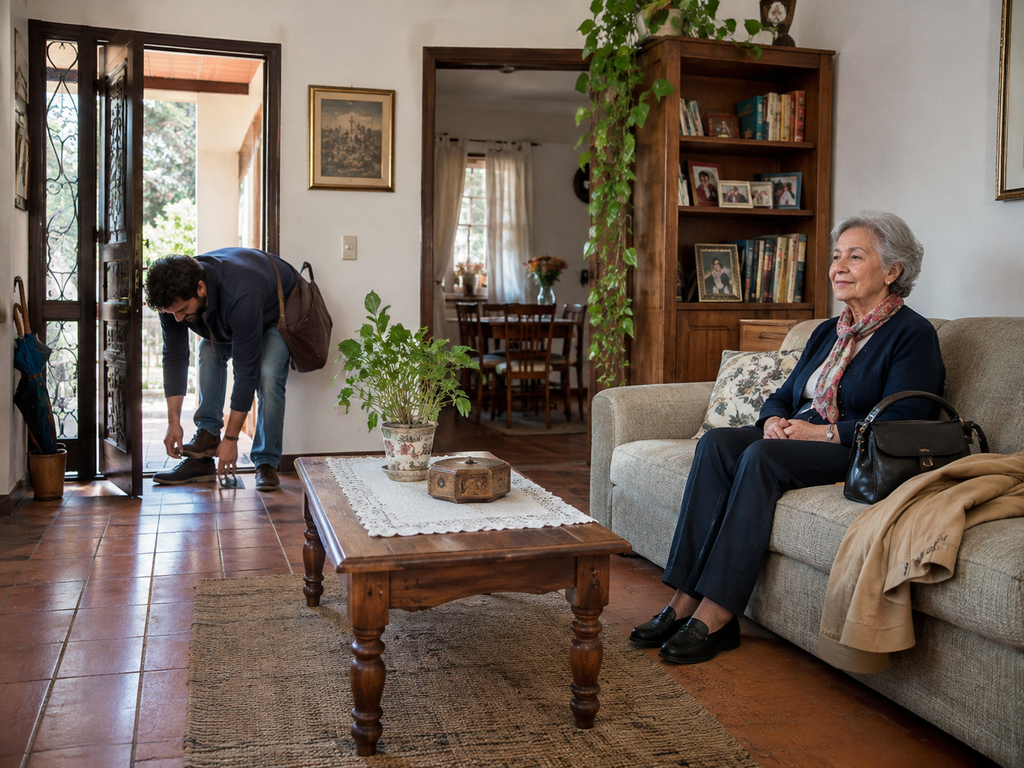
Ready too early, ready just in time.
Ismar has another weekly arrival ritual, and it could hardly be more different.
He goes dancing with Amélie. Sometimes they travel separately; sometimes he picks her up by car. A few minutes before arriving, he sends a message.
Three minutes. Five minutes. Nearly there.
By the time he reaches her building, she is ready. “She doesn’t leave me waiting for long,” he says.
His mother is prepared for departure long before departure exists. Amélie appears at almost exactly the right moment. Ismar has a name for his role in this arrangement.
“Normally, I’m her particular chauffeur.”
Then they drive to the class together.
The difference between Pilates and dancing continues after they arrive. Before Pilates there is not much social ceremony. Ismar mostly talks with his mother, and they wait in the exercise area rather than at reception. His teacher is unusually punctual. The class starts on time.
Dancing has another atmosphere. The room is open, with less separation between the place where people arrive and the place where they dance. People gather naturally. Ismar greets almost everyone.
“At the dance, I talk to many people.”
The conversations are ordinary: family, the latest ballroom event, the next one, somebody’s plans. When someone has a birthday, drinks and snacks may appear and the class briefly develops another life around itself. After some classes they go out together, and Ismar says the conversational “repertoire is larger”. Family still appears. Dancing appears. Society may appear. Politics occasionally slips in, although people generally prefer not to stay there for too long.
Ismar has no difficulty moving from one subject to another. If he knows something about it, he joins in. If he does not, he listens.
Asked who talks more when he and Amélie are with other people, his answer slightly surprises the Mayor.
“In a group, I think I talk more.”
When they are alone, Amélie talks more.
There is another surprise. All this sociability does not mean Ismar thinks the conversations are the best part. Asked whether the little conversations around dancing might sometimes be more interesting than the dancing itself, his answer is immediate.
No.
“I think dancing is more interesting than the conversation.”
The reason is simple enough. People generally do not talk about the subjects that interest him most. A philosophical discussion before the music starts would apparently be welcome.
“I think I don’t have any partner for that.”
So the minutes before dancing matter.
But the dancing still wins.
Ten minutes to the metro.
Ritesh’s morning begins with a different kind of preparation.
If you secretly followed him from his home to the office, the first thing you might notice is speed.
“You will see me rushing sometimes.”
His walk to the metro is about 1.2 kilometres. If he is relaxed, it takes perhaps fifteen minutes. If he is running late, he can reduce it to ten.
Then comes the crowd. People cut queues. People try to board quickly. Everybody seems to be in motion. Some disappear into their phones or headphones, physically close to hundreds of other people while mentally somewhere else.
Ritesh watches them.
“Most of the time, I just look at people and I think that I don’t want to do this one.”
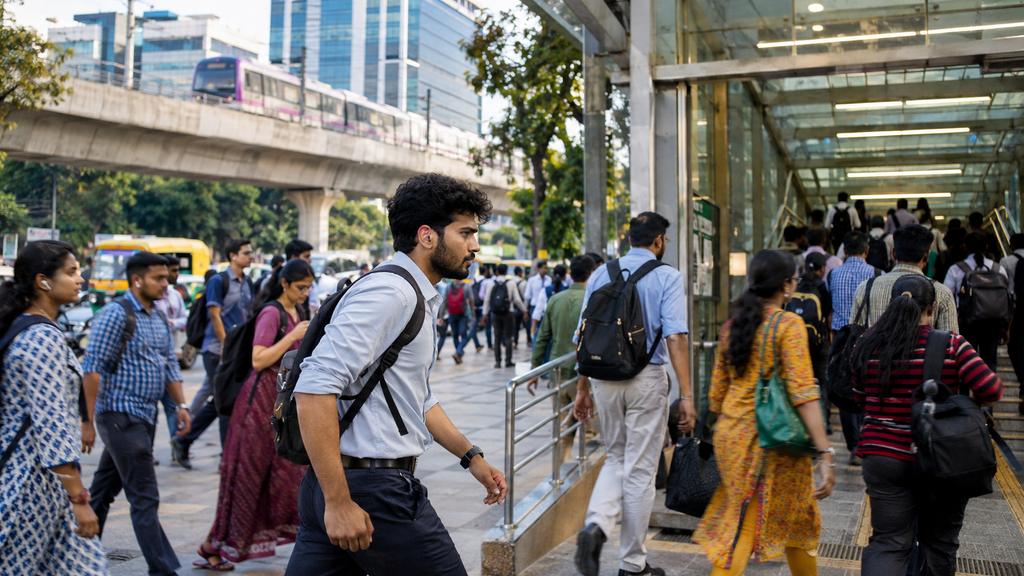
His complete journey takes around forty to forty-five minutes, including the walks at both ends. Yet somewhere inside those minutes, the working day has already begun.
“When I leave from home, all I think about is work.”
Priorities begin assembling. What has to happen today? What needs attention? What might go wrong?
There is no formal moment when home disappears and work begins. Work simply leaks in.
Home leaks back too. On the last part of the journey, Ritesh sometimes calls his wife and talks with her until he reaches the office.
The two worlds overlap.
At work there is another small border. Ritesh is now on the third floor of a large open-plan office. Near reception there is a coffee machine, vending machines, a table and high chairs. People sit there with coffee, greeting one another and asking about yesterday or the weekend.
It is not yet serious.
Ritesh puts down his bag, gets water or coffee and looks at what is waiting for him.
Then comes the stand-up.
“Until this stand-up is over, I’m not in that serious mood.”
Before it, there is coffee, conversation and a little space. During it, information arrives quickly. The meeting exists to identify blockers and keep work moving. Questions appear. Problems appear. Ritesh can sometimes become caught in one thought while the discussion has already moved somewhere else.
Asked whether the meeting is fun, he does not pretend.
“Not at all.”
Useful, yes.
Fun, no.
The ten minutes beforehand are not simply dead time before the real thing. They have an atmosphere of their own.
Rooms change the waiting.
Occasionally Ritesh reaches the office very early. Then the open-plan floor is almost empty. There may be security or reception staff, but none of the normal office noise.
He likes that.
He can take a coffee somewhere, watch something without earphones or open one of the courses available through work. He often chooses to learn something.
Other early arrivals have their own routines. Some work. Some drink coffee. Some use their phones. Nowadays, Ritesh says, waiting is easy to fill. There is always something to scroll.
For him, the better version is to use the time deliberately.
For Ismar, waiting before a class depends partly on the room itself. At Pilates, people may remain at reception talking if the teacher has not started, while he and his mother tend to wait inside the exercise area. At dancing, everybody occupies much more of the same space.
“People stay together,” he says. “I think it’s more appropriate to talk.”
A reception area creates one kind of waiting. An open dance floor creates another. An empty office creates another again.
But the room is only part of it.
If somebody recorded the ten minutes before Ismar’s dance class without showing the actual dancing, he already knows roughly what the soundtrack would contain: the previous ballroom dance and the next ballroom dance.
“Eighty percent of the conversation would be about it.”
The larger ballroom events can take place somewhere surprisingly ordinary, even at somebody’s home if there is a large covered area beside the house with enough space for dancing. But the bigger event does not automatically make Ismar more sociable.
At the class, he knows the people.
At the ballroom event, many are strangers.
“I normally don’t talk to them.”
The activity itself does not create connection automatically. Seeing the same people again helps. So does arriving in the same place week after week, until unfamiliar faces become recognisable ones and somebody eventually says something.
Whether anybody then speaks is another matter.
Leaving is harder.
Ritesh finds it relatively easy to move towards work.
Moving away from it is harder.
“Connecting is easy,” he says. “Disconnecting is difficult.”
When he leaves the office, he normally calls his wife to say he is on his way. The call is practical. She knows roughly when he will arrive. Food may be started. She may ask whether he wants something particular to eat or whether anything needs to be bought.
Sometimes Ritesh has an idea of his own.
Flowers. Chocolate. Something small.
The problem is that the idea can disappear beneath whatever is still circulating in his head from work.
“I’m so much involved in what I’m thinking, and I forget that one.”
There are successes. Sometimes he brings home something she likes to eat. Sometimes he remembers the flowers.
But the commute does not reliably wipe the working day away. He tries music. He listens to recorded discussions about social issues that interest him. He uses a setting on his phone that can switch off work-related applications.
Still, work may follow him through the front door.
He can be sitting with his wife while his mind continues working through some scenario from the day. She notices.
“What are you thinking? Something is wrong?”
Nothing is necessarily wrong.
His mind simply has not arrived home yet.
How much should we notice?
Towards the end of the conversation, Frank asks whether Ismar might notice people differently at his next Pilates or dance class after spending an hour talking about all these small moments.
“If I remember this class discussion,” Ismar says, “I think I observe people more.”
Then he immediately complicates the idea.
Someone has told him that he is very curious about other people’s lives. He asks many questions, and those questions may sometimes make people uncomfortable.
So perhaps observing more does not mean talking more.
“I think it’s not advisable that I talk more.”
It is a very Ismar answer.
He wants to know people better, but he also knows that curiosity can cross lines he does not always see.
Ritesh arrives at almost the same place from the opposite direction. He would like to speak more easily with strangers. He remembers travelling on the metro with somebody from his own workplace. The other man recognised him and started the conversation. Only then did Ritesh realise he had seen him around the office too.
Would Ritesh have approached first?
Probably not.
“I would like to have that kind of skill to start that conversation.”
So one man wonders whether he asks too much.
The other wonders how to begin.
They meet somewhere in the middle.
The part that does not appear on the timetable.
None of these moments is officially the event.
Ismar’s mother sitting ready on the sofa is not Pilates. The message saying “three minutes” is not dancing. Coffee beside reception is not work. The metro journey is neither home nor quite the office. The conversation after dancing is not the class.
Yet much of the texture of ordinary life seems to gather in precisely these spaces.
Ismar’s dance class becomes partly social because people arrive in the same open room and recognise one another. Pilates feels different. Ritesh’s working day starts somewhere on the walk to the metro, softens briefly over coffee, then becomes serious at the stand-up. Going home reverses the journey, but not necessarily the mind.
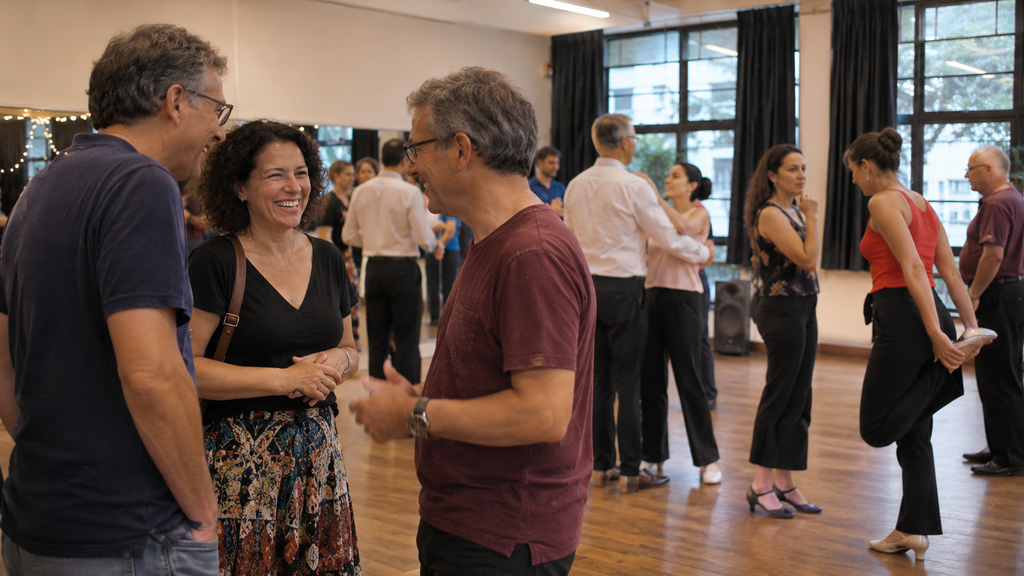
Nothing official has happened in those minutes before things begin. The teacher has not started. The meeting has not begun. The music is still quiet.
But people are already changing roles.
Ismar becomes his mother’s Pilates companion, then Amélie’s “particular chauffeur”. Ritesh moves from husband to commuter to colleague, and later has to make the journey back again.
Perhaps that is what makes these minutes so easy to miss.
We think we are waiting for something to start.
Often, it already has.