

The Correct Distance Between Us.
One man likes strangers about a metre away. Another spent twenty minutes silently listening because he did not want to interrupt. Somewhere between a crowded bus, an empty waiting-room chair and a dance floor, Ismar and Ritesh tried to work out how close is too close.
By Ismar, Campo Grande, Brazil, and Ritesh, Bangalore, India.
For about twenty minutes, Ritesh was in the conversation without anybody knowing he was there.
He had joined late, seen that Ismar and the Mayor were already talking, and decided not to interrupt. So he stayed quiet in the corner of the screen, listening to a conversation about dancing, strangers and personal space.
Eventually he spoke.
“I think I joined this call twenty minutes before,” he said. “I don’t know if you saw me or not.”
Nobody had.
Ritesh explained that he had wanted to say hello, but the conversation was already moving and he did not want to break it. It was difficult to imagine a better contribution to a discussion about the correct distance between strangers. He had been close enough to hear everything, but far enough away not to intrude.
Ismar, meanwhile, had already established a more measurable rule.
About one metre.
One metre is comfortable.
With strangers, Ismar prefers roughly a metre of space. Friends can come closer. Amélia is obviously another matter. But when somebody he barely knows moves inside that invisible circle, he notices — especially if they start touching him while they talk.
He once had a colleague who did exactly that.
“You speak, but don’t touch me. It’s not necessary,” Ismar told him.
Moving away did not always solve the problem. Ismar would step backwards and the other person would simply move closer again.
“I go back, but sometimes people get closer. And it’s not good.”
Ritesh understood immediately. Later, they were both given the same simple situation: imagine an almost empty waiting room. Ten seats are free. A stranger walks in and chooses the chair immediately beside you.
“Uncomfortable,” Ritesh said.
Then, as Ritesh tends to do, he began building exceptions. Perhaps the person was older and did not want to walk further. Perhaps Ritesh was sitting beside the entrance. Perhaps the stranger wanted to speak. Age might matter. Gender might matter. The position of the chairs might matter.
But his first reaction remained the same.
“There are so many seats. Why you come and sit beside me?”
Ismar reached almost exactly the same conclusion. If the room were nearly empty and somebody chose the chair beside him, “I think it’s weird.”
If the stranger began talking, at least there would be an explanation. Sitting silently beside him would be harder to understand.
Two men, thousands of kilometres apart, had independently designed almost the same waiting room.

Then dancing ruins the rule.
There is, however, a serious problem with Ismar’s one-metre principle.
He dances.
He has been learning for around ten years, although he remains modest about the result.
“I am in a level that I can have fun, but I’m not a good dancer.”
Progress, he has discovered, is slow and very personal. Somebody can have danced longer and still not necessarily dance better. Amélia tells him he has improved over the past few months. Ismar accepts the compliment cautiously and doubts that he will ever become an exceptional dancer.
It no longer matters very much.
“I can have fun. I think fun is the most important.”
The reason he returned to dancing was never only the dancing itself. Around thirty years ago, after the end of a relationship, he first took dance classes. Much later, living in Campo Grande without much of a social life, he thought about trying again.
Classes brought people together. Afterwards they might go somewhere to eat. They talked. The social life continued after the music stopped.
And suddenly the man who dislikes strangers entering his one-metre circle had deliberately chosen an activity where another person is supposed to enter it.
Some women, Ismar notices, prefer dancing closer. Others want more space. He has also seen men use dancing as an excuse to move nearer than their partners appear to want. That, for him, crosses the line.
Yet the line itself remains flexible. Dance allows a physical closeness that would feel absurd in an empty waiting room. Ismar thinks that may always have been part of its purpose: an accepted way for people to meet, approach each other, talk and perhaps begin something more.
His evidence is personal.
Amélia invited him to dance.
That was the first move.
“After that, it was my initiative.”
Not his initiative to dance, he explained.
His initiative “to get closer.”
He does not remember their first dance clearly. What stayed with him was simpler: she was kind to him, she had a good sense of humour, and he thought she was “an interesting person to live together.”
One metre had become irrelevant.
Crowded does not mean the same thing everywhere.
Once Ritesh had revealed himself on the screen, the conversation moved from personal distance towards cities.
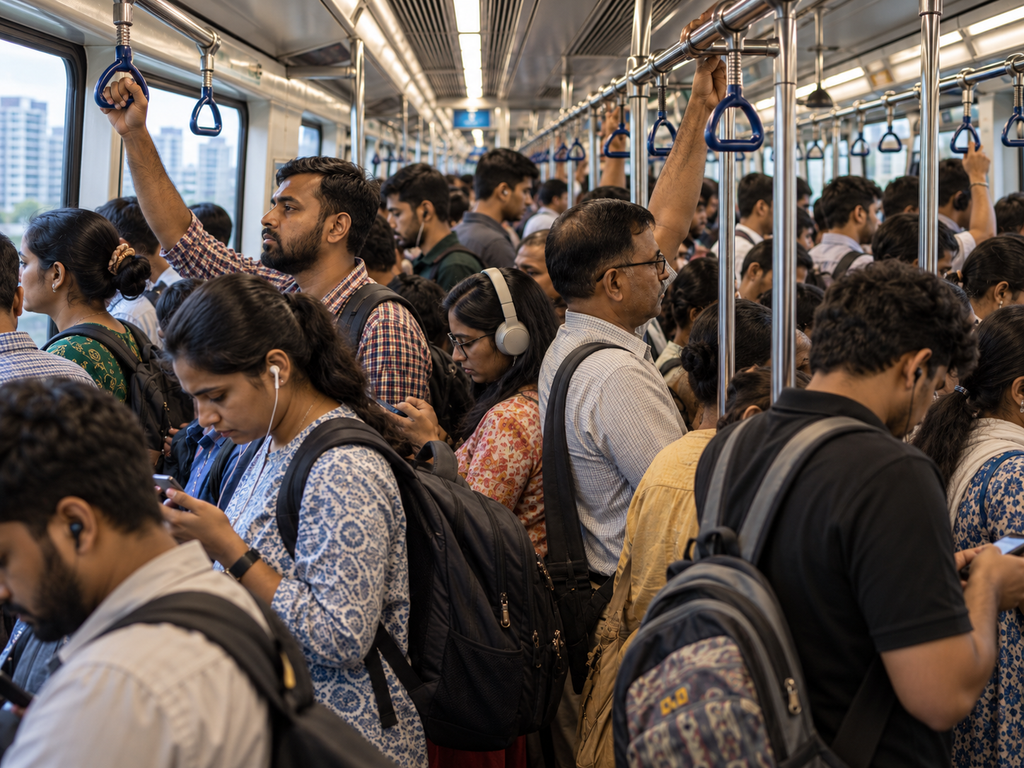
Bangalore has an international reputation for crowds, traffic and noise. Yet photographs Ritesh had recently taken did not quite show the expected chaos. His daily journey is now relatively well connected, particularly by metro. The trains are crowded, certainly, but the experience is different from the buses he once relied on.
He had actually tried to photograph the crowds at a station.
Security stopped him.
So the photographs had accidentally made Bangalore look quieter than it really was.
Ritesh’s wife had moved from a much smaller place to Bangalore less than a year earlier and noticed the crowds more immediately than he did. Years in the city had changed what Ritesh himself registered as unusual. What overwhelms you at first can eventually become part of the background.
Ismar has seen his own variations across Brazil. He has lived in or around several very different cities and regions, and Campo Grande, Curitiba and the place where he lived near São Paulo do not organise public life in quite the same way.
Campo Grande has shopping malls and neighbourhood commercial centres where people gather. Some people go to the mall even when they have no intention — or perhaps no money — to buy anything.
Maybe, Ismar suggested, they go “to see and to be seen.”
You can stand among hundreds of people without speaking to anyone. You can sit alone at an airport watching the sunset and feel perfectly content. You can live in a crowded city and disappear.
Or you can sit beside one stranger in an empty room and make them wonder why on earth you chose that chair.
The sardine rule.
There are also places where personal space simply loses the argument.
Public transport is one of them.
Ismar described buses in Campo Grande as being like “a can of sardines.” He often has to stand because there are no seats available. Some are reserved for older people, pregnant passengers and people with injuries, although the existence of a rule does not always guarantee that everybody will follow its spirit.
Ritesh has the same basic problem in Bangalore’s metro. At busy times, the question is no longer whether somebody has entered your personal space.
Everybody has.
People find other ways to create a little privacy. Ritesh mentioned headphones and earphones. In some residential areas, doors and windows shut out the sounds of neighbouring homes; elsewhere, daily life spills much more visibly into the street.
Sometimes distance is physical.
Sometimes you have to invent it.
The stranger who was already there.
Which brings us back to Ritesh quietly sitting in the meeting.
He had not disappeared because of technology. He had not fallen asleep or forgotten the appointment.
He was listening.
When he finally announced himself, he said he had enjoyed hearing Ismar talk about dancing, personal space and the way his relationship with Amélia had developed.
He had been present for the story without entering it.
At the beginning of the conversation, personal space had sounded almost measurable. Ismar wanted his metre. Ritesh wanted the stranger in the waiting room to choose one of the other nine chairs.
Then came the dance floor, the Bangalore metro, the sardine buses of Campo Grande and a silent man sitting unnoticed inside a conversation.
Perhaps the correct distance between people is not something you can measure after all.
Sometimes it is a metre.
Sometimes it is an empty chair.
Sometimes it is knowing when to step forward.
And sometimes it is knowing when not to interrupt.