
Good Manners Travel Well.
An imagined visit between Bangalore and Campo Grande begins with questions about etiquette and ends somewhere simpler: notice the people, make them comfortable, and adapt.
By Ismar, Campo Grande, Brazil and Ritesh, Bangalore, India.
The plan was deliberately dangerous.
Ismar and Amélia would travel from Brazil to visit Ritesh and his wife in Bangalore. Then Ritesh and his wife would make the return journey to Campo Grande. Nobody was actually booking a flight. The idea was to walk through the visits step by step and discover all the unwritten rules waiting to trip them up.
Who meets whom at the airport? Do you shake hands or kiss? Do you take your shoes off? What happens if somebody refuses food? Who chooses the restaurant? Who pays? How do you behave around an elderly relative? At what point may a guest open the fridge without asking?
Two countries, two cultures, two couples. Surely there would be trouble somewhere.
There was surprisingly little.
Start with the airport.
Ritesh began by imagining Ismar and Amélia arriving in Bangalore after a long journey. His first instinct was not etiquette but care.
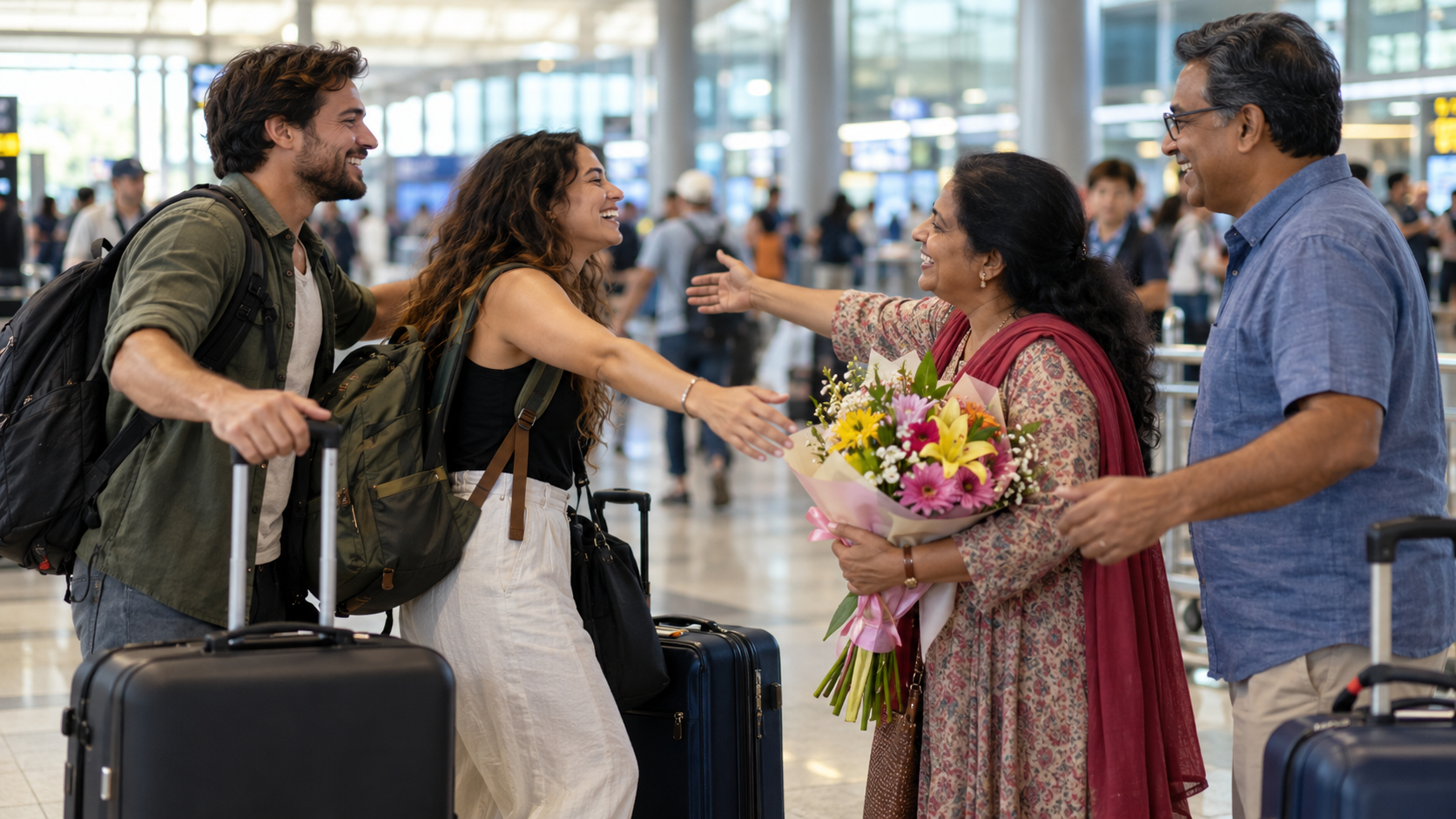
He would meet them at the airport. Because they were arriving for the first time and he would be excited to welcome them, he might bring a bouquet of flowers. Then he would start thinking about whether they were tired and, very quickly, whether they were hungry.
“I don’t think we are doing anything special,” he said. The aim would simply be to make their stay “comfortable and easy.”
There was already one misunderstanding, though. The imagined visitors had apparently booked a hotel.
Ritesh had not imagined that at all.
His assumption had been that Ismar and Amélia would stay in his flat.
That small difference was revealing. Before anyone had reached questions of handshakes, footwear or table manners, hospitality had already expanded from airport collection to accommodation. Ritesh had enough room, so why would his guests be somewhere else?
Campo Grande produced almost the same answer in a different form.
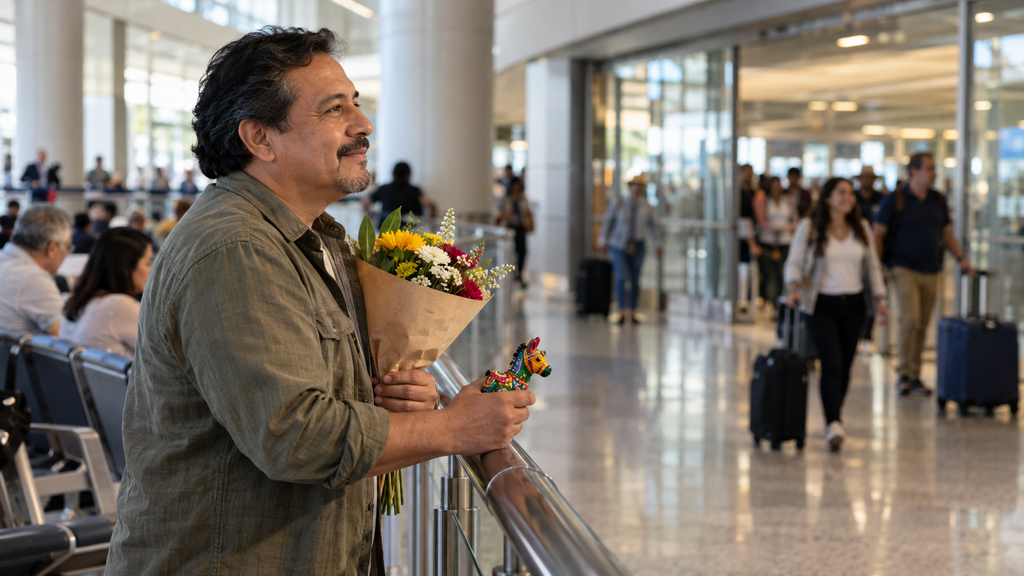
If he had the time, Ismar would also go to the airport himself. If work made that impossible for somebody else, a family member might collect foreign visitors instead. The first practical question in his mind was not ceremony but luggage: could four people and all the suitcases actually fit into his car?
If not, he said, it would simply be “something to solve at the moment.”
No bouquet in Brazil, perhaps. Flowers at the airport did not strike Ismar as particularly usual. A small local souvenir was more familiar.
Different object. Same message: you have arrived, and we were expecting you.
Shoes off, coffee on.
At Ritesh’s flat, the first visible difference would appear at the door.
Shoes normally come off.
There is a rack outside or near the entrance, and the visitors would follow the household inside without them. Once seated, they would be offered water and perhaps tea, coffee or something small to eat. They would be shown the bathroom, told where things were and given the chance to freshen up after the journey.
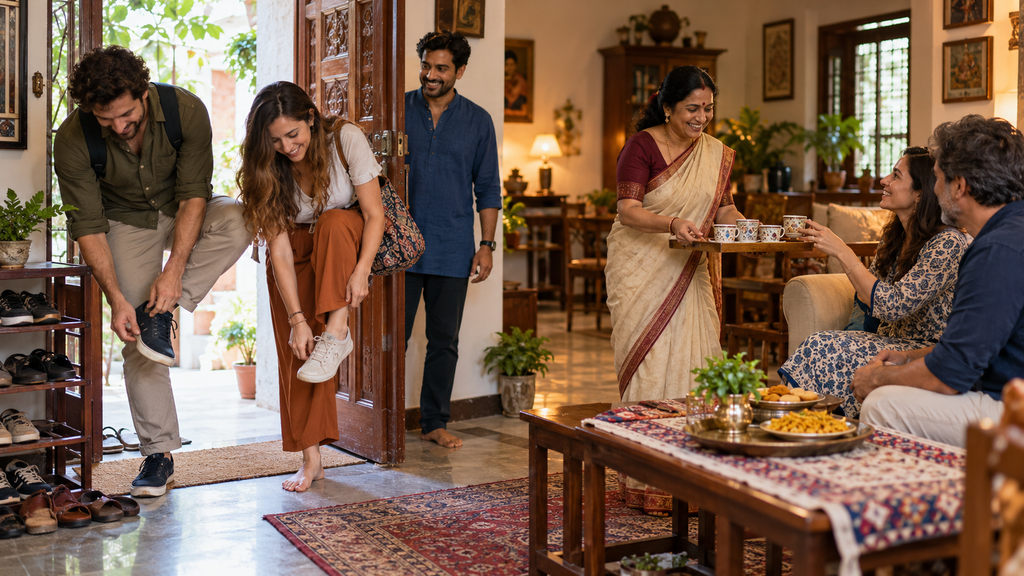
The purpose, again, was straightforward: “make sure that they feel home and comfortable at home.”
For Ismar, removing his shoes presented no philosophical difficulty.
In Brazil, he said, people normally enter a house wearing them, even though he sometimes takes his own shoes off when he is alone. But if Bangalore requires shoes at the door, that is easy enough.
“In Rome, like the Romans.”
Back in Campo Grande, the sequence sounded strikingly familiar. Find somewhere sensible for the suitcases. Offer water. Offer coffee.
Tea would be less likely, Ismar explained. Coffee is far more common.
The differences were real, but oddly modest. Nobody was facing a ceremonial minefield. Mostly there were shoes, drinks and the question of whether somebody needed the bathroom.
The dangerous business of feeding people.
Food looked more promising as a source of cultural collision.
Ismar imagined offering afternoon pão de queijo, Brazilian cheese bread, perhaps with coffee. At home it could simply be eaten with the hands.
Ritesh saw no difficulty.
“We are not going to say no, thank you,” he said. They would try it.
Eating with the hands, in fact, sounded reassuring. Ritesh is accustomed to doing that with Indian food and is aware that in some settings people can judge the practice. Knowing that eating something by hand would not automatically cause discomfort removed one possible worry.
The reverse journey required more preparation.
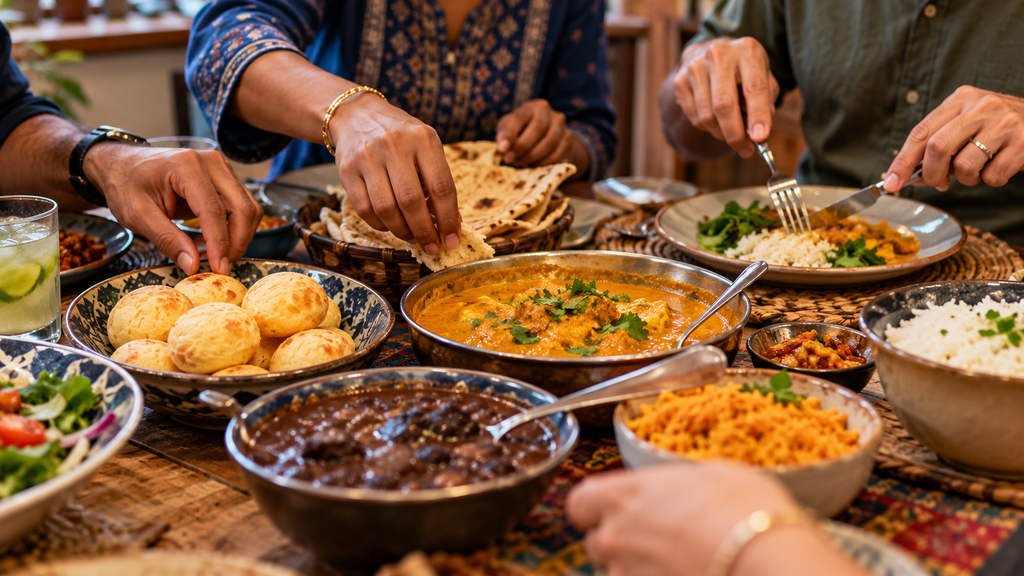
Ismar does not cope well with heavily spiced food. Amélia can manage rather more, but he was clear about his own limit. If everything available were very spicy, he joked in effect, hunger might be preferable. Eating an unfamiliar meal with his hands would also make him uncomfortable.
Ritesh’s answer was not that a visitor should learn to cope.
A suitable restaurant would be chosen around the guests: what they eat, what they avoid, whether they can tolerate chilli and what they actually want to try. A good restaurant would have spoons and forks available anyway.
The rule turned out not to be “When in India, eat like an Indian.”
It was closer to: when somebody has travelled thousands of kilometres to see you, make sure they can eat dinner.
Even refusing food produced less drama than expected.
Suppose Ismar was sitting in Ritesh’s home and was offered something to eat. He said clearly, “No, thank you.”
Would that be insulting?
Ritesh thought about the possible reasons. Perhaps Ismar was not hungry. Perhaps he did not know what the dish contained. Perhaps it was too spicy. Perhaps he simply did not want it.
“There might be several scenarios.”
They might ask whether he wanted something different, but his refusal would not be taken as a personal rejection.
Intent mattered more than ritual.
Then comes the bill.
Restaurants offered another chance for trouble.
In Campo Grande, Ismar would first think about what his visitors could eat. Ritesh is vegetarian; his wife eats some meat but not beef. A Brazilian barbecue, despite being an obvious local experience, would therefore not necessarily be the sensible choice.
Ismar might suggest fish or chicken and help with an unfamiliar Portuguese menu.
And the bill?
“As they are my guests, I would pay the bill.”
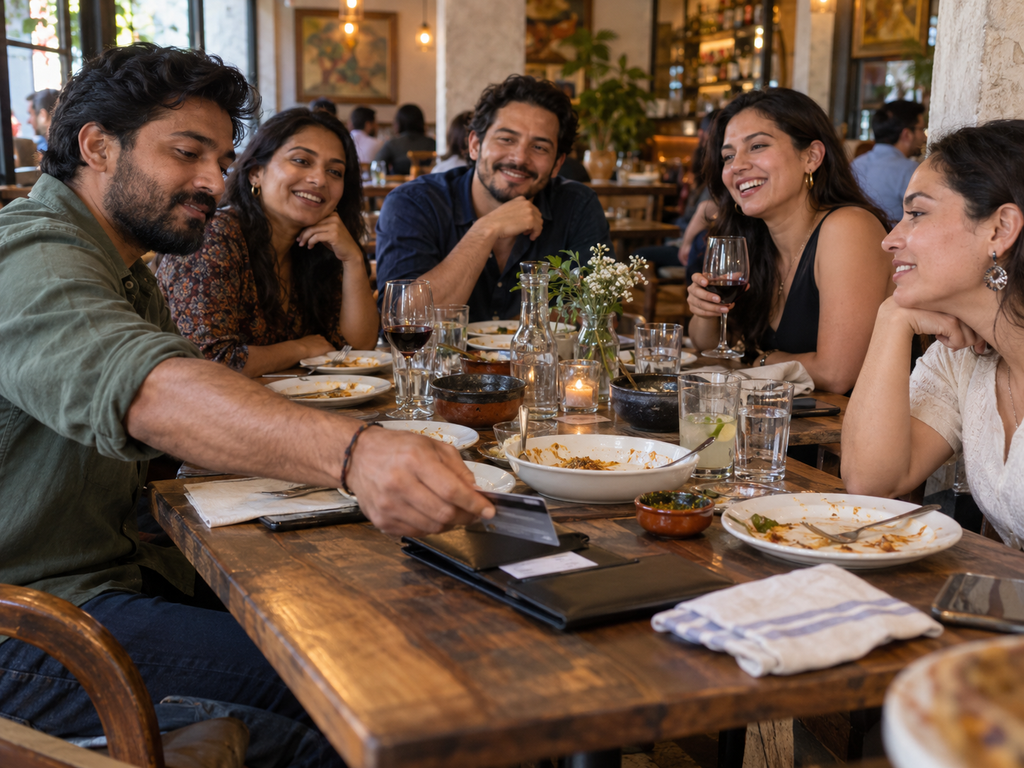
Ritesh saw nothing uncomfortable in that. If Ismar had invited them and chosen the restaurant on their first outing, being treated as his guests seemed entirely natural.
Then the scene moved to Bangalore.
Ritesh would select somewhere according to what Ismar and Amélia were comfortable eating, but also according to what he himself could realistically afford. The host should not choose an extravagant restaurant and then hope everybody splits the bill.
“We know that we can go somewhere that we can take care of them.”
He would recommend dishes. His wife could help with non-vegetarian choices because he could not honestly recommend food he does not eat himself. The visitors could accept or refuse the suggestions.
At the end, Ritesh would pay.
Again, two countries had managed to produce almost the same rule independently.
If you invite the guests out, you look after them.
Respect without a manual.
Age seemed likely to expose a deeper difference.
Ismar described visiting his mother, who is in her late eighties. He does not fundamentally change the way he speaks to her, but he does use senhora, a respectful form of address. His younger sister does not necessarily do the same.
For Ismar it is a personal expression of respect rather than a complicated social performance.
Ritesh explained that in India, addressing older people often begins from a different instinct. Someone noticeably older may naturally become “uncle” or “auntie,” even without a family relationship.
“It’s just in our blood,” he said.
Nobody teaches a child a detailed international rulebook for this. The language emerges from the social environment. Then, when travelling elsewhere, the person has to notice that the same form may not work.
Faced with Ismar’s mother in Brazil, Ritesh would therefore have to think. His automatic instinct might be to use the respectful relationship language familiar from India, while the situation itself might call for her name or whatever Ismar indicated was appropriate.
The interesting thing was not that the rules differed.
It was that Ritesh expected to adjust.
When guests stop being guests.
The imagined holiday eventually reached one week.
By then, flowers had faded, suitcases had been unpacked and everybody knew where the bathroom was. The more interesting question became what happens when visitors begin living inside somebody else’s ordinary routine.
Could Ritesh open Ismar’s fridge? Could Ismar make coffee in Ritesh’s kitchen without asking? Could somebody disappear for the afternoon? Could a guest simply announce that he was tired and go to bed?
Both households were relaxed about most of it.
Ismar would not impose many restrictions. His concern was ordinary domestic consideration: do not make a great deal of noise late at night. He usually goes to bed before eleven. A guest operating on a completely different timetable might disturb him, although for one week he would probably tolerate rather more than usual.
Ritesh was equally relaxed about guests helping themselves to something from the fridge or making tea or coffee.
He and his wife would probably keep trying to serve them anyway.
The one thing he would appreciate was information. If Ismar and Amélia went out, particularly if they might return late or not come back that evening, tell the hosts.
Not because permission was required.
Because the hosts would be waiting, perhaps preparing food, and wondering whether their guests were safe.
That distinction may be the closest the conversation came to defining its own unwritten rule.
Courtesy was not obedience.
It was consideration.
The rules between people.
The journey had begun with the expectation that Brazil and India would expose a long list of incompatible manners.
There were differences.
Flowers in Bangalore, perhaps a souvenir in Brazil. Shoes off here, shoes on there. Coffee more readily than tea. More or less chilli. Hands, forks, spoons. Senhora, uncle, auntie. Different habits around greeting and different assumptions about what a visitor already knows.

But none of them looked particularly dangerous once the people involved were allowed to speak.
Ismar could remove his shoes.
Ritesh could use a knife and fork.
A restaurant could be chosen around what the guests actually eat.
Food could be declined without creating an international incident.
The host could explain what needed explaining and let the visitor discover the rest.
And if somebody did not know what to do, there was always the oldest piece of social technology available: look around and see what everybody else is doing.
Ritesh remembered doing exactly that when he first encountered unfamiliar table manners. He watched other people use the cutlery and learned from them.
Perhaps that is why the great Brazil–India etiquette clash never arrived.
The imagined visit kept returning to the same ordinary behaviours: ask, notice, explain, accommodate, recommend, warn, pay attention.
Know enough to prepare.
Be flexible enough to change the plan.
And when necessary, do as the Romans do.