
Before the Music Starts.
Twenty minutes before a fitness class begins, there is already a great deal happening. For Geneviève, those small preparations became part of a much larger story about friendship, patience and building something together in a village.
As told by Geneviève L.
Twenty minutes before the first women arrive, I am already in the room. I have opened the door, checked the equipment and made sure the music will work. That last part is particularly important. Without music, you cannot have a proper fitness class.
Today, you can connect a telephone to a loudspeaker and begin. When I was teaching, we had CDs, later USB sticks, and a sound system that did not always cooperate. Sometimes a USB stick refused to work, and I had to search through my bag for the CDs I had brought as a precaution. All this had to be sorted out before anybody arrived.
I usually came about twenty minutes early and opened the doors for the participants ten minutes before the class. By then, the equipment was ready, the music was organised, and I could turn my attention to the women coming through the door.
That was when another part of the evening began.
Everybody has her place.
We had around twenty women in the class. Men were welcome, but none came. Perhaps they thought the exercises were not demanding enough. Or perhaps some were afraid of discovering that they were not quite as flexible as they imagined. I cannot say.
The women, however, knew exactly what they were doing.
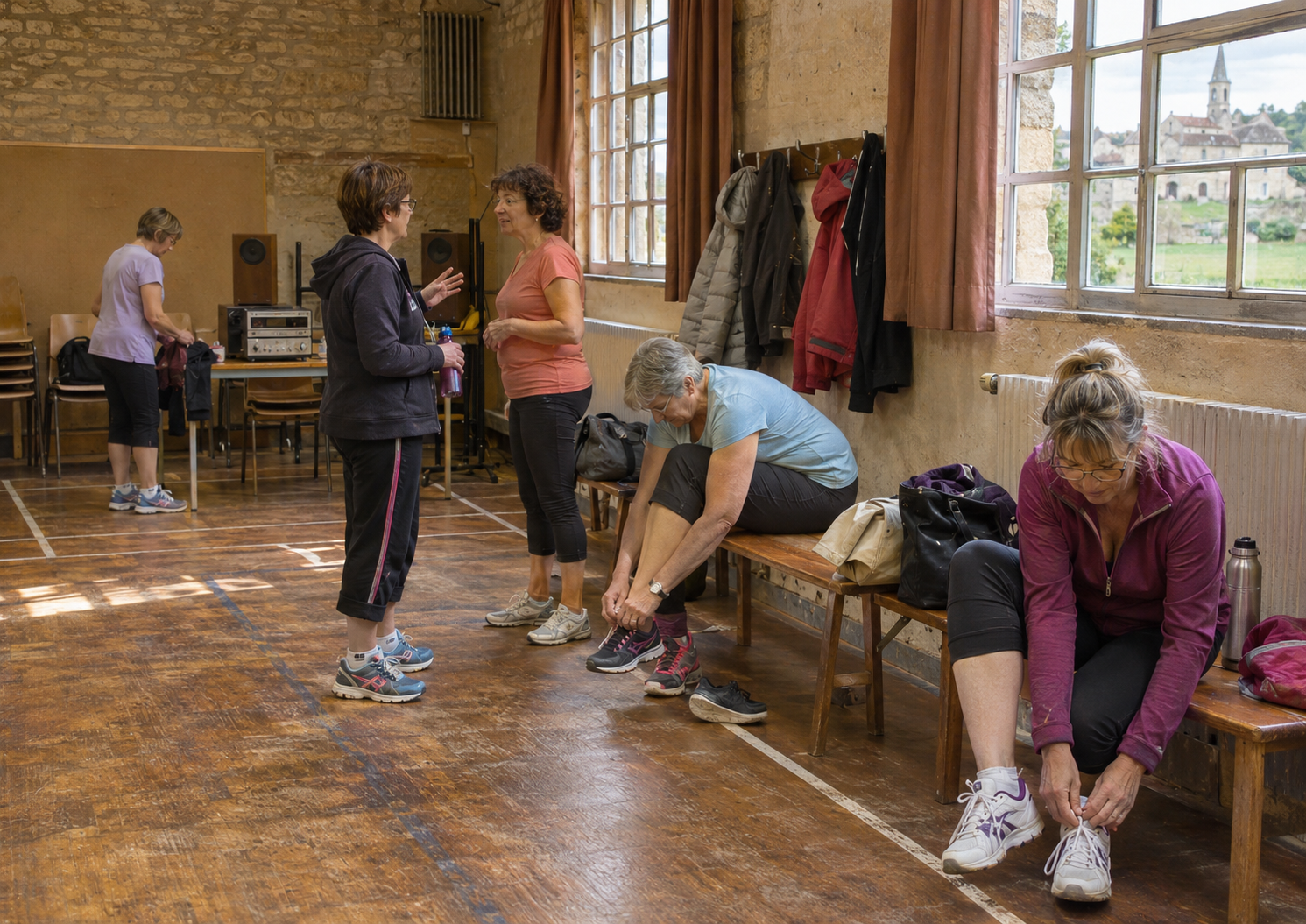
They arrived, changed their shoes and went to their usual places. Changing shoes was important because outdoor shoes brought in water and little stones that could scratch the floor. Choosing a place was something else entirely.
People develop habits in a fitness class. Those who like standing in the front row tend to arrive early enough to secure their position, while others prefer to stay at the back. After a while, everybody knows where everybody else belongs. I noticed the same thing when I attended fitness classes during summer holidays elsewhere. Even among people who did not necessarily know one another, the familiar pattern appeared.
In our village, these habits became particularly well established. More or less the same women arrived at the same time each week. Some were always early, others arrived just in time, and there was usually somebody who came rushing through the door at the very last moment.
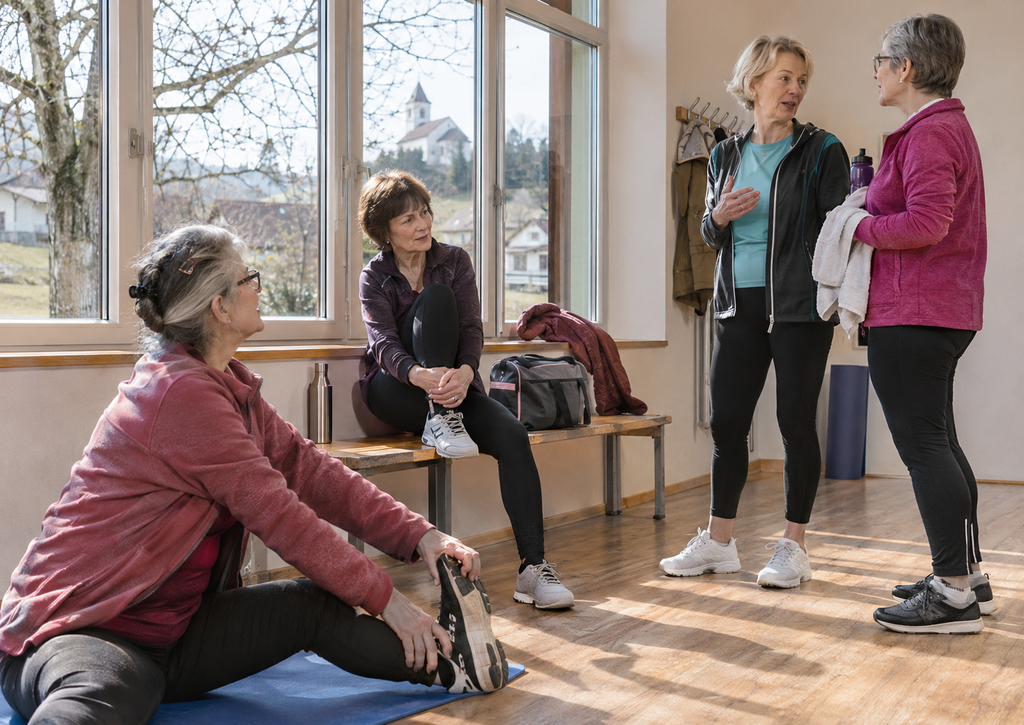
That was never a problem. Some women came directly from work, while others had been attending another activity or had stopped to speak with somebody outside. They would hear the music, realise that it was time to begin and hurry into the room. They said hello, we said hello, and that was that. There was no reason to make a difficulty out of it.
Before we started exercising, there was always time for conversation. The women exchanged news, asked about somebody who was ill, mentioned a holiday or discussed something happening in the village. Sometimes somebody had a little story to tell, sometimes a joke, and five minutes could disappear quite easily.
After Christmas, there was even more to say. Everybody had to wish everybody else Bonne année, a happy New Year, and that could take ten minutes. The first class in September was similar, although for another reason. People had not seen one another during the summer and wanted to know where their friends had been, what they had done and how their holidays had gone.
You could not simply turn on the music and expect everybody to forget about all that.
I always thought you had to allow a little flexibility. We were a village association, not a professional fitness centre where one class must finish after precisely forty-five minutes because the next group is already waiting outside. We had an hour together, and if the conversations took a little longer, we could adjust the exercises or sometimes finish a little later.
Of course, we still had to do our gymnastics.
Sometimes the talking became rather loud, even after we had started. I soon discovered that trying to speak louder than twenty women was not particularly effective. They simply became louder themselves.
There was a much better solution. I stopped the music.
Suddenly everybody looked up. They understood that something had changed, and once the conversations had finished, we could continue.
How a village club began.
The fitness group began because there was very little organised sport for women in our village. There were other activities, including music, but nothing quite like the exercise classes I had in mind. I spoke with other women, including some connected with the local music association, and we wondered why we could not start something ourselves.
We decided to try.
We asked Ernest, who was the mayor at the time, whether we could use the school premises. He agreed, so we prepared a little leaflet, only a few lines, and put copies into the village letterboxes. Then we waited to see whether anybody would come.
They did.
For about a year, we ran the group informally. We wanted to discover whether enough women were interested and whether we could make it work before taking on the responsibilities of a proper association. Once we knew that it was possible, we decided to make things official.
That was in 2000.
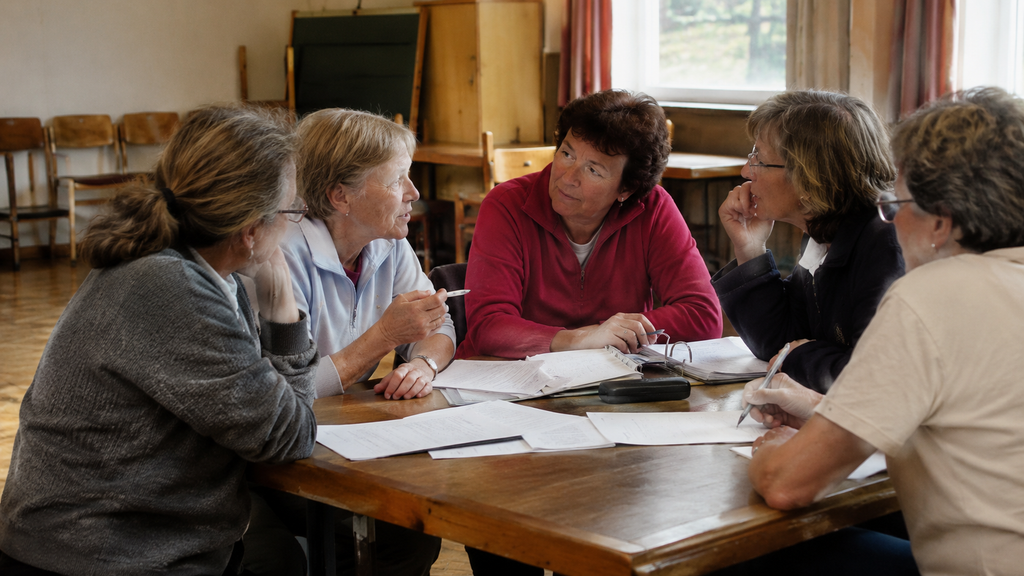
I remember the founding meeting particularly well because I had never helped establish an association before. We had to prepare documents, choose a committee, appoint a president, secretary and treasurer, and complete the formalities required for registration. There was considerably more to it than arranging a room and inviting women to exercise.
Our first president, Michelle, accepted the position. I am not sure any of us fully understood how much work and responsibility would follow, but we learned as we went along.
Over the years, we became more experienced at conducting annual general meetings, preparing agendas, organising votes and making sure important decisions were not forgotten. We also learned how to share the work between committee members, because an association cannot depend entirely on one person.
What began with a few leaflets through village letterboxes became something lasting. Twenty-six years later, the association is still there, and I am still involved, although I no longer teach the classes.
Finding the right music.
Being a fitness instructor involves much more than standing in front of a group and demonstrating exercises. There is a great deal of preparation, and when I was teaching, I had to think carefully about the movements, their sequence, the music and the different abilities of the women taking part.
After the summer holidays, for example, I could not simply begin at the same intensity as before the break. Some women had done very little exercise during July and August, so the first classes had to be progressive. I needed to judge whether an exercise was too difficult, too easy, too fast or too slow, and find ways of adapting the programme.
I also had to keep finding new ideas, which was not always easy when I had a job and a family as well. Sometimes I felt that my head was empty. I had used so many exercises and combinations that I could not think of anything new.
Fortunately, the sports federations organised training sessions for instructors. These sometimes took place on Saturdays, occasionally over two days. Professional trainers demonstrated exercises, introduced new methods and showed us how to use music more effectively. I attended these sessions over many years and obtained the necessary qualifications. They helped enormously, particularly when I needed fresh inspiration.
Music was an important part of the preparation. When I drove to work, I listened to the radio, and sometimes I heard a song that immediately made me think of a suitable exercise. Then I had to find the CD.
We did not have an endless selection of music available through a telephone. You bought CDs, and sometimes the song you wanted was only one track among many others. It was useful to find several suitable songs on the same disc so that I did not have to keep changing CDs during the class.
I had a CD player that allowed me to programme the order of the tracks. For the warm-up, I might select four songs and arrange them to play one after another. Then the music would stop, giving me time to prepare the next part of the class while the women had a drink or took off a pullover.
There were also special fitness CDs. They were more expensive, but the music was arranged in sequences of thirty-two counts, which made it much easier to prepare choreography. When you knew how many beats were coming, you could arrange the exercises so that the movements fitted naturally with the music.
It all sounds rather complicated today, but it worked. There was a particular satisfaction in hearing the music begin and knowing that the exercises fitted.
Sometimes I began thinking about a Thursday class on Tuesday or Wednesday. I would listen to a piece of music and try to imagine the movements that could go with it. Once the music became familiar, the exercises gradually began to form in my head.
Knowing an exercise is not the same as teaching it.
Over the years, I discovered that being able to perform an exercise is not necessarily the same as being able to teach it.
Somebody might not understand an instruction the first time. Repeating exactly the same words, only louder, would not necessarily help. Perhaps I needed to demonstrate the movement again, explain it differently or simply give the person a little more time.
That was one of the interesting things about teaching. You became more attentive to how other people learned, and you discovered that everybody did not learn at the same speed or in the same way.
I also noticed differences between instructors during the training sessions I attended. Some had a wonderful sense of how music and movement belonged together. Their exercises flowed naturally from one sequence into another, and you could understand not only what you were doing but why one movement followed another.
Others might know the exercises perfectly well but find it harder to communicate that connection. After four or five repetitions, the participants might eventually remember the sequence, but that was not quite the same as understanding it.
For me, good teaching involved both. I had to know the movements myself, but I also had to find a way of bringing the other women with me.
More than an hour of gymnastics.
At the beginning, our idea had simply been to give women in the village an opportunity to exercise. But as the association developed, we began organising other activities, and friendships grew beyond the weekly classes.
At the end of the season, we usually organised a little excursion. Sometimes we visited a town, such as Luxembourg, and sometimes we went somewhere for a good meal together. It was an opportunity to spend time with one another without having to concentrate on exercises or watch the clock.
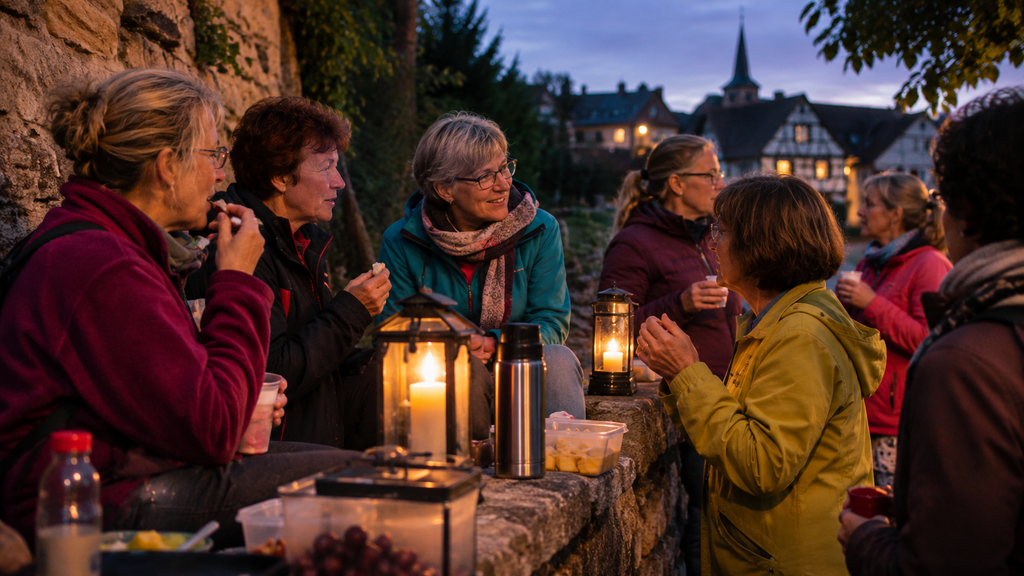
On another occasion, we organised an evening in a local shelter, with a walk beforehand. There was no electricity, so we brought lanterns and candles. Everybody contributed something to eat. Some brought savoury dishes, others cakes, and we arranged drinks, including water and fruit juice for those who did not want alcohol.
We could sit together, eat and talk about the year. There was no need to hurry.
Before Christmas, we had another tradition: an evening with Christmas cookies. We did not meet to bake them, but to eat them together.
Our association also took part in village activities, which meant that we needed volunteers to help with different events. That was one reason we liked to begin the autumn season early in September, before the village festival. The women knew one another through the classes, but they also worked together and met through other parts of village life.
Of course, when new women joined, we had to remember that they were entering a group in which many people already knew one another. A newcomer might be uncertain about where to stand, whether she could manage the exercises or how easily she would fit in.
I tried to pay attention to that. Other women could help too, and usually they did. It was important that somebody arriving for the first time should feel comfortable enough to come back the following week.
A season that never quite ended.
At our final gathering before the summer holidays, we usually had a reasonable idea of who intended to return in September. But there were still dates to arrange and practical questions to settle. During the summer, we would exchange messages and agree with the instructor when the classes should begin again.
When I was still teaching, I used the summer to prepare as well. I kept notes about the exercises the women enjoyed, sometimes making a little cross beside something that had worked particularly well. Later, I could look through those papers and decide which exercises to use again, which needed changing and which could be left out.
Then there was new music to find and new combinations to prepare. Even during the holidays, I sometimes heard a song and began imagining how it might work in a class.
Today, the club has other instructors. I still hold my instructor’s qualification, but I participate as an ordinary member and remain involved in the committee. That is quite a change after so many years of preparing and leading the classes.
I can now arrive, change my shoes and take my place like everybody else.
And I no longer have to worry about whether the CDs are in my bag.
A different path.
When I was young, I enjoyed sport and movement and wanted to do something connected with them. But the possibilities were different then.
In 1974, when I was fourteen, going away to study was not a simple option. The training I would have liked was not available nearby, and travelling to somewhere such as Paris was not something my parents could arrange.
So I followed another path. I worked, had my family and continued to enjoy sport as an interest. Later, I trained, obtained my qualifications and began teaching fitness classes.
I do not regret it.
The experience gave me much more than I had expected when we first put those little leaflets through the village letterboxes. I learned how to organise an association, work with a committee, prepare lessons and teach people with different abilities. I also learned to be patient, to listen and to accept that a group of twenty women would not always behave exactly as I had planned.
And perhaps that is why I never minded those ten minutes before the class.
A woman arrived, changed her shoes and found her usual place. Somebody had news from the village. Somebody else had a joke. Another woman came rushing through the door, late as usual, and everybody said hello.
Then I turned on the music.
And we began.