
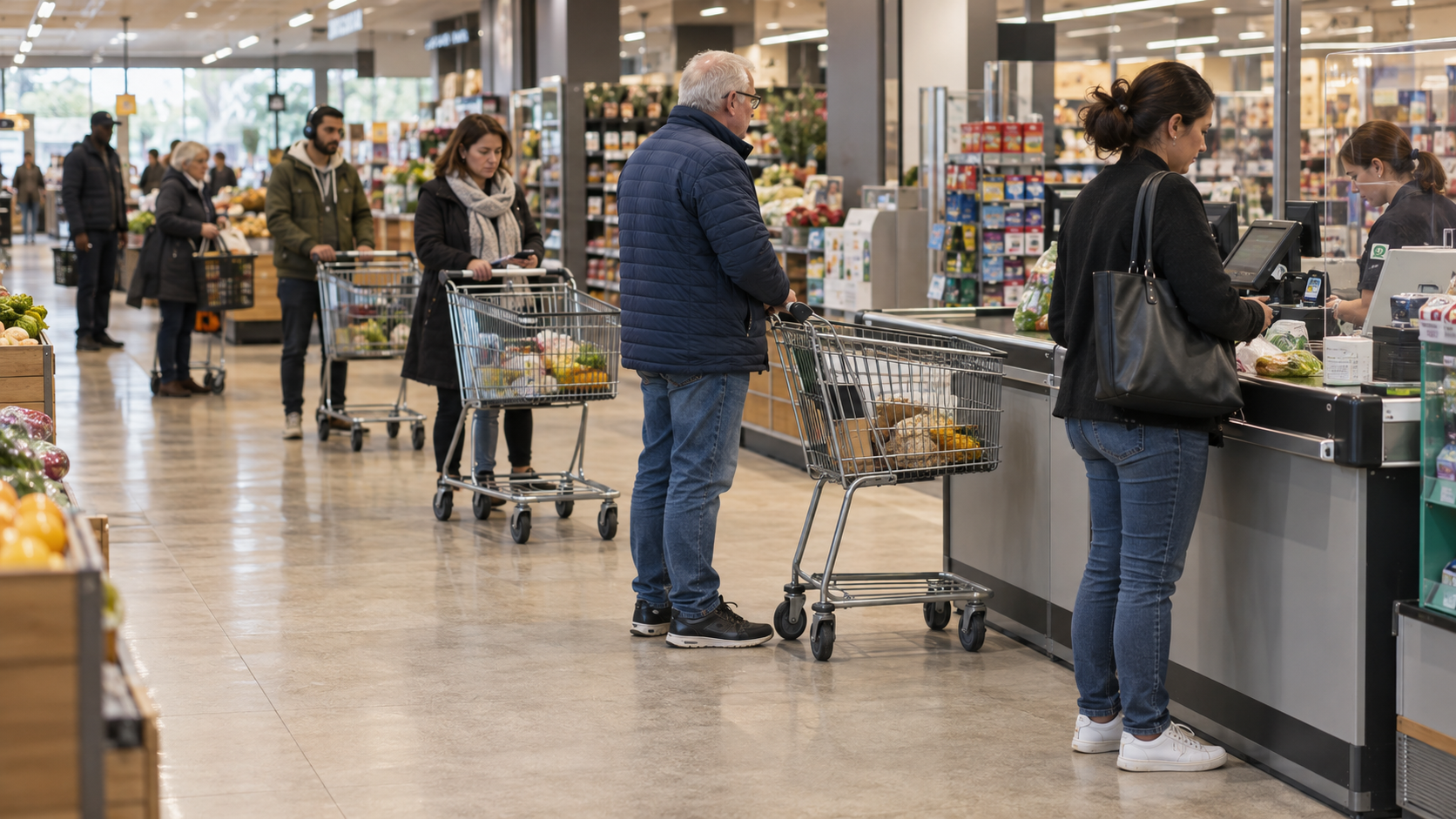
One Shopping Trolley Between Us
The correct distance between strangers is sometimes one and a half metres. Sometimes it is one good cup of coffee.
By Ralf the Grillmeister, Germany
There was one thing during the COVID time that I really liked: at the supermarket cashier, people kept their distance.
One and a half metres. Beautiful.
Today, this has disappeared completely. People come closer and closer again, and sometimes I think they want to go home with me.
On Sunday my wife said, “I need bananas.” Some supermarkets near us are open on Sundays, so we drove there. There was an extremely long queue at the cashier. Then came the magic announcement: cashier number two was opening.
I sometimes think there is only one thing faster than Usain Bolt: pensioners when cashier number two opens.
Suddenly everybody was moving. Shopping trolleys were changing direction, people were calculating positions, and normal social behaviour was temporarily cancelled because somewhere, perhaps twelve metres away, there was the possibility of being served thirty seconds earlier.
I was standing there when an older woman and her daughter came behind me with their trolley.
Bum.
The trolley touched my backside.
Bum again.
At some point I turned around and said, “Excuse me, can you please keep more distance? Your trolley does not need to be on my body. I don’t like it.”
There is a limit.
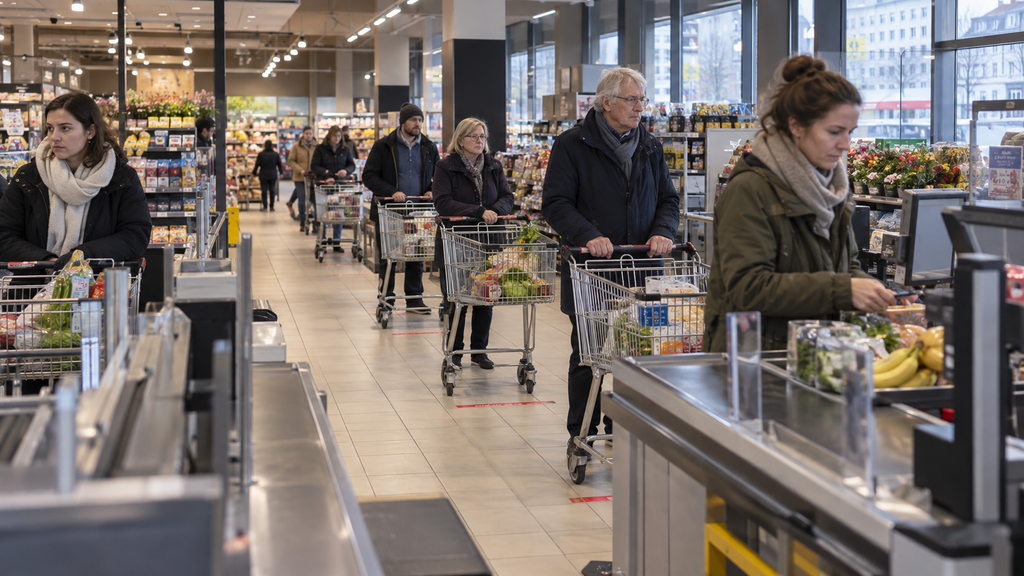
A week before, it was even worse. A man stood behind me without a trolley. He had all his shopping in his arms and came so close that I could hear him breathing on my neck.
No. Sorry.
Again I asked him to keep more distance.
Maybe one and a half metres is not necessary every time, but breathing into my neck is definitely too close.
I have developed a technical solution. If I have a shopping trolley and somebody behind me keeps coming closer, I move around to the other side of my trolley. Then the trolley becomes my security system.
It is not perfect, but it is better than nothing.
Cashier Number Two.
The supermarket cashier is a very interesting place for studying human beings.
Distance is only the beginning.
Then somebody reaches the cashier and hears, “That will be €12.20.”
You think this is the end of the transaction.
No.
Now comes the purse.
One coin. Two coins. Three coins. Four coins. Five coins. More coins. Another compartment. More searching. More coins.
Then, after the complete archaeological excavation of the handbag: “Oh, I don’t have enough.”
Everything goes back into the purse and out comes a banknote.
At such moments I become slightly nervous.
The funny thing is that I collect coins myself. I have a big red pig at home, and everything that is left in my pockets goes into it. I leave it there for a long time, sometimes until another holiday has come and gone, because otherwise it is not worth the effort.
Then I take the pig to the bank and pour everything into the counting machine.
Suddenly the machine tells me, “Mr Brand, €758.”
Yes!
That is a good moment.
So I have nothing against coins. Coins are fantastic. I only prefer them when they are inside my red pig and not being counted one by one in front of me when I am waiting with frozen food in my shopping trolley.
Closing the Other Distance.
In my working life, strangely, I often do exactly the opposite.
At the supermarket I want more distance. When I meet somebody for business, I usually try to reduce the distance.
Not physically. Please, no breathing on the neck.
Human distance.
When I enter somebody’s office for the first time, I look around. Right side, left side, wall, desk. What is there?
A photograph of a sailing boat? Good.
A picture of a balloon? Even better.
Something from Norway? A particular computer? A strange object on the desk?
That is my starting point.
I can say, “Oh, you sail?”
Or, “Have you been to Norway?”
Or perhaps I see a balloon picture and can tell them that I once gave my wife a balloon flight for her birthday.
Immediately we are not only two people sitting down for a sales meeting. We have something else to talk about.
This is important to me.
You can start with the product, the price and the presentation. Of course you can. But I prefer first to find the person.
Even an almost empty office tells you something. If there are four blank walls and an empty desk, I might say it looks like Stuttgart-Stammheim prison. Then at least we have a conversation.
There is nearly always something.
I also still like paper. I like writing with a pen. If I see somebody with an Apple computer, that can also start a discussion because I use Apple myself.
A life without Apple is possible.
But not desirable.
The Coffee Rule.
Coffee is another very good bridge.
When somebody asks me at a meeting, “Would you like coffee?”, my answer is normally yes.
Sometimes the coffee is not very good. Then I drink it and say thank you.
But when the coffee is excellent, I say something.
“This coffee is really good. It smells fantastic. What machine do you have?”
And suddenly the other person starts talking.
“Yes, we have this special machine…”
And off we go.
Before we have discussed the real subject of the meeting, the atmosphere has changed.
We are talking like people.
For me, this is much more natural.
The important thing is that it must be genuine. If the coffee is fantastic, I say it is fantastic. If I see an interesting picture, I really want to know the story. It is not a trick where I have learned three sentences from a sales book.
I am curious.
And often the little thing beside the actual business becomes the thing that opens the business conversation.

Du, Sie and the Hamburg Solution.
Then there is Germany’s great social measuring system: du and Sie.
English makes life very easy. Everybody is “you.”
We Germans had to build an entire social engineering project around one pronoun.
With some customers I use du. With others I use Sie. In my present working world it is probably around fifty-fifty.
In another company I worked for, we often came from an Austrian background and simply asked customers, “We normally say du. Is that okay?”
Usually they said yes.
Finished.
Very easy.
But it is not always so easy, because the choice says something about distance. If you move to du too quickly, perhaps you are too familiar. If you stay with Sie forever, perhaps you create a wall that is no longer necessary.
Hamburg even has its own solution: the Hanseatic du.
You use the person’s first name but continue with Sie.
“Hallo Ralf, können Sie bitte…”
Fantastic.
Close and distant at the same time. Very Hamburg.
People often say North Germans are reserved and closed. I do not completely agree. I have heard the opposite many times. People meet us and say, “You are not closed at all.”
For me, being open does not mean becoming everybody’s best friend in five minutes. It means that when the connection is real, it can stay real.
You can meet somebody again after many years and continue almost where you stopped.
That is a different kind of distance.
The Radar.
The Mayor asked me whether I have some kind of radar for strangers.
Yes.
Can I explain it?
Not really.
Sometimes I see somebody and immediately think: I don’t like this person.
Other times I meet somebody and think: this is the right man.
There is something there. The way somebody looks, behaves, speaks or reacts. I cannot make a technical drawing of it. I cannot measure it with my invisible tape measure.
You can look at a person, but you cannot look inside their head.
Still, after many years of meeting customers and all kinds of different people, I think you learn to read between the lines.
Sometimes, of course, you can be wrong. That is human.
But sometimes the connection is immediate.
I remember meeting a manager for the first time in a restaurant. We introduced ourselves, started talking and very quickly the conversation was not really about work anymore. We talked about private things and ordinary life.
The chemistry was simply there.
Later, when I was somewhere near his home, I could send a message: “I am nearby. Shall we have a coffee?”
“Yes!”
That is nice.
And perhaps this is why I cannot give one answer to the question of the correct distance between strangers.
At the supermarket, please give me some space. If you have a shopping trolley, even better. We already have a very practical measuring instrument.
In a conversation, it is different.
Then I look for the picture on the wall, the object on the desk, the good coffee, the small joke, the word that tells me how this person wants to communicate.
Nobody really teaches you these rules. Often everybody simply expects you to know them.
Some people want Sie. Some are immediately comfortable with du. Some people need a little time. Some need a conversation before the real conversation. Some say almost nothing at all.
You have to look.
You have to listen.
And sometimes you simply need to know when to move your shopping trolley between yourself and the person breathing on your neck.