

The Long Way to Somewhere Wonderful.
From a supermarket fifteen kilometres away to a chocolate shop on another planet, the Lunch table discovers that some journeys are worth the extra effort.
As told by Monica in Adelaide, Australia; Nathalie, Accra, Ghana; Rosii, Sao Paulo, Brazil; Fruitloop in South Africa and turning down the heat, The Mayor in Cleebourg, France.
There is a perfectly good supermarket just around the corner from Fruitloop’s home in South Africa. It sells everything she needs, and getting there requires very little effort. Yet, whenever there is a little extra money available, she and her family prefer to drive fifteen kilometres to another town.
Why? Because that supermarket has a wonderful bakery, a large fruit and vegetable section, and shelves full of things that make an ordinary shopping trip feel like a small outing. There are promotions, interesting products and plenty of opportunities to find something delicious.
Of course, there is a slight problem with this arrangement.
As Fruitloop explained, you arrive intending to save money, but then you start walking through the shop. This looks nice. That looks nice. Perhaps just one more thing.
And before you know it, you have spent your savings on all the other things you discovered.
The Mayor understood the danger immediately. He remembered visiting the famous Harrods Food Hall in London during the 1990s, where he found himself standing behind an elderly couple doing their ordinary weekly shopping. Their trolley contained everyday groceries, nothing particularly extravagant, yet the bill came to £250.
He was astonished. The cashier, however, explained that the couple came every week. For them, this was perfectly normal.
It was a small reminder that one person’s everyday shopping trip can be another person’s extraordinary experience.
And that was where our Lunch conversation began: with the places we are willing to travel a little farther to reach, even when something perfectly adequate is available much closer to home.
A Market That Offers More Than Shopping.
For Rosii, one such place is the Mercado Municipal in São Paulo, Brazil.
It is a huge market filled with fruit, vegetables, meat, fish, coffee, restaurants and traditional Brazilian food. There are fruits of almost every imaginable kind, including varieties that visitors may never have encountered before.
Getting there can take thirty, forty or even fifty minutes by car at weekends, depending on the traffic. The prices are not always cheap either. But Rosii loves the place.
What makes it special is not simply the food. It is the atmosphere.
Some sellers have worked there for decades, and Rosii remembered hearing about a man who had spent thirty-five years at the market. In some cases, businesses have passed through generations of the same family.
The people are friendly, she explained, and visitors can taste unfamiliar fruits before deciding what to buy. You can wander between the stalls, talk to the sellers, sit down for coffee or enjoy a traditional Brazilian pastry, a popular snack with savoury or sweet fillings.
Rosii also remembered going there to buy bacalhau, salted cod traditionally enjoyed at family meals.
For her, the market is not simply somewhere to purchase ingredients. It is somewhere to spend time.
As she put it, you can go there “not only to buy things, but to go around, to see, to talk, sit and take some coffee.”
There is something rather lovely about that distinction. The journey may begin with a shopping list, but the pleasure is not necessarily in what you bring home.
Sometimes it is in everything that happens before you leave.
The Things We Will Do for Bread, Wool and Tea Towels.
Our detours were not limited to food.
Nathalie remembered travelling farther than necessary to visit an outlet shopping village in Roppenheim, in the Alsace region of France. There, she could explore a wider selection of clothing brands and find good-quality items at reduced prices.
Monica, meanwhile, had an entirely different shopping destination in mind.
A wool shop.
During a recent visit to Germany, she and John took a train to reach a particular knitting shop. Unfortunately, the weather was not cooperating. After leaving the railway station, they had to walk through the rain, following directions on Google Maps.
John was not impressed.
Fortunately, Monica explained, these shops often provide a sofa where husbands can sit while their partners explore the wool.
The Mayor thought this was a very sensible arrangement, although he was quick to defend John’s position. He remembered another shopping incident in Wissembourg, when Monica spotted some Christmas tea towels.
According to the Mayor, Usain Bolt would have struggled to match the speed at which she entered the shop.
Monica did not deny her enthusiasm. The tea towels were for her Christmas trip, after all.
The Mayor and John, meanwhile, had apparently found themselves outside the shop discussing the situation.
It seems that a worthwhile detour depends very much on which side of the shop window you are standing.
The Mayor had his own weakness, although his involved something considerably more edible.
Bread.
He explained that Germans have a particularly close relationship with their bread, and when he lived outside London, finding the kind of German bread he loved was not always easy. He would deliberately travel into parts of the city that were nowhere near his usual route, simply to stock up.
Sometimes he would also seek out a particular café where he could feel among familiar people.
Fruitloop, who loves bread herself, immediately suggested that perhaps she was German too.
And somewhere between the wool, the Christmas tea towels and the German bread, it became clear that these little journeys were about more than convenience. They were also about familiar tastes, personal pleasures and the things that make a place feel special to us.
Geographically Embarrassed.
Of course, not every detour is intentional.
Sometimes we simply go the wrong way.
Fruitloop asked whether anyone had ever taken a wrong road or entered the wrong place and discovered something unexpectedly wonderful.
Rosii was not convinced. She remembered taking a wrong turn and finding herself somewhere dangerous, where she needed help from the police. Fortunately, everything turned out well, but it was certainly not the pleasant discovery Fruitloop had in mind.
Nathalie had a happier example.
While in Ghana, she and her husband wanted to visit a small park near a university where people went running and walking. Her husband was driving, but he turned left too early.
Instead of arriving at the park, they found themselves inside the university grounds.
It was not where they intended to go, but Nathalie was delighted by what they discovered. The university was large and beautiful, with people walking around the grounds. It was somewhere they would probably never have thought to visit otherwise.
A wrong turn had become a little sightseeing adventure.
Monica knew the feeling. During her travels, she had sometimes followed Google Maps only to find herself somewhere completely different from where she intended to be.
She still prefers paper maps.
But even when the technology leads her astray, she can appreciate the unexpected discoveries along the way. Eventually, she reaches her destination, having seen somewhere she would otherwise have missed.
She has a wonderful expression for these moments.
“Geographically embarrassed.”
The Mayor immediately appreciated the phrase.
It is certainly a much more dignified way of announcing that you are lost.
His own experience of taking a wrong turn, however, had involved rather more excitement.
While living in Britain, he was driving with his then girlfriend, apparently on another mission to rent Dirty Dancing, when he accidentally entered a one-way street in the wrong direction.
It was pouring with rain, and before long, police lights appeared behind him.
The officers stopped him and instructed him to report to a police station within seven days.
The Mayor was worried because he still had a German driving licence and was not entirely certain whether everything was in order.
He eventually chose a Saturday morning to present himself at the police station, preparing for the worst.
When the officer examined his licence, he noticed that it was German.
The Mayor confirmed that he was German.
The officer was surprised.
“But you speak such excellent English.”
The Mayor explained that he had grown up in Australia.
Whether the licence was perfectly acceptable or the officer was simply distracted by this unexpected linguistic discovery, the Mayor could not say for certain. What he remembered was that he left without further trouble.
His wrong turn had not revealed a beautiful garden or a hidden café, but it had certainly produced a story.
And, as Fruitloop soon discovered, it was not his only police story.
The Wonderful Places in Our Own Backyard.
As the conversation continued, another kind of detour emerged.
What about the places close to home that visitors travel thousands of kilometres to see, while we hardly ever bother going there ourselves?
Monica immediately thought of Kangaroo Island in South Australia.
For years, friends and relatives visiting from Germany had made a point of going there. Yet Monica herself had never visited.
Eventually, she decided that perhaps she should see what everyone was so excited about.
She took the journey, which involved driving to the ferry and crossing to the island, and discovered somewhere she absolutely loved.
The wildlife, the scenery and the beauty of the island made such an impression that it became one of her favourite places in the world.
She had a similar experience with the Flinders Ranges, a spectacular region of South Australia’s outback. Once she finally visited, she fell in love with the landscape and returned several times.
The curious thing was that she had travelled to Germany many times while leaving these wonderful places in her own part of Australia unexplored.
Rosii recognised the same pattern in São Paulo.
When an American English teacher who had once taught her came to stay, the visitor began researching places to explore around the city.
Rosii was surprised by how many attractions her guest wanted to visit.
Some were places Rosii knew about but had never actually seen herself.
Her visitor could hardly believe it.
Here was someone living in São Paulo, surrounded by extraordinary attractions, yet still unfamiliar with some of the city’s most interesting places.
Rosii admitted that she still has many places to discover.
She did, however, remember visiting a high glass viewing platform overlooking São Paulo. With glass beneath her feet and views across the city, it was a remarkable experience. While there, she met American visitors who asked her for information, giving her an unexpected opportunity to speak English.
The Mayor had his own example.
He lived in and around London for six or seven years without visiting the British Museum, despite always intending to go.
It was only later, when his daughter wanted to see an Egyptian exhibition featuring Tutankhamun, that he finally visited.
He had travelled to many places, yet one of London’s most famous museums had remained on his list for years.
Fruitloop, on the other hand, had been fortunate to explore many of South Africa’s attractions while growing up.
Her father had made it a goal to show the family as much of the country as possible.
She remembered visiting places around Sabie and Graskop, with their waterfalls, caves, unusual rock formations and famous viewpoints such as God’s Window.
Even now, there are places she still wants to explore.
The Drakensberg mountains are high on her list. Perhaps one day she will go hiking there.
The Mayor immediately began imagining a much grander adventure: travelling around South Africa and hosting Brida meetings from the bush.
Monica suggested Starlink for the internet connection.
The Mayor pointed out that the technology was not the problem.
The money was.
He also preferred slow travel. If he set off on foot, he calculated, he might arrive by the end of the decade.
The Place Nathalie Didn’t Want to Visit.
Perhaps one of the loveliest discoveries came from Nathalie.
During a summer visit to Paris with her daughter, she had a list of places she wanted to see, including the Panthéon and the Seine.
Her daughter, however, had a different idea.
She wanted to visit the Grande Mosquée de Paris.
Nathalie was not enthusiastic.
There were so many other beautiful places in Paris, she thought. Why spend time visiting a mosque?
At first, she told her daughter to go alone.
Eventually, however, she agreed to accompany her.
And what she found surprised her completely.
Inside was a beautiful space with blue mosaics, a basin and architecture that felt very different from the Paris she had expected to explore.
She was amazed by the beauty of the surroundings and delighted that she had gone inside.
The Mayor knew the place too. He remembered sitting in its peaceful café area for about an hour, enjoying the tranquillity.
For him, it had felt almost like taking a little holiday somewhere far away, despite being in the middle of Paris.
Nathalie had begun with no desire to visit.
She left with a beautiful memory.
It was not a wrong turn, and it was not a journey she had planned for herself. It was simply a place someone else had wanted to show her.
Sometimes that is all it takes to discover something wonderful.
Five Years for a Chocolate Shop?
Naturally, no Lunch conversation would be complete without Fruitloop taking the discussion somewhere completely ridiculous.
After travelling through supermarkets, markets, mountains, museums and unexpected destinations, Fruitloop decided it was time to leave Earth altogether.
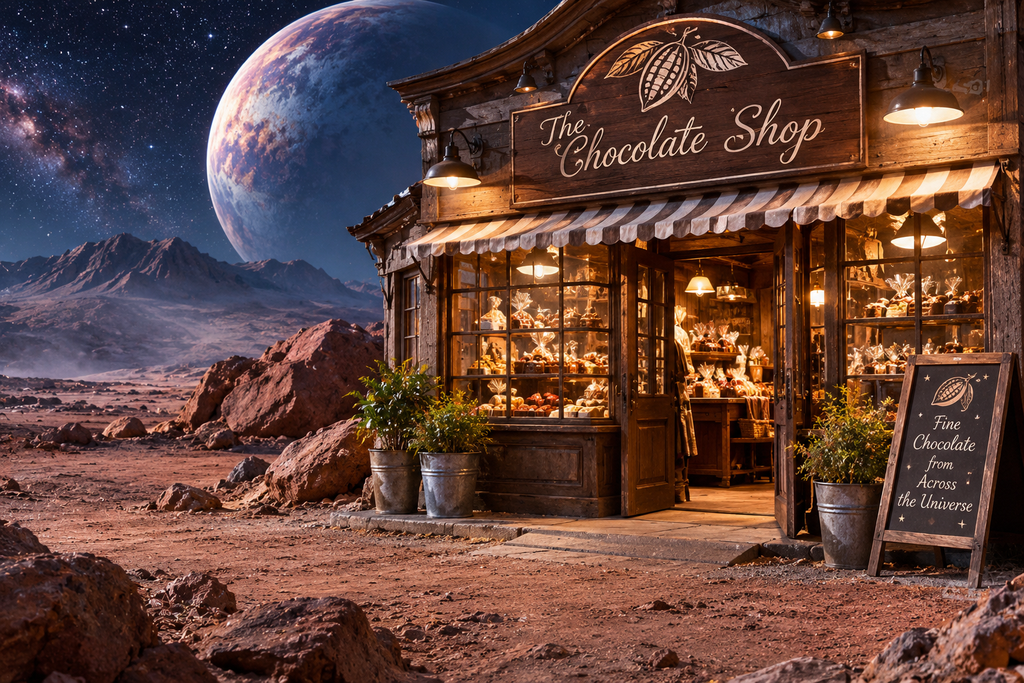
Imagine, she suggested, that you are walking to the supermarket when an alien spaceship lands beside you.
The aliens offer to take you to the best chocolate shop in the universe.
There is just one small problem.
The journey will take five years.
Would you get in?
The Mayor immediately wanted clarification.
Were these five alien years or five human years?
Human years, Fruitloop confirmed.
Would the aliens accept no for an answer?
Probably.
In that case, he was staying home.
He pointed out that excellent chocolate was already available in Switzerland and Belgium. Why spend five years travelling through space?
Fruitloop was not persuaded.
How could they know whether it really was the best chocolate in the universe unless they went to investigate?
The Mayor had another objection. What exactly did best mean? His favourite chocolate might be completely different from the aliens’ favourite chocolate.
Rosii, however, was willing to take the chance.
Five years was a long journey, but the possibility of delicious chocolate and an exciting new experience sounded rather appealing.
Fruitloop was delighted.
At last, she had a travelling companion.
Nathalie had a more practical solution. Having recently returned to Ghana, she pointed out that the country was an important source of cocoa for chocolate makers around the world.
Perhaps she did not need to travel anywhere at all. She simply needed to find a very good local chocolatier.
Monica was less certain about the intergalactic expedition.
She loved chocolate, particularly Cadbury Fruit & Nut, and was fascinated by the extraordinary chocolate sculptures created by a French chocolatier she enjoyed watching.
But five years was a very long time.
And then the Mayor reminded everyone of something rather important.
Five years would only get them there.
The return journey would take another five.
Ten years for chocolate?
Monica decided that was a little excessive.
Fruitloop suggested that perhaps they could simply stay at the chocolate shop.
The Mayor was beginning to suspect that Fruitloop had not thought this adventure through very carefully.
More importantly, who would run the meetings, help with The Pineapple and manage everything while she was away?
Fruitloop was confident that the aliens would have the necessary infrastructure.
They would figure something out.
The Mayor was unconvinced.
Monica suggested that Fruitloop was defecting to Mars.
Rosii, meanwhile, was still willing to go.
The Mayor finally had enough.
“You’re not going.”
Fruitloop accepted this with remarkable good humour, although she admitted that her husband probably would not approve of the journey either.
Her son, on the other hand, might be delighted to see her leave. With no mother around to remind him to make his bed, clean his room, pick up his toys and eat his food, he would have considerably more freedom.
The Mayor had one final concern.
Did the aliens have any idea what they were letting themselves in for?
Fruitloop was not worried.
“They have five years to learn.”
And perhaps that was the perfect place to end our journey.
We had started with a supermarket fifteen kilometres from home and somehow arrived at the possibility of spending ten years travelling across the universe for chocolate.
Along the way, we had discovered German bread in London, wool shops in the rain, beautiful places overlooked by the people who live nearby, a peaceful mosque in Paris and the unexpected pleasures of being geographically embarrassed.
Not every detour had been worthwhile. Some were expensive, some inconvenient, and some led nowhere particularly pleasant.
But a few had taken us somewhere we would never have thought to go.
And somewhere out there, Fruitloop and Rosii still have a spaceship to catch.