
The Difference Between Knowing More and Understanding Better.
I studied computer systems and wrote my thesis on artificial intelligence, but for a long time, using ChatGPT felt almost like cheating. Then I started asking people from different generations how they used it. Some of their answers surprised me.
As told by Abbas, Azerbaijan, in conversation with Bruce, London; Janita, South Africa; and Frank, Cleebourg, France.
I studied computer systems and wrote my thesis on artificial intelligence, but when I first encountered ChatGPT, using it felt somehow not allowed.
I know that sounds strange, especially for somebody studying technology. It was almost a taboo for me, as though asking a machine for help was a form of cheating. I was curious about what it could do, but I avoided using it because I worried about what would happen to my own ability to solve problems.
Would I become better at thinking, or simply better at asking AI to think for me?
For quite a while, I watched other people using these systems without becoming very involved myself. Eventually, I started experimenting, and once I did, I learned quickly. But I never completely lost that original concern.
It also made me interested in how other people approached artificial intelligence. Particularly people from different generations. I wondered whether older people found it harder to accept new technology, or whether younger people were simply more comfortable with it because we had grown up surrounded by computers and the internet.
I wanted to hear different experiences, so I brought the subject to a Brida conversation with Dr Bruce Lloyd in London, Frank Peters in France and Janita Le Grange in South Africa.
I had recently completed my bachelor’s thesis in Riga, Latvia, and returned home to Azerbaijan, where I was beginning my professional career. The other three had travelled very different professional paths. Bruce had spent decades exploring ideas about the future. Frank was now using AI to build systems for Brida, and Janita was applying it to education and publishing.
We were different ages, living in different countries, with different experiences of technology. That was exactly what interested me.
I wanted to know how they had started using AI, what they were doing with it, and how they knew whether the answers they received were correct.

The man with the Betamax recorder.
Bruce began by telling us that he still had a Betamax video recorder.
I didn’t know much about Betamax, so he explained that it was an early video recording system produced by Sony. It competed with VHS, and Bruce believed it was technically better in certain ways. But VHS became the more successful system.
I found that interesting. Here was somebody who had been enthusiastic about technology for decades, and he still owned a reminder that the technically better product doesn’t always win.
Bruce couldn’t remember exactly when he started using ChatGPT, but he had become very interested in experimenting with artificial intelligence. He described it almost as a hobby. He was using different systems to investigate subjects that interested him, especially philosophy, the future and questions outside his own area of knowledge.
Then he said something I liked very much.
AI, he explained, was excellent at revealing his ignorance. It helped him move from ignorance towards less ignorance.
I had never thought about it quite like that.
When I was studying, I was usually trying to find an answer to a problem. Bruce seemed just as interested in discovering new questions. He wasn’t expecting the machine to know everything. He was using it to explore things he didn’t know himself.
He also mentioned that some people criticised him for publishing AI-assisted work on LinkedIn. He didn’t usually argue with them. He suspected that some of his critics hadn’t really tried the technology.
For Bruce, it wasn’t a question of choosing between human intelligence and artificial intelligence. He wanted to understand how the two could work together.
I could see his point. But I was still thinking about something that had happened during my studies.
What happens when the sources don’t exist?
When I was writing my bachelor’s thesis, I used ChatGPT to help find academic information and references.
Some of the answers were very convincing. They looked like proper academic references, with titles and links. But when I tried to check them, I discovered that some of the references didn’t exist. Other links went nowhere.
That was a serious problem for me.
When you’re writing an academic thesis, you can’t simply include a reference because ChatGPT tells you it’s correct. You need to find the actual source and make sure it supports what you’re writing.
This was one of the reasons I had been hesitant about using AI in the first place. The answer could look perfectly reasonable and still be wrong.
So I asked Bruce whether he had tried different models, rather than depending on ChatGPT alone.
He had experimented with seven or eight freely available AI systems. Sometimes he gave them quite unusual questions. One example was asking the systems to develop a theory of everything.
That made me smile. I hadn’t expected him to be testing AI with questions quite like that.
He would collect the different answers and then ask several models to evaluate them, comparing their strengths and weaknesses. Sometimes he transferred the results into Google’s NotebookLM, which could turn the material into other presentations, including discussions and videos.
He found that different AI systems could be quite critical of one another.
In one experiment, a system even pointed out that evaluating its own answer might introduce bias. It suggested removing the identifying information from the responses before comparing them.
Bruce found that remarkable. He was careful about calling it self-awareness, because he didn’t mean that the machine understood itself like a human being. But he was fascinated that it could recognise and express such a limitation.
Frank described some of these responses as a little eerie.
I could understand why. But I also had another question in my mind.
If several AI models compare their answers and agree with one another, does that mean the answer is correct?
Not necessarily.
They might all make the same mistake. Or one model might produce a very convincing explanation of why another model is correct, even when neither has reliable information.
For me, comparison was useful, but it wasn’t the same as verification.
I was beginning to understand Bruce’s way of experimenting, although I still wanted to know how far we could trust the results.
Janita’s three-hour lesson.
I was curious about Janita’s experience because she wasn’t approaching AI primarily as a technical subject.
She told us about preparing lessons for virtual classes. Before using ChatGPT, she worked with handbooks, searched Google and visited different websites to collect the information she needed. Then she had to organise everything and prepare questions for her students.
Sometimes it took three hours to prepare one lesson.

When she began using ChatGPT, the work became much faster. She could explain what she wanted, ask for information and develop questions around the subject. A lesson that had previously taken three hours could sometimes be prepared in thirty minutes or an hour.
That was a considerable difference.
But I was pleased when she explained that she still checked the answers. She wanted to know whether the information was correct and whether she agreed with what the AI had produced.
I thought that was important. Making something faster doesn’t automatically make it better. If the material is going to be used with students, somebody still needs to understand it.
Bruce became interested in her mention of handbooks. He suggested that artificial intelligence might completely change the way we used technical manuals.
Normally, when you have a problem with a machine or a piece of equipment, you have to search through the manual. The information is organised according to the manufacturer’s system, not necessarily according to the problem you’re experiencing.
But with AI, you could begin by explaining what was wrong.
Instead of reading through many pages, you could ask a question about the specific difficulty and receive instructions related to it.
I could see how useful that might become. Of course, you would still have to make sure the instructions were correct, especially if you were working with technical equipment.
That was becoming a recurring issue in our conversation. We were finding many ways to make information easier to access, but the question of reliability kept returning.
Bruce had an interesting way of dealing with it.
He told us about asking several AI systems to identify the most important books about the future. The models produced their lists, and he noticed that most of the recommendations came from Western authors and perspectives.
So he challenged them.
What about Chinese perspectives? What about authors from other parts of the world?
The systems acknowledged the limitation and produced broader recommendations.
Bruce explained that he often found this process of questioning more interesting than the first response.
I liked that approach. Instead of accepting the answer, he was looking for what might be missing. It reminded me that an AI system could be useful even when its first response wasn’t very good, provided you knew enough to challenge it.
But there was still a difficulty. You have to recognise that something is missing before you know what to ask next.
And what happens when you don’t know enough about the subject to recognise the problem?
That question stayed with me.
If AI makes everything faster, why is Frank still working?
Frank’s use of AI was different from Bruce’s and Janita’s.
He was using it to develop systems for Brida, the international conversation community he runs with Janita. They also publish The Pineapple, a magazine based on conversations with members and contributors.
They have quite a lot of work to do for a small organisation. Recordings need to be processed, articles prepared, images created, material edited and social media posts produced.
Frank explained that they couldn’t afford to employ lots of people to do all this work. Instead, he was using artificial intelligence to build automated processes.
Janita described how those processes worked from her side.
She could take a conversation transcript, select the relevant options, provide some information and ask the system to prepare an article. She would review the result, make changes where necessary and prepare it for publication.
Sometimes the process took only fifteen or twenty minutes.
They had developed similar systems for creating images and social media material.
I thought this was impressive. But then Frank told us something that seemed to contradict the whole idea of saving time.
He had been working late in his office, trying to solve a programming problem. His wife asked him when he was coming out. He thought he would finish soon, but several hours later he was still working on the same problem.
Now I was confused.
If AI was making everything faster, why was Frank spending so many hours working?
So I asked him.
He explained that there was a difference between developing the systems and using them. When Janita used an established process, she could complete her work very quickly. But Frank was still building those processes, solving technical problems and maintaining the infrastructure.
Even when AI wrote much of the code, somebody had to make everything work.
I understood that. I had studied programming myself. But I was also interested in something else.
Was artificial intelligence really reducing the amount of work people did? Or was it simply allowing them to take on more work?
Frank gave an example involving Janita.
He had found her working on a Saturday afternoon while she and her husband were watching rugby. She was preparing the following week’s social media posts and scheduling them to appear automatically.
That meant she wouldn’t necessarily have to do the work on Monday morning.
Frank explained that he didn’t mind when she completed her tasks, provided everything was ready by the deadline.
That was an interesting distinction. AI wasn’t only saving time. It was giving Janita more flexibility about how she organised her work.
I hadn’t really considered that before.
But I was still thinking about Frank in his office, trying to fix the programming problem while his wife waited for him.
It seemed that AI could make some jobs much easier while creating opportunities to do other things that might take just as much time.
Perhaps saving time wasn’t the same as working less.

But who finds the bugs?
There was another question I wanted to ask Frank, particularly because I had studied computer systems and had experience with programming.
He explained that artificial intelligence helped him produce much of the code for Brida’s systems.
But writing code is only part of programming. You also have to test it.
So I wanted to know who found the bugs.
What happened when the AI generated code that looked correct but didn’t work when somebody tried to run it?
I had experienced this myself. Sometimes ChatGPT produces a program that appears perfectly reasonable, but when you test it, something fails. You explain the error and ask it to make a correction.
Then it might rewrite a large part of the code, and suddenly you have another version with different problems.
You can spend quite a lot of time moving between versions, trying to solve something that originally looked simple.
That was exactly the sort of situation that worried me when I first began using AI.
If I relied on the machine too much, would I still understand what was happening when something went wrong?
For a programmer, I think that is a very important question. You need to understand the logic behind what you are building. Otherwise, you can end up with code that appears to work without knowing why, or code that fails without knowing where to begin looking.
Frank’s experience helped me understand that AI-assisted programming still required a lot of human work. The machine could generate code, but the developer remained responsible for making sure the system actually did what it was supposed to do.
I could appreciate the amount of work Frank had put into building Brida’s systems, even though I wasn’t convinced that AI always made programming as straightforward as people sometimes suggested.
And I still thought there was a danger in becoming too dependent on it.
When the internet came through the telephone.
I wanted to take the conversation back a little further.
We had discussed ChatGPT and different AI systems, but I was curious about how Bruce and Frank had found information before these technologies existed.
For my generation, computers and the internet have always been around, although I do remember a time when getting online wasn’t easy.
I was about five or six when my father brought a computer into our home in Azerbaijan.
We connected to the internet through the telephone line, using cards with prepaid balances. If somebody called the house, the internet connection could be interrupted.
I remember that downloading a single song could take hours.
Now I can access almost any information within seconds. It’s difficult to imagine having to work without that possibility, although I remember enough of the early internet to know that things used to be very different.
Frank told us about doing research projects when he was at school in Australia.
He would start at the school library. If he couldn’t find enough information, he would visit the municipal library. Sometimes he needed to go all the way to the State Library.
He described using catalogues and index cards to locate books. You would find the reference, work out where the book was supposed to be and then go to the shelf, hoping it was actually there.
I found that fascinating.
Today, if I want information about something, I can ask ChatGPT and receive an answer immediately. Frank sometimes had to travel to another library just to find a book that might contain the information he needed.
But I wanted to know something else.
How did people validate information in those days?
Frank suggested that much depended on the individual and how curious they were. A student could copy information from a book without really understanding it, just as people later copied information from the internet.
He didn’t think that having to work harder to find information automatically meant that people understood it better.
That made sense to me.
Bruce added that the important question was what we actually did with the information once we had found it. Having easy access to enormous amounts of knowledge didn’t necessarily mean we were making better use of it.
I thought about the references ChatGPT had invented during my thesis.
In some ways, my problem wasn’t so different from somebody finding a book in a library. I still needed to establish whether the source was reliable and relevant.
The main difference was that I could now receive a great deal of information almost instantly, including information that might not exist.
That created opportunities, but it also created new problems.
The skill that wasn’t on the list.
Towards the end of the conversation, Bruce brought up something that was particularly relevant to me.
He had asked ChatGPT to identify the ten most important skills for someone who wanted to succeed in engineering.
He thought the list was quite good. But there was one thing he felt was missing.
Enthusiasm.
Bruce told us about being recruited for his first job many years earlier. The people interviewing him had placed a lot of importance on commitment. They believed that technical abilities could be developed, but they wanted someone who was genuinely interested in the work.
I liked that.
As somebody who had recently completed my studies, I was thinking about the knowledge and technical skills I would need in my career. But technology changes so quickly that it’s impossible to learn everything at university and expect that knowledge to remain sufficient for the rest of your working life.
Some of the tools I studied may be replaced. Others will develop in ways I cannot yet predict.
Bruce suggested that younger people shouldn’t be frightened by not knowing everything when they started a job. Employers also had a responsibility to help people develop their abilities.
What mattered was having the interest and commitment to keep learning.
I found it encouraging to hear that from somebody with so much professional experience.
And I liked the fact that ChatGPT had produced a good list of engineering skills, but Bruce had identified something he thought was missing.
The machine had provided information. Bruce had contributed an observation from his own life.
I could see how valuable that combination might be.
What I hadn’t expected from different generations.
Near the end, Bruce mentioned something else that took us away from artificial intelligence for a while.
He spoke about an old saying that we learn a great deal about emotions from our parents and wisdom from our grandparents.
Bruce had experienced very little contact with his own grandparents. Frank said he had a similar experience.
Bruce wondered whether Western societies had lost something by reducing the everyday role of grandparents and older people.
He suggested that older generations could sometimes look at problems with more distance. They had already experienced situations that might feel completely new to younger people, and that experience could help them recognise things that weren’t immediately obvious.
I thought that was interesting, particularly because our conversation had started with a question about generations.
I had wanted to know whether older people approached artificial intelligence differently from younger people.
But the conversation hadn’t developed quite as I expected.
Bruce had been experimenting with technology for decades. He still had his Betamax recorder, and now he was asking several AI systems to develop theories of everything. He was certainly not somebody who was afraid of new technology.
Frank remembered researching school projects with library catalogues, yet he was now using AI to write software and automate much of the work of running an organisation.
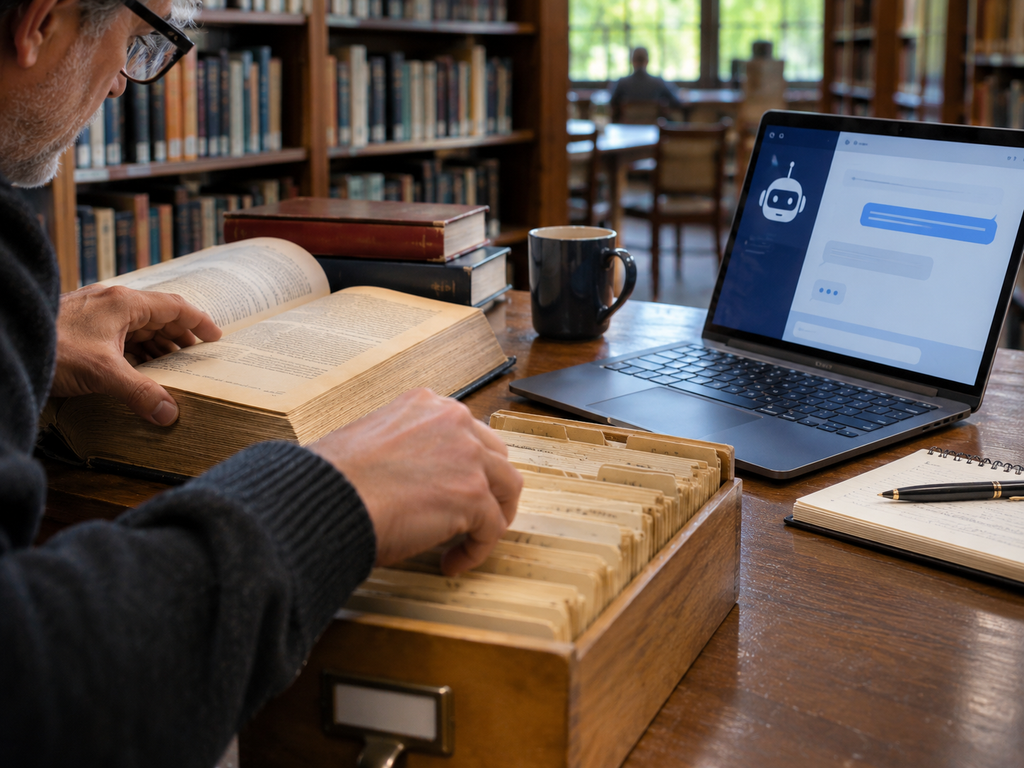
Janita had moved from spending hours preparing lessons with handbooks and websites to producing teaching materials and articles through AI-assisted systems.
And I had studied computer systems and written my thesis on AI, yet initially treated using ChatGPT as something almost forbidden, even though I was curious about it.
If somebody had asked me before the conversation which of us would be most enthusiastic about experimenting with AI, I don’t think I would have predicted the answers correctly.
Age didn’t explain as much as I had expected.
Bruce approached AI with curiosity. He enjoyed testing different systems and discovering what they could do. Janita was interested in making her work more efficient. Frank wanted to build things that would help Brida operate with limited resources.
My interest was partly technical, but I was also concerned about whether the information and code generated by AI could be trusted.
We weren’t all trying to achieve the same thing, and that probably explained more about our different approaches than our ages did.
I also began to see why talking with people from other generations could be useful.
Bruce had experiences I didn’t have. Frank could describe ways of finding information that were very different from my own. Janita could explain how artificial intelligence affected her work in education and publishing.
I could contribute my experience of studying computer systems, working with code and discovering how easily a system could produce convincing but incorrect academic references during my AI thesis.
None of us had all the answers.
And I think that was one of the reasons the conversation was valuable.
I started with questions about artificial intelligence and how different generations used it. By the end, I was thinking about something broader: the importance of remaining curious, being willing to question what we’re told and learning from people whose experiences are different from our own.
I still believe that AI should be treated as an assistant. It can be a very capable assistant, and sometimes it can do things much faster than we could manage ourselves. But we need to understand what we’re asking it to do and remain responsible for the results.
If it provides academic references, we should check them. If it writes code, we should test it. And if it gives us an answer that sounds convincing, we should still be prepared to ask another question.
Bruce showed me that asking more questions could be one of the most interesting parts of using AI. Frank and Janita showed me how the technology could change everyday working life, even if greater efficiency didn’t always mean less work.
And Bruce’s comments about enthusiasm made me think about my own future working with technology.
I know that I have a great deal more to learn.
But I also know now that I don’t have to learn everything from people of my own generation, or even from people who have studied the same subjects as me.
I came away from the conversation with more questions than I had when I started.
I don’t mind that.
After all, I’m only at the beginning of my career.