The Machine Has Done Its Job.
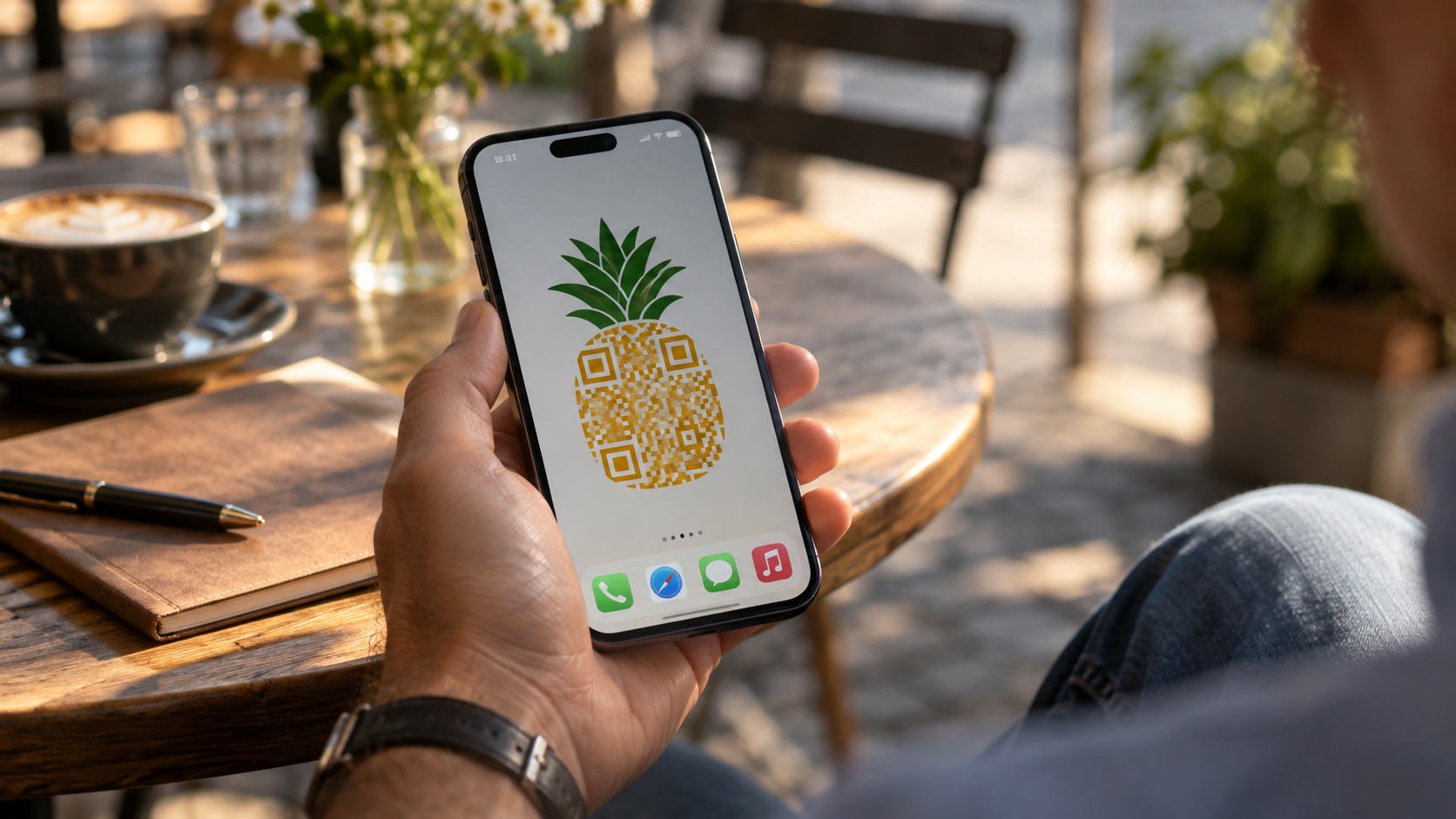
This morning I put a pineapple on my phone.
Not an actual pineapple. That would have been inconvenient. A QR code, dressed up with the Pineapple logo and sitting on my home screen.
The idea is simple. I meet somebody. We talk. Somewhere along the way they ask what I do, and I tell them I publish a small magazine in English. Perhaps Brida comes up too. Perhaps I explain that we bring people from different places together for conversations in English about ordinary life, work, ideas and whatever else happens to find its way onto the table.
And they say:
“I never thought of doing that.”
Nine months ago, I might have regarded that as a problem.
Today, I think it may be the whole point.
Looking for people who weren’t looking for us.
For much of the past nine months, I have been trying to solve a fairly conventional problem: how do you find people who might be interested in something you have created?
There is an entire industry devoted to this. Leads. Funnels. Campaigns. Conversion. Capture the email address. Get the telephone number. Follow up. Put people into boxes according to what they clicked, when they clicked it and whether they came back on Tuesday afternoon.
I tried versions of it.
They didn’t work particularly well, and eventually I realised that I was looking for an intention which, in most cases, probably didn’t exist.
Very few people wake up thinking, What I really need today is a conversation in English with five people I have never met. Why would they? They aren’t searching for us or comparing providers of curious conversations over breakfast. There is no urgent problem waiting to be solved. They may speak perfectly adequate English already. They may use it at work or when travelling. They simply haven’t considered sitting around a table with people elsewhere talking about things nobody throws away, strange habits, local life or why everything seems to require an app these days.
There is no intention.
Until there is an idea.
Ideas tend to enter our lives rather casually. Someone mentions a restaurant. We notice a book in somebody else’s hand. A friend talks about a place we’ve never visited. We hear about somebody doing something slightly unusual.
We don’t immediately buy, join or book.
We think, That’s interesting.
Perhaps nothing happens. Perhaps three weeks later, something does.
That was the bit I had been missing.
Traditional outreach rather likes that moment because it can be captured. The person is standing in front of you. Quick. Get the email address. Put them on the list. Push them towards the next stage before they escape.
I increasingly dislike that.
Suppose I meet Anna tomorrow and our conversation wanders towards Brida. I don’t particularly want to turn Anna into a lead.
I’d rather give her the pineapple.
“Have a look sometime.”
She scans it.
That is all.
Then I lose Anna.
There is an obvious flaw in this beautifully relaxed approach.
Anna now has me.
I don’t have Anna.
She can explore the Pineapple, read an article, look through previous issues, discover Brida, close the whole thing after seventeen seconds and never return.
I don’t know.
For somebody who has spent months building databases and systems, this requires a certain amount of nerve. But Anna hasn’t asked me for anything yet. She hasn’t expressed an intention. She has simply encountered an idea.
So we added one small thing to the app.
Say hello to the Duo.
If something eventually catches Anna’s attention, she presses a button. WhatsApp opens and she can say hello to Janita and me.
No application. No sales form. No twelve questions asking things we don’t need to know.
Just hello.
At that point, Anna has chosen to cross the little gap herself.
Why build all this machinery?
There is another side to the story, because there are only two of us.
The Duo.
And, inconveniently for anybody designing an infinitely scalable organisation, Janita and I both have lives. We sleep. We eat. We have families, appointments and bad days. There are only so many hours available.
That is why I started building the machinery in the first place. Not because I wanted Brida to become more automated, but because I wanted us to have more time to be human.
Finding people across Europe takes time. Researching them takes time. Keeping records takes time. Publishing every week takes time. Following threads, remembering conversations and connecting one piece of information with another all take time. Two people doing all of that manually eventually have very little time left for the nicest part of the job.
Talking with people.
So over nine months we have gradually handed more of the mechanical work to technology and AI. It searches, sorts, researches and remembers. It helps us publish. It keeps track of things that two imperfect human brains would inevitably lose somewhere between breakfast and Thursday afternoon.
Not so that Janita and I can disappear.
Quite the opposite.
So that we can turn up.
Proximity.
I have been searching for the right word for what all this machinery is supposed to produce.
Reach sounds like broadcasting. Audience suggests people sitting on one side while somebody performs on the other. And leads is dreadful. I’ve met a lot of people in my life. I don’t remember ever walking away thinking, What an interesting lead.
The word I increasingly like is proximity.
How many people are close enough to Brida for something to happen?
They don’t have to be members. They don’t have to attend next week. They don’t even need to understand the whole thing. Perhaps they met me. Perhaps someone sent them the Pineapple. Perhaps they read one article six weeks ago. Perhaps a friend mentioned a Table. Perhaps they scanned a ridiculous pineapple from somebody’s telephone.
The idea can sit there.
Then, one day, something may resonate. A subject. A person. A story. A conversation.
Curiosity can do the next bit.
This changes the purpose of all the technology behind Brida. AI can help us find people and communities. It can give us enough context not to approach somebody completely blindly. It can organise thousands of pieces of information, help make the Pineapple and remember connections that would otherwise disappear.
But suppose Anna is interested in architecture and, three weeks after meeting her, I notice that we are having a conversation about whether cities have become too convenient. The system can make the connection.
I would still rather write:
“Anna, saw this and thought of you.”
Because I did.
That, for me, is the important distinction.
The machine can remember Anna. It can find the connection. It can save me the hours I would otherwise spend searching files, rebuilding lists and doing repetitive work.
What it gives me back is time.
Time to write to Anna properly. Time to host the Table. Time to listen.
Time to talk.
The machine has done its job.
There is a peculiar paradox in where these nine months have taken us.
Behind Brida there is now more technology than there has ever been. The machinery has become considerably more sophisticated, yet the thing I want it to achieve has become much simpler.
Get people talking.
We have built an increasingly sophisticated technological machine in order to stop behaving like a machine.
Whether that works remains to be seen. People may scan the pineapple, look around and disappear. Proximity may turn out to be another clever word for people who aren’t particularly interested. Nine months from now I may be writing another column explaining why this didn’t quite work either.
Fair enough.

But I am becoming comfortable with something I wasn’t comfortable with nine months ago.
Not every encounter has to produce a result.
Sometimes it may be enough to put an unfamiliar idea into somebody’s world and leave it there.
There is now a pineapple on the home screen of my phone. Tomorrow I can meet somebody, have a perfectly ordinary conversation and, if Brida happens to come up, show it to them.
They can scan it.
They can wander around.
I don’t need their email address. I don’t need their telephone number. I don’t need them to decide anything while I am standing there.
If, one day, something germinates, they know where to find us.
And if they do come back, the machinery has done exactly what I built it to do.
It has saved two people enough time to do the nicest part of the job.
Talk to them.