

The Day the Doorbell Became a Mousetrap.
Lunch with Rosii, (Brazil), Janita (Fruitloop, South Africa), Frank, (The Mayor, France)
We use them, lose them, complain when they stop working and almost never wonder who invented them. Then Fruitloop suggested replacing the doorbell with a mousetrap, and ordinary life became considerably less ordinary.
Some inventions arrive with fanfare. Others quietly enter our lives, become indispensable, and then disappear into the background until the electricity goes off, the internet dies, the car keys vanish or somebody discovers there is no coffee left.
At the Lunch table, the plan was to give a little applause to the everyday inventions we take for granted.
Instead, within minutes, we were discussing who invented headaches, whether inconvenience had an inventor, what would happen if every shoe disappeared overnight, and whether visitors to Fruitloop’s house should be required to risk a finger simply to announce their arrival.
In other words, it was a perfectly normal Lunch conversation.
It began with Rosii feeling tired and nursing a headache, while Fruitloop was battling flu and feeling, in her words, as though she had been “hit by a train.”
The Mayor immediately saw the connection.
Perhaps the flu and the train hitter were in cahoots. Perhaps somebody had invented inconvenience. If so, he suggested, that person should report to reception.
Fruitloop was not convinced she was in the mood to be kind to them.
And yet she was smiling.
Rosii noticed this. She couldn’t imagine Fruitloop in a bad mood at all. The Mayor agreed that even when the occasional “little grumpy wave” crossed the Sahara, Fruitloop somehow remained remarkably cheerful.
Which raised our first truly important scientific question of the day:
Who invented laughter?
Nobody knew.
But by the end of the conversation, we would have some evidence that it was one of the better inventions.
And the award goes to…
Fruitloop began sensibly enough.
If ordinary inventions had their own awards ceremony, what would deserve first prize?
There were plenty of candidates: the mobile phone, laptop, television, radio, dishwasher, fridge, toilet paper and sunglasses.
Rosii’s mind travelled somewhere more personal. She remembered a creative project from her teaching days, when students had to invent or improve something. One group arrived with a cleaning glove designed to make cleaning kitchens and bathrooms easier. Another created an enormous washing-powder box as part of their presentation.
Years later, versions of that cleaning glove are completely ordinary.
That was the first little mystery of the morning. An object can begin as somebody’s strange idea, become useful and eventually reach the point where nobody even thinks of it as an invention anymore.
The Mayor took the question in another direction. He remembered A History of the World in 100 Objects, the British Museum and BBC Radio 4 project that explored human history through objects. It made him think about money: coins, banknotes and, later, credit cards.
A piece of paper can have value because we collectively agree that it does. A piece of plastic can allow us to buy something now and pay later. Today, money can travel electronically between bank accounts without a banknote appearing anywhere.
The Mayor happened to have a €10 note nearby.
Tear it in half, he pointed out, and you do not magically acquire two €5 notes.
A pity, really. That would have been an excellent invention.
Then Rosii remembered the old credit-card machines from her travel-agency days: the card, the paper slips and the machine that went zip-zip across them. Tickets were handwritten too. A customer could buy a journey on a piece of paper, and if that piece of paper disappeared, the journey suddenly became considerably more complicated.
The Mayor became fascinated by the ticket itself.
Somebody, somewhere, had invented the idea that a document could give a human being permission to travel from A to B.
And before the ticket, somebody had to invent paper.
Before handwritten tickets, somebody needed ink and a pen.
One invention was sitting on top of another, which was sitting on top of another.
Suddenly the ordinary world looked less ordinary.
You notice it when it disappears.
Fruitloop asked which invention we use almost every day without noticing it.
For her, a toothbrush came to mind. Then her glasses. She needs them to see things in the distance, especially when driving or watching something from far away.
The Mayor pointed out that he was thousands of kilometres away and she could see him perfectly well without them.
Yes, Fruitloop explained. Because although he was far away, the screen showing him was close.
Modern life in one sentence.
Rosii chose the car key—or rather the modern version of one. It is still called a key even when it has become a collection of buttons. In some cars, you do not even put anything into an ignition anymore. The key simply needs to be nearby and the car knows what to do.
“This is the world that we live,” Rosii said.
The Mayor reversed the question. Perhaps the things we take for granted are easiest to identify when they stop working.
Lose your keys and suddenly they become extremely important.
Let the laptop break and there is trouble.
Lose the internet and there is even more trouble.
Then there are the inventions behind the inventions. We walk into a kitchen, switch on a light, turn on a tap and boil a kettle without considering the enormous system—and the people—behind that tiny morning routine.
Fruitloop has a slightly different relationship with this assumption.
“No water, no electricity, make another plan.”
Living in South Africa has given her practice.
The Mayor admitted that a sudden loss of electricity where he lives in Europe could produce a rather different reaction. There is a gas stove and an old-fashioned kettle, so at least cooking would remain possible.
Work might not.
He seemed surprisingly willing to consider that a possible benefit.
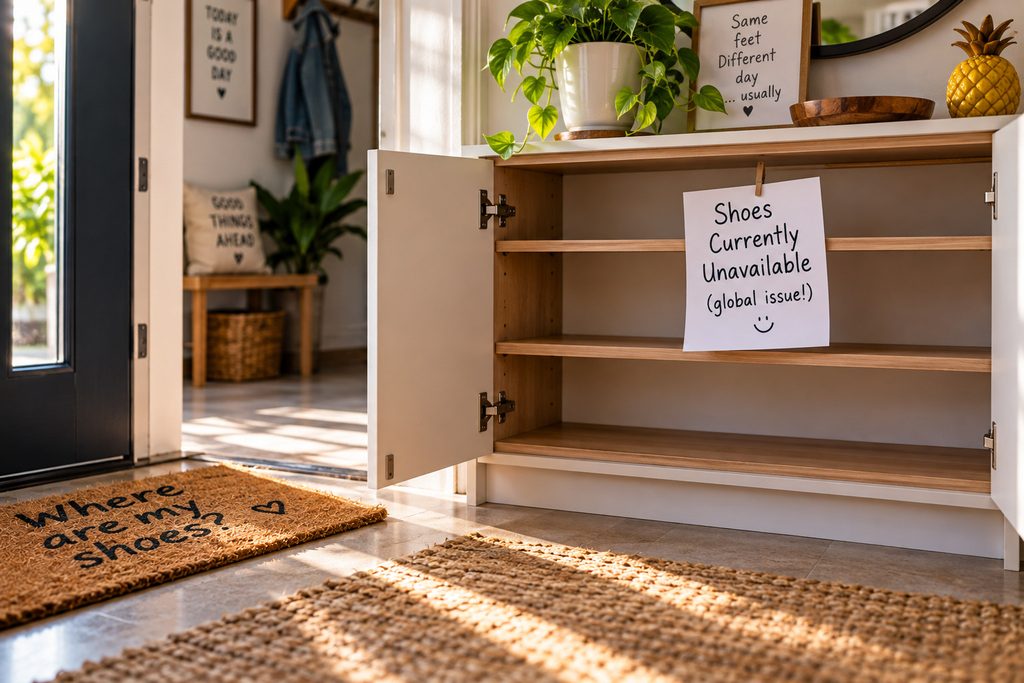
Tomorrow morning, nobody has shoes.
Then Fruitloop asked the dangerous question.
Imagine one ordinary invention disappears tonight. Which disappearance creates the funniest chaos tomorrow morning?
Her first answer was clothes.
Everyone wakes up.
Everyone opens the cupboard.
Nothing.
“I don’t think anybody’s going to leave their homes,” she decided.
This reminded the Mayor of old Roman spa baths he once visited near Frankfurt, where nudity was perfectly normal. He was therefore unconvinced that disappearing clothes would produce quite the universal stay-at-home crisis Fruitloop imagined.
Fruitloop tried another invention.
Wheels.
Imagine walking outside in the morning and discovering every car sitting there perfectly intact but completely wheel-less.
Rosii chose shoes.
That might be even better.
Fruitloop immediately pictured her son asking where his shoes were. She would tell him they were in the cupboard. He would insist they weren’t. She would check. Then the shouting would begin.
“Where are your shoes?”
Meanwhile, nobody on Earth has shoes.
At least, the Mayor pointed out, one morning question would disappear forever: Which shoes am I going to wear?
The discussion briefly wandered into untidiness, zodiac signs and Fruitloop’s family combination of water, fire and air. Her son is Aquarius, she is fire, and her husband is air—a cloud, according to a family discussion inspired by the film Elemental.
The Mayor immediately saw the financial potential.
One day the child could simply ask: “Dad, you’re a cloud. Can you download some money, please?”
Fruitloop thought this was an excellent idea.
Please protect the coffee.
The Mayor struggled to choose an invention whose disappearance would create funny chaos.
His morning depends on a few basic things: a shower, breakfast and coffee.
Fruitloop suggested removing the coffee.
Rosii’s reaction was immediate.
“Oh my God.”
This was no longer a comedy.
The Mayor had, in fact, once run out of coffee and been forced to survive temporarily on his wife’s instant coffee until he could reach the shops and restore civilisation.
Nobody seemed convinced that removing coffee would make the morning funnier.
Rosii added water to the list of things that absolutely must not disappear. She begins her day with a large glass and drinks water throughout the day.
So we had discovered an important distinction.
Some inventions may disappear for comic effect.
Shoes: possibly.
Wheels: chaotic but entertaining.
Coffee and water: absolutely not. The experiment is cancelled.
From three television channels to everything.
Then the conversation moved backwards.
What do we consider completely normal today that did not exist when we were growing up?
For Rosii, electronic payment has transformed ordinary life. She can buy something small with a card or phone and may suddenly discover that she does not have even a small banknote in her wallet.
Fruitloop’s list was longer: mobile phones, the internet, laptops and Netflix.
She also remembered growing up with only three television channels. There was no endless menu waiting for her. Whatever was showing was what you could watch. Cartoons appeared during a particular afternoon window, followed by programmes such as Days of Our Lives and The Young and the Restless. Sometimes Saturday television meant rugby.
The Mayor grew up without television because his parents did not want one. At school, this occasionally left him outside conversations about The Three Stooges, Bugs Bunny and Mickey Mouse. Later came television, then colour television, while radio moved from AM to FM and eventually to internet radio.
Each technological leap felt remarkable.
Then it became normal.
And somewhere along the way, convenience changed something else too.
The Mayor wondered whether we once had more time and more person-to-person contact. Years ago, getting takeaway food meant going to the shop, speaking to somebody, carrying the meal home and perhaps reheating it. Now food and groceries can arrive after a few taps on a phone.
He remembered lying in bed with his wife one Sunday morning and buying a garden table and two chairs.
Just like that.
No expedition. No great resistance. A few clicks and €165 had disappeared.
Whether that is good or bad was not the question. The strange part is how quickly the unimaginable becomes mundane.
His mother, born in 1937, now uses the internet and buys books online. Her childhood world could hardly have imagined that experience. Fruitloop’s seven-year-old son is growing up in another world again.
What will he find hilariously old-fashioned one day?
Ding-dong. Ouch.
Then Fruitloop announced that it was time for the Fruitloop questions.
This was where civilisation began to deteriorate.
The challenge was simple: replace every doorbell with a completely different invention.
Fruitloop had an answer.
“A mousetrap.”
There was a pause while everybody considered the hospitality implications.
The new system was beautifully simple. A visitor presses the button. The mousetrap snaps. Fruitloop hears the scream from inside the house.
No electricity required.
The Mayor reconsidered all future plans to visit South Africa.
Fruitloop remained delighted with her invention. There might be screaming. There might be swear words. More importantly, visitors would have to stop before ringing and ask themselves an important question:
How desperate am I to visit this person today?
The Mayor imagined arriving at Johannesburg airport and being questioned by immigration.
You want to visit her?
Are you sure?
You have been warned, Mr Peters. Proceed with caution.
The joke became even better when Fruitloop explained that her real intercom had already caused enough trouble. At her complex, visitors at the gate could press buttons connected to residents’ phones. People sometimes pressed random numbers late at night simply because they wanted somebody—anybody—to open the gate.
Fruitloop eventually had their number removed from the intercom.
So perhaps the mousetrap was not entirely hypothetical.
The Mayor proposed a virtual version that could leap through the phone and bite whoever was pressing the button.
Innovation was accelerating rapidly.
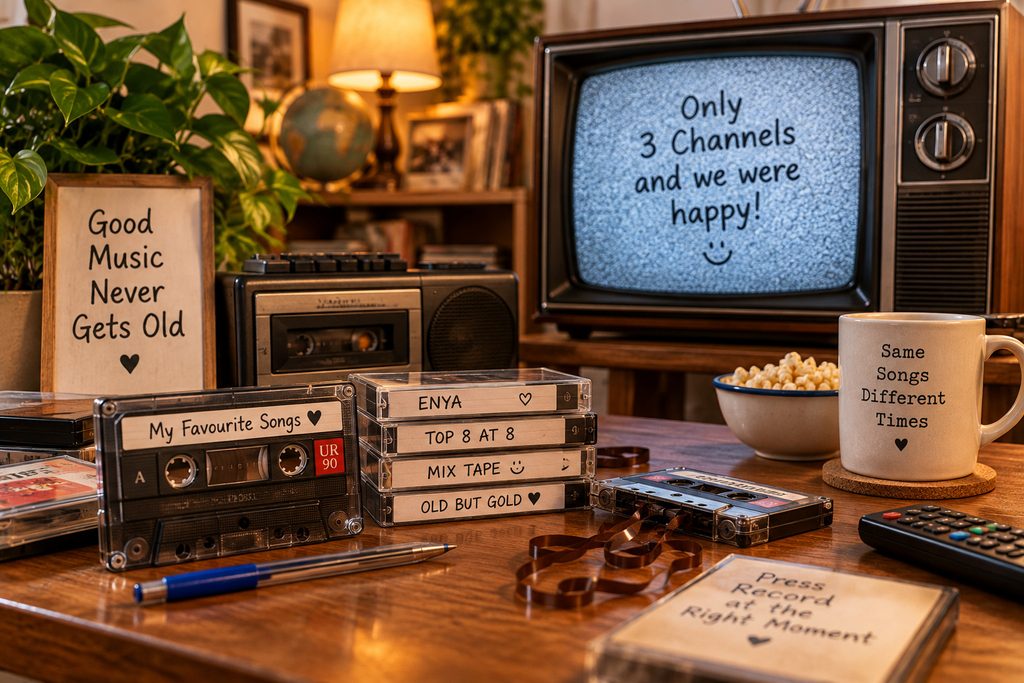
Please explain the cassette to the year 3026.
The final Fruitloop challenge sent a time traveller from the year 3026 into everyone’s home.
What would they laugh at?
The Mayor suggested himself.
A thousand years from now, perhaps a visitor would stare at him and ask, “What’s that? Can we eat it?”
Fruitloop chose her husband’s old Xbox. It still works, but newer games have already moved beyond what the old console can handle.
Rosii thought of an even better museum piece: the cassette.
That tiny plastic box unlocked an entire world of memory.
Rosii remembered an Enya cassette she loved and the frustration when the tape stopped working properly. Then came the universal cassette-repair tool.
A pen.
The Mayor remembered cassette players chewing up the tape. He remembered waiting beside the radio for a favourite song and hitting record at precisely the right moment—only for the DJ to continue talking over the beginning.
Fruitloop knew that world too.
At eight o’clock in the evening, she used to listen to a programme called Top 8 at 8, waiting for the week’s favourite songs. If the song she wanted did not make the top eight, there would be no recording for her homemade mixtape that night.
Now there is Spotify, YouTube and other streaming services. A song can be found in seconds.
The Mayor wondered what Fruitloop’s son will remember struggling with when he looks back.
Perhaps his great hardship will be the day he could not find a song on Spotify.
Perhaps the time traveller from 3026 will laugh at the idea of pressing buttons, carrying keys, owning an Xbox or putting a cassette into a machine.
Perhaps they will find our credit cards, laptops and mobile phones as strange as we find handwritten airline tickets and zip-zip card machines.
Or perhaps they will stand outside Fruitloop’s house, stare at the ancient mousetrap attached to the doorbell and wisely decide not to press anything.
By the end of the conversation, Rosii’s headache had lifted.
“I’m better now,” she said.
Maybe the best invention had been hiding in the conversation from the beginning.
Laughter.
We still don’t know who invented it.
But whoever did deserves first prize.