
From Tennis Courts to Cocktail Queues.
By Sylvie, France.
From tennis nerves and supermarket calculations to concert crowds, safari nightmares and the quiet art of letting someone go first, an ordinary conversation about waiting kept finding somewhere else to go.
Sylvie lost her tennis match 6–2, 6–1, which did not particularly surprise her. What mattered more was that the score did not tell the whole story. In the second set, there were several games where she reached 40 and stayed level with her opponent before the final point went the other way.
At the beginning, though, she was nervous. Her heart was pounding and she made mistakes. Then she noticed her family around the court: one daughter had come to watch, another walked past, and her husband appeared in his cycling clothes. Somehow, seeing everyone made her even more stressed.
Her opponent had a different relationship with pressure. When she lost a point or made a mistake, she became visibly angry with herself, sometimes loudly enough to make Sylvie’s family nervous.
Sylvie does not play that way.
“If I lose, I accept,” she said. “The best should win.”
There is another difficult match coming in two weeks, this time against Strasbourg and a very strong team. Sylvie is realistic about her chances. In the meantime, she was going back onto the court that same evening to practise with a 21-year-old player. Training is one thing, she explained; an official match is another. There are more breaks in competition, but also more nerves.
Ten years ago, some of her matches lasted three hours, sometimes in the sun. She remembers one recurring problem: she could keep reaching the same level as her opponent, but struggled to finish the point.
“I was younger,” she added.
It was the sort of remark that did not need anything more.
Six Hundred Kilometres and Raclette for Breakfast.
Tennis led naturally to another kind of endurance.
Sylvie’s brother-in-law had recently finished what she described as the SwissPeaks trail, covering roughly 640 kilometres. According to what he told the family, sleep during the first week could be as little as an hour during the day because he struggled to sleep in a room with other people. The second part of the event was harder, taking competitors through the mountains at night, with ice and snow.
Sylvie remembered that around 100 people began and roughly half eventually completed the longer challenge. Her brother-in-law, who is 57, finished 24th.
“It’s very impressive.”
And apparently not enough to make him rest for very long. He was already planning another trail of around 170 kilometres within a week or two. He regularly runs trails in Switzerland and has also competed in places including Austria, Germany and France.
The scale of the exercise is difficult enough to imagine. Then came one detail that made it suddenly human: breakfast.
Every morning, he ate raclette.
“You need to eat a lot,” Sylvie explained. With that much energy being spent throughout the day and night, food becomes part of the work. The organisation behind such an event is enormous too, with security, food and support along the route.
Her brother-in-law, Sylvie thinks, prefers putting his mental and physical energy into sport rather than into something such as learning another language. These trails demand plenty of both.
They also, she pointed out, cost plenty of money.
And from there, somehow, we arrived at queues.

The Wrong Queue.
Mention a supermarket queue to Sylvie and the mystery is immediately recognisable.
You choose the short queue.
It stops.
The customer in front has a problem. An employee needs to check something. Someone needs a refund. Meanwhile, the queue that looked hopelessly long begins moving beautifully.
So you change queues.
Naturally, the queue you have just abandoned immediately becomes faster.
“That happens always.”
Sylvie is convinced this is not a personal curse. Everybody has experienced it. When she and her husband are together, however, she says they seem particularly talented at choosing the wrong one.
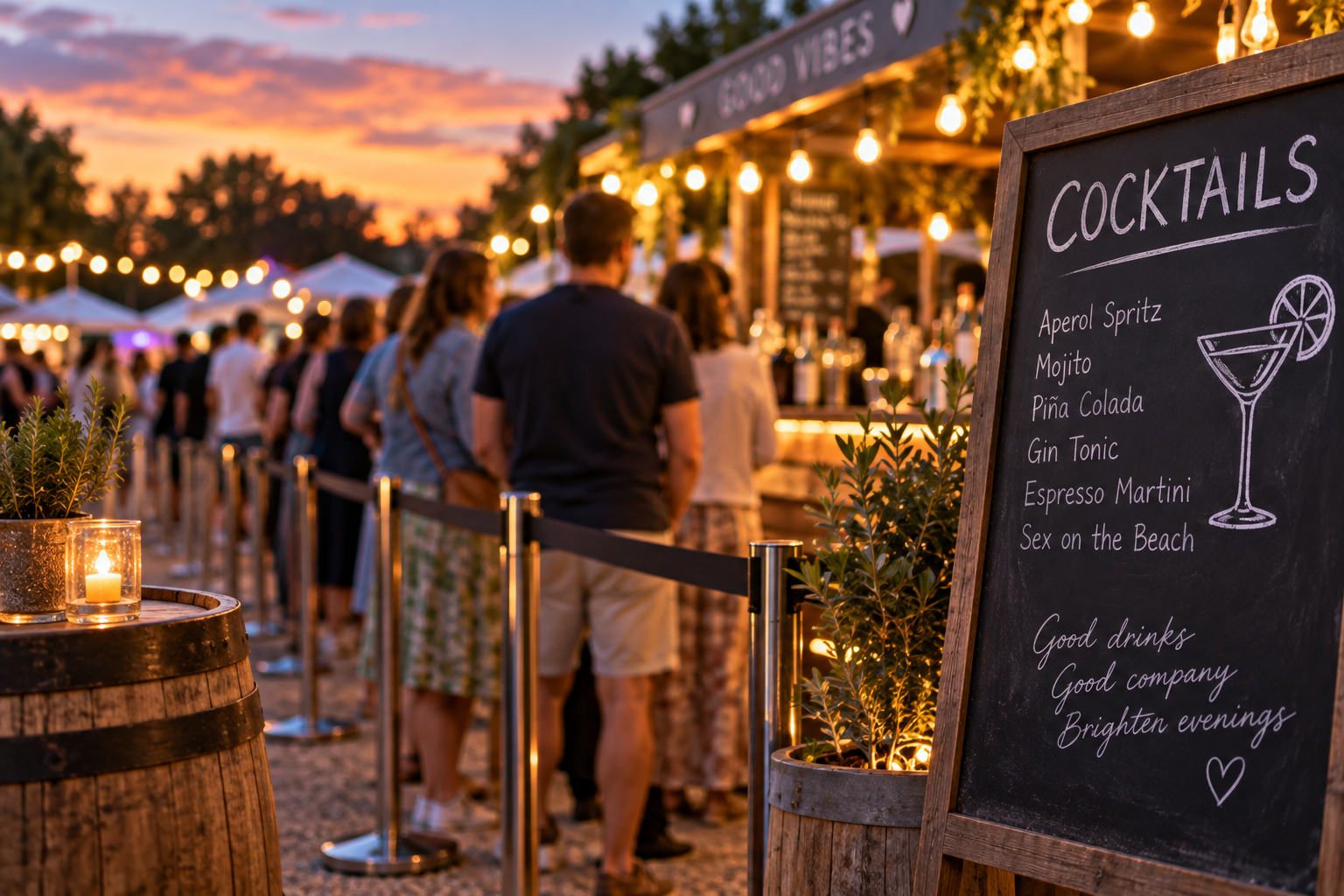
Her recent queues have included a 30-minute wait for cocktails at an open-air event. There were separate stands for beer, soft drinks and cocktails, and she took her turn waiting for drinks for other people while they swapped around.
Then there was a shopping trip with her daughter two weeks earlier. A queue that had barely existed suddenly stretched from the till almost to the end of a large shop.
Sylvie has a theory about how this happens. You see that nobody is waiting, decide there is still time to continue shopping, and then everyone else apparently makes exactly the same calculation. One person joins the queue, then another, then another.
By the time you return, the queue has become an event.
Queue Surveillance.
Sylvie’s first activity while waiting in a supermarket is not checking her messages.
It is checking the competition.
“You will always have a check if another queue is faster. That’s the first thing.”
She will glance at her phone briefly if there is a message, but cannot become too distracted. There are queues to monitor.
There are also other people’s shopping baskets.
Of course, this must be done discreetly.
You cannot simply stare into somebody’s trolley and openly study what they are buying. You look quietly. Perhaps you appear to be looking somewhere else.
There is etiquette involved too. If Sylvie has a full trolley and somebody behind her is holding only two or three things, she may offer to let them go first. In a very long queue, though, the calculation changes. Moving one person forward achieves very little, and everybody is already waiting.
The same applies to somebody asking to jump ahead because they are in a hurry. It depends on the circumstances. Sylvie does not treat the queue as an absolute moral system. She looks at what is happening.
That practical instinct may come partly from having once stood on the other side of the till.
After her studies, Sylvie’s first job was as a cashier. She remembers customers complaining because advertised promotions had not been applied or prices were wrong. That experience stayed with her, and she still checks her receipt.
Sometimes she spots a small error and decides not to complain.
Partly it is because the amount is not worth delaying everybody. Partly it is because shopping close to home comes with another complication: within ten kilometres, she says, she nearly always knows somebody.
And Sylvie is on the local council.
If she starts complaining at the till, there is a good chance somebody familiar is standing nearby wondering what Sylvie is complaining about today.
“You are all polite and friendly,” she said. “You are on the council, you need to be quiet.”
That may be one of the stranger forms of queue discipline.
Five Minutes at the End of a Very Long Wait.
Not all queues involve groceries.
At Europa-Park in Germany, Sylvie has experienced queues so long that the imbalance begins to feel absurd. You can wait outside in rain, heat or sunshine for an attraction that lasts perhaps five minutes.
That is the part she dislikes: the proportion between the waiting and what waits at the end.
Concerts create an entirely different version of the same problem.
Sylvie’s husband went with a friend to an AC/DC concert in Germany a couple of years ago. Her recollection of what he told her is less about the music than the extraordinary mass of people. They arrived two or three hours before the concert and found themselves standing in a crowd so dense that moving left or right was difficult.
Her husband found it hard, although he was glad he had seen the concert. For people who dislike being tightly surrounded, Sylvie could imagine it becoming deeply uncomfortable.
Even going to the toilet required strategy. Her husband and his friend went together because, in a crowd that size, finding each other again could have been difficult.
Everybody was standing.
“And you pay for that,” Sylvie observed.
There is something beautifully unfair about it. You buy a ticket, travel to the venue, arrive hours early and then pay for the privilege of being squashed among thousands of strangers.
Still, people do it because what waits at the end matters enough.

The Celine Dion Ticket.
That thought brought Sylvie to Celine Dion.
A tennis friend of hers had managed to get six tickets for a Celine Dion performance in France, enough to take family and friends. Sylvie described a ticketing process in which interested buyers first had to register and only selected people received the opportunity to purchase, with six being the maximum.
For her friend, simply being selected felt fortunate.
The conversation wandered into the size of major concerts, the travel required when an artist performs in only a few places, the cost of accommodation and the visitors such performances can bring into a region. Then it wandered further still: the Titanic song, Celine Dion’s French-language music, Canada, Montréal and the particular French spoken there.
“She has a nice voice,” Sylvie said.
It was no longer really a conversation about queues.
Then again, perhaps it still was. Sometimes the queue is part of how much we are prepared to endure for something we genuinely want.
The Nightmare Before the Safari.
From concerts we moved to petrol prices, and from petrol prices, somehow, to South Africa.
Then Sylvie remembered her nightmare.
In the dream, she was travelling in South Africa and had left her official papers unsecured in her room instead of putting them in the safe. The following day, they were gone.
That would have been bad enough.
But the group was supposed to catch a flight for a safari.
Without her documents, Sylvie was the only person who could not go.
Worse still, she had organised the whole thing.
She woke up shocked and enormously relieved that none of it had actually happened.
The safari was not entirely imaginary. A friend of hers had recently flown out on a trip involving Tanzania and Zanzibar, and Sylvie was waiting to hear about the experience. She knew she would see her friend again for one very practical reason: her friend had Sylvie’s luggage.
The conversation moved towards Namibia and Botswana, river cruises and other possible journeys through southern Africa.
By then, the great queue mystery had been left somewhere behind us.
Or perhaps not.
There had been tennis matches where the final point would not come. Hundreds of kilometres through mountains with almost no sleep. Thirty minutes waiting for a cocktail. Five minutes of amusement after a long theme-park queue. Thousands of people standing for hours before a concert. A friend fortunate enough to get into the queue for Celine Dion tickets. A nightmare about missing a safari after organising the entire journey.
All different forms of waiting, effort and uncertainty.
And Sylvie’s approach is remarkably consistent.
Watch what is happening. Check the other queue. Let somebody through when it makes sense. Accept the point when the better player wins. Do not make a public fuss over something too small to matter.
And, when possible, make sure there is something good to eat afterwards.
At the end of the conversation, tennis returned one last time. Sylvie’s tennis association is planning an evening with mussels and French fries at the end of October. When the possibility of travelling all the way there for dinner came up, Sylvie had an immediate solution:
“Do you want to come?”
A special flight, apparently, could be arranged just to taste it.
After all the queues, the nerves, the crowds and the waiting, that seems a reasonable place to finish.