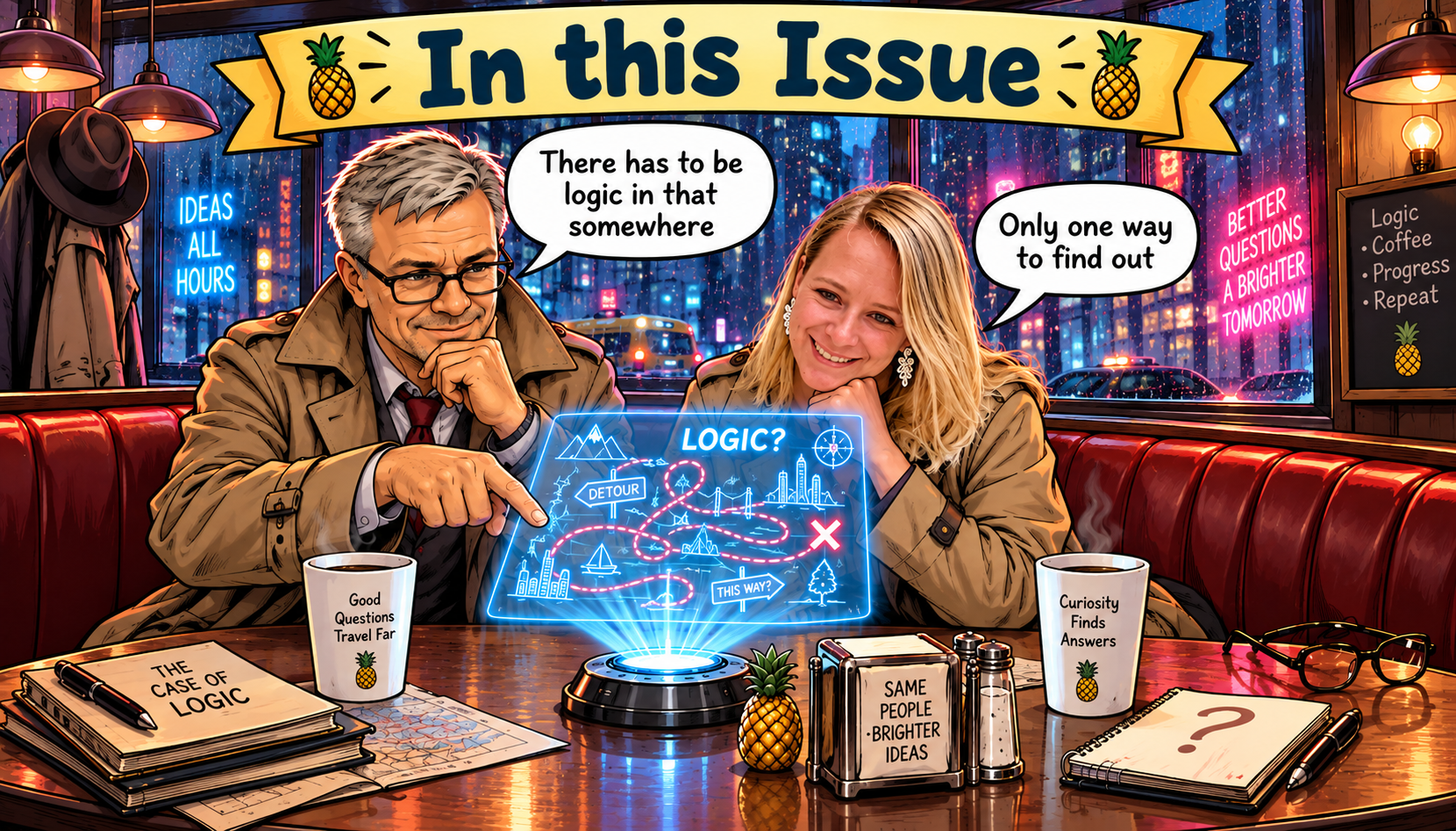
In This Issue.
Why do we keep a drawer filled with tangled cables when we have no idea what they actually plug into? Why do we instinctively stand in queues, hang up our towels after a shower, or refill the ice tray when somebody has used the last cube?
Some of these habits have perfectly sensible explanations. Others began as practical choices, inherited rules, family customs, or systems designed for a particular moment. Over time, though, many of them simply became normal.
We rarely stop to ask whether the logic still holds.
In this issue, we look again at the everyday systems, habits, and assumptions we usually take for granted—and what becomes visible when somebody finally checks.
Unseen Rules and Mysterious Boxes.
The journey begins at the editorial desk, where Janita goes looking for the unspoken rules and daily systems we accept without much thought—asking why some things make perfect sense while others survive simply because nobody has questioned them for a while.
From there, a necessary trip becomes an unexpected encounter with a city in Lyon Looked Back, as an unfamiliar place slowly reveals itself through wrong turns, second looks, and unexpected moments of familiarity.
Back at home, Alex considers the difference between useful inventions and solutions looking for problems in The Orange Cutter and the Mystery of Wi-Fi. What happens when we completely understand something we do not need, but depend every day on something we barely understand at all?
In The Box for ‘In Case Of’, Sylvie wanders into that familiar household territory of objects kept because they might one day become useful—and begins to wonder whether usefulness is always the reason we keep things.
Tables, Queues, and Unspoken Codes.
Around the table, everyday household rules face an unexpected test. In Normally They Behave Themselves, shoes, ice cubes, laundry, beds, pans, and tomatoes spark a lively debate when three different households discover that the “obvious” way of doing things is not quite so obvious after all.
Crossing borders, the Atlantic Corridor team brings Brazil, India, and South Africa together in The Queue Is Never Just a Queue, turning a simple wait in line into a look at rules, exceptions, uncertainty, and the quiet agreements strangers use to cooperate.
In The box in the doorway, a photo-verified package delivery proves that a system can work exactly as designed—and still somehow fail the person it was supposed to serve.
Bruce then widens the question in More Choice Is Not the Same as More Wisdom. Technology keeps giving us more possibilities, more information, and more ways to act, but perhaps the difficult part was never having options. Perhaps it was deciding which ones are actually worth choosing.
Crunchy Solutions and Unsettled Logic.
On a lighter note, a craving for crisps collides with internet health theories in Try Eating Something Crunchy, Like a Carrot, leading to a swift and increasingly unsuccessful attempt to apply logic to snack-time reality.
Peeling Potatoes Episode 63 takes us back to Fruitloop University, where dancing chickens, bureaucratic coconuts, dragons, and an ambitious broom gather to investigate the logic of the world—only to discover that humans may be the strangest exhibit of all.
Sit back, grab your favourite mug, relax, and enjoy Issue 28 of The Pineapple.