
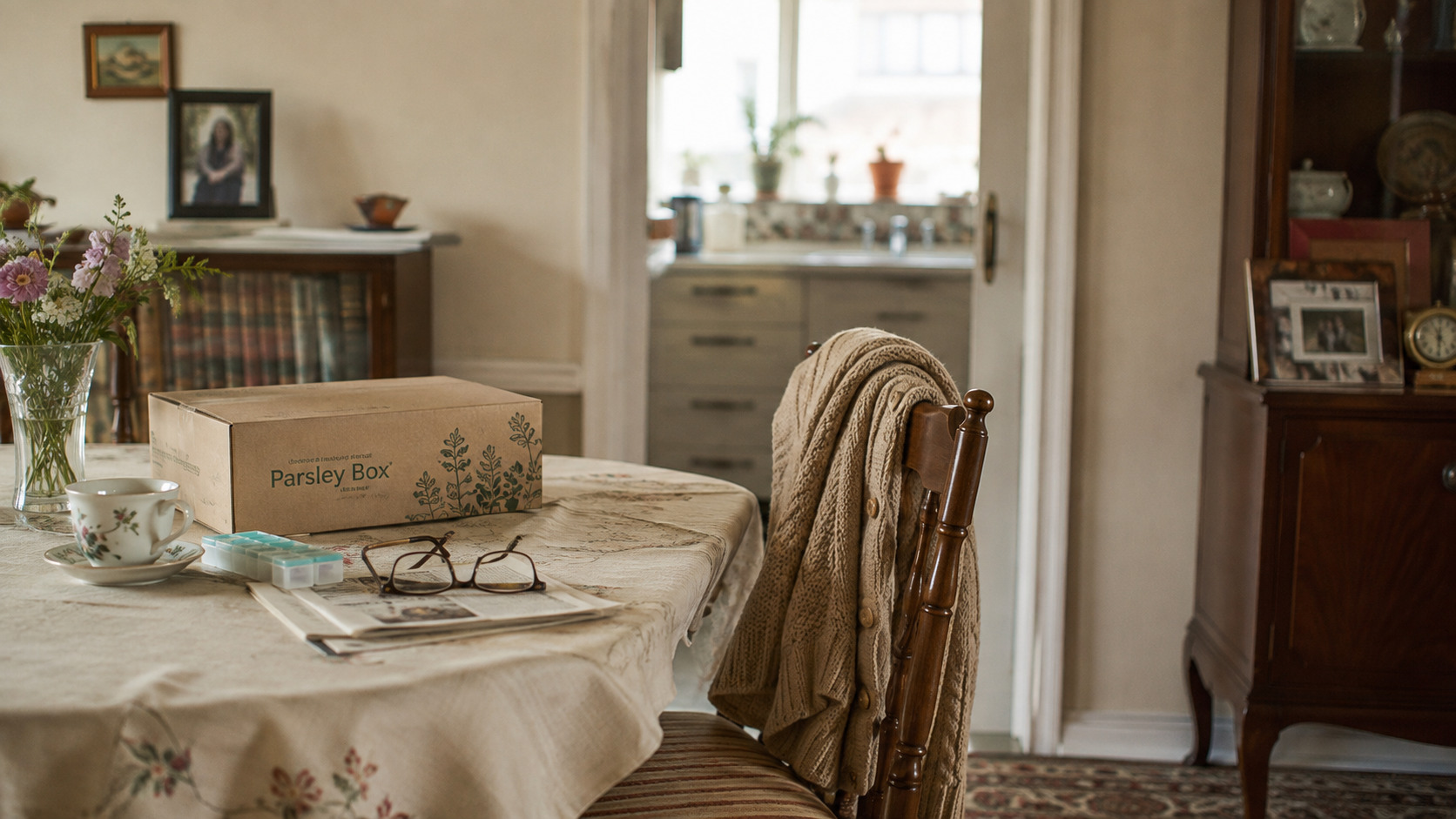
The Box in the Doorway.
The Human Bit, by Frank Peters.
My mother-in-law lives in the UK. She is in her mid-eighties, not particularly healthy, and has meals delivered by a company called Parsley Box.
It is a useful service. The meals arrive at the door, they can be stored, and they are easy to prepare. At her stage of life, that matters.
For a long time, the deliveries came through DPD. Then Parsley Box changed to InPost.
I assume there was a perfectly sensible reason. Cost would be my first guess. When you are sending large numbers of boxes around the country, a small saving on each delivery soon becomes a very large saving.
Perfectly logical.
The problem is what happens when that logic eventually reaches the front door.
The InPost drivers seem to be under enormous pressure. Deliver the parcel. Photograph it. Move on. There is always another address waiting.
On the most recent delivery, the boxes containing my mother-in-law’s food were left directly in front of the main entrance to her block of flats.
Not beside the entrance.
In front of it.
Anyone trying to leave the building had to push the boxes out of the way, probably without knowing what was inside them or who they belonged to.
My wife complained to InPost.
Nothing.
She complained to Parsley Box. They explained that my mother-in-law could still have her deliveries made by DPD. She would simply have to pay the postage.
Again, perfectly logical.
And that is where I get stuck.
I can understand Parsley Box looking at delivery costs. I can understand InPost trying to make its operation efficient. And I can certainly understand the driver. He may have a van full of parcels, a timetable that was unrealistic before he even started, software watching his progress and somebody somewhere measuring how many deliveries he completes in an hour.
Perhaps putting the boxes down, taking the photograph and moving on is exactly what the system expects him to do.
Which makes me wonder what he thought when he put them there.
Maybe nothing.
Not because he is uncaring, but because there was no room in the system for thinking.
That may be the more uncomfortable possibility.
Does he have a mother in her eighties? Does somebody deliver things to her? Would he want a box of her food left outside the entrance to her building?
I don’t know.
And I don’t particularly want to turn the driver into the guilty party. He may be the person in this story with the least freedom to change anything.
Somewhere between the spreadsheet, the delivery contract, the route planner and the front door, a person disappeared.
An eighty-something-year-old woman became a delivery point. The box became a completed transaction. The photograph became proof that the job had been done.
Except the job hadn’t really been done.
The parcel had arrived.
That isn’t quite the same thing.
We do this surprisingly often. We build systems in which every individual decision can be defended. The price is lower. The delivery is faster. The target is met. The box on the screen turns green.
Then we look at what the whole chain has produced and wonder how something so logical became so stupid.
Perhaps the human check is a very small one.
Not: Did we complete the process?
But: What happened to the person at the other end of it?
That question doesn’t make logistics easy. It doesn’t remove costs, timetables or pressure. And it doesn’t mean every eighty-year-old needs to be treated as helpless.
It simply puts the person back into the calculation.
My mother-in-law eventually got her food.
So, according to the system, the delivery worked.
There were just a few boxes sitting in front of the door.
You could almost miss them.
Until you check the logic.