
The Human Bit — Prove You Are Human
When did we forget to be simply human?
Yesterday my wife flew to the UK.
Shortly after arriving, her phone received a message pointing her towards a French government service that could warn her about security risks while travelling.
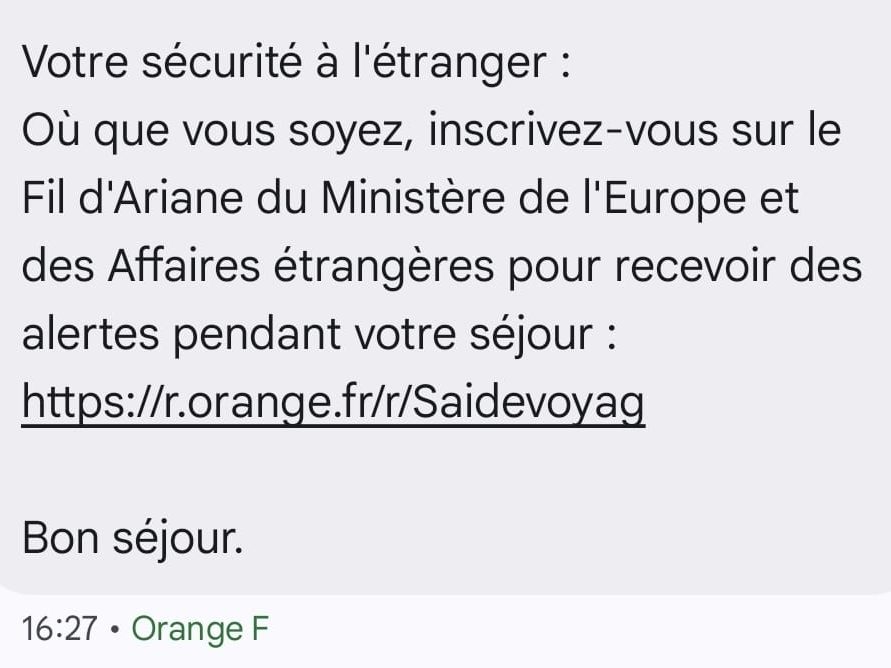
Apparently Britain has become a very dangerous place.
She survived the airport.
Of course, there is a serious point behind all this.
Spam is real. Fraud is real. Malicious bots are real. Cybercrime is real. Governments have a duty to warn people. Banks have to protect our money. Websites cannot simply leave the door open and hope everybody behaves themselves.
I am not naive about any of that.
And I am certainly not anti-technology. Far from it. I use technology constantly, enthusiastically and with considerable curiosity.
But cause and effect interests me.
Bots multiply, so websites challenge everybody.
Fraud grows, so ordinary transactions become suspicious.
Scammers automate, so genuine humans spend more time proving that they are genuine humans.
One bad actor can unleash a million automated attacks.
A million ordinary people then have to tick the box.
Prove you are human.
These days I can barely enter some websites without Cloudflare first checking that I am not a machine.
There is something wonderfully absurd about a machine asking a human being to prove that he is a human being.
Especially when, five minutes later, another machine arrives on LinkedIn pretending to be one.
“I found your work fascinating…”
No you didn’t.
A machine found something I wrote, manufactured the appearance of curiosity and sent it to me because somewhere behind it somebody wants a sales meeting.
So one machine suspects I am not human.
Another pretends that it is.
Meanwhile, I travel to Strasbourg quite regularly by train.
I buy my ticket. I get on. I find a seat.
Over the last few months, I cannot remember a single conductor checking my ticket.
There is real money at stake.
Yet somehow the SNCF, on this particular route, can occasionally tolerate the possibility that I am simply a decent human being who bought a ticket.
The internet increasingly cannot.
Strasbourg gives me another example.
My wife needs Special Assistance when she flies. At Strasbourg Airport, the wonderful team at the Special Assistance desk know her.
On one occasion, someone at baggage drop forgot to give her a piece of paper she needed. The Special Assistance woman went back to the desk and had a few words.
“She is a regular,” she said.
That was it.
No biometric scan. No six-digit code. No risk score.
She recognised her.
And recognition is not the same as identification.
A database can identify you extraordinarily well.
It can know where you are, which device you use, what you buy, what you read, what you click on and perhaps what you were looking at at 10.43 last Tuesday.
And still not know you.
“She is a regular” contains almost no data.
But it contains a relationship.
That distinction matters.
We are building systems that know more and more about us while often becoming less capable of seeing us.
Social media is an obvious example.
There is currently a major court battle around Meta and the effects of social media on young people. It is tempting to look at a corporation that size and say: there is the villain.
Too easy.
Meta is full of human beings.
Parents. Sons. Daughters. Partners. Friends.
Right up to Mark Zuckerberg.
I doubt many of them arrive at work in the morning thinking, “How can I make humanity slightly worse today?”
But humans create systems.
Systems acquire incentives.
Incentives become targets.
Targets become behaviour.
And eventually the system can begin to devour the people who built it.
Politics can do the same.
I have a Brida member who is politically opposed to me. The current government is a nightmare for him.
I disagree with him.
We still talk.
Sometimes we agree across the political divide. Sometimes we don’t.
Sometimes we simply agree to disagree.
Neither of us has to declare the other morally defective before we can continue the conversation.
That really should not be remarkable.
Increasingly, it feels remarkable.
Somewhere along the way we seem to have decided that disagreement requires classification.
Left or right.
Us or them.
Good person or bad person.
Friend or enemy.
Once the label is attached, curiosity becomes unnecessary.
We already “know” who the other person is.
Years ago, in Zurich, I had a conversation with a very senior manager. He was the head of a division of a large multinational company.
Powerful position. Serious responsibility. Impressive title.
Then, quite unexpectedly, he asked me:
“Why doesn’t anybody like me?”
I have never forgotten it.
Behind the hierarchy, the title, the targets, the meetings and the authority was simply a human being asking perhaps the most human question imaginable.
The organisation knew exactly where he sat on the chart.
It could measure his performance.
It could calculate his budget.
It could define his responsibilities.
It could not tell him whether anybody liked him.
Maybe that is the bit we keep losing.
We create systems to make ourselves safer, faster, richer, more connected and more efficient.
Then we begin behaving like the systems.
We classify.
We verify.
We optimise.
We target.
We segment.
We sort people into categories.
Customer.
Lead.
Voter.
Follower.
Risk.
Threat.
Opportunity.
And somewhere in there we lose the most natural beginning of a human relationship.
Curiosity.
Not trust.
Trust has to be earned.
But before trust comes something much simpler.
Who are you?
That’s interesting.
Tell me more.
Curiosity becomes conversation.
Conversation can become recognition.
Recognition can become trust.
Trust can become relationship.
And that has to work beyond our clubs, associations, professions and tribes.
Those groups make trust easier because they give us a ready-made signal:
You are one of us.
But surely a healthy society also depends on our ability to encounter someone who is not one of us.
Someone who thinks differently.
Someone who votes differently.
Someone from another country, another profession, another generation.
Someone who simply happens to sit across the table.
That is not naive.
It does not mean trusting everybody.
It does not mean abandoning security.
It does not mean pretending that malicious people, fraudsters, extremists and manipulators do not exist.
It means refusing to allow their behaviour to determine the terms on which every decent human being meets another.
The systems we create eventually devour us if we let them.
Technology is not going away.
Nor should it.
AI will become more capable. Platforms will become more sophisticated. Security will become tighter. Verification will become more seamless.
Fine.
But none of that removes our individual responsibility for what happens between two human beings.
At Brida we say:
No Human, No Language.
And as Brida is a business, increasingly I think another belongs beside it:
No Human, No Business.
Because language without humans becomes output.
Business without humans becomes transaction.
Politics without humans becomes tribal warfare.
Technology without humans becomes optimisation.
And curiosity without humans becomes another clever algorithm pretending to care.
The answer is not less technology.
Nor is it blind trust.
It is remembering that systems do not absolve us of individual responsibility.
We decide whether disagreement becomes contempt.
We decide whether curiosity gets a chance before suspicion closes the door.
We decide whether the person in front of us becomes a category, a lead, a threat — or simply another human being.
In the age of AI, remaining human is not somebody else’s job.
It is ours.