
The Trouble With “Do Not Open”.
With Monica, currently in Germany; Rosii, in Sao Paulo; Fruitloop, in sunny South Africa; and The Mayor at home.
Curiosity begins with delayed trains and Sunday traffic, wanders through secret boxes, forbidden buttons and mysterious doors, and somehow ends up somewhere between Narnia, a five-course dinner and a very well-guarded bar of chocolate.
Curiosity was already causing trouble before anyone officially asked a question.
Monica arrived from Germany feeling decidedly under the weather, having made a bakery run and stocked up on orange juice before an early flight the next morning. Rosii arrived from São Paulo with news of an upcoming training day and the important discovery that this one would take place in a hotel—with lunch. The Mayor immediately requested photographic evidence of the food.
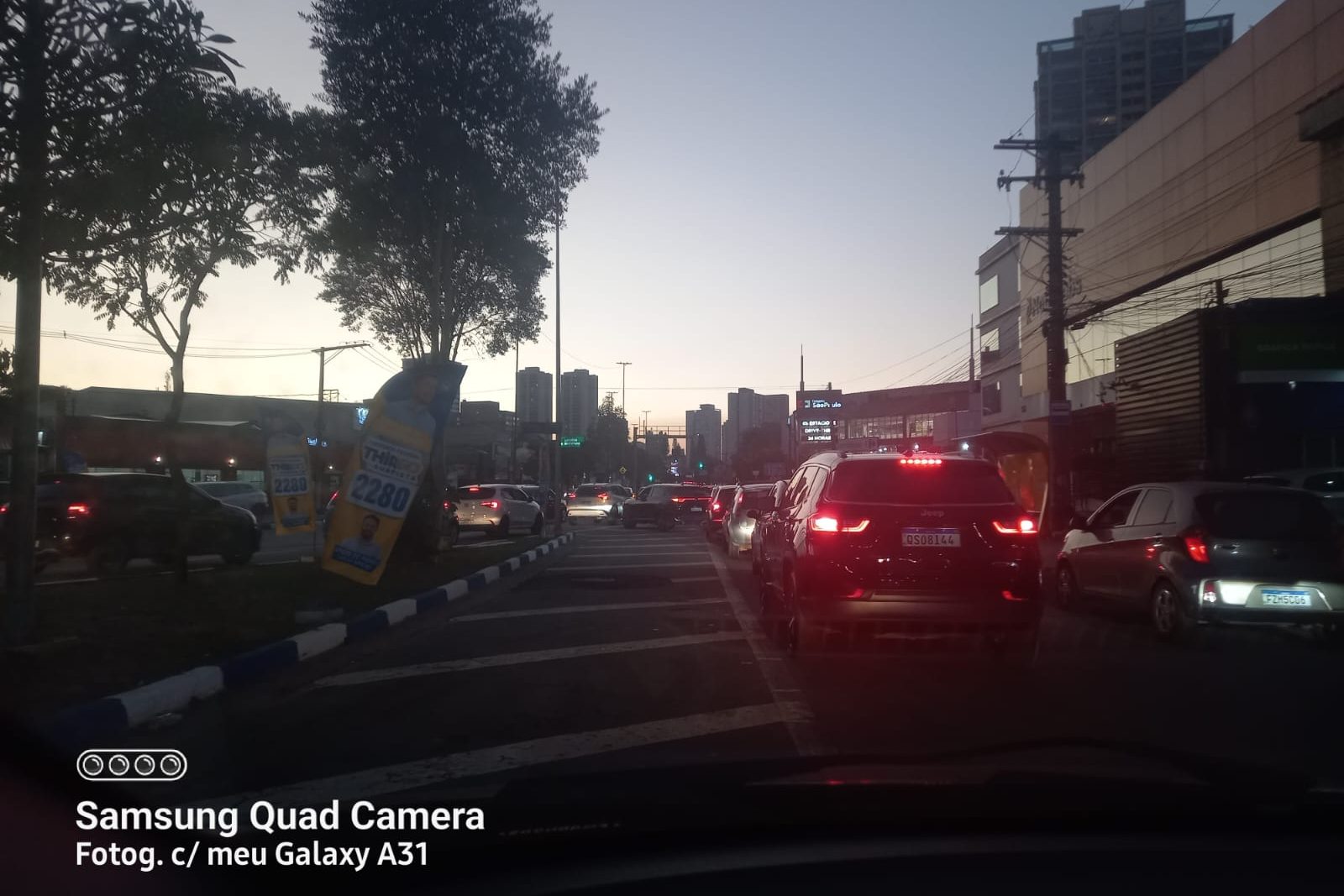
There were also photographs to discuss. Rosii had already sent a picture of São Paulo traffic that, through a small design accident, appeared to suggest the Mayor was travelling on a road to nowhere. Fruitloop admitted she had been so focused on the speech bubbles that she had missed this minor existential detail.
Rosii had not missed it.
She had gone to bed thinking about that road to nowhere.
And Monica had been given a mission for Scotland. Since Scotland’s national animal is the unicorn, Fruitloop wanted photographic proof.
“A unicorn,” Monica repeated.
She promised to keep an eye out.
This was roughly the level of order at the table when Fruitloop finally announced the day’s topic:
How curious is too curious?
Nobody seemed particularly qualified to answer.
Which made them perfect for the job.
Where Is Everybody Going?
Fruitloop began with something simple.
“What made you curious this week?”
For Monica, the answer was Deutsche Bahn.
She had been travelling in Germany and had rediscovered the peculiar suspense involved in waiting for a train. Would it arrive on time? Would it arrive late? Would it arrive at all?
“It’s a bit of a lottery,” she said.
With an 8:15 flight the next morning, curiosity about the railway timetable was becoming slightly less philosophical and considerably more practical. Monica was considering a taxi.
The Mayor, broadcasting from what he described as the railway paradise of France, was unsympathetic. French trains, according to him, ran beautifully—unless, of course, the train had come from Germany.
Then Fruitloop asked the question that perhaps summed up the entire meeting.
“Do you really lose if you know you are going to lose?”
Nobody settled that one.
Rosii’s curiosity was much happier. Her goddaughter Natalia was returning to Brazil after two years in the United States, and Rosii wanted to hear the stories she would bring home.
There was also the luggage.
Apparently there was enough of it to raise serious questions about whether everybody, including Grandma, could fit into the same car. Natalia had accumulated clothes, belongings and gifts over two years abroad, and Rosii was trying to imagine the mountain arriving with her.
But beneath the luggage was something lovely: Rosii was curious about the person returning with it. What had Natalia experienced? What stories would she tell? How had she changed?
Curiosity, it seemed, was not always about discovering something completely new. Sometimes it was about meeting someone familiar again and wondering what the intervening years had added.
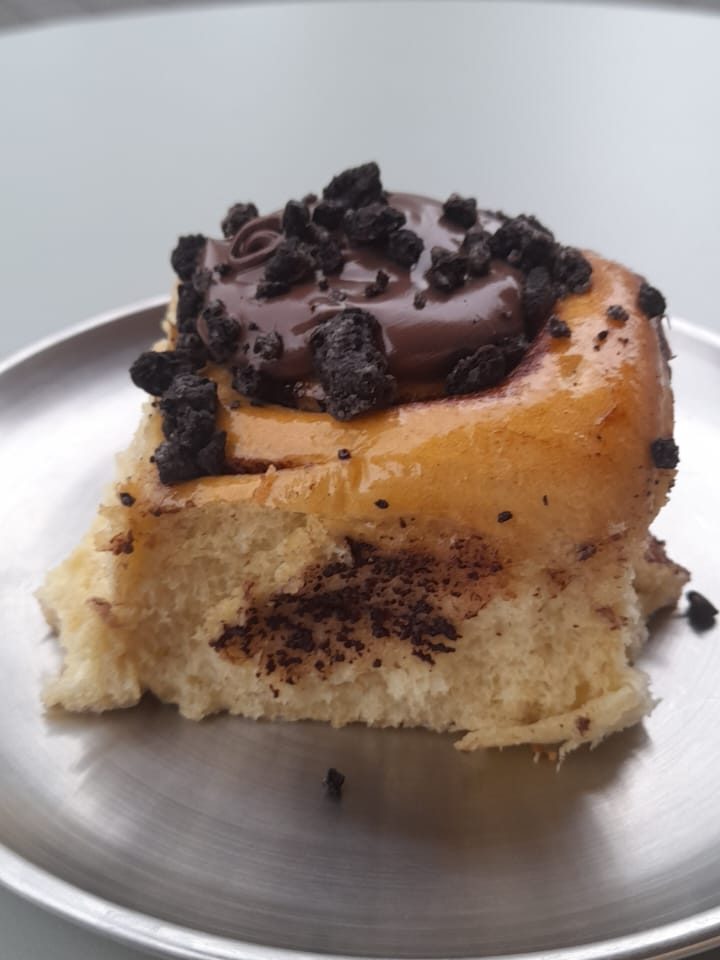
The Mayor’s curiosity involved a cinnamon roll.
Not an ordinary cinnamon roll, naturally, but an enormous one discovered in Strasbourg and described with enough enthusiasm to make clear that further investigation would be required.
And then there was Fruitloop. Her curiosity had begun beside a South African freeway on a Sunday. She was visiting her sister and watching the constant stream of cars passing nearby.
Where were all these people going?
There was no weekday traffic jam. The cars were moving freely. Yet they kept coming. Some people would be working. Some would be visiting family. Others might be returning from weekends away.
All perfectly sensible explanations.
Where was that car going? And that one? What little story was moving past her at motorway speed?
The Mayor suggested she contact a Johannesburg radio station and ask everybody to report in.
Apparently The Pineapple had discovered a new investigative department.
The business, he pointed out, was literally driving past.
The Box.
Then Fruitloop placed an imaginary box on the table.
It was closed.
It was mysterious.
And attached to it was a note:
DO NOT OPEN.
How long could everyone resist?
Fruitloop reckoned she could manage a day. She would leave it alone, walk past it several times and wonder what was inside. There was, however, a flaw in this strategy. Her son would apparently open it the second he saw it.
Problem solved.
Monica immediately recognised the psychological trap. It reminded her of envelopes marked “Confidential.” Put nothing interesting on the envelope and people may ignore it. Write confidential across the front and suddenly the mystery becomes irresistible.
She also confessed to an even more serious offence.
Christmas presents.
If Monica receives a wrapped present weeks before Christmas, there is a reasonable possibility that she will open it, inspect it and wrap it again.
“I’m a curious person,” she said.
Rosii thought she could resist the box for a few hours. She would spend those hours thinking, What is in this box? What is the secret? But until tomorrow? No chance.
The Mayor claimed greater discipline.
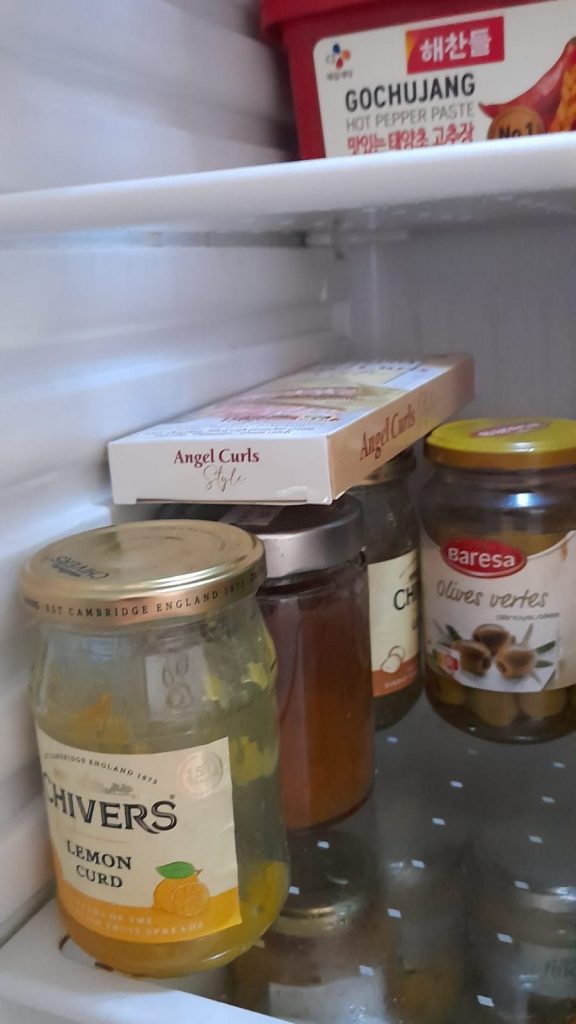
His training ground was the refrigerator.
Inside it sits a special bar of chocolate belonging to his wife. It has apparently survived there for months, despite repeatedly encountering a hungry man who knows exactly where it is.
The chocolate even talks to him.
“I know you want to eat me.”
The Mayor talks back.
“And I know you want to see me dead.”
Marriage can apparently turn confectionery into a hostage negotiation.
His point, underneath the chocolate drama, was that curiosity does not always have to be satisfied immediately. Sometimes you wait.
Eventually, the secret reveals itself.
The box might even be empty.

Never Give Someone Half a Secret.
Fruitloop raised the stakes.
Someone tells you:
“I know a secret about you.”
Then refuses to say what it is.
How do you survive?
Monica knew this torture well. Her mother used to begin stories and then refuse to reveal the rest. She would offer just enough information to create the question.
Who said it?
What happened?
What did you hear?
“I can’t tell you.”

For Monica, that was maddening. If you were never going to finish the story, why start it? Once someone gives you one little piece, she said, curiosity takes over. You begin imagining the missing parts.
Rosii’s answer wandered unexpectedly into another kind of secret. Recently, while her car was being repaired, she needed transport. A normal Uber was expensive. A motorcycle Uber was much cheaper.
There was one problem.
Rosii considered motorcycles dangerous. Her sister disliked them too.
Rosii booked one anyway.
Before setting off, she asked the driver to please go slowly and take care. He reassured her. She arrived quickly and safely—and suddenly understood why people used them.
The secret did not remain secret for long.
Fruitloop, meanwhile, had a completely different strategy for the mysterious person claiming to know something about her.
Negotiation.
“You tell me what secret you know about me, and I’ll tell you what I know about you.”
There was a moment of appreciation around the table. Then came the word “blackmail.” Fruitloop refined her position. Everything depended on the situation. More importantly, how did she even know the alleged secret was true? Perhaps someone had heard false information.
Now curiosity had reached its boundary.
Wanting to know is one thing.
Believing everything you discover is another.
Sometimes the unanswered question needs patience. Sometimes it needs scepticism. And sometimes, apparently, it needs negotiations.
Whatever You Do, Don’t Press This.
Next came a button.
Naturally, it said:
DO NOT PRESS.
What happens when you press it?
The Mayor’s wish was modest: something restorative.
Rosii wanted the button to produce a ticket to anywhere she wanted to go. France was somewhere in the picture, although she admitted that such a journey would need planning.
Fruitloop improved the technology. Why bother with a ticket? Press the button and simply appear wherever you want to be. She had several possibilities in mind: Zanzibar, the Kruger National Park, perhaps Mauritius. Tropical beaches appeared to be gaining ground.
Monica was more cautious. A forbidden button, she pointed out, might be an ejector-seat control. She had flown gliders and knew that important controls could be deliberately conspicuous for a reason.
Press first and investigate later, and you might discover yourself travelling unexpectedly upwards.
Fruitloop’s button was considerably more domestic. She wanted a five-course meal, with drinks, for the whole family. No cooking. No fuss. She could simply sit down and eat.
The Mayor promptly invited himself.
All they needed now was the button.
Then a Door Appeared.
By this stage, a mysterious door appearing in the house at midnight seemed entirely reasonable.
Fruitloop offered three choices.
Open it immediately.
Investigate first.
Or move house.
The Mayor said that at his age he would simply hope there was a loo behind it. That answer sent the conversation somewhere it probably did not need to go.
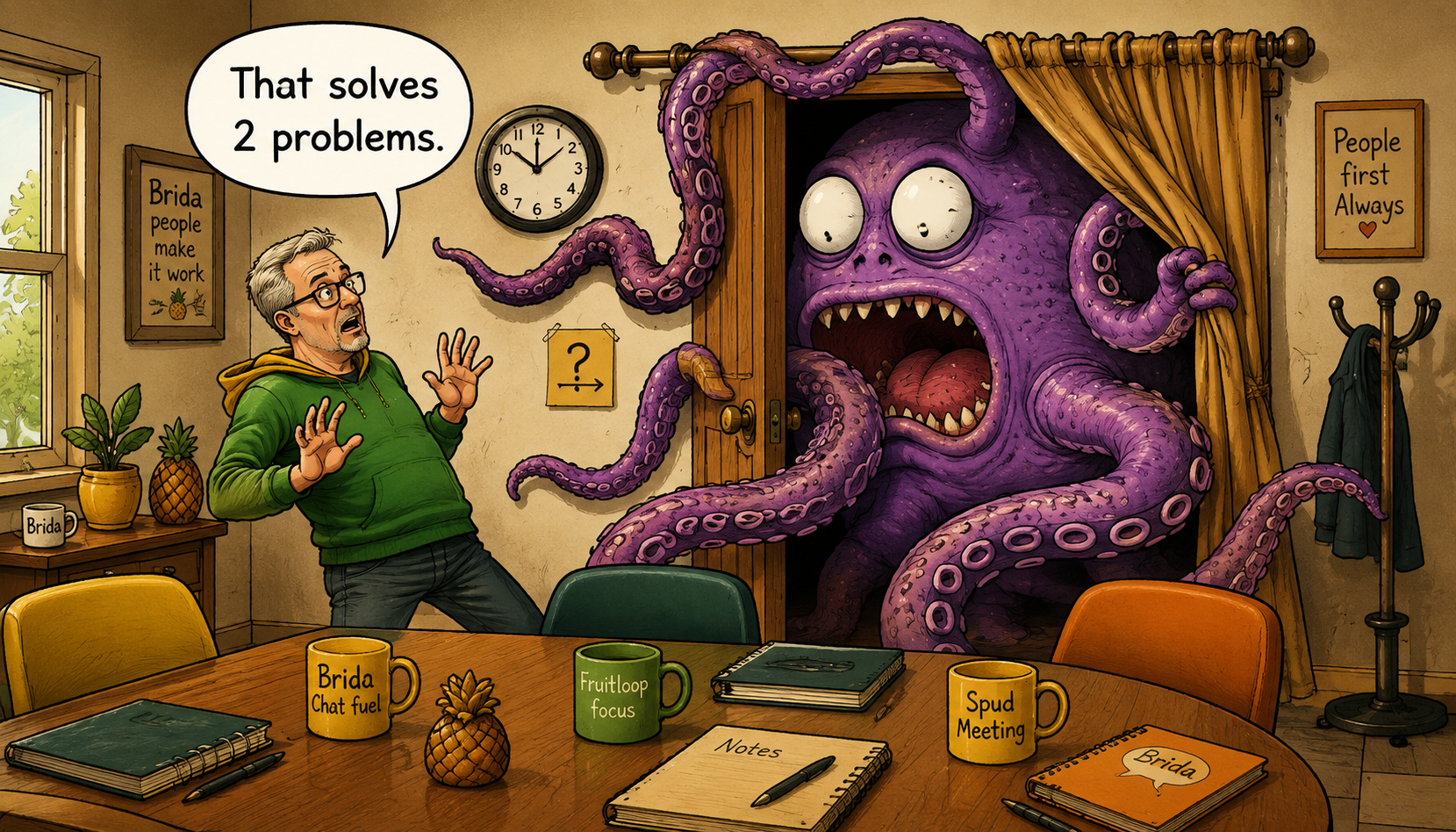
Fruitloop immediately imagined him opening the mysterious door only for a giant monster to jump out. There would be no loo. There might, however, be an urgent requirement for clean trousers.
She began laughing at the picture in her own head.
“I don’t even know why it’s a monster,” she admitted.
Then she added tentacles.
This did not improve matters.
Monica, whose years of nursing had left her rather less shocked by the direction of the conversation, rescued the mysterious door with The Lion, the Witch and the Wardrobe.
Perhaps the door opened into another world. Now the question changed.
Would you go?
Monica thought she probably would. She described herself again as curious, although she knew stories about mysterious doors did not always end well.
Rosii would open it too.
“Let’s see what happens,” she said.
Perhaps there would be a big family party on the other side. Perhaps a beautiful place to spend the day.
Fruitloop did not hesitate either. She wanted to know why the door was there. And if something was waiting behind it?
“Where did you come from? What do you want? How can I help you?”
Even the unknown, apparently, would first have to survive an interview.
Then something strange appeared behind Monica on the screen.
A blurred shape.
A gremlin?
A ghost?
Fruitloop asked Casper to leave the meeting.
Someone observed that a Zoom call already sounds suspiciously like a séance: Can everybody hear me? Is somebody there? Can you answer me?
At this point the mysterious-door question had effectively escaped supervision.
Fruitloop decided that if the door led to Narnia, she was going. Hogwarts would also be acceptable. She promised to come back with stories.
And because this was her imaginary magical world, she introduced one further condition: time would stand still on this side. She could disappear for years of adventure and return almost exactly when she had left.
Curiosity Has a Habit of Escaping.
Somewhere along the way, the conversation also travelled to Bahia, old memories of a very large tortoise in either Johannesburg or Durban, Rosii’s years working in tourism, Monica’s family connections in Brazil, magical travel, Scottish unicorns and plans to make a video of the Mayor’s village for Rosii after she had said she wanted to see it.
It was chaotic.
Nobody pretended otherwise.
Perhaps that is what curiosity looks like when nobody tries too hard to control it.
It starts with a question about trains and ends with a ghost in a Zoom meeting. It turns a traffic-filled motorway into hundreds of untold stories. It makes a wrapped Christmas present unbearable, a bar of chocolate philosophical and an ordinary imaginary door an entrance to another world.
But the conversation also found the other side of curiosity.
A question does not always need an immediate answer. A secret may not be true simply because somebody whispers that they know it. A warning can make us more curious, but occasionally the red button really is red for a reason.
And perhaps that is why nobody ever managed to decide exactly how curious is too curious.
They were too busy opening the door.
The story ends by balancing curiosity with caution, a tension that becomes clearest when the box, button and door are compared as three different kinds of risk.