
Do Not Read This If You Want to Be Perfectly Rested
My warning light glows politely, my gramophone refuses to optimise me, and sometimes the best way to recharge is to travel hundreds of kilometres to a concert.
During our Wednesday Swimming Club conversation, we tried to understand what rest actually looks like. This immediately created a problem: the moment people begin explaining how to rest properly, rest starts becoming another task.
Perhaps we need a warning light instead.
Mine would not flash aggressively or play loud music. Loud music would be cool, but it would require headphones, and I do not always wear them. My warning light would glow politely, becoming brighter as my need for rest increased.
I imagine one of those small lamps on an old record player. Does anybody remember them? The light would not demand anything. It would simply glow, quietly and soothingly, until I finally noticed it.
Coffee, Shoes and the Inner Devil
When rest begins properly, there is a sequence.
First comes coffee: strong, black and always freshly ground. Then I sit down and take off my shoes. The headphones go on, followed by music.
A few snacks would enhance the experience. The exact quantity is difficult to establish.
At this point, my inner resistance usually begins fighting a fierce battle against my inner devil. One side says that snacks are unnecessary. The other side has already opened the packet.
This is more or less my resting station. It does not require a spa, a mindfulness coach or a twelve-stage relaxation programme. It requires coffee, music, no shoes and the temporary defeat of unnecessary responsibility.
An official rest inspector might disagree.
The first thing such an inspector would say upon entering my home is, “Oh my God.”
The place is small, and there are too many things. According to the inspector, I would probably have no right to rest because the untidiness itself would be considered unrestful.
My answer would be simple: being a genius allows me to manage this chaos.
Then I would show the inspector the door.
The door is still in a tidy zone. Outside, in the stairwell, it is especially tidy because it is empty.
Rest First, Except in Emergencies
My basic rule is: rest first.
This is excellent advice whenever the to-do list contains nothing important. The difficulty is deciding what “important” means.
My definition is quite strict. Nothing is important unless it is absolutely life-threatening. In a genuinely life-threatening situation, rest first might not be the best decision. In most other situations, the task can probably survive without immediate attention.
Rest gives us back things we temporarily lose. Patience, curiosity, humour, imagination and even the desire to speak to other human beings may all return after we stop.
Patience is especially important. When you are caught in a vicious circle of hectic activity, stopping opens the door to it. There is a reason Rome was not built in one day.
It would probably not have been improved by a self-optimisation app either.
The Gramophone Knows Better
An old gramophone understands rest better than a modern app.
The gramophone does not try to take control of me. It requires calmness and patience. I have to sit down, choose an old 78 rpm record and place it carefully on the machine.
Nothing happens instantly. That is part of the pleasure.
A self-optimisation app would behave differently. It would monitor the situation, judge my choices and perhaps warn me that what I was doing at that moment was unhealthy. It would transform sitting quietly with a record into a measurable performance.
This is the central problem with professional rest advice. The varieties of rest I would refuse to buy—even with a loyalty-card discount—are the ones that tell me exactly how I must relax.
They would only stress me.
The same applies to the imaginary robot that works brilliantly but becomes suspicious whenever nobody gives it a task. I would explain that human beings need rest. A robot may argue that the day has 24 hours, but a human cannot function for all 24 of them.
To help the robot understand, I would give it a self-optimisation app programmed to maximise its performance. Eventually, its systems would begin short-circuiting—the robot version of becoming ill—and it would automatically shut itself down.
That might finally teach it something about being human.
My Recharging Stations
Some forms of rest do not look restful from the outside.
Travelling hundreds of kilometres to concerts, coming home and then travelling hundreds of kilometres again could appear exhausting, inefficient or slightly mad.
The secret ingredient is not the travelling.
It is the fun, the pleasure and the memories that remain afterwards. Those memories become energy. They keep me going during the time between concerts.
A concert is simply a recharging station.
This is why a full, interesting and slightly chaotic life may sometimes be better than a perfectly rested one. Nobody really knows what a perfectly rested life feels like. The people searching for it are too busy optimising everything.
They are planning their rest, monitoring their rest, improving their rest and assessing the quality of the rest they have just completed.
By the time they finish, they may need to rest.
Bring Back Boredom
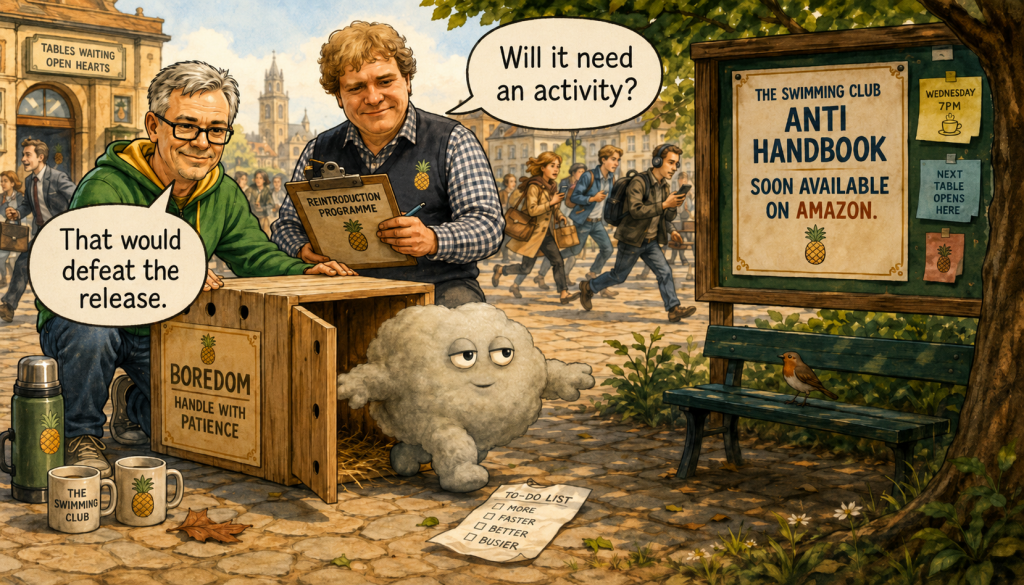
I would also like to bring boredom back into society.
If boredom were an endangered species, I would release it on every street corner. It could act as a serum against the modern pace of life and the constant traps demanding our attention.
Boredom is not lethal, although people often behave as if it is—especially when children are involved.
Parents, and particularly mothers, can carry the burden of finding activities to keep children occupied all the time. Every empty hour has to be filled. Every quiet moment becomes a problem requiring a solution.
But boredom can create space. It allows the mind to move without being directed. It may produce imagination, curiosity or nothing at all.
Nothing at all is also allowed.
There is no need to achieve something every time we stop.
The Unwritten Warning
The Swimming Club anti-handbook on rest probably needs a warning page.
My contribution would be one sentence:
Do not read this if you want to be perfectly rested, because searching for perfection is not restful.
Of course, this advice should never actually appear in the handbook.
It might cause people stress.