

How to Rest Properly Without Making It Into Another Job
The Swimming Club’s Anti-Handbook for doing less without doing it incorrectly
Rest has become suspiciously complicated.
There are apps, experts, programmes, routines and new tools released strategically to help us relax. They promise comfort but often arrive carrying passwords, updates, targets and emotional responsibilities.
Soon, you are not simply resting.
You are failing to achieve your rest objectives.
This is therefore not a proper handbook. A proper handbook would give you a system, a schedule and perhaps a certificate at the end.
This is an Anti-Handbook.
It contains rules against having too many rules.
Anti-Rule Number One: Rest First
When the question is, “Do I have to do something, or should I rest?” the answer should always be:
Rest first.
This is important because we have learned to treat rest as something we must earn.
First, we finish the work. Then we organise the house. Then we answer the messages. Then we prepare properly for resting.
By this point, we need another restful day to recover from the preparation.
The purpose of rest is not to turn you into a more efficient worker. It may do that, but this is not the point.
The point is to discover that there is more to life than working.
After one week of proper rest, you might learn something about your personality. You might become more curious. You might learn patience or begin to appreciate silence.
You may even become slightly more independent from the expectation that you must always be fully functional, like a robot or a wage slave.
This could be dangerous.
Anti-Rule Number Two: Do Not Measure the Improvement
A small improvement to your rest should not require new equipment, an app, a consultant or a twelve-stage certification course.
Listening to your favourite music will probably improve your rest by much more than ten percent.
Even an old gramophone presents an opportunity.
Rest knows no technical boundaries.
Of course, every serious rest ritual also needs one completely unnecessary luxury.
Mine is a pair of high-tech headphones.
They are the fourth-generation Sony headphones. Sony has now reached the sixth generation, but I see no reason to panic.
Mine still work with a cable or wirelessly through Bluetooth. They cover the whole ear and contain many tiny microphones.
They can also cancel noise.
This is useful when I go shopping and horrible sounds interrupt the shopping experience.
Sometimes I do not even want to listen to my favourite music. I only want silence.
In certain situations, I would prefer construction noise to the feeling that I am being brainwashed by supermarket music.
This may not be what the designers intended, but it is an excellent resting function.
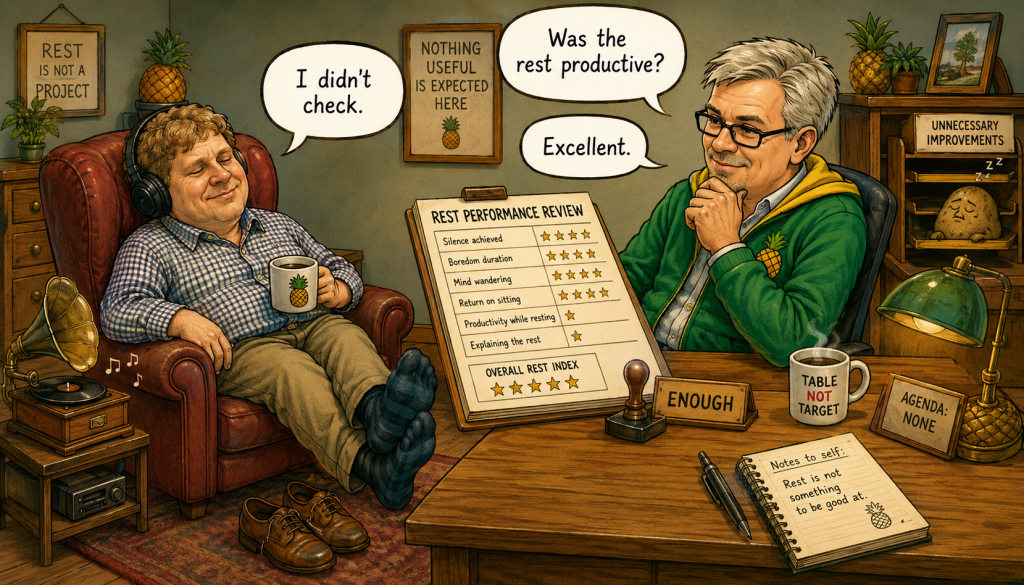
Anti-Rule Number Three: Find a Place Where Nothing Useful Is Expected
Everyone needs an officially approved resting station.
This is a place where the brain understands that nothing useful is expected from it.
For me, this happens when I visit the graves of my sister and my mother.
It is my own space.
It is, of course, a place of sadness, but it also helps me to look at the bright side of life.
Rest does not always mean escaping sadness. Sometimes it means having enough quiet to sit beside it.
There are places where nobody asks you to perform, improve or explain yourself. Nothing needs to be solved.
You are simply there.
That can also be rest.
Anti-Rule Number Four: Be Suspicious of Professional Relaxation
Sometimes having too much to do is exhausting.
Sometimes being given professional instructions about how to relax correctly is worse.
The problem is pressure.
New tools and advice appear all the time. They are presented as help, but they can make me feel guilty.
Apparently, I am not resting correctly.
I am not following the latest method.
I am being too individualistic.
This is one of the main dangers for inexperienced resters.
You can listen to advice about good rest, but do not let the advice overtake your own idea of resting.
Never try too hard to follow the newest trend of overplanned schedules designed to tell you exactly how much you must do in order to do nothing.
A schedule for doing nothing is still a schedule.
Anti-Rule Number Five: Protect Boredom
When I was young, boredom was allowed.
Today, it would probably be supervised, measured or turned into an educational programme.
Boredom is dangerous because it can force you to start thinking.
You might develop an imagination.
You might enjoy freedom without being given unnecessary boundaries.
You might cross a boundary and learn from the mistake.
This is inconvenient for any system that would prefer to organise your experience in advance.
Boredom gives the mind an empty space. It does not immediately tell you what the space is for.
That is why it matters.
Less entertainment can create more imagination.
Less instruction can create more independence.
Less activity can reveal more life.
Anti-Rule Number Six: Do Not Let Comfort Become Administration
Some modern inventions genuinely help us rest.
Air conditioning in a car is one example. With changing temperatures in Europe, air conditioning at home may also become less of a luxury and more of a necessity.
But many other inventions promise comfort and arrive carrying administrative work.
Self-optimisation apps are a good example.
I avoid them like the plague.
Supermarket apps are another. They offer discounts and special offers, but first you must download the app, create an account, remember a password, accept notifications and begin a new relationship with a supermarket.
This does not feel restful.
Technology should remove unnecessary effort.
It should not give you another small institution to manage.
Anti-Rule Number Seven: Joyful Stress Is Allowed
Not every activity that looks tiring is the opposite of rest.
Coming home from one Garbage concert and preparing to travel to the next Garbage concert may look like stress to other people.
It is not.
And if it is stress, it is a very joyful kind of stress.
For me, the preparation is part of the rest and part of the adventure.
I do not need to recover from it unless I begin thinking about every possible “What if?”
What if the train is late?
What if I forget something?
What if something happens that has never happened before but has now become extremely important because I have imagined it?
The “What if?” department can turn an adventure into a project-management exercise very quickly.
The solution is not always to remove activity.
Sometimes it is to remove unnecessary worry from an activity you love.
Rest is not only lying still.
Rest can also be movement without resentment.
The Anti-Handbook Emergency Procedure
When I know that I need rest, I begin with something small.
Sometimes I sit down and have a good cup of coffee.
Sometimes I take off my shoes in the evening and listen to music that I love.
There is no assessment form.
There is no performance review.
I do not need to prove that the rest was productive.
The shoes are off.
The music is playing.
Nothing useful is expected.
This is enough.
And when you are unsure whether it is enough, return to the only rule in this Anti-Handbook that really matters:
Rest first.