
The Theory Is Easy. The Practice Is Something Else.
What began as a conversation about emotional rest slowly became a conversation about responsibility, family, quiet worries, and the surprisingly ordinary ways we stop ourselves from truly resting.
There is something special about a Friday afternoon.
Fruitloop asked me which day of the week makes me happiest, and I didn’t even have to think about it. Friday. Not because something exciting always happens, but because the work is finished, the house has usually been cleaned, everything feels organised, and I know I have two days ahead of me that belong to something other than work.
It feels like permission to breathe.
Of course, life doesn’t always cooperate. We had just celebrated the French national holiday, the streets were full of people, and France had lost an important football match. Even our weekends have a habit of becoming busy.
Perhaps that’s why emotional rest is more complicated than it sounds.
Work Doesn’t Always Stay at Work
Everyone says you should leave work at work. I agree with that.
The problem is that real life doesn’t always listen.
Fruitloop asked whether I can really switch off once the working day is over, and I realised my answer depends on what is happening at the office. If everything is running smoothly, then yes, I close my laptop and carry on with my evening.
Sometimes my colleague is covering my work while I’m away and needs to ask me something. I have Outlook and Teams on my phone, not because my company insisted, but because I chose to install them.
That makes it difficult to blame anyone else.
Most evenings I only want to have a quick look. Just one email. Just one message. Then another appears, followed by another problem, and before I realise it, work has quietly found its way back into my home. The computer may be closed, but my mind has opened again.
We laughed because the theory is simple.
Close the laptop.
Don’t think about work.
The practice is something else entirely.
The Weight That Doesn’t Show
That led us to another question.
What actually makes us emotionally tired?
Physical tiredness is easy to understand. If you’ve been cycling for hours or you’ve slept badly, your body tells you exactly why you’re exhausted.
Emotional tiredness is much quieter.
It can come from worrying about work. It can come from waiting for difficult news. It can come from family responsibilities or simply carrying too many thoughts at the same time. Students often experience it during exams. Parents know it too. You can look perfectly fine while carrying far more than anyone around you can see.
The strange thing is that emotional tiredness doesn’t disappear after one good night’s sleep.
Sometimes it stays for a while.
Two Daughters, Two Different Worlds
Talking about emotions made me think about my daughters.
They couldn’t be more different.
One of them keeps everything inside herself. If something is bothering her, she usually goes to her room and prefers to deal with it alone. We don’t always know what she’s thinking, and we’ve learnt to respect that.
Her sister is almost the opposite.
She talks about work, about her friends, about the things that worry her, and about what is happening in their lives. Perhaps she doesn’t tell me absolutely everything, but she shares a great deal. She knows she can always come to us.
Neither way is right or wrong.
They’re simply different people.
As a parent, you learn that emotional rest doesn’t look the same for everyone.
The People Who Can Carry Your Thoughts
Fruitloop asked whether I prefer solving problems on my own or speaking to someone.
I realised that depends on the problem.
If something is really bothering me, I usually speak to my husband. Sometimes my sister-in-law. They know me well enough to listen without making everything bigger than it already is.
Not every person can carry every conversation.
Some friends are wonderful for laughing together.
Others are the people you call when life becomes difficult.
I think we slowly discover that over the years.
We also discovered something else during our conversation. When someone shares a problem with us, our first instinct is usually to solve it. We offer advice because we want to help.
But advice is often much easier to give than emotions are to carry.
Sometimes people don’t need solutions first.
Sometimes they simply need someone willing to sit beside the problem with them.
Quiet Roads Make Quiet Minds
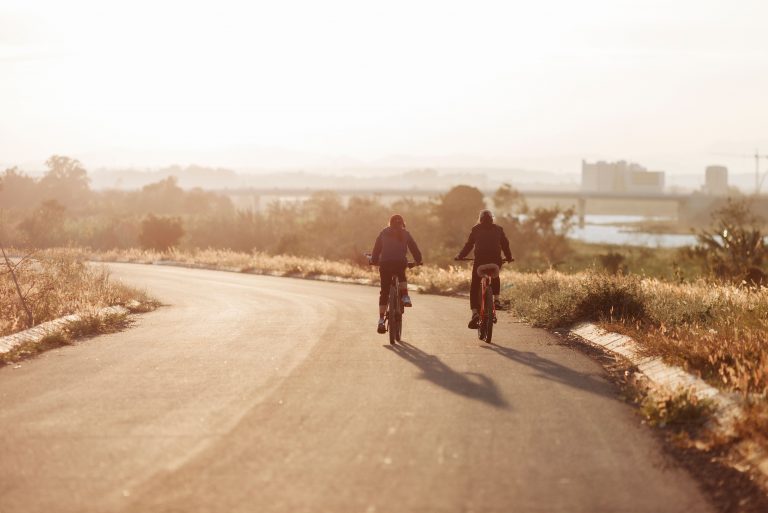
When life becomes noisy, I often go cycling.
Fruitloop asked whether I listen to music while I ride.
I don’t.
I prefer listening to everything else.
I usually cycle along the same roads, and I never really become bored. I know where I’ll see the rabbits. Sometimes there are deer. Quite often I spot foxes crossing the fields, and occasionally I even see young foxes following their mother. There are farms with pigs, familiar villages, fields that change with the seasons, and people I recognise well enough to wave as I pass.
Nothing dramatic happens.
Perhaps that’s exactly why I enjoy it.
Those quiet roads somehow make my own thoughts quieter too.
Maybe Rest Is Smaller Than We Think
Near the end of our conversation, Fruitloop asked one last question.
If someone suddenly gave me one whole afternoon with absolutely no responsibilities, what would I choose to do?
The answer came quite naturally.
I’d probably go cycling.
Or meet a friend for coffee.
Perhaps sit somewhere with a good book.
Then I laughed.
“I would finally start reading one.”
Not finish one.
Just start.
Because every evening I tell myself I’ll begin tomorrow, and somehow tomorrow always becomes another tomorrow.
Maybe that’s what emotional rest really looks like.
Not escaping your life.
Not solving every problem.
Not reaching a magical day when everything is finally under control.
Maybe it begins much more quietly than that.
Closing the email without opening another one.
Talking to someone who already understands.
Watching a fox disappear into a field.
Starting the book that has been waiting on the bedside table for weeks.
The theory of emotional rest is wonderfully simple.
The practice, like most worthwhile things in life, is a little more human.