
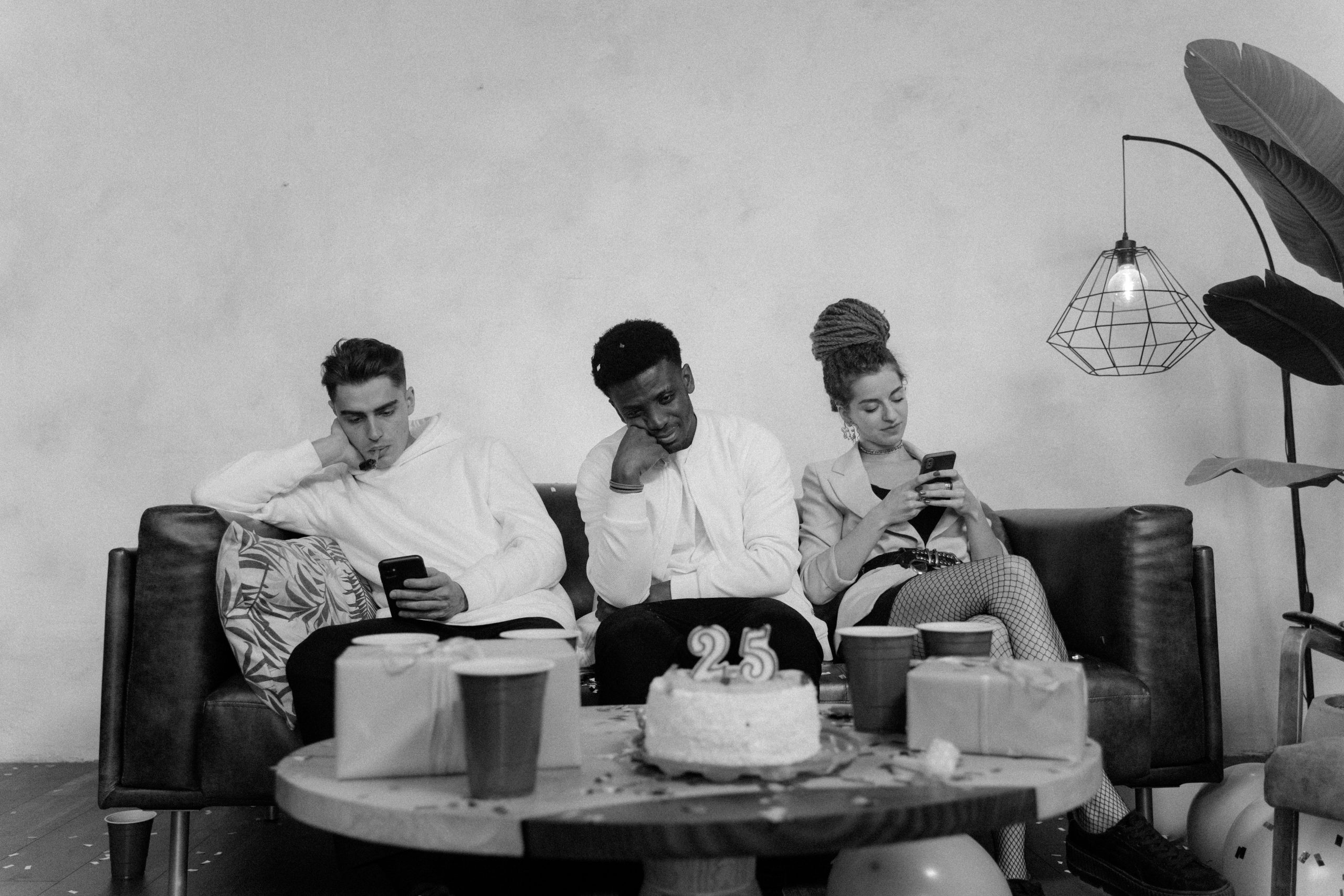
The Fear of Missing Out
The strange thing is that I did not even have time to use my phone very much when I was away.
That was my first answer to The Mayor, and it was true. I had been travelling for work, sitting in meetings, moving from one place to another, and the phone was there, of course, but not in the way it normally is. Normally, I use it a lot. I check emails. I check messages. I look at Instagram to see new videos. In the morning, even before I get out of bed, I check what has arrived. And when I go to bed, I often open YouTube, put one AirPod in my ear, and listen to something until I fall asleep.
I said to him, very honestly, “I think this is horrible for my brain and my mind.”
But I also said the other truth.
I fall asleep faster when I hear something.
That is already the problem with digital balance. The phone is not only bad. It helps. It relaxes. It gives information. It gives music. It gives connection. It gives work. It gives distraction. It gives everything. And maybe that is why balance is difficult, because the phone is not one thing. It is private life, business life, family life, entertainment, stress, memory, pressure, and comfort in one small object.
For my work, I really need digital tools. My phone, laptop, and tablet are important every day. When I am with a customer, I write notes about the conversation. When I leave the meeting, I add more details that are important for me. When I travel, I check emails on my smartphone. At a trade fair or a training event, when someone comes to speak with us, I write down who they are, where they work, what they need, and all the contact details, especially when they do not give me a business card.
I could work without digital tools, yes. I could write everything on paper. But then, when I come home, I have to transfer all the notes into the system. And that means I have more work in the evening. This is why I use digital tools. When I write it directly, it is finished. I do not carry the work home in the same way.
The Mayor showed me his notebook. He has many notebooks. He writes by hand every day. He told me he has enough paper to continue until 2028. I had to smile a little, because for me this feels old school, but also interesting. I know this feeling because when I started in my current professional path, I also used paper. I wrote with a pencil. I could write very fast, and it was only important that I could translate it later after the meeting.
At that time, someone senior travelled with me and told me, “Alex, we are in 2024. Please make your notes on your laptop.”
After that, I used only the laptop.
At the beginning, it did not feel nice. With a pencil, I was faster. With the laptop, I needed maybe ten seconds longer to write everything down. And then there were ten seconds of quiet in the room. That quiet was unusual. It felt strange. But now most people use laptops in meetings. Everyone sits around the table, everyone types notes, and it is normal.
Still, I understood what The Mayor was saying. Sometimes the year and the technology become more important than the question of what works naturally for a person. The argument becomes, “We are in 2024,” not, “What helps you listen better? What helps you remember? What helps the conversation?”
That stayed with me.
Then we spoke about one moment from my week when my phone made my life easier. During a break in a training session, I checked my phone for new emails. It was easier than opening the laptop or tablet. Just a quick check.
But The Mayor challenged me there.
He said, “Wasn’t the break important enough?”
And he was right.
The break was there to switch off, speak with people, maybe relax for a few minutes. Instead, I took out the phone and pulled myself back into work. I did not think about it. I just did it. You sit down somewhere, at an airport or in a break or in a waiting room, and the first thing you do is take out your phone. Not because something is really important. More because you have the feeling that maybe something is happening somewhere, and you should know it.
He called it the fear of missing out.
FOMO.
I knew immediately what he meant.
And I had a very clear example. During that training week, I checked my emails in a break and saw a bad message from a customer. There had been a problem in a warehouse. One of our products was damaged, and there was a small fire. In the end, it was not the biggest disaster, because they saw it early and reacted quickly. But in that moment, when I read the email, my whole mindset changed. The next half hour, maybe the next hour, was negative in my brain.
The important part is this: I did not even answer the email that day. I answered it later.
So nothing would have happened if I had not read it during the break.
But because I saw it, I carried it into my head. And then I shared it with other people around me. Some of them needed to know, yes. Others maybe did not need to know at that moment. I think this is human nature. When I get a bad message, I want to share it because then I hope someone gives me a good answer, or brings me down, or helps me feel calmer. But by sharing it, I also give the negative feeling to other people.
That was not nice to realise.
It was not panic, but it was a shock reaction. A bad message came in, and my brain said, “Oh my God, this is important.” But rationally, there was nothing I could do in that moment. The damage had already happened. I was in a training course. The customer did not know that. The topic would need a proper answer later, with the right people involved, not a stressed reaction during a coffee break.
So yes, I think I overreacted emotionally.
And the easiest way for me to delete that negative feeling was to share it.
The funny thing is that in that training, we were asked not to use phones or laptops. We were supposed to make notes for ourselves, but not digitally. So, in a way, the rule was already pointing to the solution. The Mayor asked me what would have happened if, in the morning, we had all given our phones and laptops to someone, like children sometimes have to do in school, and only received them back at the end of the day.
Nothing would have happened.
Actually, I think it would have been better.
Maybe in the first moment it would feel negative. I am very used to checking when something is new. Private things, business things, all mixed together. I want to know. But when I look back, I think it would have been healthier to leave the phone outside, in the hotel room, in a safe, anywhere. Just not available.
That is easy to say after the moment. It is harder inside the moment.
Because the phone is normal now.
Later, we turned the question around. The Mayor asked what he could learn from me if he joined me for one workday and watched how I use digital tools professionally.
My first answer was: nothing.
For me, writing something in a notebook or writing it directly into a laptop is not so different. The only real difference is that with digital notes, I do not have to transfer them later. But then he challenged me again. He spoke about memory, about how the human brain is a miracle, about how he remembers things from conversations years ago because the connection itself stores something. He asked if maybe we are losing our power of observation and memory because we depend too much on technology to think for us.
I agreed with part of that.
But I also think the quantity of information is higher every year. At some point, you cannot remember everything. In a meeting, a customer may tell me what the company does, how big it is, how long it has existed, how long he has worked there, how old he is, when his birthday is, and many other things. If I do not write these things down, after the meeting they are gone.
Maybe that is because my memory is not trained enough.
Maybe it is because the information load is too high.
I think it is both.
The Mayor gave the example of birthdays. You can write them on paper. You can keep a birthday list. Or you can put them into a digital calendar. Then the system reminds you. LinkedIn makes it even easier. It gives you a notification and even prepares a message, and you only press a button. You feel like you remembered the birthday, but actually you did not remember anything. The system remembered. The system instructed you.
On this point, I am very bad. I cannot even tell you all the birthday dates in my family. Some important dates are saved in my calendar so I can congratulate the person. And yes, Julia helps me a little bit too. I think many partners do this. They carry part of the family memory.
But I also defended digital tools here. The Mayor has many notes in many places: notebooks, calendars, paper lists, maybe books with telephone numbers. Today we can work smarter and keep many of these notes on one or two devices. That is also balance. Not everything old is better. Not everything digital is bad.
Of course, then there is the question: what happens if the system is down, or the data disappears?
Then we have a big problem.
So there is no perfect system.
Maybe digital balance is not about choosing paper or technology. Maybe it is about knowing what each one does to your mind. Digital tools are very efficient. But they also create pressure. Paper is slower. But maybe that slowness sometimes protects the human part.
At the end, The Mayor asked me a strange question. He asked what would happen if I had to spend one week in a monastery or a temple, with no technology at all. No news. No emails. No WhatsApp. Nothing.
I said I think it would be healthy for me.
But I also said I cannot imagine it.
Because I would want to write Julia. I would want to ask how she is, how my son is, if everything is okay. That is not business pressure. That is family. That is love. That is also why the phone is complicated. The same device that brings a bad work email into my break also brings my wife and son close to me when I am away.
So what should I do with that?
Maybe I do not need to throw the phone away. Maybe I need to respect the moment more. A break should be a break. A family evening should be a family evening. A training course should be a training course. And when there is really a problem, I can answer it properly, not emotionally, and not always immediately.
I think I learned that my phone helps me a lot, but it also steals small pieces of my mind. Not in a dramatic way. Just quietly. A quick check here. A message there. A video before sleep. An email during a break. Music when I could maybe sit in silence.
And maybe the real fear is not only missing out.
Maybe the real fear is being alone with the moment in front of me.
I am not sure yet.
But I know this: if I had not checked that email during the break, the problem would still have been there later. The answer would still have been possible. The world would not have ended.
And my mind, for that one small break, might have stayed free.