Dream Jobs (or How to Get Paid for Doing Absolutely Nothing… Properly)
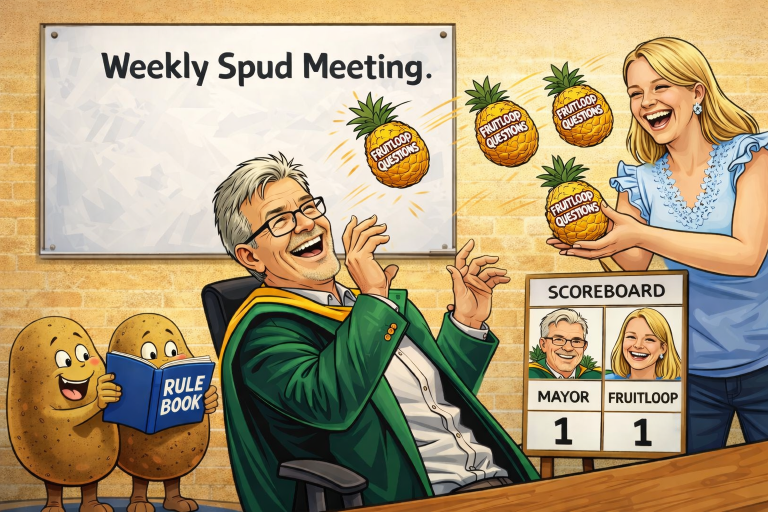
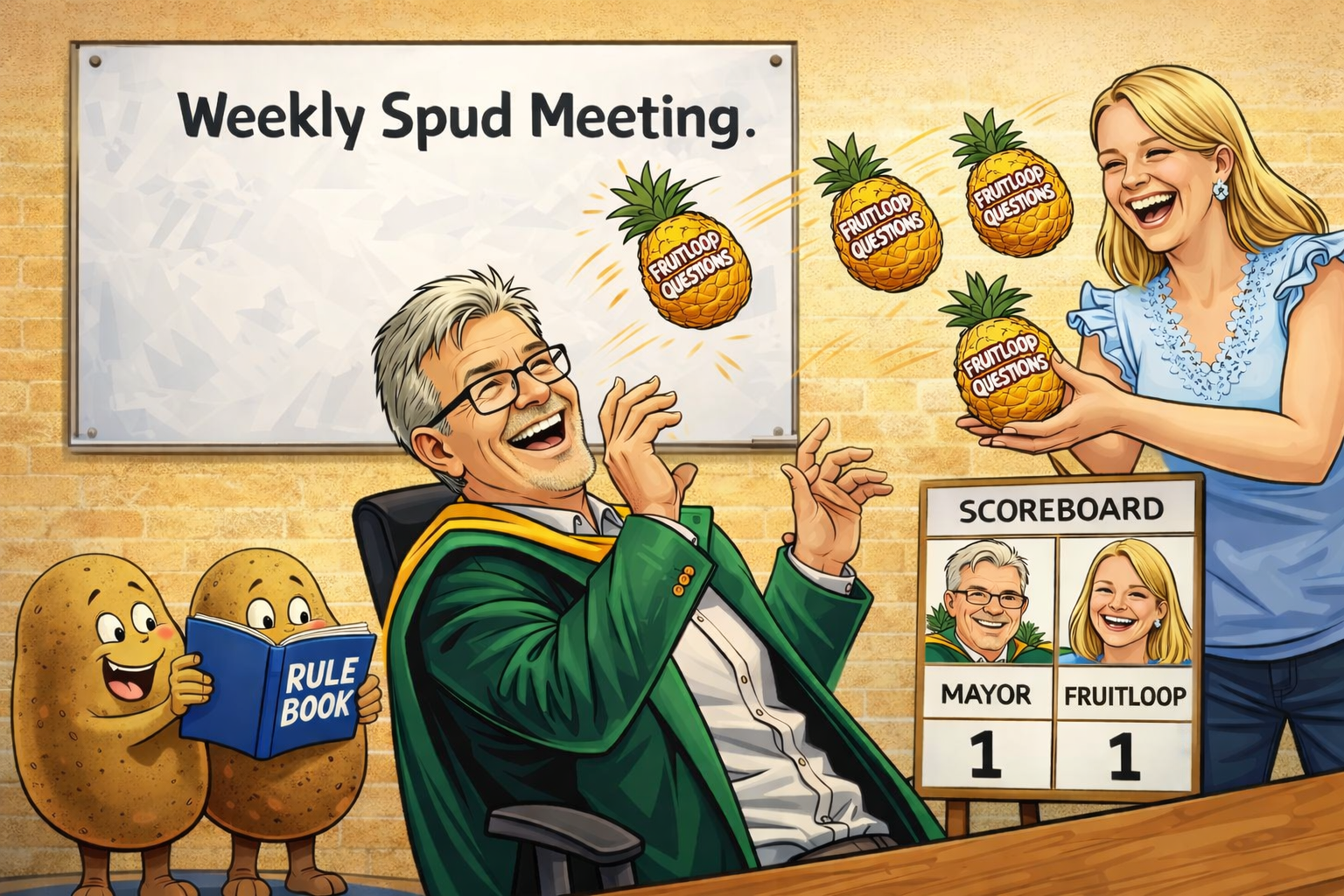
The Mayor & Fruitloop are live. Or at least, they are pretending to be. Which, if you think about it, already qualifies as someone’s dream job.
Fruitloop opens, in that tone suggesting she has notes (she doesn’t), and introduces the subject: dream jobs. She pauses. The kind of pause that either carries deep meaning… or simply hot air.
“I have questions,” she says.
Of course she does.
Not ordinary questions. Not the kind that appear in polite interviews where people discuss five-year plans they don’t believe in. These are Fruitloop questions—slightly sideways, mildly dangerous, and quietly philosophical.
The Professional Sleeper
Her first question lands gently: if someone could be paid to sleep professionally, how would they prove they were good at it?
The Mayor considers this—not as a question, but as a calling.
He explains that he would ignore instructions, directives, and policy changes. Then pauses.
“Hang on,” he realises. “I already do that.”
Fruitloop responds with calm precision.
“Basically, Mr Mayor, I agree with you. Then I tell you what to do.”
“Good,” he replies. “Can I go back to sleep?”
And just like that, the first dream job emerges—not sleeping itself, but the rare ability to sleep while still appearing professionally relevant.
Dragons vs Unicorns
Fruitloop continues. Would one rather be a dragon trainer or a unicorn dentist?
The Mayor approaches the dilemma with surprising clarity. He explains that he dislikes bad breath, and that the unicorn’s horn would present unnecessary logistical challenges.
So, dragon trainer it is.
“I like feisty characters,” he adds.
And somewhere beneath the humour lies a quiet truth: dream jobs are less about the job, and more about the kind of chaos one is willing to embrace.
Chocolate Testing and Existential Doubt
The next scenario sounds idyllic—testing chocolate all day.
But the Mayor sees the flaw immediately.
For him, it becomes a question of quantity versus quality. If the chocolate is excellent, he would need to double-check that he isn’t hallucinating. If the chocolate is terrible, he would need to double-check that he isn’t hallucinating.
Either way, the conclusion is the same: uncertainty, wrapped in cocoa.
Not, perhaps, the worst professional setting.
Meetings with a Cat
When asked to imagine a boss who is a talking cat, the Mayor does not need to imagine.
He already lives with three cats, he explains—alongside three women (Fruitloop, wife, mother) —each of whom communicates in ways that require interpretation rather than instruction.
In this imagined workplace, meetings would be conducted in silence. Thoughts would hover unspoken. Communication would rely on raised eyebrows, subtle expressions, and the occasional, rare smile.
He admits, with some resignation, that he never quite gets it right.
And so he returns, as he often does, to the metaphorical naughty step, quietly repeating his lesson:
“Improve, Mr Mayor. You must improve.”
It feels familiar. Perhaps too familiar.
The Banana Costume Clause
Fruitloop asks whether he would accept his dream job if it required wearing a banana costume every day.
The Mayor doesn’t hesitate.
“But I do.”
It is a simple answer, but it carries weight. Because every dream job, in some form, includes a banana costume—the element of absurdity, discomfort, or quiet embarrassment that comes with being fully visible.
The real question is not whether it exists, but whether one is willing to wear it.
Naming Clouds (Badly)
The final question drifts into more abstract territory: naming clouds for a living.
The Mayor immediately identifies the risk.
He suspects he would fall asleep while thinking of names, and then expect those around him—particularly the cats and the women in his life—to somehow interpret his unfinished thoughts.
He pauses, acknowledging the flaw in the system.
“Therein lies a problem,” he concludes.
And leaves it there.
Somewhere Between the Absurd
What begins as playful nonsense—sleeping as a profession, dragons, banana costumes—quietly reveals something more grounded.
Dream jobs, as they describe them, are not about perfection or structure. They are not about certainty.
They are about the freedom to be slightly ridiculous, the ability to misunderstand and still continue, and the willingness to sit on one’s own metaphorical naughty step without walking away.
But more than anything, they are about companionship.
Because in this ongoing, slightly chaotic exchange—half radio, half conversation at a kitchen table—the dream is not the job itself.
It is the space in which they are executed.
A space where words are forgotten, meanings are improvised, and laughter carries just enough sincerity to make it real.
And somewhere in that mess—unplanned, imperfect, and shared—the idea of a dream job quietly shifts into something else entirely.
Something closer to belonging.