

Of Cleaning, Burrowing, and Minor Revelations
Tuesday began, as certain inconvenient Tuesdays do, at four in the morning.
Guinea Pig woke with that unmistakable sense that sleep had quietly packed up and left without consultation. His body had decided that morning was already underway, though the hotel world, with its clerical devotion to proper hours, insisted that daybreak was still some way off. It was, in other words, a dispute between biology and administration. Biology had won.
But there was work. There was always work. Or rather, there was Doodle Horse, who wanted her status report p.d.q., and she was not a creature one kept waiting merely because the clocks were being theatrical. So he wrote it, submitted it, and, some ninety minutes later, found himself not relieved but emptied.
It was not quite sadness. Not quite fatigue. Not even confusion. It was something flatter and stranger: the sensation of being unable to go either forward or back, while still being required to move physically through the world as though movement itself were proof of meaning. Inside, he was motionless. Outside, he was doing what one does. Walking from room to room. Checking. Straightening. Ensuring that things were proper.
There are mornings when tidiness is less a virtue than a form of self-defence.
He swept the floors and observed, not for the first time, that dust seemed to possess a theology of its own. It multiplied in silence. It required no encouragement. Even on a comparatively calm day, even when the offspring had apparently reduced their more vigorous contributions to domestic entropy, the dust persisted in arriving as though invited. It no longer seemed to amuse anyone. Not even itself.
The cats were fed. The dishwasher was emptied. He stepped outside for air and found the day preparing another stretch of improbable spring sunshine. It had become an unusually fine run of weather. He briefly entertained the notion that Doodle Horse might somehow be responsible for it. Calm people, perhaps, attracted calm skies. Chaotic lives summoned tempests. It sounded just plausible enough to be satisfying and just implausible enough to remain safely philosophical.
This is often the ideal condition for a theory.
Then breakfast. Or rather, the preparation of breakfast, which in civilized homes begins not with personal appetite but with infrastructure. The muesli container was empty and therefore, in a very real sense, vulnerable. Guinea Pig had developed a rule: feed the vulnerable first. Only then could one feed oneself. In this case the vulnerable party happened to be a plastic container awaiting oats, flaked almonds, linseed, and sunflower seeds, but moral principles do not become invalid merely because they are applied domestically.
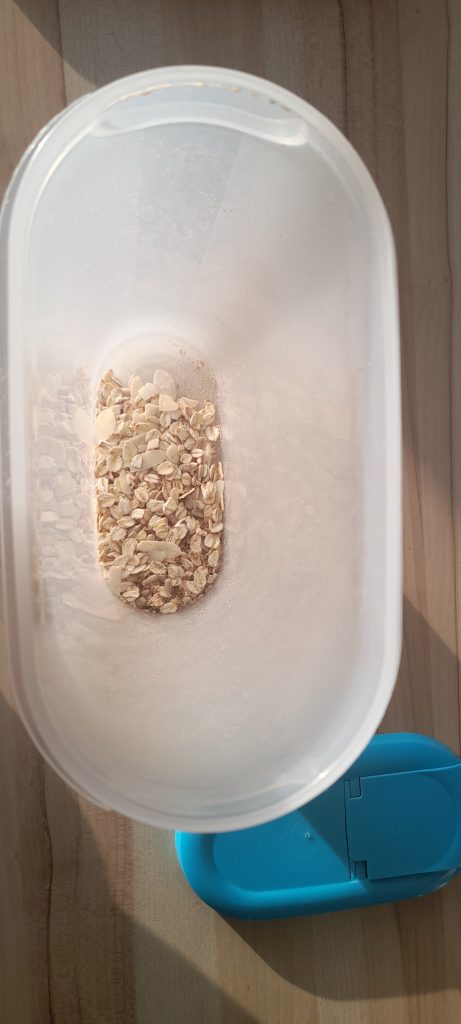
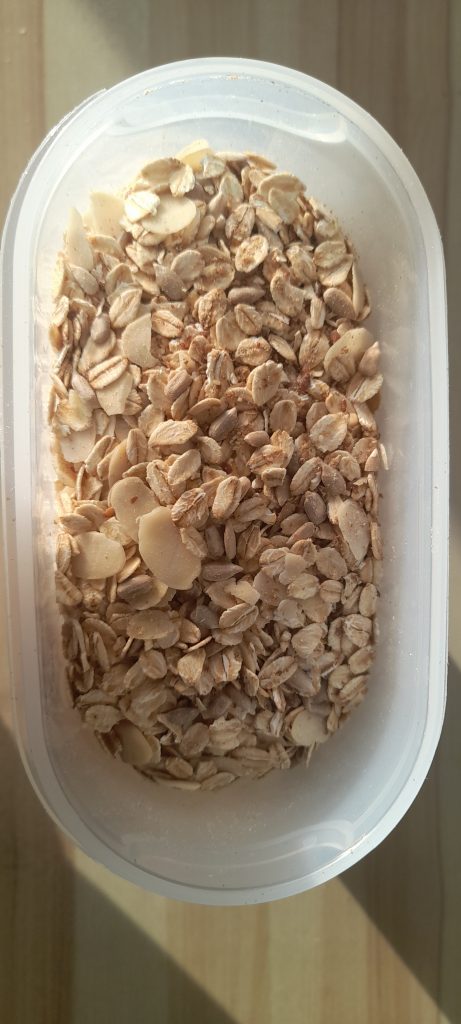
He enjoyed the tactile pleasure of it all. The dry whisper of oats. The mild dignity of almonds. The little granular seriousness of seeds. In former times his wife might have assembled this with the quiet efficiency of someone who did not need to turn every act into reflection. Now it was his task, and he discovered in it a satisfaction he had not expected. The container, once replenished, looked almost grateful. A full vessel has a way of restoring confidence in the system.
And then there was Uno.
Number Four Cat had been different all morning, and this was notable because Uno specialised in being different on his own terms. He had arrived three years earlier in the manner these things happen: a neighbour, three houses up, suddenly at the door, announcing the existence of a little black kitten under his deck and inquiring whether it might belong to Guinea Pig’s feline establishment. Guinea had said no. Yet something had shifted in him. He said he would come by that evening if nobody claimed the creature. By nine o’clock, Uno was in the kitchen, lapping milk with the composure of someone who had not been rescued at all but had merely completed a housing decision.
Since then, he had governed himself accordingly.
The other three cats had accepted him in the way established populations often accept arrivals: with a blend of resignation, diplomacy, and clearly defined limits. Uno, for his part, believed in only one legal framework, and it was Uno’s.
Guinea Pig went to the dining area and found his contemplative seat occupied by Friday, who was recovering from the exertions of breakfast with the limp authority of the well-fed. So Guinea sat in his usual place instead. Upstairs, Mother had occupied the bathroom according to the kind of exact timetable that makes military movements look improvisational: from 7.23 until somewhere around eight. The notebook lay there. The Post-its lay there. They felt unwelcome. He could not grip the day. Nothing wished to move.
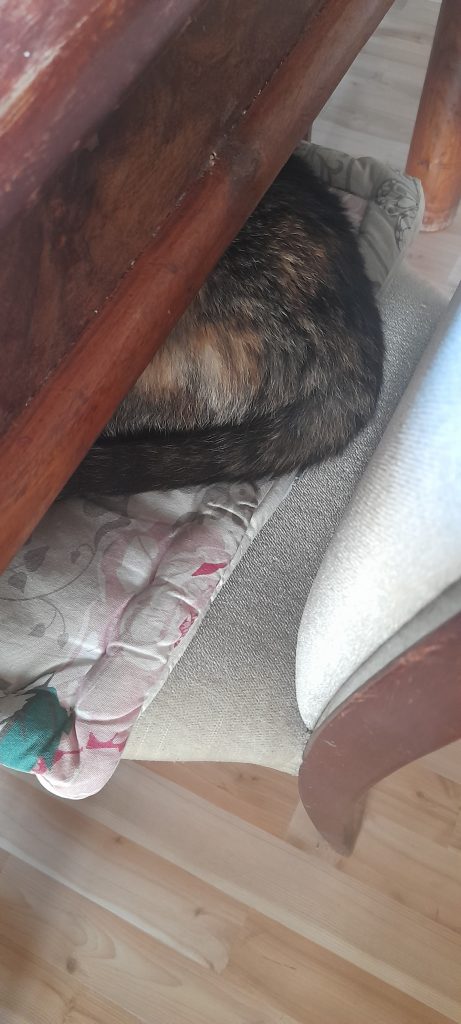
Except Uno.
Uno, having detected vacancy in the right-hand side of Guinea Pig’s dressing gown, burrowed into it and took up residence there as though the garment had been designed for that purpose. He was, by temperament, a burrower: under cushions, beneath blankets, inside throws, among folds and shadows and soft domestic caverns. This morning he even permitted his head to be stroked, his chin tickled, his person mildly adored.
This was not standard Uno behaviour.
There are creatures whose deviation from routine feels more informative than other people’s speeches.
Later Guinea Pig went upstairs, and Uno followed, stationing himself in the bathroom doorway and gazing up at the handle with the fixed interest of someone who had every intention of entering. Once Guinea opened the door, entry became inevitable. Uno leapt onto the bathmat, which Mother habitually used and which, for reasons no one fully understood, was wrapped in an old towel. Some domestic arrangements are not meant to be explained. They are merely inherited.
Guinea needed to go to the utility room. Two seconds later came the delayed but important realisation that Uno adored this room. The clutter. The shelves. The clustered display of cloths and sprays and tonics and all the small chemical instruments of domestic correction. It would, Guinea reflected, be one of the spaces he would not attempt to improve too drastically in the Doodle Horsing process. There are battles that announce their own futility before they begin. Wisdom consists partly in hearing them.
Uno settled by the window and surveyed the world. Guinea, acting in the spirit of accommodation he had so recently been forced to think about, leaned over and closed the tilting window before any adventure became too literal, then left him there among the clutter he loved.
The second coffee was made.
Then came Doodle Horse.
He was mildly curious about how she would receive what he considered the sharper edges of the agenda. He had expected perhaps a reaction to this, or at least a passing glance in its direction. But Doodle Horse, faithful to the laws of her own universe, began elsewhere.
“How’s the cleaning?”
It was her first question. This, apparently, was the central concern. Everything else could wait.
And immediately the entire morning took on a different shape.
She told him about the talk she had attended on Saturday morning. Food, God and You. It had stayed with her. At the centre of it was the notion that purpose, vocation, the sense of following one’s proper course in life, did not only alter one’s mind but one’s habits, one’s body, one’s appetite, perhaps even one’s relation to excess itself. Guinea Pig understood at once what she meant. He had seen it in people. He had lived part of it. The vocation question, at least, was no abstraction to him. He had been practising his vocation for more than thirty years, though not always with the orderly lighting and polished confidence one might wish for in retrospect.
They moved to the problem at hand. The consequences of the previous day, which had loomed so ominously in his chest that morning, were in fact soon resolved. A path appeared. The furniture, metaphorically speaking, was rearranged.
“How’s the cleaning?”
The phrase remained with him.
In another setting it would have been some corporate phrase padded into lifelessness. Not a cleaning, but a realignment. Not a misunderstanding, but an opportunity area. One can always rely on institutions to take the clear and make it murky. Experts would be assembled. Findings would be generated. A policy would emerge with the mechanical air of something designed to remove the last traces of human ease from the matter.
But this was different.
“How’s the cleaning?” was practical without being dead. Humane without being vague. It meant: how are we clearing the obstruction? How are we restoring flow? How are we making the room livable again?
That was what they did. They cleaned the mishap in the same way one might symbolically move a chair, open a curtain, or shift a table so that the room could breathe. If a gust of wind entered one life or the other, then the arrangement must be such that work did not collapse with it. A brief message. Sorry, can’t do this today. The other steps in. No drama. No martyrdom. No unnecessary theatricality.
Good basic housekeeping.
Basic.
So basic that, naturally, it had required an unpleasant experience to remind them of it.
This is one of the quieter humiliations of adulthood: the essential truths are often very simple, and one still manages to learn them the hard way.
That, Guinea thought, was why untidy spaces mattered. That was why discomfort mattered. Not because suffering itself was noble, which it generally is not, but because disorder reveals what order is for. It sends one back to the basics. To the furniture. To the flow. To the small arrangements by which larger peace becomes possible.
And beneath this there was another shift, subtler but perhaps more important. Hidden in the talk was a question neither of them could entirely ignore: what was the proper relation between work and fun?
Later he would think that fun was not quite right. Too airy. Too casual. Enjoyment was closer. Enjoyment allowed for seriousness. For craft. For effort without dreariness. The real question was whether work could be enjoyable without ceasing to be work.
He thought of the three-quarters baked potato. He made the executive decision to bin it. Certain elements would remain, but the thing itself did not belong in the present corporate landscape because, effectively, it did not exist. It had served its purpose by failing. Later still, after the meeting, Guinea reflected that he had reached a stage in life where he no longer needed to prove everything. That was another cleaning of sorts. A removal. A letting go. Doodle Horse had her own approach, her own relation to the work, and for her there was genuine fun in it. Money mattered, naturally. Money always mattered. But there was also a path there, and perhaps paths mattered more than declarations.
“How’s the cleaning?”
By the end of the meeting the effect was almost physical. The way a deep-cleaned room feels when one enters it after the windows have been opened and the surfaces wiped and the corners attended to. Not perfection. Not glamour. But calm. A sense that the space has agreed to hold you again.
He thought back to the title of the talk.
Food, God and You.
Replace God, perhaps, with Belief. Not because belief must be smaller, but because sometimes it must be named in a way one can carry. Then the thing became unexpectedly clear. If the environment around you — the food, the space, the conditions, the work — is something you can believe in, even imperfectly, then happiness becomes not a performance but a consequence. And happiness, when it is honest, is not decorative. It strengthens. It steadies. It creates energy enough to deal with life’s mess without being conquered by it. That energy calms other people. It alters the weather in a room.
Perhaps even the weather outside it.
Doodle Horse radiated something of that through the meeting, and it carried into the day. As they moved the metaphorical furniture around, Guinea understood more clearly what the morning had been trying to tell him. Working together should feel like an adventure. Not chaos. Not pressure in fancy dress. But adventure. Enjoyment. Purposeful effort with life in it. Success, when it came, would be the reward, but not the only reward.
And then, quite suddenly, he understood Uno.
Uno had not merely been odd that morning. He had been adventurous. He had wanted attention, involvement, participation. He had been showing, in the cat way, that life was not simply about inhabiting territory but about testing it, sharing it, finding pleasure in movement. His burrowing, his insistence, his unusual softness — all of it had been a small domestic prophecy. The sign had been there long before Guinea was ready to read it.
That evening there was a birthday celebration.
Guinea knew the format. Every six months the same social choreography unfolded around the birthdays of the couple in question, and with it came that reassuring combination of repetition and mild novelty on which so much communal life depends. The same people gathered. The same wider orbits briefly closed. People caught up. Local gossip was exchanged. Children milled about with that mysterious surplus of energy children always appear to possess in enclosed spaces. Parents sat, ate, talked. The older generation did the same, though on different subjects and generally with more confidence in their conclusions.
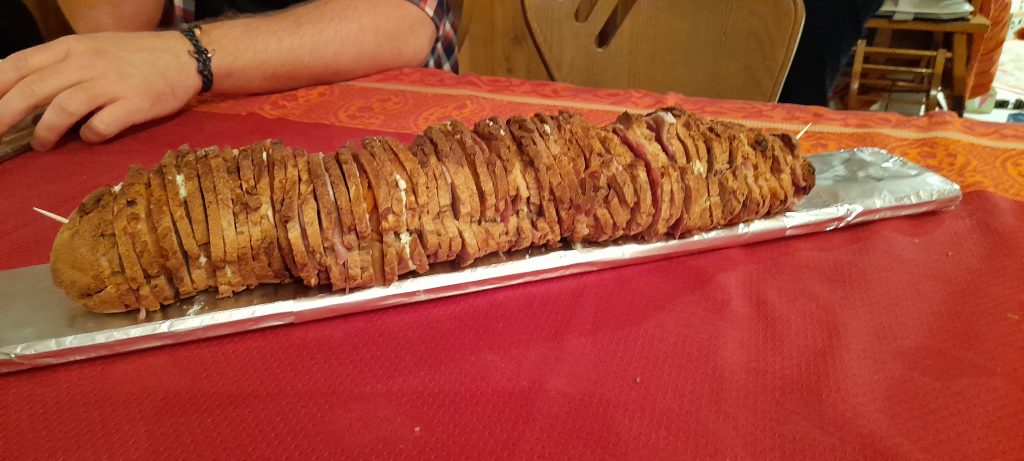
A small game of memory was underway at one part of the table. Sparkling wine flowed. Knacks appeared. Pain surprise made its inevitable and entirely welcome entrance. There were cakes too, which, for Guinea Pig, formed one of the more convincing moral arguments in favour of social attendance. They did not disappoint.
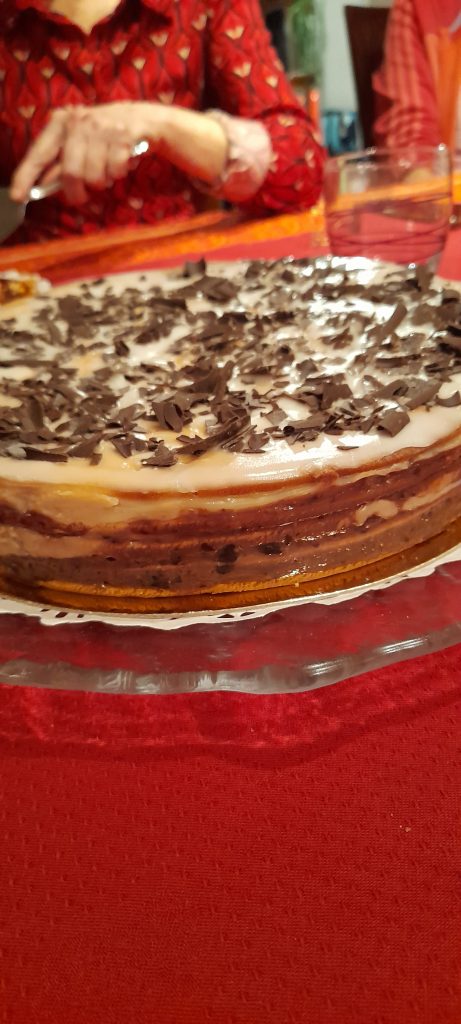
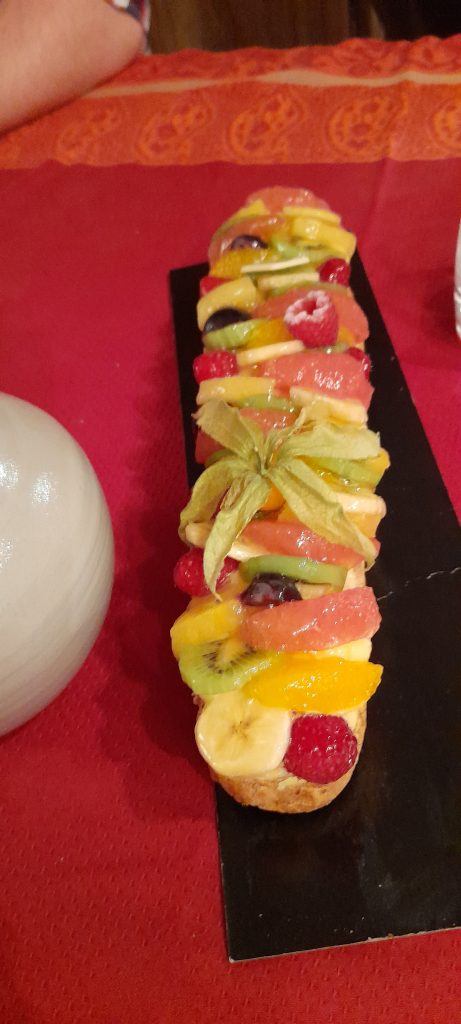
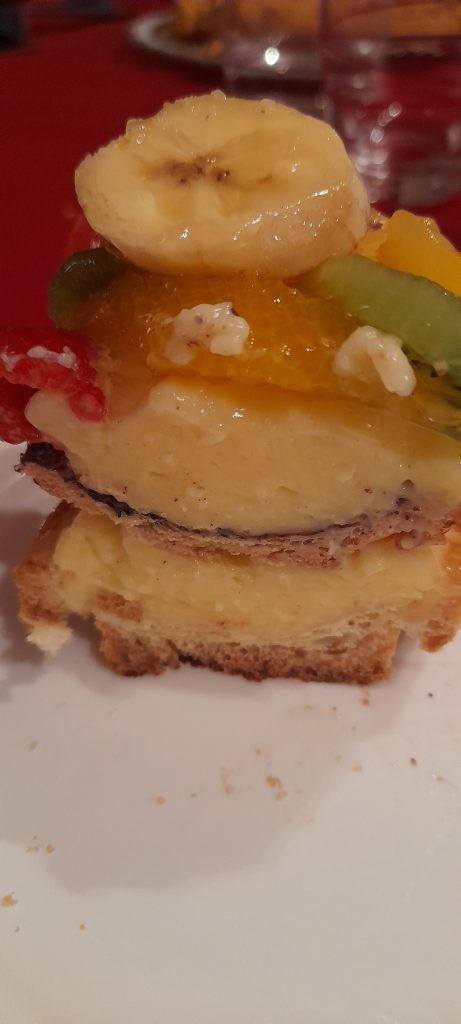
The party had that cosy quality some gatherings manage quite by accident: not grand enough to be performative, not small enough to be intense, but held together by habit, food, mild affection, and the understanding that one does not need to reinvent community every time one sits down at a table.
After coffee, it was time to drive the twenty kilometres home through the evening.
And as the day settled behind him, Guinea Pig understood that what had begun in restlessness and emptiness had become something else entirely. Not triumph. Not revelation in any heroic sense. Just a day that had found its order again. A day in which the furniture had been moved, the vulnerable fed, the signs interpreted, the basics remembered.
It had been, in the end, a good day.
Which is not a small thing.
It is, in fact, the whole point.
The Meals
Exotic Fruit Éclairs
These tropical éclairs are filled with a silky orange cream, topped with mango, and finished with a passion fruit glaze.
Prep time: 37 minutes
Resting time: 1 hour 10 minutes
Cooking time: 24 minutes
Serves: 6
Ingredients
For the orange cream
- 3 unwaxed oranges
- 1/2 mango
- 3 eggs
- 2 gelatine sheets (2 g each)
- 160 g caster sugar
- 80 g unsalted butter
For the passion fruit glaze
- 200 g ready-made pastry fondant
- 2 passion fruits
To assemble
- 12 mini éclairs, ready to fill
Method
1. Make the orange cream
Finely grate the zest of the oranges, then squeeze them to get 150 ml orange juice.
Peel the mango and cut it into small dice.
In a bowl, whisk the eggs lightly. Soak the gelatine in cold water until softened.
Put the orange juice, sugar, orange zest, butter and beaten eggs into a saucepan. Set over gentle heat and whisk continuously. Once the mixture becomes smooth and creamy, add the softened gelatine and continue whisking until the cream thickens.
Transfer to the fridge and chill for 1 hour.
2. Make the passion fruit glaze
Halve the passion fruits and scoop out the seeds.
Melt the pastry fondant gently over a bain-marie, without adding water. Stir in the passion fruit seeds, then keep the glaze warm over the bain-marie until ready to use.
3. Fill and finish the éclairs
Spoon the orange cream into a piping bag.
Slice the tops off the éclairs and pipe in the orange cream. Scatter a few small cubes of mango over the filling.
Using a spoon or pastry brush, coat each éclair with the passion fruit glaze.
Chill for a few minutes to allow the glaze to set, then arrange on a serving platter.
Serve with coffee or a cold refreshing drink.
Chef’s tip
If you do not have pastry fondant, you can use a simple icing made from icing sugar and a little water instead.