Issue 14 — 5 June 2026

The Pineapple

A collection shaped by the voices of the Brida Community

Created by Members of the Brida Community.
Compiled by Frank Peters, Founding Editor.
Shaped in Spirit by Janita Le Grange, Keeper of the Flame.

The Pineapple is published every Friday afternoon. If you would like the next issue to arrive in your inbox, you can subscribe free.

Subscribe

Contents

Partner Page
Advertisement
source
The Pineapple

In This Issue…

In This Issue…

Balance sounds like such a sensible word.

Clean. Mature. Responsible. The sort of word that arrives wearing polished shoes, carrying a notebook, and suggesting that everything would be easier if we simply organised our lives into neat little boxes.

This week, The Pineapple is not entirely convinced.

Pineapple 14 begins with a challenge to the whole idea. Maybe life was not meant to be balanced, at least not in the polished, packaged, scented-candle version of the word. Maybe real balance begins much lower to the ground: when we stop pretending, when we admit the room is not tidy, when we notice which balls are made of glass and which ones can safely bounce.

From there, the issue moves through the places where balance is actually tested.

Janita counts the many balls most of us try to keep in the air. Martin and Manfred take us into emotional weather, dangerous silence and the small miracle of a fifteen-minute walk. Sylvie reminds us that social balance is not about avoiding people, but about finding the right rhythm between coffee, company and a quiet corner. Ralf finds the line between work and life somewhere near Parmesan, shipyards and a yellow Mercedes. Alexander shows that being reliable is not the same as saying yes to everything. Fabrice prepares to walk 100 kilometres and reminds us that the hardest step is often the one before the beginning.

And then there is fiction.

This week, Niki from Azerbaijan brings us a short story about softness, wisdom, and the quiet strength it takes not to become hard in a hard world. It is a welcome reminder that The Pineapple is not only a place for real conversations, but also for imagined ones — the kind that sometimes tell the truth from a different direction.

Elsewhere, Lunch gives us passport dreams, popcorn economics, birthday wishes, frozen internet, sleeping cats, carrots, cheesecake and the uncomfortable possibility that taking care of ourselves may begin with something as ordinary as water, sleep, movement and a phone switched off for a while.

Fruitloop stages a bedtime rebellion, discovers the healing power of bohemian nails, and continues to prove that domestic chaos should probably be listed as an endurance sport.

And because no issue of The Pineapple should become too sensible, we also return to last week’s Peeling Potatoes, where the Mayor is sent into a time glitch and everyone pretends this is a normal educational method.

So yes, this issue is about balance.

But not the tidy version.

This is balance with mud on its shoes, a phone on silent, a casserole in the oven, a birthday song freezing halfway through, a quiet corner waiting somewhere, a story in the corner, and a potato peeler still looking suspiciously pleased with itself.

Welcome to Pineapple 14.

For people with something to say.

source

I am supposed to write about Balance.

Emotional Balance.
Financial Balance.
Relationship Balance.
Health and Lifestyle Balance.

All very sensible.

All very grown-up.

All very nice on a poster.

And I keep looking at this word.

Balance.

Really?

You open the bank app and close it again quickly because, frankly, not today.

You tell someone, “I’m fine,” while mentally calculating whether the car repair, the electricity bill, and the birthday present can all live in the same month.

You answer a message with “No worries” when there are, in fact, several worries.

You stand in the kitchen, look at the dishes, and decide that future you can have a character-building experience.

You say, “I’m just busy,” because it sounds better than, “I am slightly overwhelmed and pretending not to be.”

And then someone says:

“You need more balance.”

Thank you, Susan.

Very helpful.

When I lived in Australia, Malcolm Fraser was Prime Minister. He had a sentence. Everybody knew it.

Life wasn’t meant to be easy.

That was the line. Or at least, that was the line everybody remembered.

It sounded stern. Dry. No nonsense. Stop complaining. Get on with it.

Only later did I realise the original line came from George Bernard Shaw.

Life is not meant to be easy, my child; but take courage: it can be delightful.

And there, of course, is the problem.

We kept the difficult bit.

We lost the delightful bit.

Very human.

Life wasn’t meant to be easy.

Fine.

But was it meant to be balanced?

I am not so sure.

Because most of the time, when people say they want balance, I wonder if they mean something else.

They want the outside to look calmer than the inside feels.

They want the WhatsApp reply to sound lighter than the mood.

They want the photo to show the smiling bit, not the argument in the car five minutes earlier.

They want the sentence “we’re managing” to cover a whole mountain of things nobody has the energy to explain.

And we all do it.

I do it.

You do it.

We all know the little performance.

“I’m fine.”

“Just tired.”

“Bit hectic.”

“Can’t complain.”

“Making ends meet.”

Making ends meet.

What a phrase.

So modest. So practical. So adult.

And sometimes it is exactly true. People have rent to pay. Food to buy. Children to care for. Parents to worry about. I am not mocking that. I would not dare.

But sometimes “making ends meet” becomes a curtain.

A way of not looking too closely.

A way of saying: I am too busy surviving to ask what this is doing to me.

The funny thing is, people often know.

They see the wobble.

They hear the pause before the answer.

They notice the tired face, the forced joke, the strange silence.

We think we are hiding it brilliantly.

We are not.

The secret is often open.

We know.
They know.
We know they know.

And still we keep the little show going.

Recently, I spoke with Ralf. He described life at home when he was a child.

I will not tell his story. It is his.

But I came away quiet.

Not inspired. I dislike that word when it is used too quickly.

Quiet.

Some stories do not need a clever answer. They just sit on the table and change the room.

Then I spoke with my Russian client, who is improving his German. We were supposed to be talking about language. Grammar. Sentences. The normal stuff.

But, as often happens, language opened another door.

We started talking about positive thinking.

Belief.

Values.

Attitudes.

The difference between saying, “Everything will be fine,” and actually having something solid under your feet when it is not fine.

Positive thinking is easy to sell.

Belief is harder.

Positive thinking says: look on the bright side.

Belief says: stand there anyway.

That is a different matter.

And I thought about my own life.

The mistakes.

The strange decisions.

The things I should have seen earlier.

The things I was not ready to understand.

Annoying, yes.

Sometimes expensive.

Sometimes stupid.

But also interesting.

Because I was not prepared properly.

That sounds harsh.

So let us be fair.

My parents were not prepared properly either.

They were raised in their own cocoon. I was raised in mine. We all inherit things. Not just money, furniture, recipes, and old photographs.

We inherit silence.

We inherit fear.

We inherit ways of coping.

We inherit ways of not coping.

We inherit sentences.

Life wasn’t meant to be easy.

Yes.

But what do we do with that?

Do we pretend everything is fine?

Nonsense.

Do we make suffering sound noble?

Worse.

Do we put a scented candle next to the problem and call it balance?

Very 2026.

No.

Maybe balance begins much closer to the ground.

Maybe it begins when you stop pretending the room is tidy.

When you admit the month is tight.

When you say, “Actually, I am not fine today.”

When you stop smiling at something that hurt.

When you finally open the letter.

When you answer the message honestly.

When you say, “I do not know what I am doing, but I am trying.”

That sentence may be closer to balance than all the lifestyle advice in the world.

I do not know what I am doing, but I am trying.

There is dignity in that.

Not glamour.

Dignity.

Because life is not a spreadsheet.

It does not sit in neat columns.

Money affects relationships.

Relationships affect sleep.

Sleep affects work.

Work affects health.

Health affects mood.

Mood affects the way you answer one harmless little message, and suddenly everybody is standing in the emotional soup wondering who added the onions.

So yes, this issue is about Balance.

But not the shiny version.

Not the curated version.

Not the version where everyone is breathing deeply beside a houseplant.

This issue is about real balance.

The kind that begins when the performance stops.

The kind that says:

Life is difficult.
Life is uneven.
Life is inherited.
Life is full of unfinished business.
Life does not fit into our categories.

And still, we come to the table.

Still, we speak.

Still, we listen.

Still, we try to say something properly.

Not perfectly.

Properly.

There is a difference.

Maybe that is where balance begins.

Not when life becomes easy.

Not when everything finally fits.

But when the open secret is allowed into the room.

When someone says, “Yes. Me too.”

When the image cracks a little.

And instead of falling apart, something more honest appears.

Life was not meant to be easy.

Fine.

But take courage.

It can still be delightful.

Not always.

Not on command.

Not because someone has put a quote on Instagram.

But sometimes.

In a conversation.

In a small admission.

In a laugh at the wrong moment.

In the relief of not pretending.

In finding words and discovering they are enough.

That is not bullology.

That is life.

And for now, that is enough.

source

I dress in the dark these days – winter in South Africa.

Some mornings, my socks are upside down and inside out because I’m trying to beat the sun to the finish line. It’s a quiet, clumsy start to a day that I already know will feel like a race with untied shoes.

I used to think balance was a static thing—a scale that stayed perfectly level if you just put the right weights in the right places. But lately, my life feels less like a scale and more like a circus act. I am juggling 300 balls at once.

Work. Homework. The endless cycle of laundry. Deciding what’s for dinner. Deciding what to wear. Feeding the dogs. Feeding the spider. Filling the car. Making the appointments. Making sure everyone else has their medicine, their food, their lunch boxes.

I juggle the 300, I inevitably drop 200, and then I focus all my energy on the 100 left spiraling in the air, praying I don’t drop those too.

The messy reality of juggling is that we never choose to drop the “important” balls. We don’t drop the work meeting or the school run. The balls I drop are usually the ones labeled with my own name.

I forget to relax. I forget to moisturize. I forget to drink water.

Some days, everything feels like a chore. Even the things that are supposed to be “living”—driving to the supermarket, filling the car with fuel—feel like they are weighing down my pockets. It becomes too much. The big picture feels too large, a blurry landscape of responsibilities that I can’t quite navigate.

I’ve read somewhere that to keep your balance, you first have to know when you’ve lost it. For me, it’s that moment in the dark, staring at an inside-out sock, wondering when “me” became the lowest priority on the list.

There is a famous quote by Albert Einstein that says life is like riding a bicycle. To keep your balance, you must keep moving.

It’s a lovely thought, but what happens when the bicycle stops? It falls over. And if we stay seated, we fall with it. To stop the fall, we have to move. We have to pedal.

But pedaling doesn’t mean sprinting. Maybe balance isn’t about perfectly still hands; maybe it’s about the “wobble”. It’s identifying which balls are made of glass and which are made of plastic.

Work and meetings? Important. Family and food? Important. Sleep? Very important.

But then there are the chores. They are important, sure, but I’ve started asking myself: Do I really have to do this today?. Sometimes, the answer is no. Sometimes, leaving the dishes in the sink is the only way to keep the “Self” ball in the air.

Regaining that center starts with focusing on what you can influence today rather than worrying about the vast, scary unknown. When the chaos shouts, we have to whisper back.

I’ve found that the easiest way to find my feet again is to strip my ambitions down to the smallest possible tasks. Instead of saying, “I want more balance with my family,” I set a goal to have ten minutes of real time with one special person.

We don’t have to do it alone, and we don’t have to do it perfectly.

Balance is leaning into the discomfort and accepting what we can’t control. It’s practicing a bit of emotional flexibility when life throws an obstacle our way. We might curse and frown while we navigate it, but we keep moving toward that place where comfort lies.

At the end of the day, balance looks less like a circus act and more like a quiet room.

It’s the glass of wine while reading a favorite book. It’s the few minutes of focused time with family. We work hard so that we can play—or simply breathe—at the end of the day.

This month, we are looking at balance in all its forms: work, finances, emotions, and relationships. We are going to figure out how to keep the bicycle going without exhausting the rider.

Maybe we’ll realize that we need to take care of ourselves before we try to carry all 300 balls. Or maybe we’ll just get better at picking up the ones we drop.

Tomorrow, I might still dress in the dark. My socks might still be inside out. But as long as I’m pedaling, I’m still upright. I might buy McDonalds for dinner because I simply don’t have the mindset to cook.

I think it counts as self-care too…
And as we navigate the wobble of the week, maybe the simplest thing to remember is that we aren’t so different from the greenery sitting on our windowsills. You are a house plant, really—you need your water, you need your sun, and you need the space to grow at your own pace. The only difference is that your feelings are a little more complicated and your “balls” are a little harder to catch. So, keep pedaling that bicycle, be kind to yourself when you drop a ball, and trust that even on the days you dress in the dark, you’re still moving forward.

source
The Pineapple

“Staying soft in a hard world ” Is it wise advice?

There was once an old bookseller who owned a tiny shop at the end of a narrow street in a crowded city. His shop was easy to miss. It had no bright sign, no expensive decoration, and no modern shelves. Dust rested quietly on the old wooden tables, and the smell of paper and rain lived permanently in the air.

Every morning, before opening the shop, the old man placed a small kettle near the window and made tea for himself. Then he waited.

The city outside was hard and restless. People hurried past each other without looking up. Faces were tense. Conversations were short. Everyone seemed to be chasing something — money, success, recognition, survival. In that city, softness looked almost foolish.

But the old bookseller remained gentle.

One winter afternoon, a young man entered the shop. He looked exhausted, though he could not have been older than twenty-five. His coat was wet from rain, and his eyes carried the kind of tiredness sleep could not fix.

“Do you have books about success?” he asked.

The old man looked at him carefully before answering.

“What kind of success are you searching for?”

The young man gave a bitter laugh. “The kind that helps people survive this world.”

The bookseller nodded slowly and poured a second cup of tea without asking permission.

“Sit,” he said softly.

At first, the young man resisted. He was not used to kindness from strangers. In recent years, life had taught him to distrust warmth. Friends had disappeared when he lost money. Love had become disappointment. Even his workplace felt like a battlefield where everyone smiled while secretly competing against one another.

Still, something about the quiet shop made him sit down.

The rain tapped gently against the window while silence settled between them.

Finally, the young man spoke.

“I think soft people suffer more,” he said. “The world respects cold people. Hard people survive. Soft people break.”

The old bookseller smiled sadly, as if he had heard these words many times before.

“When I was young,” he began, “I believed the same thing. I thought wisdom meant becoming untouchable. So after life hurt me enough, I changed. I became colder. More distant. I trusted nobody. And do you know what happened?”

The young man shook his head.

“I survived,” the old man said quietly. “But I stopped feeling alive.”

The room fell silent again.

The bookseller looked toward the street outside where people rushed beneath dark umbrellas.

“The world will teach you many things,” he continued. “It will teach you suspicion, pride, anger, and emotional distance. But if you learn only those things, the world wins.”

The young man stared into his tea.

“Then what should a person do?”

The old man’s eyes softened.

“Stay soft,” he said. “But stay wise.”

The young man frowned slightly, confused.

“There is a difference between softness and weakness. Weakness allows people to destroy you. Softness simply means your heart remains human.”

He pointed toward one of the old books on the shelf.

“Paper is soft too. Yet words written on paper survive for centuries.”

The young man said nothing.

The old man continued: “You do not need to become cruel to protect yourself. Learn distance without hatred. Learn silence without bitterness. Learn kindness without expecting it back every time. The hardest thing in this world is not becoming cold. The hardest thing is staying gentle after life gives you every reason not to.”

Outside, the rain slowly began to stop.

Years later, the young man would remember that tiny bookstore more clearly than many important moments in his life. He would forget the names of bosses, the numbers in his bank account, and most of the arguments he once thought mattered.

But he would never forget the old man who taught him that surviving the world was not the greatest achievement.

Keeping your heart alive was.

source
The Pineapple

Drizzle, Sunshine, and the Dangerous Silence

Manfred’s Story

I arrived at the Swimming Club with a weather system already forming above my head.

The Mayor asked me, quite innocently, what my mood would be if it were a weather forecast. I considered the options. Calm sunshine seemed too optimistic. Sudden storms near the inbox sounded dramatic, but not entirely wrong. In the end, I chose drizzle with sunshine on the horizon.

That felt accurate. Not a catastrophe. Not yet. Just a gentle, persistent emotional rain, with the possibility that something better might appear later if nobody interfered too much.

Then he brought out the Emotional Thermometer.

This is the kind of thing The Mayor does. He takes a perfectly normal human difficulty, gives it a friendly name, and suddenly Manfred is expected to measure the invisible weather inside his own head. He asked where I usually am when I arrive at a meeting, from zero to ten, and what number I pretend to be.

I told him the truth. I normally start between zero and one, but the sky is the limit.

This is not pessimism. It is simply a realistic starting position. Some people enter a room ready to shine. I enter a room cautiously, as if the furniture may ask me a difficult question.

The Mayor then wanted to know the first physical sign that my emotional thermometer is rising. Tight shoulders, faster talking, silence, sighing, eyebrow activity, or something only trained observers can detect.

For me, it is silence.

But not peaceful silence. Dangerous silence. The silence that arrives when I am lost for words because everything is so stupid. People often misunderstand this. They think silence means calm. In my case, silence may mean that the internal committee has stopped taking minutes and is now discussing emergency procedures.

Martin, of course, would probably notice this. The Mayor might notice it too, although he would ask a follow-up question and make it worse by being interested.

At one point, The Mayor asked me to think of a recent moment when I reacted too quickly, and what the wiser, calmer version of myself would have done instead.

This was a difficult question, because I am convinced of my own practical and theoretical genius, which nobody else can see, but always wants to disprove.

That is the problem with other people. They look at my clear, elegant, perfectly reasonable inner logic and somehow decide to test it against reality. This creates tension. Not for me, obviously. For reality.

They look at my clear, elegant, perfectly reasonable inner logic and somehow decide to test it against reality.

The Mayor then asked what everyday situation most often turns me from a thoughtful adult into a man negotiating privately with his own irritation.

I asked him whether he had ever listened to “The Logical Song” by Supertramp.

This, I believe, was a complete answer.

There is something in that song that understands the tragedy of becoming reasonable. You begin as a person full of imagination, and then the world teaches you forms, systems, instructions, expectations, and other small crimes against the soul. Eventually, you are standing somewhere as an adult, trying to remain calm while a printer, a person, or a sentence behaves in a way that no intelligent civilisation should allow.

Still, I do have a rebound strategy.

The Mayor offered several possibilities, including competitive deep breathing, advanced coffee preparation, and silent window staring. I chose the 15-minute walk.

This is a strong event. It should possibly be included in the Olympics. The 15-minute walk is not just walking. It is the ancient discipline of removing oneself from the scene before becoming part of the scene. It is emotional balance with shoes.

Then The Mayor asked what Martin could say to me when I am emotionally at an eight that would actually help, and what sentence would make it worse.

This was easy.

Anything that smells of unwanted advice, positive or negative, would make it worse. I do not need advice when I am at an eight. I do not need wisdom in a cheerful tone. I do not need someone explaining the bright side. The bright side can wait outside until I have finished being correct.

What helps is simpler.

John Lennon already said it: let it be.

And perhaps this is the point. Emotional balance is not always about becoming calm immediately. Sometimes it is about not adding more fuel to a fire that is already conducting its own private research. Sometimes it is about letting the drizzle pass, trusting the sunshine on the horizon, and allowing the dangerous silence to remain only silence.

In the end, I think The Mayor understood this.

Martin probably understood it too.

Neither of them said too much.

Which was wise.

Remember Bikini Atoll?

Martin’s Story

The Mayor began the meeting with emotional weather, which was already suspicious.

He asked Manfred about drizzle and sunshine, which suited him rather well. Then he turned the whole thing toward me and asked what tiny thing can instantly change my inner weather from “pleasantly stable” to “why is this happening to me?”

This was not a difficult question.

Almost every tiny thing can do this to me. Unfortunately.

Horrible coffee. Idiot drivers. Any technology older than teletext, and by that I mean post-1980. Politics. Humanity in general. And, of course, English spelling.

English spelling deserves its own emotional support group. It is not a language system. It is a historical accident wearing a dictionary.

The Mayor seemed pleased with this answer, which is always dangerous, because it encourages him.

He then asked about my redline moment, when the emotional gauge goes dangerously high. Technology? Traffic? Unclear instructions? People being cheerful too early?

For me, it is unclear instruction manuals. Especially those worse than IKEA assembly instructions. IKEA, at least, has a certain Nordic sadness to it. You know what you are suffering for. But some manuals are written as if the author had only heard rumours about the product.

And then there are software error messages.

Idiotic software error messages, which I did not write.

This is important. If I wrote the error message, then at least the stupidity would be mine, and I could defend it professionally. But when some mysterious system produces a message that explains nothing, solves nothing, and somehow suggests that I am the problem, then emotional balance becomes a theoretical subject.

The Mayor later asked who would notice first when I am at a seven or eight: me, Manfred, The Mayor, or an innocent bystander.

I answered: Remember Bikini Atoll?

That was enough.

Some emotional events do not require detailed explanation. They are simply measured afterwards by geography, fallout, and the disappearance of nearby optimism.

The Mayor also asked what sentence I should never send when my emotional thermometer is above eight.

I said: Sorry, too late.

This was not a joke. Or perhaps it was a joke that had already happened. There are sentences that leave the building before the calmer version of Martin has had time to put on his shoes. By the time reason arrives, the message has been delivered, the damage has been admired, and someone is probably typing a reply beginning with “Just to clarify.”

Nothing good begins with “Just to clarify.”

Still, I am not without methods. When The Mayor asked what my most reliable rebound strategy is after an emotional hit — disappointment, stress, bad news, or a strange message — I gave the sensible answer.

Stop. Breathe deeply.

This sounds almost too healthy, which makes me suspicious of it. But it works. Not always beautifully. Not with music and soft lighting. But it creates a small gap between the event and the explosion, and sometimes that gap is enough to avoid becoming local news.

Then The Mayor asked whether humour helps me rebound, or whether it sometimes arrives too early and makes everything more suspicious.

I asked whether anyone offers a course in advanced cynicism or sarcasm for emotional explosions.

I would attend that course. Possibly teach it. Module One: How to Say Nothing While Saying Everything. Module Two: The Eyebrow as a Warning System. Module Three: Turning Disaster into a Comment Nobody Asked For.

Manfred would probably sit in the back, pretending not to enjoy it.

The Mayor would take notes and call it “a useful learning moment,” which would immediately require Module Four: Surviving Helpful People.

Finally, The Mayor asked what Manfred could say to me when I am redlining that would bring me back to a five, without sounding like a motivational poster.

The answer was simple.

Just change the subject.

This is underrated wisdom. When a man is emotionally overheating, he does not need a poster. He does not need a sentence involving growth, resilience, or journey. He needs a new topic. Preferably something unrelated, harmless, and far away from whatever caused the internal reactor to start humming.

Ask about bicycles. Ask about weather. Ask about whether coffee has declined as a civilisation. Anything.

Just do not give advice.

In the end, I think the Swimming Club discovered something useful. Emotional balance is not the absence of irritation. That would be unrealistic, and possibly bad for humour. Emotional balance is the art of noticing the explosion before it becomes historical.

Manfred has his 15-minute walk.

I have breathing, sarcasm, and the ability to change the subject before the island disappears.

The Mayor, as usual, stood in the middle of it all, asking questions as if this were safe.

It was not safe.

But it was useful.

Partner Page
Advertisement
source
The Pineapple

Coffee, Company, and the Need for a Quiet Corner

Some weekends leave me feeling as if I have been everywhere at once, even though I never went very far.

Last weekend was one of those. It was busy, but in a good way. A friend came to visit, a French woman I met during my treatment years ago. We became friends through something neither of us would have chosen, and somehow that friendship stayed. She is a year older than me, her husband is an English teacher, and whenever we meet, it feels easy. She spent the afternoon at our house by the pool. The weather was pleasant, and there is something comforting about sitting outside with someone who already knows parts of your story without needing explanations.

The day before that, my daughter had invited two friends over to swim, so the house was already full of voices and wet towels. Then, in the evening, we celebrated Mother’s Day a little early because she had to work on Sunday. My husband, my two daughters and I went to a restaurant together. These days, whenever both girls agree to come somewhere with us, I consider it a small victory. Going to a restaurant is usually accepted immediately. Suggest a cycling trip or a walk, and suddenly everyone has other plans.

On Sunday, my mother-in-law joined us for lunch. Afterwards, my husband and I took our bicycles and rode through the countryside. I always enjoy those moments. The rhythm of the pedals, the fresh air, the feeling that nobody is rushing anywhere. As our daughters have grown older, they spend more time living their own lives, so sometimes it is just the two of us. I have learned to appreciate that.

That weekend made me think about something Fruitloop and I often talk about: social balance. For me, social balance is not about counting how many people I see. It is more about feeling comfortable in my own place among people. Everyone should be able to be themselves without feeling pressured to become someone else just to fit in.

When I unexpectedly find myself with a free afternoon, I usually keep it for myself. Those moments are rare. I might sit quietly, read a little, watch something on Netflix, or simply enjoy not having obligations. If I want to see friends, I normally arrange it well in advance. Everyone is busy. Between work, family and daily life, finding a date that suits everyone often feels like planning a military operation.

There is one exception: my sister-in-law. She appears regularly for coffee, sometimes so often that my husband jokes about it. But I genuinely enjoy her company. Some people bring energy instead of taking it away.

I notice this especially at the tennis club. Several times a year we organize events to raise money. We cook, serve food and spend the day working together. Technically it is work, but it never feels heavy. There is laughter, conversation and a sense that everyone is pulling in the same direction. By the end of the day I am tired physically, but not emotionally. Quite the opposite. I feel energized.

What drains me is usually not the number of people but the length of time.

My husband enjoys parties until the very end. If we are invited somewhere, I already know there is a strong chance we will be among the last people standing. Sometimes I feel tired before the party even begins because I am thinking about how little sleep I will get afterwards. There have been afternoons when I quietly took a nap beforehand just to prepare myself.

That is probably why my ideal weekend is a mixture of both worlds. I do not want to spend the entire weekend alone, but I also do not want every hour filled with activities. The older I get, the more I notice how much I value a little space between social events. My husband likes to remind me that this is a sign of age. He may not be entirely wrong.

I do not want to spend the entire weekend alone, but I also do not want every hour filled with activities.

I know I have had too much people-time when visitors fill every day of a weekend. Friday, Saturday and Sunday with guests at the house would be too much for me. I would smile and be polite, but inside I would be counting the hours until I could sit quietly again.

At the moment, our house is preparing for another busy few days. My youngest daughter has finished classes and is studying for exams. She and a friend decided they would study together at our house. The friend will stay overnight, which sounds perfectly reasonable until you discover, the evening before, that she cannot eat gluten.

I had already planned everything. There is a pizza van that comes regularly near our house. My entire strategy for feeding teenagers was solved with one WhatsApp message. Then my daughter casually announced, “By the way, she’s allergic to gluten.”

So there I was, immediately redesigning the menu.

Motherhood never really stops surprising you.

Sometimes people ask whether I ever feel lonely in a crowd. The answer is yes, occasionally. It usually happens when I am surrounded by conversations that do not interest me. If I go out with my husband’s colleagues and they spend the entire evening talking about work, I find myself drifting away mentally. I am there, but not really there.

With family, it is different. There is always something happening. Someone needs help, someone is telling a story, children are running around. There is no time to feel lonely.

I have also learned that some people recharge me while others leave me exhausted. My husband is one of those people who can lift the mood of a room. He makes people laugh. He makes situations feel lighter.

On the other hand, there are people who spend an entire evening complaining. They talk about problems, gossip about others, criticize everything and everyone. By the end of the conversation, I feel as though someone quietly drained the battery inside me. It is exhausting.

Maybe that is why I have become more selective with friendships over the years.

Friendships change. Life changes. People move away, divorce, discover new interests, join new clubs, start new jobs. Some friendships remain. Others fade naturally. Looking back at the friends my husband and I had when we first met, many are no longer part of our lives. Some couples separated. Some simply grew in different directions. At the same time, new people arrived.

Trust has become more important than quantity. I would much rather have one meaningful conversation with someone I trust than spend an evening making small talk with dozens of people.

Trust takes time. It grows naturally. You cannot force it. You meet someone, spend time together, share little pieces of life, and one day you realise you feel comfortable telling them something personal.

That happened with my friend from treatment. We share memories and experiences that belong to a specific chapter of life. We can talk about hospitals, doctors and fears without needing long explanations. Yet we do not spend every conversation talking about illness. We also talk about our children, daily frustrations and ordinary things. Life moves on, but some connections remain.

Technology has changed the way we stay connected too.

WhatsApp is incredibly practical. Organising a dinner, a walk or a gathering is much easier than it used to be. I am not someone who enjoys making phone calls. A message gives people time to think before answering.

Sometimes the convenience becomes slightly ridiculous. My daughters send me messages from another room. I answer them. We are in the same house. We could simply walk to each other.

Yet I do it too.

Messages are useful, but they can never fully replace sitting across from someone, seeing their expression, hearing their laughter and understanding what they really mean.

Social media creates another strange illusion. It can make you feel as though you have hundreds of friends. On your birthday, messages arrive from people you have not spoken to in years. It looks impressive, but it is not the same thing as friendship.

Real friendship still happens slowly.

It happens over coffee. During walks. Through shared experiences. Through trust.

And perhaps that is what social balance means to me now.

Not filling every moment with people.

Not shutting myself away either.

Just finding the right mix of conversation, connection, laughter, quiet afternoons, family dinners, cycling tours, coffee with my sister-in-law and the occasional WhatsApp message asking for pizza that suddenly turns into a gluten-free challenge.

For me, that feels about right.

Partner Page
Advertisement
source
The Pineapple

Parmesan, Shipyards, and the Yellow Mercedes of Destiny

When I hear the word balance, I do not first see a scale or a yoga picture or somebody sitting very quiet with candles. No, no. For me, balance is much more practical. I see my kitchen.

When I have had a hard working day, when the head is full and the body says, “Okay, Ralf, enough now,” then I go into the kitchen. I want to cook. That is the difference between the hard working day and the relief afterwards. This is balance for me. Cooking is like holiday at the stove.

Or, better, holiday at the induction hob. I learned that one. Not on the stove, because if I am on the stove and the stove is on, then maybe I start cooking myself. But with induction, maybe I am safe. So, yes, I go into my kitchen, and this is my little holiday.

On Friday, after the week was closed, I did not make a big complicated thing. I made something simple, but it was fantastic. I had cauliflower, broccoli, carrots, and onions. Sweet onions. That is very important. I put everything together in a casserole dish. I added herbs, salt, and pepper. Then I took my olive oil can, the one you can pump, and sprayed the olive oil over the vegetables. Then I put Parmesan cheese on top and put the dish in the oven.

I did not make a big plan. I looked what would come outside.

After about twenty minutes at 170 degrees, I took it out, put more Parmesan on top, switched on the grill in the oven, and made it a little bit brown and crunchy. It came out fabulous. My wife was really enthusiastic, and this is always the best test. When she says it is good, then it is good.

On the market that Friday, between working time, I also bought chicken legs for Saturday. Good chicken legs, without antibiotics. On Saturday we had the vegetable pan again, this time with the chicken legs from the barbecue. That is also balance for me. Friday evening, close the week. Saturday, barbecue. Kitchen, fire, food, wife happy. The sun is shining.

When The Mayor asked me to go back to my childhood and think about work and play, I had to go first to my father. My dad worked for forty years at a shipyard in Bremen. He was a machine man, a kind of engineer, a practical man. The shipyard was old, more than 175 years, and it was a family business. When I was a young boy, at Nikolaus time, all the children of the workers came together in a big hall. We sat at tables by age — seven years old, eight, nine, ten, twelve — and when you were fourteen, then it was finished for you. You were too old for the party.

But before that, it was fantastic.

We got cake and cacao, and later in the afternoon we got little presents. A woman from the owner family managed the whole party, and for us children it was magic. We could play, eat, drink, laugh, and be together. That was not normal for an employer. It felt special. The Mayor said maybe this is why the shipyard lived so long, not only because of quality and the market, but because they looked after their people. I think this is true.

Later, after my father had worked there for forty years, the shipyard went down. There was a problem with a ship and the calculation was not good. Somebody did not quite get the mathematics right. In northern Germany, many shipyards died in that time. It was not only one. There were big places where thousands of people lost their jobs from one day to the next. In Bremen there had been several shipyards, and now there is only one left. I remember this as part of the world around us. Shipyards, metal, work, pride, and then suddenly the world changes.

My mother was at home for my sister and me when we were small. Later, when we went to school, she started cleaning in a bank. She stood up at four in the morning, sometimes maybe even before four, went to work from four to six, came home, made breakfast for us, made our bread for school, and then we went to school. My father started work at six, so when my mother came home, he was already gone.

When I think about it now, it is difficult to imagine. But for us, as children, it was normal. My mother was there for us. When we came home from school, we had fresh food, good food. In the afternoon, she went to the sofa and slept for one hour. Of course she did. She had already lived half a day before other people had their first coffee.

My parents were partners. They were always there for us. They put nearly all their money into the house. New windows, a new main door, things for the home. Holidays were not like today, where everyone flies everywhere all the time. When my parents had their twenty-fifth wedding anniversary, we went with the whole family to Sweden and celebrated there on holiday. Another time they went to the Mosel River and visited places there. But these were almost all the big holidays I remember for them.

Most of the time, holiday was at home. Barbecue in the garden. Sitting together. Friends coming over. Family there. Party in the garden. That was holiday for them. I could not always understand this when I was younger, but this was their generation. The house was important. The family was important. The garden was important. The work went into the house, and the house gave life back.

Most of the time, holiday was at home. Barbecue in the garden. Sitting together. Friends coming over. Family there. Party in the garden. That was holiday for them. I could not always understand this when I was younger, b

My father also had his own balance. He built things. He made things. He worked with steel. Grinding, welding, repairing. For everything in our street, he said, “No problem, I make that for you.” And then he made it.

He built a carport for me from old wood from a ship. He made himself a little hobby room. He helped family with practical things. My cousin still thinks every day about her father and my father because they built the railing on her staircase. Before, there was nothing to hold on to. Her father worked with stone and cement, a bricklayer, and my father worked with metal. Together they made the stair rail. Now, when she goes out of the house, she says, “Hello, Max. Hello, Papa.” Every day. That is how practical work becomes memory. You touch the railing, and two men are still there.

My father did not make big plans on paper. If he wanted something, he took the metal, maybe thirty centimetres this way, thirty centimetres that way, put it in a right angle, welded it, looked at it, and said, “Okay, next step.” Then next step, next step, and at the end it was ready. No plan. But in his head, he saw it. He was fantastic with this. A natural genius in practical things.

So when I think of my parents and balance, I do not think they had “playtime” like we say it today. But they had joy. They had the garden. They had barbecue. They had friends. They had family. My father had steel and welding. My mother had the house and us children. It was serious, yes, but there was laughter inside it. There was grounding.

As children, we had the best life. We had friends, family, relatives, garden, parties, and we felt safe. Very safe. The work was there, but it did not eat the house.

That is maybe the big difference. My father worked hard. Sometimes he worked at Easter Monday, or on the first or second day of Christmas, or during the night. If a ship came into the yard for repair and the time window was small, they had to work hard, very hard. They had to finish. But when my father came home, he was home. He was there for my sister, for my mother, and for me. He was a good father and a good husband.

The Mayor asked if it was easier then to leave work outside than it is today. I think for my parents and for me, it is almost the same principle. When my wife comes home from work and I come home from work, we drink a coffee. We do not talk immediately about the working time. Later in the evening, maybe we say, “It was a good day,” or “It was a bad day,” or “This was a problem.” But first, we are together. First, coffee. First, home.

For me, Friday evening at five o’clock is a border. I put my business mobile phone on the table in my office, and I do not take it in my hand again until Monday morning. That is my life.

I learned why this is important. There was a time in my working life when I had too much pressure. I could not switch off in the evening. I woke up at three in the morning thinking about my job. That was not okay. Then an opportunity came to change direction, and I said, “I can work everywhere, but not like this anymore.” It was the right step. Work must not follow you until three o’clock in the morning. That is not balance. That is a thief in the bedroom.

Modern work would make my parents shake their heads, I think. Emails, reports, Excel sheets, apps, online meetings, passwords, systems, all the things. My father would say, “You have a problem with your brain. Why do you make this? It is not productive.” And I understand him. He was practical. He put two things together, welded them, and something existed. Today you can spend one hour filling something into a system, and after that you have nothing in your hand. Only a green check mark, maybe. If the password works.

This is why I like real things. Food, tools, machines, cars, bicycles, coffee. Things you can touch. Things that answer.

At the weekend I had another little moment of play. I drove my Vespa to go shopping for food. Then my wife and I had to fetch our small cabrio car from the next town, where it had been standing in a garage because the battery was broken. We bought a new battery, put it in, started the car, and drove it home.

It was only eighteen degrees, but I have a rule. After fifteen degrees, you must open the roof. This car has a metal roof. The back opens, the roof folds itself inside, and then the windows go down. For me, this is fine. My wife said, “It is cold.” I said, “Yes.” Then she drove home in the other car, and I drove home in the cabrio. Funny. That is also balance. A little wind, a little cold, but the roof open because life is short.

The Mayor and I also talked about the silly games for driving. Before, there were rapeseed fields, yellow fields, and the word “rapsy.” But now the rapeseed is not really yellow anymore. It is going brown and waiting for harvest. So we started the yellow car game. I told my wife the story, and then a yellow Mercedes came. I said, “Yellow, yellow!” She said, “What is yellow yellow? It is no rapeseed.” I said, “No, it is the car.” So now the game has started. I have one point. She has zero.

But it is fair. We only play when we are together in the car. If I drive alone for work and count yellow cars, that is not fair. The Mayor was worried maybe one day he meets my wife and she complains. No, no. The rules are clear. Together in the car, then the game counts.

This is also advice for younger people, I think. Make rules that protect the joy. Make the game fair. Make the work finish.

Now many people work from home, and this is dangerous if they do not have borders. My advice is: work in a business room, in an office, if you can. When the day is ready, go outside and close the door. That is the best thing. I have my office. My business phone stays there. My private phone goes with me into life.

But many people have a small apartment. They work at the eating table, in the kitchen, in the living room. Then there is no real end to the working day. The computer is still there. You think, “Only five minutes.” Then five minutes becomes one hour. It is seamless. No border. That is not good.

I also do not like one phone with two SIM cards. I know myself. If a message comes on the business number, I would be too curious. “Oh, somebody sent me a message. I look quickly. Only two seconds.” And then it is not two seconds. So I keep two phones. The business phone belongs in the office. The private phone belongs in the living room, in the house, in the car, in normal life.

It also helps that my wife and I have a full private life. After work, there is cooking, coffee, bicycles, hedgehogs, the garden, the small things. If your private life is alive, work has less room to sneak in. You have something to close the door for.

And then, of course, there is food.

The Mayor told me he was making mushrooms with butter, onions, garlic, cream, Dijon mustard, a little white wine, and pasta. I asked him the most important question: “Where is the meat?” It was warm where he was, and he had made barbecue every evening, so maybe he wanted no meat. But I said chicken breast would be good. Cut the chicken breast in small pieces, put it in a pan with olive oil, make it a little crispy, and then put it inside the mushrooms. Or, even better if you have a good Italian shop, use original salsiccia with fennel. Take it out of the intestine and cook it into the sauce. That is a good thing.

This is how my mind works. Work and play, parents and children, shipyards and steel, phones and office doors, yellow cars and cabrio roofs, and at the end always something in the pan.

Balance is not a theory for me. It is Friday evening when the phone stays in the office. It is coffee with my wife before we talk about problems. It is my father coming home from the shipyard and still being a father. It is my mother sleeping one hour on the sofa after standing up before the sun. It is a railing on a staircase that still says hello to two men. It is the roof open at eighteen degrees. It is a casserole dish full of vegetables, olive oil, herbs, and Parmesan.

It is holiday at the stove.

Ralf’s Recipe: Crunchy Vegetable Casserole with Parmesan

Ingredients

Optional for the next day:

Cooking Instructions

For the next day, you can make the same vegetable pan again and serve it with chicken legs from the barbecue. Then it is also fabulous.

Partner Page
Advertisement
source
The Pineapple

I Don’t Always Say Yes — But I Try to Be There

The Mayor started with a difficult question.

He asked me if I am someone people ask for help because they know I normally say yes.

And immediately I thought, no, this is not the point.

I do not think people come to me because I am a yes-sayer. Nobody wants to be seen like that. Nobody likes the feeling that people think, “Ah, Alexander will always say yes. He will do it.” That is not a nice picture. So when the Mayor asked me this as the first question, I had to laugh a little, but I also felt it directly. It was uncomfortable.

He knew that, of course. That is why he asked it.

There is method in his madness.

But it also brought me very quickly to the real point. I do not think people ask me because I always say yes. I think people ask me when it is really important. They ask me when they have a problem and they know they can trust me. That is different. For me, this difference is very important.

A yes-sayer says yes because he cannot say no.

A reliable person says yes because he understands that this moment matters.

That is how I see it.

In my work, when a customer calls or writes, I try to answer very quickly. For me this is part of trust. It is one tool for building a relationship. The customer should know, “Okay, when I have a problem, Alex is fast, and Alex has good answers.” That does not mean I can always solve everything in five minutes. If a customer calls me from Vienna and says, “Can you be here in five minutes?” then of course I cannot say yes. I am not always standing around the corner.

But if they need help with products, information, problems, or a decision, then I try to help as fast as I can.

Sometimes this is difficult for me inside CRC. When I need support from Belgium, they often have more time than I would like. They do not always have the same speed. For me, that is hard to accept. If somebody wants something from me, I try to answer now, or I give a clear time frame. But when I need something, sometimes it feels like I have to pull it out with force. The Mayor understood this very well. He said he has the same problem. When people ask him, he goes out of his way. But when he needs something from someone else, it can feel like going to the dentist and pulling teeth.

I know this feeling.

The Mayor then asked me where my phone was during our conversation.

It was on my left side, on the table.

He asked if I would look at it during the meeting or put it away for one hour. I was honest. I said I would look at it. I have a bad feeling if I do not look at my phone for an hour. When a message pops up, I look for one second and then I am back. But if a customer calls during this meeting, then he has to wait.

That is also balance.

I am available, but not without limits.

This became the next point. The Mayor asked me if there is a difference between being reliable and being always available. At first I had to ask what reliable means. Then I thought about it, and I realized I understand this through stories.

I have a good relationship with a salesman from Autoglass. He sold two Smart Washers, and with both of them we had problems. The first one, I think, was damaged during delivery. The second one had another damage two or three weeks later. The salesman called me, told me the problem, and I helped him very fast.

A few weeks later I was at Autoglass with another salesman, and I saw this guy again. He said to his colleague that I am the best salesman in the world.

Of course, this is a nice compliment. The Mayor asked if I got a medal. I did not get a medal, but I remember the sentence.

For me, this was the connection between availability and reliability. It is not that I must answer every second. It is enough when I call back in one hour or two hours if I am in a meeting. But the customer must know that I will call back. The customer must feel, “Alex will do this.” That is the important part.

Still, The Mayor kept saying this thing about me always saying yes, and at some point I told him I had the feeling we were going in the wrong direction.

He asked me why.

I said, “Because you say so often I am a yes-sayer.”

He made a difference then. He said there is a difference between being a yes-sayer and saying yes.

Maybe that is true.

I can say no. In my job as a salesman, I think you have to learn to say no. If customers know that you do everything for them without a clear line, then you have a problem. Helping is good, but helping without limits is dangerous.

The Mayor told me a story about another Brida Community Member, Ritesh in Bangalore who helped a friend fill out an online government form. Then he helped his friend’s friends. Then half the neighborhood. Then half the city. One act of kindness became a big problem.

I understand that. If The Mayor asks me for help, that is one thing. If he then sends his whole network to me and says, “Call Alex, he will solve it,” then at some point I have to say no. If the next person says, “But I am a friend of the Mayor,” that makes it more difficult, but still, I have to protect the line.

If he then sends his whole network to me and says, “Call Alex, he will solve it,” then at some point I have to say no.

This is true in work as well. There must be a professional distance. If a relationship becomes too personal, it is harder to say no, harder to talk about prices, harder to keep things clean. I know this from sales.

At CRC, I do not have this problem so much. But in my previous job at Hommel, it happened. The strategy there was, when you had no customers, you went to new customers and tried to get their top ten or top twenty products. Later, when I had customers, they sent me lists and asked me for offers.

After a while I learned that some customers did not really want to buy from me. They only needed my offer to put pressure on their current competitor. They wanted to show the other supplier my price and force him down.

When I understood this, I started asking directly: “Do you need this offer because you want to buy from me, or do you need it to put pressure on your competitor?”

If they said they needed it for the competitor, then I gave a very, very good price. A low price. Then the competitor had to put down his trousers. If they really wanted to buy from me, then I gave a normal price.

This is also part of understanding people. You have to know what is really happening.

The best customers are the honest ones. I love this kind of customer. When they are transparent, I know where I stand. I know what the real problem is, and then I can think about what I have to do to solve it. In Germany, not everyone is so transparent. In Austria, it is often different. People there are very direct. They say, “This is your problem. Solve it or not.” Maybe it sounds hard, but I like it, because then I know the point.

The Mayor told a story about the Catholic church next to his home. The church facade and foundations were renovated for around 134,000 euros. It was a lot of money, but not crazy, because the people involved were transparent. They probably knew each other, respected each other, and said clearly what they could do. Then he heard about another church renovation that cost 800,000 euros, because there was an expert here, another expert there, an architect there, and suddenly it became a cash cow.

That kind of thing drains energy.

Honesty gives energy.

I see this with customers. For example, I know a customer who sells 3,500 cans of WD-40 to his customer. I asked him, “What do I have to do so that you change from WD-40 to my product?” He was very transparent. He said it was a great idea and he would do it, but there was one problem: the end user only likes WD-40. He had already tried to change it, but the problem was not him. The problem was the end user.

That was helpful for me. We know now what the real problem is. It is on the agenda for this year that we go together to the end customer and try again. I think our product is better, and we can give the same price. But WD-40 has done great marketing for thirty, forty, fifty years. That is difficult. We have almost no chance, but we try.

That is sales. Sometimes the product is not the only point. Sometimes the story in the customer’s head is stronger than the product.

The Mayor then asked me something important. I am good at preparing for people. I try to understand how they think, how they work, how they tick. But is it also important that people understand how I tick?

Yes. Absolutely.

This is also trust.

I think I am very transparent with my problems. If I need something from a customer, I say it. I say, “Hey, I need this. Can you help me with this problem?” They know quite fast how I tick. They know I have to grow my business. That is clear. If we have a good relationship, they help me grow my business, and I help them grow theirs.

In a first appointment, I often say that I am a very honest person. I tell them, “If you have bad news for me, that is okay. Your job is not to make me happy. Our job is to grow the business. But give me the honest story.”

Do not talk bullshit.

That is maybe the simplest way to say it.

This also helps when things are difficult, like price increases. When CRC says we have to increase prices, I have to do it. I tell the distributor directly, “Sorry, I cannot change anything. This is not my idea. This is not my private position. But I have to do this.”

Most people respect that, because they understand the difference between Alexander the person and Alexander the representative of CRC. My private opinion and my company role are not always the same thing. But I have a job, and I do it with all consequences.

If there is a problem after that, I tell my bosses. I pass the message on, and if the customer reacts badly, I pass the message back. But in the moment, I do what the company tells me to do. I have no problem with that.

That is another kind of balance: not taking everything personally.

Then we moved to home.

The Mayor remembered that I often arrange appointments for Julia because she does not like making phone calls. That is true. If she needs to call the dentist or arrange something, I often do it. For me, this is normal.

He asked if she does something for me that is difficult for me.

Yes. Cooking. Washing my clothes.

I can do these things. I had a very small time slot in my life when I had to do them alone. I can wash. I can cook a meal for myself. It is not the best meal, but I can stay alive.

The Mayor said maybe I should spend more time with Ralf, because Ralf can cook for Germany. I think that is a good idea.

At the end, Frank asked me how the conversation developed from my perspective, because these are not always comfortable subjects for me.

I said I thought it was very good. The first question was uncomfortable, yes. But maybe it is more uncomfortable for people who know they say yes every day and do not feel good about it. People who feel they should say no but cannot.

For me, it was okay. I can work with these questions. In most situations, I try to say no when I feel something is not the best idea, or when I am tired, or when the line is not clear.

I also joked in the conversation that I am tired every day and help people every day. That was not really true. I was fresh and fit. I had just turned thirty-one. The Mayor said I am almost forty now, which was very kind of him. I do not like getting older. Not because the number is terrible, but because I do not like changes.

Right now, the time is perfect. I have a good age. I know how life is running. I have money. I have family. I can play football. I can go with friends to a bar or even to a disco. It is a good time.

Maybe it will also be good when I am forty. But still, I do not like changes.

Maybe that is also why reliability is so important to me. Reliability gives shape to life. Trust gives shape to relationships. Clear lines give shape to work. Honesty gives shape to difficult conversations.

And maybe social balance is not only about being with people or being alone.

Maybe it is about knowing when I am helping because it is right, and when I am helping because people expect me to. It is about knowing when to answer the phone, and when to let it ring. It is about being fast, but not being controlled by every message. It is about being useful without becoming empty.

I do not want to be a yes-sayer.

But I do want people to know they can trust me.

There is a big difference between those two things.

And maybe I needed The Mayor’s uncomfortable first question to say that clearly.

Partner Page
Advertisement
source
The Pineapple

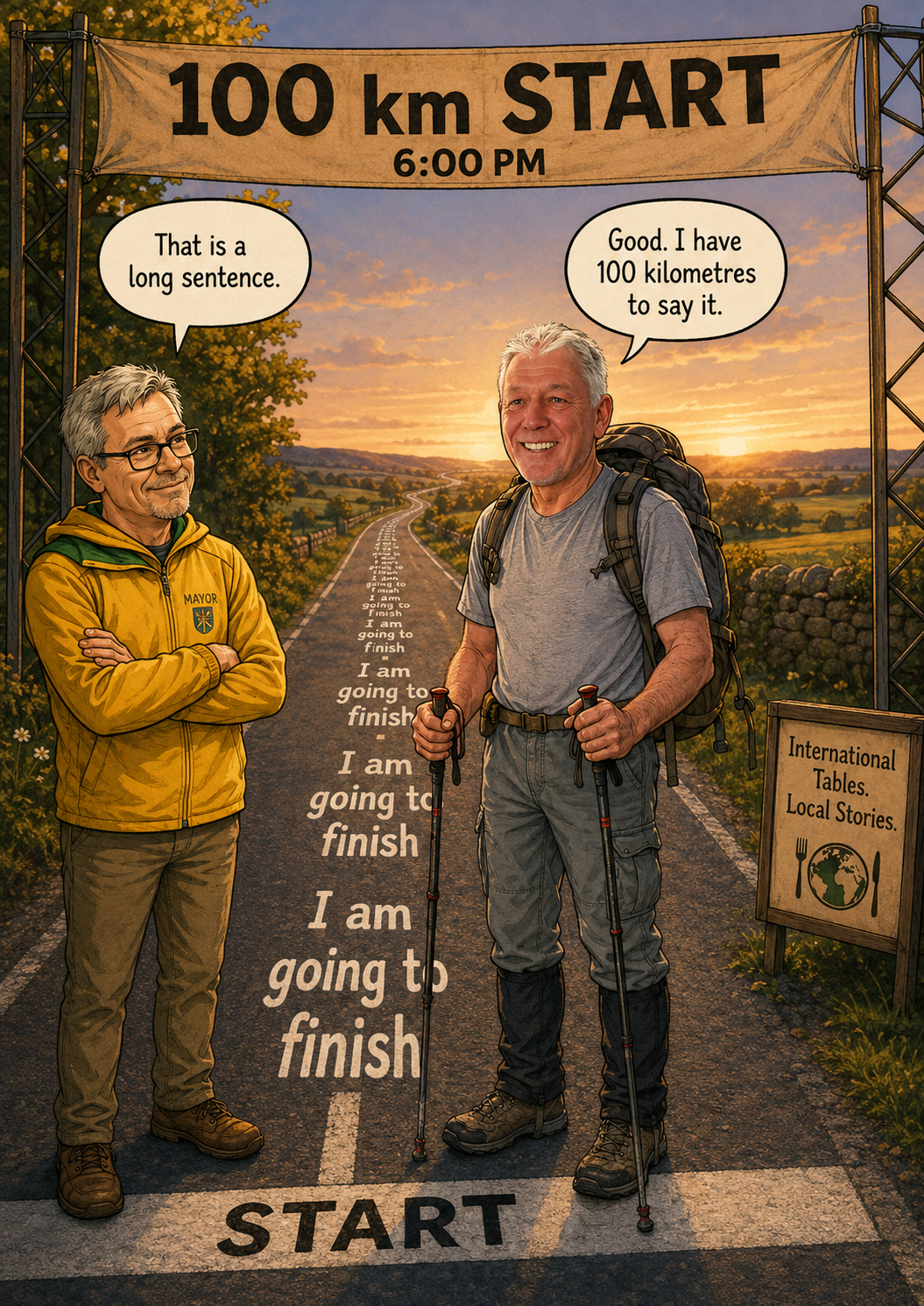
I Am Going To Finish

Fabrice’s Story

I met Janita for the first time on the screen. The Mayor was there, but he said he was not there. He said it was only his ghost. Of course, he was still there, because The Mayor is never completely not there. He also said I could use a joker card, like in Who Wants to Be a Millionaire, and call him if I was stuck. But he also said it would cost me a lot of money.

So Janita and I started.

She asked me who I am, where I come from, and why this 100 kilometre competition is important to me.

My name is Fabrice. I am French. I am 59 years old. My birthday is on March 30th. I come from Cleebourg, in Alsace. I lived my childhood here until I was 18 years old. Then, from 18 to 25, I was in the French army. After that I came back, and I worked. Today my principal work is as a lorry driver. I work in Karlsruhe, in Germany. I also have another work connected with EOD and mine search, sometimes in Germany or in other countries. I was also a reservist in the French army until I was 52 years old.

That is a little bit my life.

This 100 kilometre competition is important for me because it is a challenge. It is not against another person. It is for me. I make this for myself.

In the past, I did competitions in the army, but that was different. Forty years ago, the army paid me for this. Today, I pay to make the competition. That is funny. Before, it was my job. Now, it is my challenge.

Janita told me about cycling. She started when she was young. Her father bought bicycles for her and her sister. Later, after school, she started again with an old bicycle and then bought a better one. First she said she would not do competitions, but then she entered one. Then another. She started with 15 kilometres, then 40, 50, 90, 100, and even 160 kilometres. For her, 100 kilometres on the bicycle became easy because she trained so much. She liked being outside, meeting people, and riding with a cycling community. Sometimes they rode 100 kilometres on a weekend just for fun.

The Mayor did not tell her that I do not like cyclists. Maybe that was better.

Janita asked me what gives me the energy to say, “Yes, I can do this,” at 59 years old.

I think the answer is simple. I am stubborn. This can be good. Last year, I learned about this 100 kilometre trail from a Dutch ex-paratrooper who organises it. I said, “Okay, why not? I test if I can or not.”

The start is Friday evening at 6 p.m. I hope to finish in 22 or 23 hours. If I finish in 21 hours, that is better. If I finish before 24 hours, it is okay. But I want to finish. After the march, on Saturday evening, I am going to a birthday party. On Sunday, I think I will be in clinical death. On Monday I have two sessions with Simon, our physiotherapist. The Mayor said Simon will rebuild me.

I am not working Friday. Friday morning I prepare my clothes and my bag. At 2 p.m. we go to the start. I have to register. The organiser will check the safety bag, drinks, oils, and other things. At 5:30 p.m. the paratroopers jump at the departure point. At 6 p.m. we start.

I am not working Monday or Tuesday. Monday is physio. Tuesday, I said maybe I walk at home and cut the grass. Janita said I should rest. Maybe she is right. Maybe.

Then I asked Janita what was more important when she competed: strong legs, good training, or a strong mind. She said all three. Strong legs, because without legs you cannot move forward. Good training, because she trained almost every day. And a strong mind, because if you say, “I cannot do this,” then you cannot do it. You must say, “I can do this. I will do this. I will get there.”

She told me about one 160 kilometre cycling competition. In the first 25 kilometres, she fell. It had rained the night before. Everything was wet and muddy. She scraped her knee. Her shoes and socks were wet. She was negative for the next 10 kilometres. Then she reached a stop, washed her knee, ate something, drank something, and maybe had chocolate. After that, she felt better and continued. She still had about 125 kilometres to go.

That is mental strength.

Then the connection with South Africa was not perfect. The Mayor said Janita was south of the Sahara and we were north of the Sahara. She had winter in South Africa, but it was 16 degrees. Here in Alsace it was also about 16 degrees, and raining. The Mayor said I brought the rain with me.

Janita asked me what is the most difficult moment when I train for a long distance: the beginning, the middle, or the last kilometres.

For me, the most difficult moment is before the beginning. The moment before I start is hard. The first five, ten, fifteen minutes are hard. I must say to myself, “Go. Just go.” When I begin, it is okay. I find my rhythm. The middle is okay. The last kilometres are okay because I can say, “Only three kilometres. Only five kilometres. I am almost home.” But before I begin, that is the hard part. To get out the door is the hard part.

In the middle, it depends. My last big training was 54 kilometres. The first 28 kilometres were many flat roads. After 28 kilometres, the road started to go up. Not a mountain like the Alps, but it climbed. It went from about 300 metres over four kilometres. That was hard. Going down is nice, but the climb is hard.

Janita told me about a mountain bike race in the rain. It rained from the morning and continued through the whole race. Everything was wet: hair, shoes, socks, body. It was muddy, slippery, cold. Her body said stop, but her mind said continue. She checked the kilometres: 10 done, 30 to go. Then 20 done, 20 to go. She kept saying, “Just a few more.” At one point, the rain came from the front so hard that she could not open her eyes properly. But she kept going. After that she said, “Never again. If it rains, I am out.” But now it is a good memory. She has the medal and some very dirty photos.

When I am tired, cold, bored, or in pain during training, I say to myself, “After is better.” When I finish, it is okay. It is only a bad moment. After the bad moment, it is better. Maybe there is hot coffee. Maybe a cool beer. Beer is a good motivation. Hot coffee and cold beer are good. Cold coffee and hot beer are not good. The Mayor said in England they like warm beer. Janita did not agree, especially not after 100 kilometres in the sun on a bicycle.

Janita had a mantra when she cycled. She thought of the cartoon fish who says, “Just keep swimming.” So she told herself, “Just keep cycling.” I liked this. For me, maybe it is, “Just keep walking.” I will test it.

Then Janita asked me about the military and difficult situations. She asked how those experiences taught me discipline and mental strength.

For me, the strongest experience was in a minefield. I worked in a minefield during the Gulf War, on a beach in Kuwait. For mine cleaning, you need discipline and mental strength. You must be very calm. You must do things correctly. You cannot make a mistake. That was one of the strongest lessons. Also parachuting gave me discipline and mental strength. When I was 19, in South Lebanon, I also learned this.

I think the same discipline will help me in the 100 kilometre competition. It is not combat against another person. It is combat against myself. I want to win this combat. The discipline is the same, but the enemy is only me, my pain, my tired legs, and my doubts.

Janita told me what competition taught her about fear, pressure, and confidence. She promised herself she would never be last. That was pressure, but it was also motivation. At the start, there was pressure because people wanted to go fast. Sometimes people push too hard in the beginning, and later they fall back. She learned not to let pressure make her too fast at the start. Confidence came every time she finished and had a good time on the clock. Fear also helped her stay safe. On mountain bike routes, sometimes there was a steep downhill. Professional riders could take it, but there was also a safer route. Maybe it was longer, but it was safer. She chose safety. I agree. Safety first. It is better when you have no injury.

In French we have a saying: Alsatians will never submit to pressure. The Mayor joked, except when it comes to pulling a pint of beer.

Janita asked me about my biggest fear and my biggest hope for the 100 kilometre challenge on June 5th.

My biggest fear is that I do not finish. Maybe I have a problem before the end. Maybe my legs are finished. Maybe my feet have blisters. But blisters are not a problem. I must finish. Maybe I get lost in the German forest, but I have GPS, so I do not think this will happen. My biggest fear is not finishing.

My goal is to finish in 22 or 23 hours. If I finish in 21 hours, better. If I finish before 24 hours, okay. But I changed my words. It is not “I would like to finish.” It is not only “I will finish.” The Mayor corrected me and said: “I am going to finish.” So I say it now:

I am going to finish.

Because I am stubborn.

I did not train for one year. Normally, training starts one year before. I started two and a half months ago. I train many days. I go swimming. Four days a week, I walk: three hours, five hours, six hours, sometimes twelve hours. One or two days I swim. This week, because the trail is Friday, I make only light work. After this session I go swimming for one hour, then walk home. Also I relax a little.

I did not train for one year. Normally, training starts one year before. I started two and a half months ago. I train many days. I go swimming. Four days a week, I walk: three hours, five hours, six hours, sometimes twel

The longest walk in my training was 54 kilometres. It took 12 hours and 10 minutes with breaks. I started at 3:40 in the morning and finished at ten to four in the afternoon. It was up and down, harder than the trail in some ways, because my training route had more climbing. After that, of course, there was motivation. A beer.

Janita told me about her training rhythm. When she was cycling seriously, she trained almost every day. She woke up at 5 a.m. and cycled 30 or 35 kilometres before work. Then she showered, went to work at 9 a.m., worked until 6 p.m., ate dinner, and slept. On Saturdays she did longer rides, maybe 60 or 70 kilometres. On Sundays it depended how she felt. Her cycling friend was 75 years old and very fit and motivated. Sometimes they did 40 or 50 kilometres. Sometimes 70, 80, or even 100 kilometres. If there was a race on Saturday or Sunday, they rested the day before. She trained a lot, but she also listened to her body. If she was really tired, she stopped. If it rained, she stayed home.

The Mayor said, “You heard? She listened to her body.” I heard. I understand.

Janita asked me what I understand about energy now, at 59, that I did not understand when I was younger.

When I was younger, energy was one direction. Go. Push. Resist. Continue. Today, I understand energy differently. The goal can be the same, but the way is different. When I was young, I could attack directly. Today, I still have the same goal, but I need more safety, more rhythm, more intelligence. I am still stubborn, but a little bit less stupid stubborn, because my body has 40 more years.

The Mayor told me he is 65. He said life begins at 60. I like that. I hope the next 59 years are good. When I am 118, maybe we meet again and speak about ideas.

I asked Janita what advice she would give me for the last 20 kilometres, when the body is tired and only the mind can carry me forward.

She said that, in long rides, she kept her head down and kept moving her feet. She did not look too far ahead. She looked where she was, and she kept going. One foot, then the other.

This reminded me of the army. When we marched 40 kilometres with weight and a backpack, sometimes we disconnected the brain. Switch off the brain and let the body walk. The Mayor joked that he does that every day, but one of us needs to have a brain.

The last question was this: imagine you finish your 100 kilometres and cross the line. What do you want to feel in that moment? And what message would you give to other people your age?

I said: I do not imagine finish. I am going to finish.

When I cross the line, I do not know exactly what I will feel. Maybe my body will say, “Okay, you can make more.” Maybe I will search for another 100 kilometres. I do not know. I will see on Saturday evening. Maybe I will say yes. Maybe I will say no. Next week I can say.

But for people my age, my message is simple.

Do not talk too much.

Just do it.

Not say. Do.

Just do it.

I am Fabrice. I am 59. I come from Cleebourg. I was a soldier. I was a reservist. I work as a lorry driver. I have walked in the army, in minefields, in hard places, and now I walk against myself.

On Friday at 6 p.m., I start.

And I am going to finish.

Just Keep Going

Janita’s Story

This was my first meeting with Fabrice, although it did not feel like a normal first meeting. The Mayor was there, but he announced that he was not really there. He said he was a ghost. Then, of course, he continued to appear, disappear, joke, correct, interrupt, and help when needed. That seems to be his way of not being there.

He told Fabrice and me that we had questions for each other. Fabrice had questions for me, and I had questions for him. The Mayor also said he had not told me that Fabrice does not like cyclists. That was useful information to receive after the conversation had already begun.

I started by asking Fabrice who he is, where he comes from, and why this 100 kilometre competition is important to him.

He told me that he is French, 59 years old, born on March 30th, and from Cleebourg in Alsace. He grew up there until he was 18. Then he joined the French army and served from the age of 18 to 25. Later, he came back and worked. His main work today is as a lorry driver in Germany. He also does work connected with EOD and mine search, in Germany and other countries. He was also a reservist in the French army until he was 52.

The 100 kilometre competition is important to him because it is a personal challenge. He is not doing it to beat other people. He is doing it for himself. He said that in the past, he did competitions in the army, but then it was his job. Forty years ago, the army paid him to do hard things. Today, he pays to do them himself. That made us laugh, but it also said something important about him.

Fabrice is not only training for a walk. He is testing himself.

He then asked me about cycling. I told him that I started when I was young, when my father bought bicycles for my sister and me. We used to ride in the afternoons. Then, in high school, we were busy with other sports and with life on the farm, and the bicycles were forgotten for a while. After school, I started riding again with a friend, first on an old bicycle. I enjoyed being outside, I got fitter, and eventually I bought myself a better bicycle.

At first, I said I would not enter competitions. Then I thought, why not? I started with 15 kilometres, then 40, then 50, then 90, 100, and later 160 kilometres. Once I trained properly, 100 kilometres became manageable. It was not only about the distance. I loved being outside. I loved the rhythm. I loved the cycling community. We would go out on weekends and ride 100 kilometres for fun.

Fabrice listened to this, even though he apparently does not like cyclists.

When I asked him what gives him the energy to say yes to a 100 kilometre walk at 59, he said, “I am stubborn.” He corrected himself with help, but the meaning was clear. His stubbornness is part of his strength.

He learned about the challenge from a Dutch ex-paratrooper who organises it. He decided to test himself. The competition begins on Friday evening at 6 p.m. He hopes to finish in 22 or 23 hours. If he finishes in 21, that will be even better. If he finishes before 24 hours, he will accept that. His plan after the event is very Fabrice: finish the 100 kilometres, go to a birthday party on Saturday evening, be in “clinical death” on Sunday, and then go to Simon the physiotherapist on Monday. The Mayor said Simon would rebuild him.

Fabrice is not working on Friday. He will use the morning to prepare his clothes and bag. They will leave at 2 p.m. for the start. He will register, and the organisers will check the safety bag, drinks, oils, and equipment. At 5:30 p.m., paratroopers will jump at the departure point. At 6 p.m., the trail begins. He will also not work Monday or Tuesday. On Monday he has physio. On Tuesday he mentioned cutting the grass at home, but I told him he should rest.

I asked him what part of long-distance training is most difficult: the beginning, the middle, or the last kilometres.

His answer was interesting. The hardest part is not the middle and not the end. It is before the beginning. It is the moment before he starts. The first five, ten, or fifteen minutes are hard. Once he is moving, he finds his rhythm. The middle is okay. The last kilometres are okay because he can count down: three kilometres, five kilometres, almost home. But before the start, he must convince himself to go.

That is a very honest answer. Many people think the hardest part is when the body is already tired. For Fabrice, the real battle starts before the feet move.

He described one of his training walks: 54 kilometres in 12 hours and 10 minutes, including breaks. He started at 3:40 in the morning and finished at ten to four in the afternoon. The first part was quite flat. After 28 kilometres, the road began to climb. It was not a mountain, but the road went up and made the body work. He thinks some of his training was harder than the actual trail because he trained with more climbing.

I shared one of my own hard moments from cycling. In a 160 kilometre competition, I fell within the first 25 kilometres. It had rained the night before, so everything was wet and muddy. I scraped my knee, and my shoes and socks were wet, which I hated. For the next 10 kilometres, I was negative. Then I reached a stop, had something to drink and eat, washed my knee, and probably ate chocolate. After that, I felt better and continued.

I also told him about a mountain bike race in the rain. It rained from the beginning and kept raining through the whole race. There was mud, dirt, slippery ground, wet hair, wet socks, wet shoes, and cold. My body wanted to stop, but my mind said, “Keep going.” I kept checking the distance: 10 kilometres done, 30 to go; 20 done, 20 to go. At one point, the rain came from the front so hard that I could barely open my eyes. I finished, but afterwards I said, “Never again. If it rains, I am out.” Today, of course, it is a good memory. I have the medal and the dirty photos.

Fabrice’s way of dealing with pain is simple: “After is better.” When he is tired, cold, bored, or in pain, he tells himself that this is only a bad moment. After it is finished, it will be better. There may be hot coffee. There may be a cold beer. Beer, we agreed, can be a good motivation. We also agreed that hot coffee and cold beer are better than cold coffee and hot beer. The Mayor tried to defend warm English beer, but I could not support that, especially not after 100 kilometres in the sun.

My own cycling mantra came from the cartoon fish: “Just keep swimming.” On the bicycle, I changed it to, “Just keep cycling.” I told Fabrice that for him it could become, “Just keep walking.” He said he would test it.

A very serious moment came when I asked him about his military experience and how it taught him discipline and mental strength. He spoke about minefields during the Gulf War, on a beach in Kuwait. He said that mine clearing requires discipline and mental strength. You must be calm. You must be precise. You must not make mistakes. He also spoke about parachuting and about being 19 in South Lebanon. These experiences taught him how to keep control in difficult situations.

He sees the 100 kilometre challenge as a different kind of combat. It is not combat against another person. It is combat against himself. He wants to win that combat.

I understood him when he said that. Long-distance sport is not always about speed or medals. Sometimes it is a private battle between the body, the mind, and the promise you made to yourself.

When Fabrice asked me what competition taught me about fear, pressure, and confidence, I told him that I had promised myself never to finish last. That created pressure, but it also motivated me. At the start of a race, there is always pressure. People go fast. You feel you must keep up. But if you go too fast too early, you pay for it later. I learned not to let the pressure control me. I also learned that confidence grows every time you finish something difficult. Fear can also be useful. In mountain biking, when there was a very steep downhill, I sometimes chose the safer route. It might have been longer, but it kept me safe. I have seen too many cycling injuries. Safety first.

Fabrice agreed. It is better not to be injured.

Then I asked him about his biggest fear and biggest hope for the 100 kilometre challenge.

His biggest fear is not finishing. Not because he does not want it enough, but because something could happen: a problem with his legs, a physical issue, maybe blisters, maybe getting lost in the German forest. But he has GPS, and he does not think he will get lost. Blisters, he said, are not a problem. He must finish.

His goal is 22 to 23 hours. Better than that would make him happy. Under 24 hours is acceptable. But the real goal is to finish.

There was a small language correction, but it became important. He first said he would like to finish. Then he said he will finish. The Mayor corrected the grammar and gave him the strongest version: “I am going to finish.”

So Fabrice said it: “I am going to finish.”

And then he added the reason: because he is stubborn.

His training has been short but intense. Ideally, training for something like this would begin a year before. Fabrice started two and a half months ago. He walks several days a week: three hours, five hours, six hours, sometimes twelve hours. He also swims. In the final week, he is doing lighter work, including swimming for one hour and walking home afterwards, while also trying to relax before Friday.

I told him about my own training routine when I was cycling seriously. I woke up at 5 a.m. and cycled 30 to 35 kilometres before work. Then I showered, went to work, came home, ate, and slept. On Saturdays, if I did not work, we did longer rides. Sundays depended on how I felt. My cycling friend was 75 years old and extremely fit and motivated. Sometimes we did 40 or 50 kilometres, sometimes 70 or 80, sometimes 100. If there was a race, we rested the day before. I trained often, but I also listened to my body. If I was too tired, I rested. If it rained, I stayed home.

The Mayor made sure Fabrice heard that part: I listened to my body.

That may be one of the most important lessons for Fabrice now. At 59, energy is different from when he was young. He said that when he was younger, energy had one direction: go, push, resist, continue. Now the goal can still be the same, but the way must be different. There must be more safety, more rhythm, more intelligence. He is still stubborn, but not exactly in the same way, because his body has 40 more years of experience.

I told him that I am 65 and that life begins at 60. He liked that. He joked that when he is 118, perhaps we can meet again and speak about ideas.

Near the end, Fabrice asked me what advice I would give him for the last 20 kilometres, when the body is tired and only the mind can carry him forward.

I told him that on long rides, especially near the end, I kept my head down and kept moving my feet. I did not look too far ahead. I looked at where I was and focused on the next movement. One foot, then the other. Keep going. Keep going.

That reminded him of army marches with weight and a backpack. He said that sometimes you disconnect the brain and let the body walk. The Mayor joked that he does that every day, although someone still needs to have a brain.

My final question to Fabrice was about the finish line. I asked him what he wants to feel when he crosses it, and what message he would give to other people his age.

He corrected the question before answering it. He said he does not imagine finishing. He is going to finish.

When he crosses the line, he does not know exactly what he will feel. Maybe, if his body says it is still okay, he will look for another 100 kilometre challenge. Maybe not. He said he will know next week.

His message to people his age was direct:

Do not talk too much.

Just do it.

That is Fabrice. He comes from Cleebourg. He has been a soldier, a reservist, a lorry driver, and a man who knows how to work with discipline in dangerous places. Now he is preparing for 100 kilometres, not to impress other people, but to test himself.

He says he is stubborn.

I believe him.

And I believe he is going to finish.

Partner Page
Advertisement
source
The Pineapple

Passport Dreams, Popcorn Economics, and a Very Opinionated Cat

Some Thursday mornings begin with deep philosophical questions. Others begin with my hair.

This week’s Lunch started exactly where many of our lunches seem to start: with Mr. Mayor questioning whether my morning hairstyle truly deserved to be called a lion’s mane. For more than two years, he reminded me, I have been promising to show him the legendary wild version of my curly hair. According to him, what appeared on screen was nowhere near lion territory. Fruitloop kindly defended me and assured everyone that my hair looked perfectly fine. I was grateful for the support, although I suspect neither of them fully appreciates the challenges of waking up with naturally curly hair.

From there, our conversation wandered—as all good Lunch conversations do—through school schedules, airport runs, exam season, and Mr. Mayor’s surprisingly firm belief that children should simply remain locked in school until all administrative problems disappear. Fruitloop, speaking as the only responsible parent in the room, pointed out several flaws in this plan. The Mayor remained unconvinced.

The first real question of the day was about travel. If I could spend an entire weekend anywhere in the world with my family, where would I go?

For me, the answer came immediately: Gramado, in southern Brazil.

I described it the way many Brazilians do—as a place that feels almost European. Beautiful streets, kind people, wonderful food, and hot chocolate that seems designed specifically for happiness. I have been there before, many years ago, and I still remember how magical it felt. Some places stay with you long after you leave them.

When the question expanded beyond Brazil, my imagination immediately jumped to France and South Africa. As a former travel agent, I spent years helping other people discover beautiful destinations, and many of those places remain on my own wish list. Sometimes travel begins long before the journey itself. It starts with stories.

Mr. Mayor surprised us with a completely different answer.

Given unlimited possibilities, unlimited money, and unlimited freedom, he would stay home.

Not because he dislikes travel. Quite the opposite. After living in France for twenty years and visiting countries all over the world, he has reached the stage where staying put feels luxurious. While many people dream of distant destinations, he finds himself dreaming about enjoying summer weather, working on future projects, preparing the next Pineapple issue, and appreciating the place that has become home.

Listening to him, I realised that travel changes meaning over time. When you have seen very little, you dream about seeing everything. When you have seen a great deal, sometimes you dream about nowhere at all.

Listening to him, I realised that travel changes meaning over time. When you have seen very little, you dream about seeing everything. When you have seen a great deal, sometimes you dream about nowhere at all.

That did not stop him from sharing future dreams. He spoke warmly about wanting to visit South Africa one day, to see the country through Fruitloop’s eyes. He spoke about Brazil, India, and the possibility that one day our strange little international project might become successful enough to bring people together across continents.

Big dreams, perhaps.

But Lunch has always had room for big dreams.

Fruitloop’s dream destination turned out to be Zanzibar. Not for a weekend, she clarified, but for at least a week and a half. She also spoke about visiting Lesotho during winter to experience snow and skiing. The discussion quickly became less about travel and more about thermal clothing. According to Fruitloop, proper preparation requires thermal socks, thermal pants, thermal everything, and probably an entirely new budget.

Mr. Mayor argued that thermal underwear hidden underneath normal clothing would solve the problem.

The discussion deteriorated rapidly after that.

As many excellent conversations do.

Our next topic explored a world without movie theatres.

I admitted that I would miss them. Although I do not go as often as I once did, I still enjoy the experience. Watching a film at home is convenient, but it is not quite the same. Besides, I have a friend who replaced his television with a giant projector covering an entire wall, which is admittedly a strong argument for staying home.

The real challenge, however, is cost.

Movie tickets are expensive. Popcorn is expensive. Parking is expensive. Theatre performances are expensive.

Everything is expensive.

Fortunately, being a teacher gives me discounted tickets, which occasionally makes these outings possible. Otherwise, a simple evening at the cinema can feel like a serious financial investment.

Mr. Mayor responded with one of the strangest cinema stories I have ever heard.

Years ago, he attended a live opera broadcast from New York that was shown inside a German movie theatre. Everyone watched, everyone enjoyed it, and then everyone quietly stood up and went home. No applause. No standing ovation. No flowers. Just silence.

He said it felt deeply unnatural.

Even stranger was his story about watching Rocky during a flight to Tokyo in the 1970s. Due to a technical failure, the English soundtrack disappeared, leaving only the Japanese version.

According to him, Sylvester Stallone somehow became a more convincing boxer when speaking Japanese.

I am still not entirely sure whether he was serious.

Fruitloop contributed her own cinema memories, recalling drive-in movie theatres, packed picnic baskets, family outings, and childhood memories of watching films from the comfort of a car. Listening to her, I realised that sometimes we do not miss the movie itself. We miss the people we watched it with.

Then came perhaps the most wonderfully ridiculous question of the morning.

What if all animals and insects suddenly learned to speak?

What would they complain about?

My answer was simple.

The animals would complain exactly like humans.

They would complain about being lazy. They would complain about being hungry. They would complain about chores.

Apparently, even in imaginary worlds, nobody enjoys cleaning the house.

Mr. Mayor immediately thought of his three cats.

In particular, one cat named Friday, who already communicates quite effectively without words. According to him, Friday’s first spoken sentence would almost certainly be, “You never feed me.”

This accusation would apparently be delivered immediately after receiving breakfast.

The resulting conversation expanded to include mice, hunting expeditions, philosophical discussions about food chains, and the complicated relationship between predators and prey.

Meanwhile, Fruitloop’s pet tarantula would apparently say only one thing:

“Leave me alone. I am warm. I am fed. I want to sleep.”

Which, after some reflection, sounded remarkably human.

As our time together came to an end, the conversation drifted back toward ordinary life. School pickups. Future meetings. Weekly routines. The familiar rhythm of people living in different countries but sharing the same table for a little while.

And that may have been the real theme of the morning.

We spent an hour talking about places we want to visit, movies we might never watch again, and animals that do not actually speak.

Yet somewhere between France, Zanzibar, Rocky in Japanese, and a tarantula demanding peace and quiet, we were really talking about something much simpler.

Home.

Sometimes home is a city.

Sometimes it is a country.

Sometimes it is a movie theatre.

And sometimes it is a Thursday morning conversation with people who live thousands of kilometres away but somehow still feel just around the corner.

Partner Page
Advertisement
source
The Pineapple

Birthday Wishes, Carrots, and the Search for Balance

“Happy birthday to you…”

The song had barely begun when Nathalie froze.

Not emotionally. Technologically.

One moment she was smiling as the entire group launched into an enthusiastic birthday serenade, and the next she was locked in place by a stubborn internet connection. It was perhaps the most fitting way to begin a Lunch meeting: with warmth, laughter, and technology quietly plotting against everyone involved.

Before the singing, The Mayor had already made Nathalie’s day special. He had created a beautiful birthday image inspired by flowing water and a tea ceremony Nathalie had once mentioned. The gift carried a thoughtful personal touch, the kind that makes people feel seen. The Mayor had even digitally dressed Nathalie and Fruitloop in a traditional Korean hanbok. Nathalie admitted it was the first time she had ever seen herself wearing one. Frank quickly reminded everyone that there was photographic evidence proving he had worn one too.

From there, the conversation drifted naturally into the month’s new theme: Balance.

Fruitloop asked what health and lifestyle balance meant to everyone. Nathalie spoke first. For her, balance was about finding harmony between professional life and personal life, making sure neither side overwhelmed the other. It sounded simple enough in theory.

I immediately agreed with her. Or at least I tried to explain why I agreed. Like many of my explanations, it began with one idea, took a scenic route through three others, and eventually arrived at the destination.

I talked about how easy it is to pour all of your energy into a single area of life. Work, family, responsibilities—sometimes one thing becomes so large that everything else disappears behind it. I admitted that there are weeks when I focus entirely on my job and suddenly realise I haven’t paid enough attention to my family, my friends, or even myself.

The Mayor listened patiently before pointing out a rather uncomfortable truth.

Even while discussing work-life balance, I was still talking almost entirely about work.

The table erupted in laughter.

To be fair, I hadn’t had breakfast yet.

That explanation didn’t help my case nearly as much as I hoped it would.

While I defended myself, Uno the cat quietly joined the meeting. The Mayor introduced him as a Zoom-crasher with very little to contribute. Given the amount of sleeping cats do, I suspect Uno may actually have been the leading expert on the day’s topic.

When Fruitloop asked about healthy habits that help us through difficult days, our answers revealed just how differently people approach wellness.

For me, it was Pilates, stretching, breathing exercises, and quiet moments with family. There is something powerful about slowing down enough to listen to your own breathing. It forces the noise in your mind to become a little quieter.

For me, it was Pilates, stretching, breathing exercises, and quiet moments with family. There is something powerful about slowing down enough to listen to your own breathing. It forces the noise in your mind to become a

Nathalie reflected on her working years and how difficult it had been to leave work behind. Even holidays had been filled with thoughts of unfinished tasks waiting for her return. These days, she said, she tries to create distance between herself and the problems that threaten to overwhelm her. Not avoidance. Perspective.

Fruitloop’s answer was wonderfully practical.

Sleep.

Drink water.

Go outside.

Simple.

The Mayor looked positively relieved.

For several minutes he had listened to discussions involving mindset, breathing techniques, stretching routines, emotional balance, and philosophical reflections. Finally he leaned forward and announced that everyone was making life far too complicated.

His healthy habit?

Going to bed.

That was it.

At the end of the day, he says “Hallelujah,” falls asleep within five minutes, and considers the matter solved.

Honestly, it was difficult to argue with his logic.

The discussion then took a surprising turn when Fruitloop accidentally revealed her dream of becoming a dog and Frank confessed that he would happily become one of his cats.

The arrangement was quickly negotiated.

Nathalie and I would take over running Brida while Fruitloop barked, Frank meowed, and both of them spent their days sleeping in sunny spots around the house.

Our only responsibilities would be supplying food, water, and suitable sleeping conditions.

It was a remarkably detailed succession plan.

Eventually, the conversation returned to caring for ourselves while caring for others.

Nathalie observed that when our basic needs are met—sleep, movement, hydration, connection—it becomes much easier to give to others. Her answer carried the calm confidence of someone who has spent years learning what truly matters.

I spoke about the importance of being alone sometimes. Not lonely. Just alone. Moments of prayer, breathing, gratitude, and reflection help me reconnect with myself. As I get older, I become increasingly aware that taking care of my body today is an investment in the person I will become twenty years from now.

The Mayor responded with a story from a conversation he had the day before. The conclusion was surprisingly simple: when we care for other people, that care often finds its way back to us.

The idea lingered around the table for a moment.

Perhaps balance is not always about dividing attention equally. Perhaps it is about recognising that our connections with other people nourish us too.

Of course, Fruitloop’s self-care strategy remained far more straightforward.

Chocolate.

Cheesecake.

Chai tea.

The Three C’s.

No further explanation required.

Later, when discussing ideal weekends, our personalities emerged once again.

I dreamed about sleeping, going outside, and baking cakes.

Nathalie wanted something much more radical.

She wanted to remove the mobile phone from her life.

Not forever. Just long enough to remember what uninterrupted conversations feel like. She spoke about real human connection, manual activities, family, friends, and being fully present without a screen demanding attention every few minutes.

The Mayor immediately asked what would happen if she simply switched the phone off for the weekend.

The fact that nobody had a good answer probably says everything about modern life.

As the meeting moved toward its conclusion, Fruitloop unveiled the traditional final challenge.

If vegetables could give life advice, which vegetable would be the wisest?

For reasons nobody fully understands, three of us independently chose carrots.

The Mayor argued that carrots improve eyesight, helping us see the world around us rather than staring endlessly at our phones.

I defended carrots because they are healthy and delicious when mixed with oranges and beetroot.

Nathalie explained that in France there is a saying suggesting carrots make people kinder. In her ideal world, everyone would eat more carrots and become more lovable.

Fruitloop refused to follow the carrot movement.

She chose a pea.

A tiny vegetable constantly escaping forks, rolling under refrigerators, surviving impossible situations, and accumulating wisdom through adversity.

It was one of the most Fruitloop answers imaginable.

Eventually, Nathalie’s connection began protesting once again, goodbyes were exchanged, and the meeting came to an end.

As the screens blinked dark one by one, I found myself thinking about balance.

We spend so much time searching for it as though it is some perfect destination waiting for us at the end of a long journey.

But perhaps balance is something smaller.

A birthday song sung across continents.

A thoughtful gift inspired by an old conversation.

A discussion about health that somehow turns into a debate about becoming household pets.

A room full of people helping each other find the right words.

And somewhere between the carrots, the scarves, the cheesecake, and the sleeping cat, remembering that taking care of ourselves might not be as complicated as we think.

Sometimes it starts with a glass of water.

Sometimes with a good night’s sleep.

And sometimes with friends who are willing to sing Happy Birthday—even if the internet freezes halfway through.

Partner Page
Advertisement
source
The Pineapple

The Great Bedtime Rebellion and the Bohemian Nail Pivot

Welcome to another episode of Fruitloop World, where the “catastrophes” are plentiful, the logic is questionable, and I am currently surviving on caffeine and sheer willpower. This week was officially Nail Week. Usually, this is the holy grail of self-care—the one thing I look forward to—but this time? It felt more like a scheduled chore between bouts of extreme exhaustion.

The Midnight Marauder

My son has apparently decided that his new secret mission in life is to completely dismantle the concept of “bedtime.” Usually, we are an 8:00 PM household. We have a rhythm! We have school bells to catch at 7:25 AM! But this week, he staged a coup.

The weekend was a blur of ungodly hours—12:00 AM, 1:00 AM—and Sunday was a full-scale battle that didn’t end until 10:20 PM. This, of course, ruins my routine, my peace, and my ability to function as a human being. By Monday, I was dragging myself through the day like a zombie. And did he learn his lesson? Of course not. Monday night was a repeat performance of stubbornness and homework-refusal until 9:30 PM.

By Tuesday, we were both basically crawling to the school gates. I spent the day wishing my way toward a pillow that never seemed to arrive.

Bohemian Dreams vs. Moody Realities

Wednesday was finally Nail Day! Yay? Honestly, I was so exhausted I could barely speak, let alone concentrate. My mom and I share this tradition—it’s “our thing”—but I sat there wishing the salon chair could double as a bed.

Then came the high-stakes decision: the color. Since it’s freezing, I initially thought “Winter.” I looked at browns, blacks, and greys, but then I realized those colors were just a reflection of my sleep-deprived mood. I had a moment of clarity: “Fruitloop, if you choose brown today, you’ll regret it the second you wake up tomorrow.” So, I pivoted. I went for Pink and Black Bohemian nails with glitter and patterns. If I can’t feel like a functioning adult, at least my hands can look like they’re attending a very tiny, very fabulous festival.

The Kitchen Gremlins

Thursday, the energy shifted. My son finally passed out on Wednesday night, exhausted from his own shenanigans, and we stumbled back into a “normal” routine. My husband even did the laundry—bless him!

But there is a catch. Every time I walk into the kitchen, it looks like a culinary bomb went off. I am convinced a gremlin crawls through the door at night, cooks a five-course meal, and leaves the ruins for me to find in the morning. Please send gremlin repellent immediately. I would like to swap them for cleaning fairies and a unicorn that knows how to wash dishes, thank you very much.

The Friday Triumph

I’ve been promising myself I’d watch Eurovision, but I haven’t had the headspace to even blink at a TV screen. I haven’t read, I haven’t written… the week has been a total blur. I am so glad this horror week is over. I just want to find a nice, sturdy rock and crawl underneath it to hide from chores, homework, and to-do lists.

But alas, the weekend has other plans. We have to go grocery shopping and—the ultimate challenge—find new shoes for my son. This means getting dressed, looking decent, and braving the mall when I would much rather be in my pajamas watching Eurovision.

But, let’s look at the “Fruitloop” positives:

I fought a war this week. I am covered in the metaphorical blood and guts of my enemies (mostly homework and dish-gremlins), but I came out as the winner.

Someone once said: “The greatest glory in living lies not in never falling, but in rising every time we fall.” That is my motivation for next week. I’ve risen, I’ve got glitter on my nails, and I am ready to face the shoe department. No guts, no glory!

source

Janita

I came into Issue 49 with a plan.

Not a gentle plan.

Not one of those “let us have a nice little Friday chat and maybe peel one emotional potato” plans.

No.

I came in with a proper Fruitloop University plan, the kind with medieval marketplaces, shiny useless bank cards, pet rocks, prehistoric butterflies, carrot cell phones, and The Mayor standing in the middle of all of it in his pajamas, trying to reason with history.

Before we even started, he said this could be his last Peeling Potatoes.

He says that every weekend.

I told him he would be fine. He always thinks this is the week he will not survive, and then he survives, and then he comes back the next week to be mildly traumatised again. It is a working system. As Ralph said, if it ain’t broke, don’t fix it.

Although Ralph had also said something very dangerous that morning.

The Mayor told me about his meeting with Ralph before we came on air. They had been talking about breaking a daily routine and making the day more playful. Cooking came up, and Ralph said he hated peeling potatoes.

I mean.

He said what?

The Mayor warned him immediately that this could not pass. He told Ralph he was going to meet me at ten o’clock for Peeling Potatoes, and now Ralph had walked straight into the sacred vegetable crime department. He said he would have to speak to me about finding a suitable punishment.

I did not have an answer yet.

Not yet.

But that does not mean the matter is closed. Some punishments need time to grow legs. Like small potatoes.

The Mayor was already suspicious of me. He said I was sharpening my knife. I told him no, he would survive like every other week. He did not find that comforting, because according to him, every other week was the week he survived, and this might be the one where he did not.

Then he addressed our two listeners and thanked them for their patronage. He told them that any future questions should be sent to his successor because he would be six feet under.

I said maybe not six feet under.

I felt that was generous.

Then I opened the door.

I gave him the scenario.

The Mayor went to sleep on a regular Sunday night, but instead of waking up to his standard phone alarm, he was jolted awake by the loud metallic clang of a blacksmith’s hammer. He opened his eyes and realised he was not in his bedroom anymore. He had been caught in a massive cosmic time glitch.

He was standing in the middle of a chaotic, bustling marketplace.

To his left, knights in full armour were arguing over the price of hay.

To his right, a bewildered 1960s businessman in a sharp grey suit was trying to find somewhere to plug in his electric razor.

The timelines had fused. He was trapped in a mashup of medieval village and mid-twentieth-century town. There was no internet. No cell phone. No satellite data. The local tavern served both mead and milkshakes. The town crier was shouting the morning news through a 1950s megaphone. He had nothing with him except the clothes he had fallen asleep in, his twentieth-century brain, and a strange sense of adventure.

I let him sit with that.

He repeated the details back to me like someone trying to understand the terms and conditions of a kidnapping. Sunday night. Pajamas, hopefully. A blacksmith’s hammer. Knights in armour. A 1960s situation. No modern communication. Mild confusion.

He said I had picked the cherry this week.

I had.

And then I asked the first question.

The Mayor was back in the medieval era, but he had forgotten any useful historical knowledge. His only notable futuristic skill was knowing the exact dance from a famous pop music video. How would he use this dance to avoid being accused of witchcraft?

He tried to escape through a historical side door.

He said witches were usually female and he was male, so perhaps he would not have to convince anyone of anything because he was the wrong gender.

I closed that door.

He had forgotten useful historical knowledge.

He did not know that.

He did not enjoy being told he had to unknow something he knew. He said that was the intelligent part of the question. How could he not know something he had learned? Well, in my scenario, he did not know it. That was the rule. My question said he forgot any useful historical knowledge, so he had forgotten it.

The Mayor accused me of making up the rules as we went along.

I was not.

The rules had been there. He was just arguing with them in pajamas.

Eventually he found the clue. The song was The Safety Dance.

So his plan was to lead whoever was trying to burn him at the stake down the garden path in the safety dance. They would be so enthralled by his music and dancing skills that they would join in the fun and forget the burning. Aggression would reduce. Bad will would disappear. He would pray a little, which was probably wise, because dancing is useful but not always legally binding in a witch trial.

That was only the beginning.

He said he had nothing anywhere, but I told him he could continue with his questions like we had done the previous week. He had his scenario. I had mine.

Then The Mayor tried to turn the conversation toward paradise.

He remembered the story in the Bible where there were two people in the Garden of Eden. Everything was hunky-dory. Then along came the serpent, offered Eve the apple, she bit into it, and boom. Game over. Do not pass. Do not collect two hundred dollars. Straight out of paradise. Jail time.

He also remembered that we had once twisted the paradise story into something involving Bohumila. I remembered a little bit too, but I said I did not think it should be recorded.

So he asked me: what if Eve had not accepted the apple and bitten into it?

I thought about the movie I had watched with my son, King of Egypt, the story of Moses leading the people out of Egypt. If Eve had not bitten into the apple, maybe there would not have been slavery. Maybe that whole story would not have happened. And if we fast-forwarded a few thousand years, maybe we would not even have clothes to wear, because that was when they started covering themselves according to the Bible.

The Mayor said that would assume people were weatherproof, or that the climate was so ambient that modesty and temperature did not matter.

Maybe it was.

Maybe clothes were simply not necessary in paradise.

Then I pulled him back into the time glitch.

He found himself in a 1920s coffee shop. Same mixed-up period. He tried to pay for a cup of coffee with a bank card. How would he explain the shiny piece of plastic to the barista without being accused of theft or illegal magical practice?

The Mayor immediately saw the whole problem.

He said it was not just the bank card. He would have to explain the whole infrastructure behind it. The bank. The system. The invisible money. The machine. The network. The paper trail. He imagined sitting in the café for years, drinking coffee and eating food, waiting for history to catch up to the payment method. Then, when card payments finally existed, he could get up and pay his bill, which by then would include compound interest and require another card to finance the experience.

He was making it very complicated.

So I reminded him that he was wearing pajamas.

Did he keep his wallet in his pajama pants?

No.

There went his cash escape plan.

He had imagined himself in a nice dapper suit, maybe wearing a hat, but that was not the scenario. He was in pajamas, in a café, holding a bank card I had given him somewhere in the 1920s because it made the question more difficult.

He wanted to know at what point I had given him the bank card.

Somewhere in the 1920s.

The easy way out would have been to say, “Can I please wash a few dishes for a cup of coffee?” But the bank card was there to throw him off.

It did.

He eventually got there, but only after building an entire financial civilisation around a shiny piece of plastic.

That is how The Mayor thinks. He does not just cross the road. He first explains road infrastructure, pedestrian ethics, asphalt history, and the emotional life of traffic lights. Then he crosses.

After that, he asked me a question that was more my intelligence level, according to him, although I think he was just trying to recover.

We had once spoken about potatoes rolling around the floor. We had both had an intense week, most of it unpleasant. So he asked me: if my thoughts were little potatoes rolling around the floor, which one would I pick up first?

I chose the smallest one.

Because it had little legs and could not run fast enough.

“Wait for me. I’ve got little legs.”

That was the potato I would pick up first.

The smallest thought was: remember to set the alarm. Hope to God I did not wake up in the wrong era.

Then I sent him back into history.

In this historical era with knights and blacksmiths and busy marketplaces, he had the opportunity to bring his wife, a noisy houseplant, and a broken microwave. How would this change the timeline?

In this historical era with knights and blacksmiths and busy marketplaces, he had the opportunity to bring his wife, a noisy houseplant, and a broken microwave.

He immediately looked for the trap.

He thought he had a choice between the three.

No.

He had to bring all three.

I had considered a vacuum cleaner, but we had spoken a lot about vacuum cleaners already. A broken microwave was better. A noisy houseplant was better. His wife was definitely better, because that was where the trap lived.

The Mayor remembered the film Midnight in Paris, where an American author visits Paris, gets transported into the literary salons of the 1920s and 1930s, meets Hemingway and the great writers, and keeps going back because he is so enthralled. Later, someone goes even further back and chooses to stay in that earlier period, while he chooses his own nostalgic place.

So The Mayor started thinking about whether one might want to stay in a different time.

The broken microwave would be totally useless, especially if there was no electricity. But it would remind him that there was something in the future. It would be a symbol. A broken future. Was the future worth returning to, or should he live in the moment and enjoy what he had?

The noisy houseplant was a distraction. It might be useful later. It might not.

His wife would bring the timeline with her.

That was complicated.

Under normal circumstances, he said, one would be happy that she was there. But maybe it would be nice in that era. Maybe he would not want the timeline brought back. Maybe he could marry her off to a rich prince. Maybe he could sell the microwave and include a wife in the deal.

Buy a microwave and get a wife free.

Buy one, get one free.

It was a joke, yes. A dangerous little joke walking barefoot over thorny ground, but still a joke. He did not go too far, because even in a medieval marketplace, The Mayor knows when the soil gets sharp.

Then it was Friday.

I said, “Thank God it’s Friday,” and immediately I had a song in my head.

It’s Friday again.

I asked what he would do if he had a blank cheque to be totally, wildly, beautifully impractical.

Then I answered for myself.

It was winter. The sun was shining. It was not very warm, but I could sunbathe while reading a book in the garden. I would not get a tan. I would not get anything, probably. But I could try.

That was impractical.

I also said I could clean the house.

The Mayor said that was practical.

I said no, it was impractical, because if I cleaned today, tomorrow it would look like a bomb exploded anyway.

He understood that immediately. He spoke about the beige-white-grey tiled kitchen floor, the most unforgiving floor in the entire world. You mop it, and then some monkey has nothing better to do than walk across it. Or you start chopping something, and the gravitational pull of the food becomes 150 percent. Suddenly something escapes the cooking pot and heads for the suicidal floor. It decides it would rather die by jumping off the counter than by boiling.

That reminded me of Sausage Party, a vulgar cartoon movie about food trying to run away from humans so it would not be eaten. My son had wanted to watch it, but I said no. I had seen it, and it was terrible. But when The Mayor spoke about food jumping to its death, that movie walked right back into my head.

Then I went back to the time scenario.

What would happen if he accidentally stepped on a prehistoric butterfly, and when he returned to the present day, everyone used standard garden vegetables as cell phones? Carrots, potatoes, broccoli. How would he fix the timeline?

The Mayor questioned the entire premise.

Who said he had to fix it?

I said I did.

My questions. My rules.

He said there was no concept of freedom in my world.

When it comes to my scenarios and my questions, yes.

He said he was going to be an anarchist and refuse to fix it.

I told him it would look silly to hold a carrot next to your head while talking to a friend.

He challenged that too. Who says it is silly? Maybe calling it silly showed intolerance or narrow-mindedness. In Froot Loop University, he said, you do not fix it. You embrace it. It is colourful. It is different. It uses imagination. It explores quirkiness. Everyone’s reality is different.

If a carrot works as a cell phone, brilliant.

He even brought Ralph back into it. Ralph had told him that morning, “Don’t fix a working system. If it ain’t broke, don’t fix it.”

Fine.

But what about the butterfly?

He had killed it.

Did he feel guilty?

At first, he did not seem very remorseful, because the psychology of the question had distracted him from the poor butterfly lying there. But then The Mayor became serious.

He said he would save a mouse from one of his cats if the mouse had a chance of survival. He would rescue a bee or some buzzing thing trapped against a window. He would take a glass and a piece of paper, coax it into the glass, and transport it outside so it could buzz in freedom.

But I had used the past tense.

He had stepped on the butterfly.

The deed was done.

So he turned it into the real question: do we go through life with open eyes and avoid stepping on the butterflies before us? Do we try not to destroy things, hurt people, hurt animals, or disrespect their right to be there?

If he had opened his eyes and stepped around the butterfly, that would have been better for the butterfly and for his own state of mind.

In my scenario, he had been too busy arguing with his wife in his pajamas while trying to find a place to sell a broken microwave.

That is how the butterfly died.

Then I asked about the soundtrack of my week.

If my life had a soundtrack this week, what song would play when I walked into the kitchen?

The song was “Go” by The Chemical Brothers.

It was trending because of a Netflix movie called Apex. I had watched it the previous weekend. It was a thriller with Charlize Theron, who is from Benoni in South Africa. The actor with her in the movie played a man who was a little bit crazy. He hunted people. He made beef jerky with human flesh. In one scene he played the song and told her she had until the end of it to run as far away from him as possible.

I had listened to it three or four times that week on Spotify. It has a nice beat.

Also, Instagram had taken it and run with it. A woman made a video pretending to call her husband and tell him he had until the end of the song to get home from the bar, while she stood waiting with a pitchfork or something. Parents were using the song to tell their children they had until the end of it to clean their rooms.

The Mayor asked if this was standard practice in my household. Did I call my husband and tell him he had until the end of the song to get home while I stood there with a mop and bucket?

No.

He is usually at home.

Maybe it could be reversed: I had until the end of the song to get to the shops, but I must not bring back a rooster.

The Mayor then compared our Instagram feeds.

I get women threatening husbands with pitchforks.

He gets European train connections.

He had been getting reels about new train routes. From 2027, maybe, one could travel from Timbuktu to God knows where. There was also something about travelling from Istanbul to Jeddah in Saudi Arabia by train, through Turkey, Syria, and somehow into Saudi Arabia. He thought that would be an interesting trip. He had also been informed that the train from Baku in Azerbaijan to Tbilisi in Georgia was back up and running, leaving at six and arriving at nine, or something like that.

So yes.

I get musical domestic threats.

He gets timetables.

We can draw conclusions.

Then I made the next question easier. Not too difficult, although I did warn him the worst was not over yet.

He woke up the next morning. It was the 1960s. No internet. No cell phones. Still in pajamas. He was hunting for breakfast, trying to find a place where he could have a decent meal. What was the very first piece of future knowledge he accidentally let slip while ordering?

He asked where he was geographically.

I let him choose.

For some reason, Tahiti jumped into my head first. Beaches. Ocean. That was because of my meeting with Chloe the previous night. Tahiti was her dream holiday destination. He had actually been to Tahiti, and he had once collected a coconut there, but he was not allowed to take it on board the ship he was travelling on. He was very upset.

Then he settled on France.

A café in France in the 1960s.

His future knowledge would be about smoking.

People smoked everywhere. My husband and I had actually spoken about that two days earlier. I remembered an old advertisement, maybe for Camel, where a woman was in hospital breastfeeding her baby with a cigarette in her mouth. Smoking was once presented as healthy, or at least accepted that way.

The Mayor said that until medical research changed things, smoking was normal. He mentioned a film with Russell Crowe where he plays a tobacco executive who challenges the tobacco company narrative because smoking is dangerous.

The Mayor is a non-smoker and always has been, although his parents smoked. So in a 1960s French café, with men drinking morning red wine and Gitanes cigarettes hanging from their mouths, he would probably be irritated by the tobacco smoke and ask for a non-smoking table or corner.

That would reveal him.

In some countries smoking is still allowed in certain public places, but where I am it is only allowed in designated smoking areas. So yes, the smoke would be noticeable.

Then I asked myself what I would press pause on in my life for one week.

I ran through school, cooking, cleaning, laundry.

But the obvious answer was time.

I would pause time.

Everything else would stand still, and I would be the only one moving. I would do the things I enjoy. I would not have to cook, drive to school, wake up early, cancel meetings, or explain myself to anyone. Everyone else would be frozen, including The Mayor and the whole working world. I would just have one week of total me-time, and when everything unfroze, we would all fall back into routine.

No one would miss anything.

No one would know.

The Mayor liked that.

I liked it too.

Because sometimes the most beautiful fantasy is not a castle or a prince or a magic microwave. Sometimes it is just one week where nobody needs you.

Then I sent him back into the medieval era.

The only way to earn money for food was to convince a room full of knights that pet rocks were going to be a multimillion-dollar idea.

The Mayor went quiet for a second.

“Please hold. Your call is important to us.”

That was his brain loading.

He said it was such a 21st-century thing: buy something you do not need because everybody wants it or everybody has it.

He had to convince a room full of knights, while still in pajamas, surrounded by every possible murderous weapon, that pet rocks were the path to wealth.

He said it sounded like Dragon’s Den.

I told him he needed money for food, so he had to sell the idea.

He started with the emotional bond. A pet rock is calm. It sits there. It does what it is told. It does not want anything. If you speak to it, it does not answer back, including with unpleasant answers you do not want to hear.

Then he found the knight angle.

Knights are not only motivated by wealth. They are motivated by power.

So he would not sell the rocks as pets. He would sell them as magical power. Once the sale was done and the gold coins exchanged, he would run for his life and have breakfast in smoky 1960s Paris, where the knights could not get him. Smoke was unhealthy, but being stabbed with a sword was worse.

Then The Mayor asked me to imagine it was 29 May 2027 and my future self sent me a postcard.

What would I write on it?

I did not need long.

“Don’t worry about the homework. It doesn’t matter.”

There.

Problem solved.

Then I gave him another one.

He walked into a 1950s disco, but now he had to explain Wi-Fi and an influencer to a teenager using only vocabulary available in a standard dictionary from that year.

The Mayor went to fairy tales.

He said fairy tales are actually quite cruel because they tell horror stories, but package them in nice language and fantasy. To explain something completely alien to a 1950s teenager, he would need that kind of method.

Space travel had not properly started yet. Sputnik had not gone up until the late 1950s. But radio signals existed. Telephones existed. So he would use those.

Wi-Fi could be explained as a message that does not travel through a copper telephone wire, but through the air like a radio signal. A magical device sends it. Another device receives it.

Then he made it Little Red Riding Hood. Imagine she could send a message to her grandmother because the wolf was about to eat her. Please call the emergency number. Please send help.

That was not bad.

But I reminded him he still had to explain the influencer.

He put the influencer into 1950s language: a pin-up girl, a cheerleader, someone on billboards, TV screens, movie screens, or in the newsreel. Everyone admires her for many reasons. The difference is that now she has something to say. She tells people what to buy, what to admire, and perhaps that the rocks The Mayor is selling to knights are magical.

At that point, my dog climbed onto my lap.

He invited himself.

He said, without saying it, that he was going to sit there whether I liked it or not. He probably wanted his morning nap. The other dog was already sleeping on the couch. Maybe his message was, “Come, let’s go lie on the bed.” Or, “Go fetch the child so we can play. I am bored.”

The child always wants to play with the dog.

Always.

Then I asked my last question.

The Mayor was still in the medieval era, but his entire modern playlist was trapped in his head. Which twenty-first-century song would he perform at a local market stage to completely melt everyone’s minds?

He thought of the scene in Back to the Future where Marty McFly plays guitar at the dance and everyone is baffled.

The first song that came to him was “Stairway to Heaven” by Led Zeppelin.

He did not know why. It was not necessarily one of his favourite songs. He might usually go to Pink Floyd or Tears for Fears or music from the seventies and eighties. But “Stairway to Heaven” made sense because it could get him out of the predicament I had put him in.

Maybe he would sing it, and the knights who had realised they had been conned into buying magical rocks would pause. Maybe some higher being, possibly his wife, possibly an influencer, would take pity on him and decide he had been punished enough. Maybe if he believed in everything and in himself, he could climb those stairs and be taken back to Adam and Eve and paradise and freedom.

I decided he had made it back.

Unless he wanted to stay in that time frame.

He did not know.

But he did admit it had been uncomfortable.

I said it had been a lot of fun for me.

And it was.

Because this was not just a silly exercise. It was brutal because the questions looked ridiculous, but they kept opening serious cupboards. A safety dance became survival. A bank card became overthinking. A tiny potato became the anxious thought with little legs. A butterfly became the question of whether we walk through life with open eyes. A paused week became the need for me-time. A pet rock became capitalism, power, and the danger of customer complaints with swords.

The Mayor survived Issue 49.

He made it through the medieval market, the 1920s café, the 1950s disco, the 1960s smoky breakfast, the carrot phone timeline, and the magical pet rock business plan.

He even made it out of his pajamas, at least metaphorically.

But Ralph still said he hated peeling potatoes.

So that file remains open.

Conclusion

I did not try to break The Mayor.

Not completely.

I only placed him in a cosmic time glitch with no phone, no internet, no wallet, no proper clothes, a broken microwave, a noisy houseplant, a wife-shaped complication, a dead butterfly, a vegetable communication system, and a room full of armed knights who might eventually want refunds on their magical rocks.

That is different.

This is what the what-if does when it works properly. It starts as nonsense and then suddenly there is a real question standing in the middle of the room wearing a funny hat. It asks whether we overcomplicate simple things. It asks whether we notice small thoughts. It asks whether we can laugh at a horrible week without pretending it was not horrible. It asks whether we are awake enough not to step on the butterfly.

The Mayor called it uncomfortable.

I call it successful.

He survived.

I enjoyed it.

And next week is Issue 50, so obviously nothing is guaranteed.

Partner Page
Advertisement
source
The Pineapple

Upcoming Brida Tables: The Potato Pancake of Balance

Every week, before Brida goes into the wild, we consult the Potato Pancake.

This is not a spreadsheet.

It is not a management tool.

It is not approved by productivity experts, lifestyle coaches, financial planners, relationship therapists, sports scientists or people who colour-code their sock drawers.

It is better than that.

It tells us what people will actually talk about.

And in Calendar Week 24, from 08.06 to 14.06, the Potato Pancake is sizzling with balance.

Naturally, this means trouble.

Because balance sounds tidy until real people arrive.

Then suddenly balance is not a clean word anymore. It is work, money, sleep, walking, emotions, relationships, lunch, messages, family, deadlines, silence, responsibility, and the small matter of trying to remain a decent human being while the world keeps throwing onions into the pan.

On Monday, Ralf begins the week with Emotional Balance.

This may sound peaceful.

It probably will not remain peaceful.

Ralf has a way of beginning with one topic and somehow arriving at food, family, work, memory, yellow cars or a sentence that should probably be printed on a tea towel. Emotional balance, in this case, may involve recognising what is happening inside before the whole kitchen starts smoking.

Also on Monday, Alex takes on Financial Balance.

Money is never just money. It is freedom, pressure, security, worry, confidence, decisions, habits and the quiet little voice asking whether the thing we just bought was necessary, useful, or simply very convincing at the time.

The Atlantic Corridor also meets on Monday, with Health and Lifestyle Balance.

This sounds suspiciously sensible.

But health is not only vegetables. Lifestyle is not only routines. And balance is not achieved by owning a water bottle and feeling guilty beside it. Somewhere between sleep, food, work, movement and reality, there is a conversation worth having.

On Tuesday, Fabrice brings us The 100km Walk.

Because apparently normal examples were unavailable.

Some people discuss balance from a comfortable chair. Fabrice discusses it while preparing to walk 100 kilometres. That gives the word a different weight. Balance may involve feet, discipline, stubbornness, preparation and the decision to continue when the sofa has made a very reasonable counterargument.

On Wednesday, the Swimming Club continues with Health and Lifestyle Balance.

Water does not care about excuses.

You either breathe, move and keep going, or you do not. This may be one of the cleaner metaphors of the week, although, as always, Brida accepts no responsibility for unexpected philosophical splashing.

Also on Wednesday, Sylvie explores Financial Balance.

This gives us another look at money, but from another table, another life, another rhythm. Financial balance is not only numbers. It is priorities, habits, plans, worries, generosity, limits and the small decisions that quietly build the future while pretending to be ordinary.

On Thursday, Babette brings us Balance Between Work and Play.

This may be the central argument of the month.

Work matters.

Play matters.

Rest matters.

Responsibility matters.

The problem begins when one of them eats all the others and then asks what is for dessert.

Sarah NC also joins Thursday with Relationship Balance.

Relationships are not spreadsheets, even though life would occasionally be easier if people came with tabs, formulas and a reset button. They involve listening, timing, patience, humour, boundaries, forgiveness and sometimes the wisdom to say nothing until the emotional weather has stopped throwing furniture.

Lunch on Thursday returns to Emotional Balance.

Lunch conversations are dangerous in the best possible way. They may begin with a birthday, a frozen internet connection, a cat, a carrot, a memory or a casual remark, and then suddenly someone says something that stays with you for the rest of the day.

And on Friday, Peeling Potatoes closes the week with Social Balance.

This sounds innocent.

It is not.

Social balance means knowing when to join the table, when to leave the party, when to answer the message, when to put the phone down, when to listen, when to speak, and when to admit that people are wonderful, complicated, necessary and occasionally exhausting.

So that is the Potato Pancake for the week.

A little emotional balance.
A little financial balance.
A little health and lifestyle balance.
A 100km walk, because moderation clearly missed the meeting.
Some work.
Some play.
Some relationships.
Some lunch.
And, of course, potatoes.

The June theme continues.

Balance is still on the table.

But in Brida, we are not looking for perfect answers from perfect people with perfect notebooks.

We are looking for real conversations.

So subscribe to The Pineapple and follow the stories as they grow from the tables each week. Read the articles, meet the voices, recognise the people, and then do the dangerous thing:

Come to a table yourself.

Join one conversation.

Bring your accent, your unfinished sentences, your opinions, your questions, your stories, your humour, your Monday face, your Thursday thoughts, or your Friday potato.

You do not need perfect English before you join.

You need something to say.

Subscribe to The Pineapple. Join a Brida Table.

International Tables, Local Stories.

For people with something to say.

Partner Page
Advertisement

Receive The Pineapple each Friday

If you’d like The Pineapple to arrive quietly in your inbox each Friday afternoon, you can subscribe here.

It’s free. Just one weekly issue, carrying the conversations a little further.

Subscribe to The Pineapple